
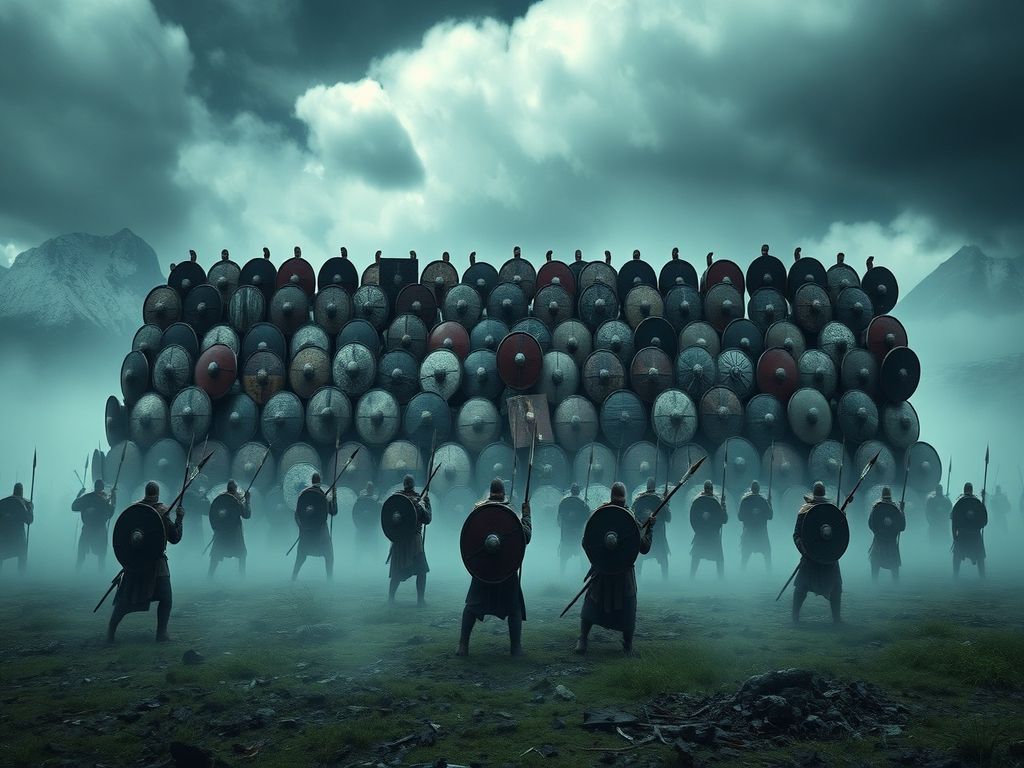
Ulfberht Sword: The Legendary Steel of the Vikings
Somewhere in 9th-century Scandinavia, a blacksmith wipes sweat from his brow and pulls a steel ingot from the furnace that looks like nothing he has ever worked with before. The metal is purer, denser, almost alive under the hammer blows. He does not yet know that the blade he is about to forge will endure for eleven centuries and challenge our understanding of medieval metallurgy. This blade bears a name: +VLFBERH+T. The Ulfberht sword is arguably the most mysterious and advanced weapon the Viking Age ever produced—an object that simply should not have existed at that time.
📌 In Brief
- The Ulfberht sword is a type of Viking sword made between the 9th and 11th centuries, recognizable by the inscription +VLFBERH+T forged onto the blade.
- Their steel contained a remarkably high carbon content (up to 1.2%), comparable to modern steel.
- Metallurgical analyses trace the origin of the steel to Central Asia or the Middle East, transported via the Volga trade routes.
- It is not known with certainty. Ulfberht likely refers to a workshop or a lineage of Frankish blacksmiths rather than a single individual.
- Many swords bear misspelled inscriptions like VLFBERHT or VLFBERH+, signs of medieval forgeries.
I. The Enigma of an Inscription on Steel
Imagine the scene. A Viking warrior, somewhere between Hedeby and Birka, draws his blade during a raid on the Frankish coast. His opponent brandishes a classic Carolingian sword—good carbon steel, forged by a skilled craftsman. The two blades clash. And it is the Frankish blade that bends. The Viking's sword, however, holds firm, barely vibrates, and bears an enigmatic inscription on its tang: +VLFBERH+T.
This name—Ulfberht—appears for the first time in the 9th century and continues to be inscribed on blades until the 11th century, a span of nearly two hundred and fifty years. No blacksmith lives that long. Therefore, the inscription does not designate a man, but a lineage, a workshop, perhaps even a trademark—the first in the history of European weaponry. The Viking sword stamped Ulfberht became a symbol of absolute quality, an object that every warrior of the North dreamed of owning.
The Ulfberht sword was not just a weapon. It was a statement: its wielder possessed the finest steel the known world could offer, a metal that defied the laws of metallurgy of its time. — Alan Williams, archaeometallurgist, The Sword and the Crucible
The crosses that flank the name—the famous "+" signs—long intrigued researchers. Some see them as a Christian reference, a sign of ecclesiastical blessing. Others interpret these symbols as a mark of authenticity, a seal of guarantee. What is certain is that the name Ulfberht became so prestigious that it spawned a remarkable phenomenon: forgery, on an industrial scale for the medieval period.
II. Steel Impossible for Its Time
This is where the mystery of the Ulfberht sword truly gains its dimension. When modern metallurgists analyzed the composition of authentic blades, they made a stunning discovery. The steel used was not ordinary steel forged by direct reduction of ore in a bloomery furnace, as practiced by the Viking blacksmiths of the time. It was crucible steel—metal melted at a very high temperature, purified of slag and impurities, with a remarkably homogeneous carbon content of approximately 1 to 1.5%.
To understand the feat, one must grasp the technical reality of the Early Middle Ages. Scandinavian and European forges generally did not exceed 1200 °C. Yet, to produce crucible steel, one must reach at least 1500 °C—the melting point of steel. This process was mastered in Central Asia, in the regions of Khorasan and Transoxiana (modern-day Uzbekistan), by Persian and Central Asian metallurgists. But in Western Europe? No one possessed this knowledge. It would take until the Industrial Revolution, eight centuries later, for Europe to rediscover this technique.
What makes Ulfberht steel exceptional
- Exceptional purity: almost no slag trapped in the metal, where classic swords contained 2 to 3%
- Homogeneous carbon content: between 1% and 1.5%, uniformly distributed throughout the blade
- Superior strength: the blade bends without breaking and returns to its shape, unlike standard medieval steels
- Durable edge: the edge of the blade remains sharp much longer than a conventional Viking sword
- Relative lightness: the absence of inclusions allows for thinner blades with equal strength
The Ulfberht sword was to medieval steel what titanium is to aluminum: a technological leap that seemed to defy the capabilities of its era. A warrior armed with an authentic Ulfberht possessed a decisive advantage in combat. His blade could shatter an ordinary Viking sword, slice through chainmail with formidable efficiency, and survive hundreds of battles without deforming.
III. Over 170 Blades Across Europe
Archaeologists have identified over 170 swords to date bearing the Ulfberht inscription or one of its variants. They have been found over a vast geography, from Norway to Russia, passing through Germany, France, Finland, England, and even Spain. This dispersion testifies to the scale of the trade and warrior networks of the Vikings, those navigators who transported as many goods as myths across medieval Europe.
Norway holds the highest concentration of finds, with over forty specimens. Finland has yielded about thirty, Germany about twenty. But isolated examples emerge regularly during excavations in unexpected contexts—tombs of wealthy merchants, riverbeds where combatants lost them, hoards buried in haste before an enemy raid.
Every recovered Ulfberht sword is a fragment of a story. It recounts a journey—from the eastern crucible to the Scandinavian forge, from the hand of the blacksmith to that of the warrior, from the battle to the burial mound where it was laid to rest to accompany its master to Valhalla. — Le Comptoir Viking, based on the census of Ulfberht swords established by Anne Stalsberg (NTNU Trondheim)
What is striking about this distribution is the prestige associated with each find. Ulfberhts are almost never found in modest burials. They accompany chiefs, jarls, and elite warriors. Possessing such a Viking sword signaled high social status—sufficient wealth to acquire the most expensive and highest-performing weapon of its time. It is estimated that an authentic Ulfberht could be worth as much as an entire farm, or even more.
Discoveries continue. In 2024, a remarkably well-preserved specimen was extracted from a Danish peat bog, its blade still gleaming after a thousand years of burial—further proof of the unalterable quality of its steel. For enthusiasts who wish to explore the world of Norse weapons, discover our collection of Viking sword replicas inspired by these legendary blades.
IV. Authentic Blades and Viking Forgeries
The fame of the Ulfberht sword spawned one of the first forgery industries in history. And it is precisely the existence of these fakes that informs us of the extraordinary prestige of the original. Among the 170 blades found, metallurgical analyses reveal that about two-thirds are forgeries—swords bearing the inscription +VLFBERH+T but made with significantly lower-quality steel.
The clues that betray the fakes are numerous. First, the quality of the metal: where authentic ones contain pure crucible steel, the forgeries are forged from classic bloomery steel, laden with slag and irregular carbon content. Second, the inscription itself: forgers often commit spelling errors, writing "+VLFBERHT+" (with the crosses misplaced), "VLFBERH+T", or even "+VLFBERIT+". These subtle errors—an inverted letter, a displaced symbol—reveal that the copyist did not necessarily understand what he was inscribing.
Criteria for distinction
- Quality of the inscription: letters inlaid by wire welding are sharp and regular on originals, clumsy on copies
- Steel composition: carbon content above 1% and homogeneous for authentic ones, variable and below 0.5% for fakes
- Presence of slag: almost non-existent in real Ulfberhts, significant in forgeries
- Spelling: the exact sequence +VLFBERH+T with the crosses in the correct position is a marker of authenticity
This phenomenon of forgery illustrates a timeless economic mechanism. The demand for Ulfberht swords far outstripped supply. Local blacksmiths, unable to replicate crucible steel, attempted to capitalize on the reputation of the name by engraving it on ordinary blades. For the buying warrior, the difference was not always visible to the naked eye—it was in combat that the truth came out, sometimes in a fatal manner. Understanding the different parts of a Viking sword helps one grasp why the quality of the steel was so decisive in the blade's performance.
V. The Steel Road: The Connection to the Orient
Where did this extraordinary steel come from? The answer leads us over thousands of kilometers, along the trade routes that connected Scandinavia to Central Asia. The Varangians—those eastern Vikings who traveled down the great Russian rivers, the Dnieper and the Volga—traded actively with Arab, Persian, and Central Asian merchants. It was through these routes that crucible steel, produced in the workshops of Khorasan and Transoxiana, reached the Scandinavian forges.
Crucible steel—which Arabic sources call fūlādh—was produced using a sophisticated process. High-purity iron ore, mixed with precise amounts of charcoal and sometimes plant matter, was sealed in clay crucibles and heated in bellows-fired furnaces for hours. The temperature reached 1500°C, sufficient to melt the metal completely. Impurities rose to the surface as slag and were removed. The result: a steel ingot of a purity impossible to achieve via European direct reduction methods.
The Vikings did not just plunder Europe. They wove a trade network that linked the fjords of Norway to the bazaars of Baghdad. The Ulfberht sword is the material proof of this medieval globalization. — According to Thomas S. Noonan, specialist in Viking-Eastern trade
Archaeological evidence confirms this eastern connection. Arabic dirhams—thousands of them—have been found in Scandinavia, testifying to the intensity of the trade. Crucibles compatible with crucible steel production have been identified along the Volga. And the chronology is revealing: the production of Ulfberht swords began in the 9th century, exactly when Varangian trade routes to the East reached their peak, and declined in the 11th century, when those same routes were disrupted by geopolitical upheavals in Central Asia.
This relationship between commerce and technology raises a fascinating question: did the Vikings import raw steel ingots to forge them in Scandinavia, or did they receive blades already formed? Recent analyses lean toward the former hypothesis. The steel arrived in the form of ingots or bars, then Viking master blacksmiths transformed them into blades according to Nordic forging traditions. The Ulfberht would therefore be the fruit of an involuntary collaboration between two civilizations—Eastern metallurgical art and Scandinavian warrior know-how.
VI. The Blacksmith and the Secret of the Forge
Let us return to our blacksmith from the beginning. He has received this steel ingot from a Varangian merchant returned from the Volga, and he feels something different beneath his fingers. When he heats the metal, it reaches a cherry color that is more intense, deeper than the steel he usually works with. When he hammers it, the blows resonate differently—a sound that is clearer, purer. And when he quenches the blade in water, the steel hardens with a regularity he has never achieved with his own smelted iron.
The manufacturing process of an authentic Ulfberht sword followed precise steps. The blacksmith began by evaluating his precious crucible steel ingot. He heated it gradually, sometimes folding it to refine the crystalline structure, then stretched it into a bar that would become the blade. The central groove—the fuller, that channel running along the blade which laymen incorrectly call a "blood gutter"—was hammered with surgical precision. This fuller reduced the weight of the blade without compromising its rigidity, an engineering principle modern architects call an I-beam structure.
The inscription +VLFBERH+T was made using an inlay technique. The blacksmith prepared iron wires, arranged them on the still-hot blade to form the letters and crosses, then welded them to the base metal by hammering at high temperature. This process, called "weld-inscribed," required considerable dexterity—one mistake and the blade was ruined. This is likely the reason why counterfeiters made so many errors: they had poor mastery of this delicate technique.
The axe was the weapon of the ordinary warrior, accessible and formidable. But the Ulfberht Viking sword belonged to another category. It required a colossal investment in rare raw materials, forging time, and expertise. For those who want to approach this warrior heritage, our collection offers Viking jewelry and pendants inspired by the motifs found on the pommels of these exceptional swords.
The quenching: the moment of truth
The most critical moment of manufacturing was the quenching—that brutal immersion of the glowing blade into a cooling liquid. The Nordic sagas mention blacksmiths who quenched their blades in blood, whale oil, or urine. Modern science confirms that some of these liquids had a rational basis: the nitrogen contained in urine could contribute to a primitive form of surface nitriding, hardening the blade's edge. But with the crucible steel of the Ulfberhts, the quenching produced spectacular results that ordinary steel could not reach—a surface hardness combined with internal flexibility that made the blade almost indestructible in medieval combat conditions.
VII. The Eternal Legacy of the Ulfberht
The Ulfberht sword ceased to be produced toward the end of the 11th century, but its legacy still resonates today. It represents a unique moment in the history of technology—that window where global trade routes allowed Eastern metallurgical knowledge to fertilize Scandinavian warrior craftsmanship, creating an object that transcended the technical capabilities of either civilization in isolation.
For archaeometallurgists, every new Ulfberht unearthed is a treasure trove of data. Analysis techniques are perfecting themselves: mass spectrometry, electron microscopy, neutron activation analysis. Each blade yields new secrets about the exact composition of the steel, the forging techniques employed, and the geographic origin of the metal. The mystery is gradually dissipating, but the fascination remains intact.
Because beyond the science, the Ulfberht sword embodies a profound truth about the Vikings themselves. These warriors of the North were not the illiterate barbarians that monastic propaganda depicted. They were navigators, traders, and strategists who knew how to weave trade ties over thousands of kilometers and recognize—then exploit—a technological superiority from the other side of the known world. The Viking sword stamped Ulfberht is the perfect symbol of this civilization: brutal and refined, warrior and merchant, anchored in the Scandinavian fjords but open to the vast world.
To extend this immersion into the Nordic universe, explore our selection of Viking rings adorned with symbols and motifs inherited from the Viking Age.
The Blacksmith's Final Word
Eleven centuries after the last Ulfberht sword was forged, we contemplate these blades with a mixture of admiration and perplexity. They remind us that innovation does not follow a linear trajectory—that technological leaps can arise, shine for a few centuries, and then disappear into oblivion before being rediscovered hundreds of years later. The blacksmith who hammered the first +VLFBERH+T onto a crucible steel blade could not have known that he was inscribing his name into eternity. But that is exactly what he did. And every Viking sword that comes out of the ground today, bearing those seven letters and two crosses, pays him a silent tribute across time.
Frequently Asked Questions About the Ulfberht Sword
What is an Ulfberht sword?
The Ulfberht sword is a type of Viking sword made between the 9th and 11th centuries, recognizable by the +VLFBERH+T inscription forged on the blade. About 170 examples have been found across Europe, testifying to a quality of steel that was exceptional for the time.
Why were Ulfberht swords so special?
Their steel contained a remarkably high carbon content (up to 1.2%), comparable to modern steel. At a time when most swords were made of fragile iron, the Ulfberhts were stronger, lighter, and retained a superior edge—a decisive advantage in combat.
Where did the steel for Ulfberht swords come from?
Metallurgical analyses suggest that the steel came from Central Asia or the Middle East, transported via Viking trade routes along the Volga. This high-quality crucible steel was not produced in Scandinavia at that time.
Who was Ulfberht?
We do not know for certain. Ulfberht likely designates a workshop or a lineage of Frankish blacksmiths rather than a single individual. Production spanned more than 200 years, which confirms that it was a brand name passed down from generation to generation.
Were there counterfeit Ulfberht swords?
Yes, many swords bear misspelled inscriptions like VLFBERHT or VLFBERH+, signs of medieval counterfeits. These copies used lower-quality steel, proving that the Ulfberht brand was already a guarantee of prestige and quality in the Middle Ages.
How much is an authentic Ulfberht sword worth today?
Authentic Ulfberht swords are exhibited in museums and have no market price. Quality artisanal replicas cost between 500 and 3,000 euros depending on the materials and level of historical fidelity.
👉 Discover our collection of Viking decorations and carry the Viking legacy in your daily life.
👉 Discover our replicas in the Viking weapons collection.

Leave a comment
All comments are moderated before being published.
This site is protected by hCaptcha and the hCaptcha Privacy Policy and Terms of Service apply.