
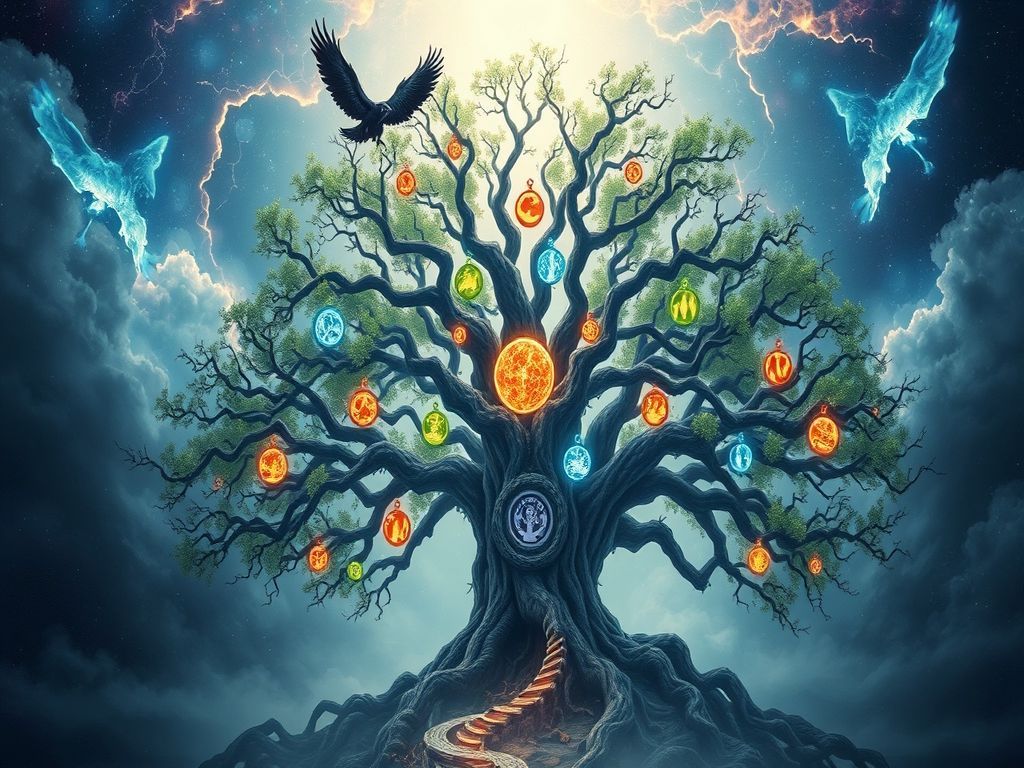
Yggdrasil: The World-Tree of Norse Mythology

Yggdrasil, the cosmic World-Tree of Norse mythology
Yggdrasil is the cosmic ash tree of Norse mythology, an immense tree whose branches extend above all worlds. It connects the nine realms of Viking cosmology, from Asgard (home of the gods) to Helheim (realm of the dead). Its name means “Odin’s steed,” in reference to the sacrifice of the supreme god who hung himself there for nine days to discover the runes. As a tattoo, Yggdrasil symbolizes universal connection, the life-death-rebirth cycle, and resilience in the face of trials.
📌 In Brief
- Yggdrasil is the giant cosmic ash tree that forms the central axis of Norse cosmology.
- Yggdrasil is home to several creatures: the dragon Nídhögg gnaws at its roots, the squirrel Ratatoskr carries messages along the trunk, and an eagle keeps watch at the summit.
- An Yggdrasil tattoo represents the World-Tree of Norse mythology, which connects the nine realms.
- The most common placements are the back for a large piece, the forearm where the vertical format suits a tree, and the full arm as a sleeve.
- Yggdrasil is combined with runes around the trunk, the Vegvisir in the center, Odin’s ravens in the branches, or Nídhögg in the roots.
Yggdrasil in Norse Mythology
Yggdrasil is the central element of all Norse cosmology. This gigantic cosmic ash tree constitutes the axis around which the entire universe of Viking mythology is organized. Without Yggdrasil, the nine worlds would collapse into nothingness — the tree is literally the pillar that supports all existence. For anyone interested in the meaning of Viking symbols, understanding Yggdrasil is an essential step.
The etymology of the name Yggdrasil
The name Yggdrasil breaks down into two parts in Old Norse: Yggr, one of the many names of Odin meaning “the Terrible,” and drasill, which means “steed” or “horse.” The full name therefore translates as “Odin’s steed” or “the Terrible’s horse.” This enigmatic name refers to the founding myth in which Odin hung himself from the tree for nine days and nine nights — the tree metaphorically becoming his “mount” during this sacrificial ordeal.
This etymology alone reveals the symbolic depth of Yggdrasil: the tree is not merely a decorative element of mythology, but an instrument of spiritual transformation, a bridge between the mortal world and sacred knowledge.
The sources: the Poetic Edda and the Prose Edda
Our knowledge of Yggdrasil comes mainly from two medieval Icelandic texts. The Poetic Edda, a collection of mythological and heroic poems composed between the 9th and 13th centuries, contains the famous Völuspá (“The Prophecy of the Seeress”) which describes Yggdrasil as an ever-green ash tree standing above the well of Urd. The poem Grímnismál provides the most detailed descriptions of the creatures that inhabit the tree.
The Prose Edda of Snorri Sturluson, written around 1220, offers a more systematic presentation of Norse cosmology in its Gylfaginning (“The Deluding of Gylfi”) section. Snorri methodically describes Yggdrasil’s three roots, the springs that nourish them, and the creatures that populate the tree. It is thanks to these two fundamental texts that we can today understand the worldview of the ancient Scandinavians and apply it to the art of Yggdrasil tattoos.
The cosmic ash tree: axis of the world
In the Norse conception of the universe, Yggdrasil is what historians of religion call an axis mundi — a world axis that connects the different levels of the cosmos. Its branches extend above all worlds, forming a canopy that covers all of creation. Its three roots plunge in three different directions, each reaching a sacred spring.
The tree is constantly threatened: the dragon Nidhogg gnaws at its roots from below, stags graze on its leaves, and its bark rots in places. Yet, the Norns — the three deities of destiny — water it daily with the white water and sacred mud from the well of Urd, keeping it ever green and alive. This permanent tension between destruction and regeneration is at the very heart of Norse philosophy.
“I know that an ash stands, called Yggdrasil, a high tree, sprinkled with white mud; from there come the dews that fall in the valleys, it stands ever green above the well of Urd.”
— Völuspá, stanza 19, Poetic Edda
To carry this cosmic symbol with you every day, discover our Yggdrasil necklace, a piece of jewelry that captures the essence of the Norse World-Tree. Our other items with this motif are gathered in the Yggdrasil collection.
The Nine Worlds of Yggdrasil

The nine worlds of Norse cosmology, all connected by Yggdrasil
One of the most fundamental functions of Yggdrasil is to connect the nine worlds (or realms) of Norse cosmology. Each world possesses its own inhabitants, laws, and atmosphere. In an elaborate Yggdrasil tattoo, these nine worlds can be represented around the tree, creating a true mythological map. For a complete guide, check out our article on the nine worlds of Norse mythology.
Asgard — The realm of the Aesir gods
Asgard is located at the summit of Yggdrasil, accessible only by the rainbow bridge Bifrost. It is the dwelling place of the Aesir gods—Odin, Thor, Frigg, Tyr, and many others. Asgard also houses Valhalla, the great hall where Odin welcomes warriors who died in battle, and Folkvangr, the domain of Freyja. It is from Asgard that Odin observes the nine worlds from his throne, Hlidskjalf.
Midgard — The world of humans
Midgard, literally "the middle enclosure," is the world of humans. It is situated at the center of Norse cosmology, surrounded by the primordial ocean in which swims the world-serpent Jormungandr. The gods created the first humans, Ask and Embla, from an ash tree and an elm tree—a direct symbolic link to Yggdrasil itself.
Jotunheim — The realm of the giants
Jotunheim is the land of the Jotnar (giants), the eternal adversaries of the Aesir gods. It is a world of craggy mountains, dense forests, and massive fortresses. Despite the hostility between gods and giants, numerous unions occur between the two peoples—Thor's own mother is the giantess Jord.
Vanaheim — The domain of the Vanir gods
Vanaheim is the home of the Vanir, the second divine family associated with fertility, nature, and magic. After the war between the Aesir and Vanir, hostages were exchanged: Njord, Freyr, and Freyja came to Asgard, while Hoenir and Mimir departed for Vanaheim.
Alfheim — The world of the light elves
Alfheim is the realm of the Ljosalfar (light elves), beings of extraordinary beauty associated with light and fertility. According to texts, Alfheim was given to the god Freyr as a gift when he lost his first tooth. The light elves are described as "fairer than the sun."
Svartalfheim (Nidavellir) — The realm of the dwarves
Svartalfheim, sometimes called Nidavellir, is the underground world of the Dvergar (dwarves) and dark elves. The dwarves are the supreme artisans of Norse mythology, smiths of Thor's hammer Mjolnir, Odin's spear Gungnir, and Freyr's ship Skidbladnir. They are the absolute masters of metal and craft magic.
Muspelheim — The world of primordial fire
Muspelheim is the realm of fire, guarded by the flame giant Surtr. It is one of the two primordial worlds (along with Niflheim) whose encounter in the void of Ginnungagap sparked the creation of the universe. During Ragnarok, Surtr and his sons of fire will march against the gods and set the entire world ablaze.
Niflheim — The world of primordial ice
Niflheim is the realm of mist and ice, the second primordial world. It is a place of absolute cold and eternal darkness. At the heart of Niflheim lies the spring Hvergelmir, from which eleven rivers flow and where one of Yggdrasil's roots drinks.
Helheim — The realm of the dead
Helheim is the domain of Hel, daughter of Loki, where those go who did not perish in battle. It is not a place of punishment comparable to the Christian Hell, but rather a cold and dark abode where souls lead a dull existence. The entrance to Helheim is guarded by the dog Garmr and the bridge Gjallarbru, which crosses the river Gjoll.
To deepen your knowledge of Viking cosmology and discover how these worlds are connected to each other, explore our article on Viking symbols and their meanings. And for a piece of jewelry that evokes this connection between the worlds, our Tree of Life Yggdrasil Viking ring is an ideal choice.
The Creatures of Yggdrasil

The mythical creatures that inhabit Yggdrasil: Nidhogg, Ratatosk, the eagle, and the deer
Yggdrasil is not a solitary tree—it is a cosmic ecosystem inhabited by mythical creatures that each play a precise symbolic role. These beings make excellent design elements to enrich an Yggdrasil tattoo, each adding a layer of extra meaning.
Nidhogg (Nidhöggr) — The dragon gnawing at the roots
Nidhogg is a monstrous dragon (or serpent) that tirelessly gnaws at the roots of Yggdrasil from the depths of Hvergelmir. His name means "he who strikes with malice." Nidhogg represents the forces of destruction and chaos that perpetually threaten the cosmic order. He also devours the corpses of the perjured and the murderers, playing a role of punishment in the Norse afterlife.
In a tattoo, Nidhogg coiled around the roots of the tree creates a striking contrast between life (the tree) and destruction (the dragon), reminding us that these two forces are inseparable in Norse philosophy.
Ratatosk — The messenger squirrel
Ratatosk ("drill-tooth") is a squirrel that runs incessantly along the trunk of Yggdrasil to carry insults between the eagle at the top and the dragon Nidhogg at the roots. This seemingly comical character actually plays a fundamental role: he symbolizes communication—even conflictual—that links all levels of existence. Without Ratatosk, the top and base of the tree would be disconnected.
Some scholars also see in Ratatosk a symbol of discord and slander, a warning about the dangers of malicious speech that stokes conflicts.
The unnamed eagle and the hawk Vedfolnir
At the top of Yggdrasil sits an immense eagle whose eyes perceive everything happening in the nine worlds. Curiously, the texts give him no name. Between his eyes is perched a hawk named Vedfolnir ("the one who pales under the wind"). The eagle represents knowledge and panoramic vision, while his perpetual conflict with Nidhogg symbolizes the eternal tension between the forces from above and those from below.
The four deer
Four deer named Dainn, Dvalinn, Duneyrr, and Durathor roam the branches of Yggdrasil and feed on its foliage. They possibly represent the four cardinal directions or the four seasons. Their constant browsing contributes to the trials the tree undergoes but is part of the natural balance of the cosmos.
Jormungandr — The serpent of Midgard
Although Jormungandr, the world-serpent, does not live directly in the tree, he is intimately linked to the cosmology of Yggdrasil. This colossal serpent, a child of Loki, surrounds Midgard while biting his own tail, forming a cosmic circle that echoes the circular structure of the worlds around the tree. During Ragnarok, Jormungandr will release his tail and emerge from the waves to face Thor in a battle that will be fatal to both adversaries.
These creatures offer a wealth of motifs for an Yggdrasil tattoo. A complete design could include Nidhogg coiled in the roots, Ratatosk running on the trunk, and the eagle spreading its wings at the top—creating a dynamic narrative composition.
Yggdrasil and Odin's Sacrifice

The roots of Yggdrasil plunge into the sacred wells of Urd and Mimir
One of the most powerful myths associated with Yggdrasil is Odin's sacrifice to obtain the wisdom of the runes. This narrative, reported in the Havamal poem of the Poetic Edda, is one of the most emblematic scenes of all Norse mythology and gives the tree a unique sacred dimension.
Nine days and nine nights hanging from the tree
According to the Havamal, Odin hung himself voluntarily from a branch of Yggdrasil, pierced by his own spear Gungnir, for nine days and nine nights. Without food or drink, he offered himself as a sacrifice "to himself, for himself." This sacrifice carries a triple meaning: it is an act of supreme devotion, a symbolic death followed by a rebirth, and a quest for knowledge at the cost of absolute suffering.
"I know that I hung on a wind-swept tree nine long nights, wounded by a spear, dedicated to Odin, myself to myself, on that tree of which no man knows from where its roots run."
— Havamal, stanza 138, Poetic Edda
The discovery of the runes
At the end of this terrible ordeal, on the brink of death, Odin glimpsed the runes—the sacred symbols that contained the wisdom of the universe. By grasping them, he obtained the power to heal, protect, bind and unbind, calm storms, and resurrect the dead. The runes of the Futhark thus become directly linked to Yggdrasil, since it is at the foot of the tree that they were revealed.
This myth is why combining runes with an Yggdrasil tattoo is so deeply coherent from a mythological perspective. Runes carved into the trunk or arranged around the tree are not an arbitrary decorative addition: they are an integral part of the Yggdrasil story. To wear this symbol of spiritual quest, discover our Odin Huginn & Muninn Viking necklace, a tribute to the god who sacrificed everything for knowledge.
The three sacred wells
The three roots of Yggdrasil each plunge into a sacred well which constitutes a source of cosmic power:
- The Well of Urd (Urdharbrunnr): the source of fate, where the three Norns (Urd, Verdandi, and Skuld) dwell, who weave the thread of all destinies. They water Yggdrasil daily to keep it alive.
- Mimir's Well (Mimisbrunnr): the well of wisdom, where Odin sacrificed one of his eyes in exchange for a draught of water that would give him absolute knowledge. The head of Mimir, preserved by Odin, continues to offer him counsel.
- Hvergelmir: the bubbling spring, from which eleven primordial rivers flow and where Nidhogg gnaws at the roots of the tree.
To explore the figure of Odin in more detail, consult our article dedicated to Odin, the supreme god of Norse mythology, and discover our Odin the Wanderer statue representing the god in his quest for wisdom.
Meaning of the Yggdrasil Tattoo
Now that the mythological richness of Yggdrasil is established, what does an Yggdrasil tattoo actually represent? Its meanings are manifold and can be combined according to your personal story and aspirations. This is what makes this motif one of the most versatile and profound in the universe of Norse tattooing.
The connection between all beings
The primary meaning of an Yggdrasil tattoo is that of universal connection. The tree literally connects all realms to each other: gods, humans, giants, elves, and the dead all coexist along its trunk and branches. Getting an Yggdrasil tattoo means wearing the symbol of the interdependence of all things.
For many wearers of this motif, the tattoo becomes a daily reminder that our actions have repercussions, that we are linked to our family, our community, and nature itself. It is a particularly meaningful symbol for those seeking to express their attachment to their roots—both literally and figuratively.
The cycle of life, death, and rebirth
Yggdrasil constantly undergoes trials: Nidhogg gnaws at its roots, deer graze on its leaves, and yet it remains, always green, always living. This resilience makes the world-tree a powerful symbol of the cycles of life. An Yggdrasil tattoo can thus represent a difficult passage in life from which one has emerged stronger, a grief overcome, or simply a philosophy that accepts change as a constant.
The roots represent our origins and our past, the trunk embodies our present and our strength, while the branches symbolize our future and our possibilities. Even at Ragnarok, the tree survives to allow the birth of a new world.
The quest for wisdom and knowledge
Thanks to the myth of Odin's sacrifice, Yggdrasil is also the symbol of the quest for wisdom. An Yggdrasil tattoo can express the desire to always learn, to seek the truth even when the path is painful, and to value knowledge above all else. The sacred wells that nourish its roots—the well of fate, the spring of wisdom, the primordial fountain—reinforce this intellectual and spiritual dimension.
Resilience and inner strength
The most visually expressive aspect of Yggdrasil's symbolism is resilience. The tree is constantly gnawed, grazed, and shaken by winds—yet it never falls. This ability to endure trials while continuing to grow resonates deeply with those who have gone through difficult times.
An Yggdrasil tattoo with deep and wide-reaching roots can symbolize a solid anchoring in one's values and identity, even when facing the storms of life. This is why this motif is often chosen by individuals who have overcome significant challenges and wish to carry a permanent reminder of their strength. Also discover the Valkyries, divine warriors who evoke the same resilience in the face of destiny.
Styles and Placements for an Yggdrasil Tattoo
One of the great strengths of the Yggdrasil motif is its artistic versatility. Whether you prefer a raw and organic style or a clean and geometric design, the world-tree adapts to virtually every tattooing style. Here are the most popular approaches and the most successful placements.
Realistic style: the majesty of the cosmic tree
The realistic style aims to represent Yggdrasil as a truly majestic tree, with meticulous work on the textures of the bark, the play of light in the leaves, and the depth of the roots. Realism in black and gray is particularly popular because it evokes the dark and mystical atmosphere of Norse mythology. This style requires space—it is ideal for full back pieces or sleeves.
Geometric style: precision and modernity
The Yggdrasil tattoo in geometric style uses circles, triangles, and straight lines to structure the design. The tree inscribed within a circle recalls the cosmic cycle, while a triangle evokes the three roots plunging into three different springs. This style offers a modern and refined look, with excellent rendering even in small formats.
Dotwork style: ethereal finesse
Dotwork (pointillism) builds the image entirely from individual dots. For an Yggdrasil tattoo, the result is of exceptional finesse, with subtle gradients that give the tree an almost ethereal quality — as if it existed between worlds, which corresponds perfectly to the nature of Yggdrasil. Ideal for the forearm or calf.
Minimalist style: pure essence
Minimalism reduces Yggdrasil to its essential lines — a trunk, a few branches, mirrored roots. Sometimes created with a single continuous line, this style is suitable for small formats (wrist, ankle, nape of the neck). It is perfect for those who are looking for a discreet yet meaningful tattoo, or as a first Norse tattoo.
The best placements for an Yggdrasil tattoo
The naturally vertical shape of Yggdrasil (roots downwards, branches upwards) lends itself to certain parts of the body more than others:
- The full back: the ideal canvas for a majestic Yggdrasil with the nine worlds, creatures, and runes. The roots extend onto the hips, the branches reach the nape of the neck.
- The forearm: perfect vertical format for a tree in a geometric or dotwork style. Very visible, it allows the details to be admired daily.
- The full arm (sleeve): the roots wrap around the wrist while the branches cover the shoulder. The cylindrical format gives the impression that the tree surrounds the limb.
- The calf: an underestimated but very suitable placement. The shape of the muscle provides volume for the trunk, and it is one of the least painful placements.
- The ribs: the verticality of this area perfectly matches the shape of the tree, although it is one of the most painful placements.
- The thigh: large surface for a detailed design, easily concealable. Excellent choice for a first large piece.
To complete your tattoo with matching accessories, our Yggdrasil Viking ring incorporates the tree of life motif in a sturdy and elegant design.
Comparison table: Yggdrasil vs Celtic Tree of Life
Frequently Asked Questions about Yggdrasil
What is Yggdrasil in Norse mythology?
Yggdrasil is the giant cosmic ash tree that forms the central axis of Norse cosmology. Its name means "Odin's steed" and it connects the nine worlds together, from Asgard (the home of the gods) to Helheim (the realm of the dead). It is described in the Poetic Edda and the Prose Edda of Snorri Sturluson.
What creatures live in Yggdrasil?
Yggdrasil is home to several mythical creatures: the dragon Nidhogg that gnaws at its roots, the squirrel Ratatoskr that runs along the trunk to deliver messages, an unnamed eagle perched at the top with the hawk Vedfolnir, and four stags (Dainn, Dvalinn, Duneyrr, and Durathor) that graze on its leaves.
What does an Yggdrasil tattoo mean?
An Yggdrasil tattoo represents the World Tree of Norse mythology that connects the nine realms. It symbolizes the connection between all beings, the cycle of life, death and rebirth, as well as inner strength and resilience.
Where should an Yggdrasil tattoo be placed?
The most popular placements are the back (for a large piece with the roots and branches spread out), the forearm (vertical format ideal for a tree), the full arm as a sleeve, or the calf.
Can Yggdrasil be combined with other Viking symbols?
Yes, Yggdrasil combines perfectly with Norse runes around the trunk, the Vegvisir in the center, Odin's ravens (Huginn and Muninn) in the branches, or the serpent Nidhogg in the roots.
Is an Yggdrasil tattoo suitable for women?
Absolutely. Yggdrasil is a universal symbol that adapts to everyone. Feminine versions often favor a finer and more detailed style, with delicate leaves, subtle interlacing, or a watercolor design that softens the Norse aesthetic.
What size for an Yggdrasil tattoo?
The recommended minimum size is 10-15 cm to preserve the details of the branches and roots. A full Yggdrasil with the nine worlds requires at least 20-30 cm. Full back pieces allow for the maximum amount of detail and symbolism.
Is Yggdrasil the same as the Celtic Tree of Life?
Although visually similar, they differ in their mythology. Yggdrasil is a Norse cosmic ash tree connecting nine worlds, inhabited by mythical creatures. The Celtic Tree of Life (Crann Bethadh) symbolizes harmony with nature and the seasonal cycles instead.
“Thence come the maidens, knowing much, three from the hall which stands beneath the tree; Urd one is named, the second Verdandi, Skuld the third. They laid down laws, they chose lives, for the children of men, the fates of men.”
— Voluspa, stanza 20, Poetic Edda
May the roots of Yggdrasil guide your path through the nine worlds.
Explore the Viking universe: discover our Yggdrasil necklace and our Yggdrasil Viking ring to carry the spirit of the World Tree every day.
❓ Frequently Asked Questions
What is Yggdrasil in Norse mythology?
Yggdrasil is the giant cosmic ash tree that forms the central axis of Norse cosmology. Its name means "Odin's steed" and it connects the nine worlds together, from Asgard (the home of the gods) to Helheim (the realm of the dead). It is described in the Poetic Edda and the Prose Edda of Snorri Sturluson.
What creatures live in Yggdrasil?
Yggdrasil is home to several mythical creatures: the dragon Nidhogg that gnaws at its roots, the squirrel Ratatoskr that runs along the trunk to deliver messages, an unnamed eagle perched at the top with the hawk Vedfolnir, and four stags (Dainn, Dvalinn, Duneyrr, and Durathor) that graze on its leaves.
What does an Yggdrasil tattoo mean?
An Yggdrasil tattoo represents the World Tree of Norse mythology that connects the nine realms. It symbolizes the connection between all beings, the cycle of life, death and rebirth, as well as inner strength and resilience.
Where should an Yggdrasil tattoo be placed?
The most popular placements are the back (for a large piece with the roots and branches spread out), the forearm (vertical format ideal for a tree), the full arm as a sleeve, or the calf.
Can Yggdrasil be combined with other Viking symbols?
Yes, Yggdrasil combines perfectly with Norse runes around the trunk, the Vegvisir in the center, Odin's ravens (Huginn and Muninn) in the branches, or the serpent Nidhogg in the roots.
Is an Yggdrasil tattoo suitable for women?
Absolutely. Yggdrasil is a universal symbol that adapts to everyone. Feminine versions often favor a finer and more detailed style, with delicate leaves, subtle interlacing, or a watercolor design that softens the Norse aesthetic.
What size for an Yggdrasil tattoo?
The recommended minimum size is 10-15 cm to preserve the details of the branches and roots. A full Yggdrasil with the nine worlds requires at least 20-30 cm. Full back pieces allow for the maximum amount of detail and symbolism.
Is Yggdrasil the same as the Celtic Tree of Life?
Although visually similar, they differ in their mythology. Yggdrasil is a Norse cosmic ash tree connecting nine worlds, inhabited by mythical creatures. The Celtic Tree of Life (Crann Bethadh) symbolizes harmony with nature and the seasonal cycles instead.
The World Tree can also be worn: our Yggdrasil collection brings together pieces where the roots and branches close into a circle.

Leave a comment
All comments are moderated before being published.
This site is protected by hCaptcha and the hCaptcha Privacy Policy and Terms of Service apply.