
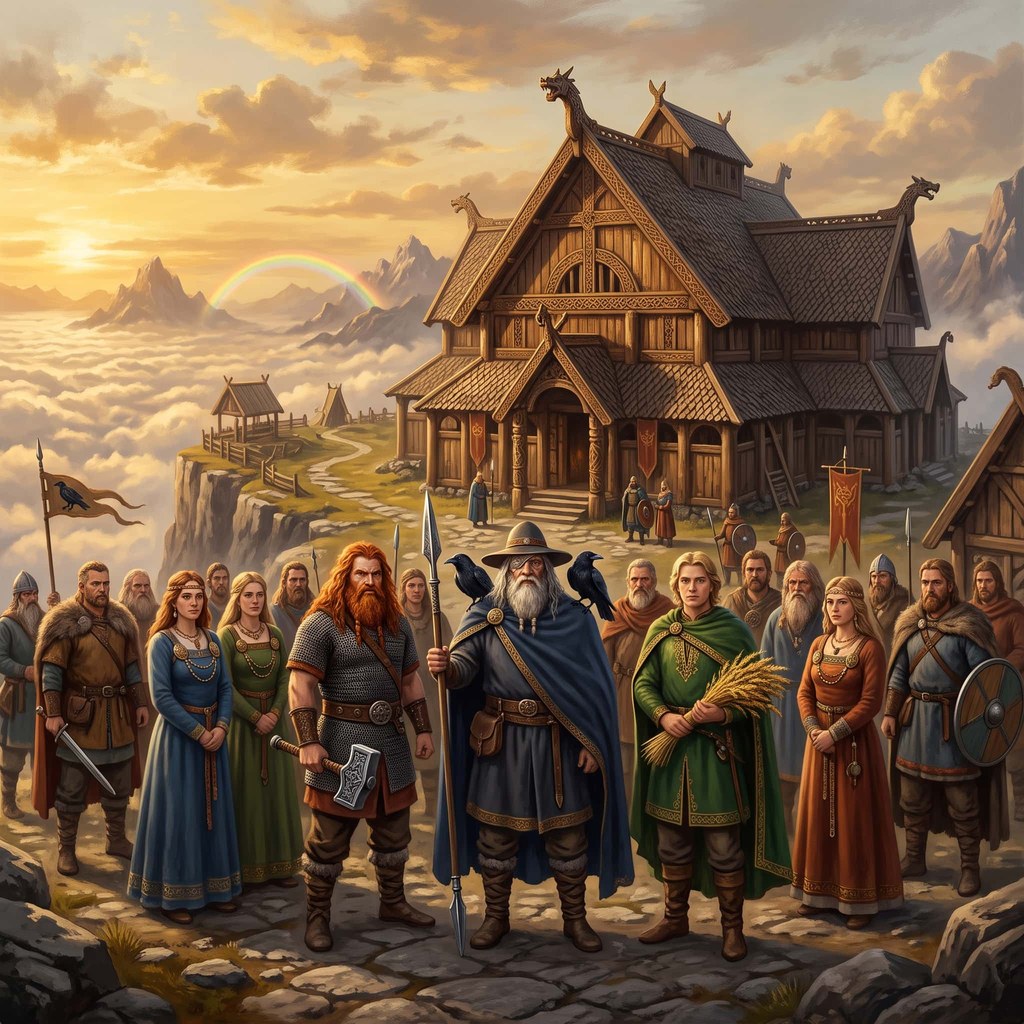
Norse Gods: A Complete List of the Asgardian Pantheon
The Norse gods are divided into two families: the Aesir—Odin, Thor, Týr, Heimdall, gods of sovereignty and war—and the Vanir—Njörd, Freyr, and Freyja, gods of fertility and wealth—who were brought together in Asgard after a war and an exchange of hostages. Snorri counts twelve around Odin and fourteen goddesses; the Vikings, for their part, mainly wore Thor's hammer. Here is the complete list, with their attributes, dwellings, real worship, and the fate of each during Ragnarök.
📌 In brief
- There is no official number: Snorri Sturluson counts twelve Aesir around Odin and fourteen goddesses, but sources name around fifty divine figures, including the Vanir.
- Odin is the chief of the gods, but Thor is the strongest and most revered: Adam of Bremen places him at the center of the Temple of Uppsala and calls him "the most powerful."
- The Aesir (Odin, Thor, Týr, Heimdall, Baldr) are the gods of sovereignty, war, law, and magic; the Vanir (Njörd, Freyr, Freyja) are those of fertility, the sea, and wealth.
- Odin, called Alföðr, "All-Father," is the leader of the Aesir: he sits on the high throne Hliðskjálf, from which he views all worlds, rules over Valhalla, and decides the outcome of battles.
- Vidar, Váli, Modi, and Magni survive, and Baldr and Höd return from the realm of Hel.
Sources: Pantheon of Norse Mythology, Wikipedia · Aesir · Vanir · Temple of Uppsala · Blót · Prose Edda. Cited stanzas are translated by us.
Who are the Norse gods? Aesir, Vanir, and the meaning of the word "Asgard"
The Norse gods are the deities honored by Scandinavian peoples before their conversion to Christianity, that is, for the period we are interested in, by the Vikings of the 8th–11th centuries. Texts rarely call them just "gods": we read goð, but also regin, "the Powers," bönd and höpt, "the Bonds" and "the Shackles," as if the gods were primarily what holds the world together. They form two families. The Aesir (Æsir, singular áss, feminine Ásynjur) bring together Odin, Thor, Týr, Heimdall, Baldr, and most of the known names: they are the gods of sovereignty, war, law, and magic. The Vanir (Vanir) are three in the texts: Njörd, Freyr, and Freyja—the gods of fertility, the sea, wealth, and pleasure. A war opposed them, a peace reunited them, and since then, the three Vanir have lived in Asgard.
Asgard (Ásgarðr) literally means "the enclosure of the Aesir": garðr is the fence, the closed courtyard, the word that gave rise to the Scandinavian gård and the English yard. It is the world of the gods, one of the nine worlds supported by the ash tree Yggdrasil, connected to Midgard, the world of men, by the rainbow bridge Bifröst, which is guarded by Heimdall. Snorri Sturluson places it in the sky; the Völuspá recounts that its ramparts were destroyed during the war of the gods, then rebuilt by a giant mason whom Thor killed to avoid having to pay him. Asgard is therefore not an abstract paradise but a fortified farm on a divine scale, with its halls, enclosures, playing fields (Idavöll), and court—the enlarged image of a large Scandinavian estate.
How many are there? Snorri, in the Gylfaginning, lists twelve Aesir after Odin, "the highest and oldest": Thor, Baldr, Njörd, Freyr, Týr, Bragi, Heimdall, Höd, Vidar, Váli, Ull, and Forseti, to which he adds Loki, "whom some call the slanderer of the Aesir." He then gives fourteen goddesses, from Frigg to Gná, and specifies that Sól and Bil are "also counted among the Asynjur." But these lists are an author's classification: older poems are familiar with Hœnir, Mímir, Kvasir, Sif, Skadi, Idunn, Nanna, Jörd, Rindr, Sigyn, Hermod, Magni, and Modi, as well as dozens of valkyrie names. Depending on how you count, you arrive at about thirty major figures and about fifty names. The Norse pantheon was never closed: it is an open, regional collection, where one person's main god was not another's.
One final precaution before the list: almost everything we know about these gods comes from two 13th-century Icelandic books, Snorri's Edda and the collection of poems called the Poetic Edda, written two centuries after the conversion by Christian scholars. Snorri himself warns that one should not believe in these gods, and his prologue makes them men who came from Troy. Alongside this, there are the witnesses of the Viking Age, less talkative but more direct: the poems of the skalds, a German chronicler who describes the Temple of Uppsala, hammer-shaped amulets, figurines, place names, and four days of the week. We will let them speak in their turn.
The complete list of the gods of Asgard
The table below gathers the twenty-four figures that a reader of the Eddas encounters, with their family, domain, attributes, dwelling, and the source to look into. The goddesses have their own table below, with Snorri's fourteen Asynjur. The names are given in their common English form; the Old Norse form is provided in parentheses when it differs.

Thor in the center, Odin armed, and Freyr: the triad of the Uppsala temple described by Adam of Bremen around 1075.
Odin, the All-Father
Odin (Óðinn) is the leader of the Aesir, and Snorri gives him the title of Alföðr, "All-Father." He reigns over war, but not in the manner of a soldier: he chooses the victors and the vanquished, recruits the battle-dead for his Valhalla, and prepares them for Ragnarök. Above all, he reigns over knowledge. He left an eye in Mímir's well to drink from it, hanged himself for nine nights on the ash tree Yggdrasil, pierced by his own spear, to grasp the runes (Hávamál 138-139), and stole the mead of poetry from the giants. His attributes speak for him: the spear Gungnir which never misses its target, the ring Draupnir which drips eight gold rings every nine nights, the eight-legged horse Sleipnir, the ravens Huginn and Muninn ("Thought" and "Memory") who roam the world each day, the wolves Geri and Freki to whom he gives his meat, for he himself lives only on wine. From his high seat Hliðskjálf, he sees all worlds. He is a god of kings, chieftains, and poets, unsettling, a wanderer, one-eyed, with two hundred names, more revered in courts than on farms, and it is he whom the berserkers invoked. He will die in the jaws of Fenrir.
Thor, the Protector of Midgard
Thor (Þórr, "Thunder") is the son of Odin and Jörd, the Earth, and the strongest god in Asgard. His role is simple and immense: to keep the giants at a distance from Midgard and Asgard, hammer in hand. This hammer, Mjölnir, forged by the dwarves Brokk and Eitri, always returns to his hand; to wield it, he requires the belt of strength Megingjörð and iron gloves. He travels in a chariot pulled by two goats that he can eat in the evening and resurrect in the morning. Poems show him fishing for the world-serpent (Hymiskviða), disguised as a bride to retrieve his stolen hammer (Þrymskviða), and challenging the giant Hrungnir to a duel. Adam of Bremen, circa 1075, places him at the center of the temple of Uppsala, between Odin and Freyr, and calls him "the most powerful"; the Vikings dedicated their children to him (names beginning with Þór- are the most frequent in medieval Iceland), wore his hammer around their necks, and asked him to consecrate graves and runes. He is married to Sif of the golden hair and is the father of Magni, Modi, and Þrúðr, meaning "Strength," "Courage," and "Vigor." At Ragnarök, he will kill Jörmungand and die nine steps later.
Freyr and Njörd, the Vanir of Asgard
Njörd is the father, a god of the sea and wind who calms storms, grants fishing and wealth, and whose home Nóatún, the "ship-enclosure," is the port of Asgard. Having come to the Aesir as a hostage at the end of the war of the gods, he had to marry the giantess Skadi, who had chosen him by his feet, believing she was choosing Baldr: the couple never got along, she wanting the mountains and the howling of wolves, he the sea and the cry of the gulls. Freyr, his son, "the Lord," is the god of fertility in the broadest sense: harvests, fine weather, peace, prosperity, and royalty, as the kings of Sweden, the Ynglings, claimed to be his descendants. He possesses the boar with golden bristles Gullinbursti, the ship Skíðblaðnir that folds up like a handkerchief, and he gave away his sword to obtain the giantess Gerðr, which will be his downfall at Ragnarök. Adam of Bremen calls him Fricco and describes his statue in Uppsala "with an enormous member": fertility, without metaphor. His sister Freyja completes the trio; we dedicate the section on goddesses to her.
Týr, the one-handed god
Týr bears the oldest name in the pantheon: it is the same word as the Latin deus and the Greek Zeus, and it simply means "god." The Romans identified him with Mars, which gives him the English Tuesday ("Tiw's day"); he was undoubtedly, before the Viking age, much more important than he is in the Eddas. We primarily remember one episode: when the gods chain up the wolf Fenrir, the monster demands that a god place his hand in its mouth as a pledge, and only Týr accepts. Once the wolf is bound, it snaps its jaws shut. Týr is therefore the god of oaths kept at one's own expense, of law, of the assembly (þing), and of courage, more than of brutal war. His rune, ᛏ, bears his name; the Sigrdrífumál advises carving it on the hilt of a sword to achieve victory. At Ragnarök, he will kill the dog Garmr and die from his bites.
Heimdall, the guardian of the bridge
Heimdall keeps watch at Himinbjörg, at the end of Bifröst, and needs less sleep than a bird. He sees for a hundred leagues, at night as by day, and hears the grass grow and the wool thicken on the backs of sheep. His horn Gjallarhorn can be heard in all the worlds: it is he who will sound for Ragnarök. The texts give him unique origins, "son of nine mothers," likely the nine waves, daughters of Ægir, and a golden tooth. A separate poem, the Rígsþula, shows him traveling Midgard under the name Rígr and fathering, in three households, the ancestors of thralls, peasants, and nobles: Heimdall is also the father of social order. He will die while killing Loki, his old enemy, with whom he had previously fought in the form of seals over Freyja's necklace.
Baldr, the mourned god
Baldr, son of Odin and Frigg, is the most beautiful of the Aesir, "so fair that light emanates from him," the wisest, the gentlest, and his home Breiðablik admits nothing impure. He essentially has only one myth, his death. Alarmed by his dreams, Frigg makes everything swear to spare him, except for the mistletoe, which was too young; the gods then amused themselves by aiming at him; Loki puts a branch of mistletoe in the hand of the blind Höd, who kills his brother. Hermod, on Sleipnir, descends to Hel to obtain his return, on the condition that everything mourn him; one giantess refuses, and it is Loki again. Baldr is burned on his ship Hringhorni with his wife Nanna, who died of grief. Saxo Grammaticus tells a completely different story, where Balderus and Hotherus are two rival kings for the hand of Nanna. In both versions, Baldr returns after Ragnarök: he is the god of the aftermath.
Loki, the god who is not one
Loki is the son of two giants, Fárbauti and Laufey, and is only counted among the Aesir because Odin mingled his blood with his (Lokasenna 9). A traveling companion of Odin and Thor, he gets the gods out of the trouble he himself caused: it is he who delivers Idunn to the giant Þjazi then brings her back, he who cuts Sif's hair then has the dwarves forge Mjöllnir, Gungnir, Draupnir, and Skíðblaðnir to redeem himself, he who, changed into a mare, gives birth to Sleipnir. With the giantess Angrboða, he fathers the three monsters of Ragnarök, Fenrir, Jörmungand, and Hel. The murder of Baldr marks a turning point for the character: the gods chain him with the entrails of his son, a serpent drips its venom onto his face, his wife Sigyn holds a bowl to collect it, and when she empties it, he writhes so hard that the earth shakes. He will emerge from this to lead the ship of the dead against Asgard.
The sons of Odin: Vidar, Váli, Höd, Bragi, Hermod
Vidar, "the silent god," is, after Thor, the strongest of the Aesir; he lives in Viði in the brush and wears a thick shoe, made from the leather scraps that cobblers throw away, with which he will hold down Fenrir's jaw to avenge his father. Váli, son of Odin and Rindr, was born to avenge Baldr: at one night of age, without having washed or combed his hair, he kills Höd. Höd, the blind one, has existence only through this involuntary murder; Snorri says that the gods "wish they never had to name him." Bragi, with the long beard, is the god of poetry and the husband of Idunn; in the Eiríksmál, it is he who, in Valhalla, announces to Odin the arrival of King Eiríkr Blood-Axe. Hermod, "the bold," is the messenger who rides for nine nights toward Hel to claim Baldr. All, except Bragi and Hermod, will survive Ragnarök.
Ull, Forseti, Hœnir, Mímir, Kvasir: the forgotten gods
Ull is Thor's stepson, god of the bow, skiing, and dueling, "good to invoke in single combat"; the Eddas say little about him, but Swedish and Norwegian place names (Ullevi, Ullensaker, Ulleråker) show that he was a major god, and the Atlakviða swears "by the ring of Ull." Forseti, son of Baldr, presides over Glitnir, the best tribunal of the gods: whoever submits a dispute to him leaves reconciled. Hœnir accompanies Odin in the oldest poems; he gave spirit to the first two humans, Ask and Embla, before being handed over to the Vanir as a hostage. Mímir, the wisest of the Aesir, beheaded by the Vanir, continues to advise Odin through his embalmed head, and his spring, under a root of Yggdrasil, is where the god left his eye. Kvasir, finally, was born from the saliva that all the gods spat into a vat to seal their peace; two dwarves killed him and mixed his blood with honey: the mead of poetry that Odin will go to steal. Three of these five names are linked to the war between the Aesir and the Vanir, which we recount below.
The goddesses of Asgard: Frigg, Freyja and the fourteen Asynjur
The goddesses (Ásynjur) are, says Snorri, "no less holy nor less powerful" than the gods. Two dominate. Frigg, wife of Odin, mother of Baldr, is the first among them: she resides in Fensalir, knows the destiny of all beings and says nothing of it, and it is she who, in the Völuspá, mourns her son. She gave her name to the English and Scandinavian Friday. Freyja, the Vanir goddess, is the most present in the myths: goddess of love and desire, but also of the magic of seiðr which she taught to the Aesir, and a warrior goddess who rides into battle and receives half of the slain in her field of Fólkvangr. She possesses the necklace Brísingamen, forged by four dwarves, a chariot pulled by two cats, a cloak of falcon feathers that Loki constantly borrows from her, and the boar Hildisvíni; she weeps tears of gold while searching for her husband Óðr, who has disappeared. The giants demand her at every opportunity, in payment for a rampart or a hammer, and the gods refuse each time. Several historians believe that Frigg and Freyja are two faces of a single ancient Germanic goddess, one guarded by kings, the other by the people.

Frigg, Freyja and her Brísingamen necklace, Idunn and her apples: the three goddesses most present in the myths.
Around them, Snorri aligns twelve lesser-known Asynjur, each of whom bears a transparent name, like personified functions: the healer, the messenger, she who guards the door, she who hears oaths. Here are the fourteen from the Gylfaginning, in his order.
To these fourteen are added goddesses that Snorri classifies elsewhere but whom the poems know well: Sif, the wife of Thor, whose golden hair, shorn by Loki and remade by the dwarves, evokes wheat; Idunn, who keeps in her casket the apples thanks to which the gods do not age; Skadi, the giantess huntress mounted on her skis, admitted among the Ásynjur through her marriage; Nanna, the wife of Baldr, who dies of grief on his funeral pyre; Jörd, the Earth, mother of Thor; Rindr, mother of Váli; Sigyn, who holds the cup over the chained Loki; Gerðr, the giantess for whom Freyr gave his sword. And there are the valkyries, "those who choose the slain," servants of Odin and Freyja, whom the poems name by the dozen.
The war between the Aesir and the Vanir: how the pantheon was formed
The Nordic pantheon has a history, and it begins with a war. The Völuspá (stanzas 21-24) recounts it in a few deliberately obscure verses. A woman named Gullveig, "Gold-drunkenness," comes to the Aesir; they pierce her with their spears and burn her three times in Odin's hall, and three times she is reborn. The gods hold council: should they pay tribute to the Vanir, of whom she is likely the envoy, or share the worship of men with them? Odin decides by casting his spear at the opposing army, "the first war in the world." The Vanir, "skilled in battle," trample the plain and break the rampart of Asgard. The seeress stops there; it is Snorri who provides the continuation in the Saga of the Ynglings and the Skáldskaparmál.
Weary of a war without a victor, the two camps conclude peace through an exchange of hostages. The Vanir send their best: Njörd, his son Freyr, and the very wise Kvasir. The Aesir give Hœnir, tall and handsome, who has all the makings of a leader, and Mímir, the wisest of them. Among the Vanir, Hœnir is made king, but as soon as Mímir moves away he only knows how to answer "let others decide"; the Vanir believe themselves deceived, behead Mímir, and send his head back to Odin, who embalms it with herbs and incantations so that it continues to speak to him. Njörd and Freyr become priests of sacrifices in Asgard, and Freyja, who came with them, teaches the Aesir the magic of seiðr. To seal the truce, all the gods spit into a vat; from this saliva Kvasir is born, so wise that no question can trip him up.

The peace of the gods: Njörd and Freyr join Asgard, Hœnir and Mímir depart for the Vanir.
What does this myth signify? Three interpretations compete. The oldest sees in it the memory of an encounter between two peoples, Indo-European invaders bearing warrior gods and indigenous people attached to fertility gods, who would have eventually merged their cults. Georges Dumézil read something else into it: the founding myth of a complete society, where the functions of sovereignty and war (the Aesir) cannot do without the function of fertility (the Vanir), and where the war followed by the treaty establishes, once and for all, the order of the world. Others, finally, hear in it the echo of a rite, a simulated battle between two halves of a community to strengthen its unity. What is certain is what the myth explains: why fertility gods live among the warrior gods, why Odin consults a severed head, and where poetry comes from. Our article on the family of giants and monsters completes this picture of the powers surrounding the gods.
Where do the gods live? The dwellings of Asgard according to the Grímnismál
The Grímnismál, "The Sayings of Grímnir," is the most precious poem regarding the geography of Asgard. Odin, disguised under the name Grímnir, "the Masked," is tied between two fires by King Geirröðr who takes him for a sorcerer; after eight nights without drinking, the king's son hands him a horn, and the god, to thank him, unfolds what he knows: the dwellings of the gods, one per stanza, then Valhalla, Yggdrasil, his own names. Twelve dwellings parade by thus (stanzas 4 to 17), each with a concrete detail, a silver roof, pillars of gold, the sound of waves, a first-tooth gift. We have gathered them together with the three great halls that other texts add.
This catalog reveals things about the gods that the stories do not. These dwellings are not celestial palaces but estates (land, salir, tún), with their lands and outbuildings, much like the great farms of a Scandinavian chieftain, and Snorri describes Asgard as a collection of halls around a field, Idavöll, where the gods play tafl with golden pieces. Excavations at Lejre in Denmark or Uppåkra in Sweden have unearthed royal halls forty to fifty meters long, with massive posts, which serve as the real-world models for Bilskirnir or Glaðsheimr. Valhalla itself, with its roof of shields and its benches covered in chainmail, is described in the following stanzas of the same poem; we have dedicated a full article to it.
What the Vikings really did for their gods: temples, blót, and amulets
The temple of Uppsala as seen by Adam of Bremen
The only detailed account of a Scandinavian sanctuary comes from Adam of Bremen, a German canon who, writing around 1075, composed a history of the archbishops of Hamburg and, relying on travelers' reports, described the temple of Uppsala in Sweden, the last great bastion of paganism. The temple is "adorned with gold" from top to bottom; a golden chain runs along its roof. Inside, there are three statues on a triple throne: in the center, Thor, "the mightiest," holding his scepter, who commands the air, thunder, rain, and crops; at his sides, Wodan, that is, Odin, in arms, who leads wars, and Fricco, Freyr, who grants peace and pleasure. Each god has his own priest; sacrifices are made to Thor against famine, to Odin for victory, and to Fricco for weddings. Every nine years, a feast unites all of Sweden for nine days: nine males of every living species, including humans, are sacrificed, and the bodies are hung in the sacred grove adjacent to the temple, where "every tree is considered divine." Adam adds that they "also worship gods who were once men," and that a huge evergreen tree stands near a spring where the victims are drowned.
This text is at once irreplaceable and suspicious. Adam never went to Uppsala; he was writing to convince his readers of the necessity of evangelization, and his numbers (nine, seventy-two corpses) are symbolic. However, archeology confirms the essentials: under the church of Gamla Uppsala, foundations of a large wooden building and a banquet hall from the Viking Age were found, and the site is surrounded by royal burial mounds from the 6th century. The series Vikings brought this scene to the screen as early as its first season, with the pilgrimage of Ragnar and Floki to Uppsala; it is one of the few episodes of the series that follows a source closely.
The central rite is called blót, "sacrifice," a word related to the verb that gave us the English bless. An animal—horse, ox, pig, or goat—is killed, its blood is collected in vessels, and the walls of the sanctuary, the statues, and the participants are sprinkled with it using branches; the boiled meat is shared, and people drink, cup after cup, to Odin for the king's victory, to Njörd and Freyr for abundance and peace, and then to the ancestors. This description comes from the Saga of Hákon the Good, which shows Jarl Sigurðr of Lade presiding over such a banquet around 950, and the 7th-century Stentoften runestone already speaks of a "good year" obtained "with nine bucks and nine stallions." Excavations confirm this: at Lejre, sacrificial bone deposits date back to the 6th-7th centuries; beneath the choir of the Frösö church in Sweden, the stump of a birch tree was found surrounded by 10th-century bones of bears, elks, pigs, and sheep—a sacrificial tree upon which the church was built. Human sacrifices, such as those described by Adam of Bremen and Thietmar of Merseburg (ninety-nine men every nine years at Lejre, claims the latter), remain rare in the archaeological record: a few skeletons at Tissø or Trelleborg, nothing on a mass scale.

The blót: sacrificing, sprinkling, sharing meat, and drinking to Odin, Njörd, and Freyr.
The hammer around the neck: Thor's amulets
The most common and best-attested gesture is wearing Thor's hammer. Several hundred small Mjöllnirs made of silver, bronze, iron, or amber have been found throughout Scandinavia, England, Russia, and as far as Iceland, in graves and hoards dating from the 9th to 11th centuries. Doubts about their meaning were resolved in 2014 by a hammer from Købelev, Denmark, which bears the runic inscription hmar x is, "this is a hammer." They were worn around the neck, alone or in series on a ring, and their proliferation in the 10th century, at the time crosses were spreading, looks like a response: the cross for the Christian, the hammer for the follower of Thor. Indeed, molds from Trendgården, Denmark, were used to cast both. Runic stones invoke the god to "consecrate these runes" or "this mound," like the one at Glavendrup (c. 900), and our Mjölnir necklace guide reviews the shapes of these pendants.
Figurines, place names, and personal names
The gods themselves left few images behind. Three tiny figurines are famous, and all three are debated. At Rällinge, Sweden, a seven-centimeter bronze man, seated cross-legged, wearing a pointed cap, gripping his beard with an erect member, dates to around 1000: some identify him as Freyr based on Adam of Bremen, but there is no proof. At Eyrarland, Iceland, a seated man holds a cross-shaped hammer object with both hands: Thor, or a game piece. At Lejre, an eighteen-millimeter silver figurine found in 2009 depicts a figure on a throne flanked by two birds and two beast heads: Odin on Hliðskjálf with his ravens and wolves, excavators suggested—except that the figure wears a dress and four necklaces, and could be Frigg or Freyja. Sagas mention such pocket-sized statuettes, kept in a pouch and honored in secret after conversion.
Place names are more revealing than objects. Odense, Denmark, is Óðinsvé, "Odin's sanctuary"; Tórshavn, capital of the Faroe Islands, is "Thor's harbor"; Frösön, Sweden, "Freyr's island"; Ullevi, the great stadium in Gothenburg, retains the name of a sanctuary to Ull; Torslunda, Onsala, Frölunda, and Njarðarlög tell us who was sacrificed to in each valley, and their distribution map shows a more Danish and Swedish Odin, a ubiquitous Thor, and an Ull and Freyr very present in Sweden and Norway. Finally, personal names: in the Landnámabók (Book of Settlements) of Iceland, nearly a quarter of the settlers bear a name starting with Þór- (Þórólfr, Þorsteinn, Þorgerðr, Þórdís), while no one is named after Odin. Our list of Viking names details these theophoric names, and our guide to Viking symbols explains those engraved for the gods.
Tuesday, Thursday, Friday: Norse gods in the calendar
A trace of the Norse gods remains that everyone pronounces several times a week. When Germanic peoples adopted the Roman seven-day week named after the planets and their gods between the 3rd and 6th centuries, they replaced each Roman god with their own, term for term. Mars, the god of war, became Týr; Mercury, the traveler who guides souls, became Odin; Jupiter, master of lightning, became Thor; Venus became Frigg. Only Saturn had no equivalent and remained itself in the English Saturday. French has kept the Roman gods, while English and the Scandinavian languages use the Norse gods: Tuesday and mardi are the same day, dedicated to the same god of war under two different names.
Iceland is an exception: converted in the year 1000, it erased the gods from its week in the 12th century, using terms like "third day" (þriðjudagur), "mid-week" (miðvikudagur), "fifth day," and "fasting day." Icelandic bishops understood what these names meant. Elsewhere, no one touched them, and the Thursday of London, like that of Oslo, still belongs to Thor.
Ragnarök: which gods die, which gods survive
Norse gods are not immortal. They do not age thanks to Idunn’s apples, but they know, through the prophecies of the seeress and Mímir, that they will perish at Ragnarök, "the consumption of the fate of the Powers." After three winters without a summer, the wolves swallow the Sun and the Moon, Fenrir breaks his chain, the serpent emerges from the sea, Loki breaks free and leads the ship of the dead, and Surtr and the sons of Muspell cross Bifröst, which collapses. Heimdall blows the horn, Odin consults Mímir's head one last time, and the gods, along with the Einherjar of Valhalla, march onto the plain of Vígríðr. Each great god has a designated adversary there, and almost all die.

Vidar avenges Odin: the silent god blocks Fenrir's jaw with his shoe and kills him (Gylfaginning 51).
Then the earth sinks into the sea and emerges, green and cleansed. The Völuspá sees the surviving Aesir meeting on Idavöll, speaking of "the great serpent" and "the ancient runes," and finding the golden pieces of their tafl game in the grass. Fields grow without seeds, Baldr and Höd return reconciled, a human couple emerges from the wood, and the Sun's daughter resumes her mother's journey. Ragnarök is therefore also a story of succession: fathers die, sons inherit, Modi and Magni receive Mjöllnir, Vidar and Váli inherit the sanctuaries. Many historians note that this ending followed by a renewal, written in Iceland around the year 1000 by an author who knew the Apocalypse, may owe something to Christianity; others point out that Vidar’s cosmic stride and the three-year winter have much older Iranian and Indian parallels. Regardless, what the myth says about the gods is clear: their power is not omnipotence, it is the courage to hold their post to the end, knowing the outcome.
Marvel, God of War, Vikings: what popular culture has changed
For most people, Thor has the face of Chris Hemsworth and Loki that of Tom Hiddleston, and there is no harm in that: the comics by Stan Lee and Jack Kirby, since 1962, have done more for the renown of the Norse gods than three centuries of scholarship. But it is worth knowing what has been rewritten. In Marvel, Loki is Thor's adopted brother; in the texts, he is Odin's blood brother, thus of the father's generation. Hela is portrayed as Odin's daughter and Thor's older sister; Hel is Loki's daughter, and she does not fight. Odin is an aging, benevolent king; the one in the Eddas is a one-eyed, devious god who betrays his favorites to fill his army. Asgard is a city of golden towers in space; in the myths, it is an enclosure of wooden halls in a field. And the blond Thor of the films is not an entirely original invention: the Norwegian sagas give him a red beard, but Snorri’s prologue, which portrays him as a prince of Troy, gives him blond hair.
God of War (2018) and God of War Ragnarök (2022) took other liberties, often more scholarly. The game makes Freya the mother of Baldur and the former wife of Odin, which is to say it merges Freyja and Frigg, exactly what some philologists hypothesize for the origin of the two goddesses; its talking Mímir head is faithful to the Ynglinga saga; its brutal Thor and manipulative Odin are closer to the poems than those of Marvel. The Vikings series chose another path, that of visions: Odin appears to the dying, Floki speaks to him, and the Uppsala episode reconstructs the nine-year sacrifice according to Adam of Bremen. Assassin's Creed Valhalla offers a visit to Asgard and Jötunheim in a dream, with a fairly well-informed pantheon. These works are good entry points; the table in this article says what awaits them behind it.
Where do we know all this from? The sources and their limits
The question deserves to be asked frankly, because the answer changes the reading of everything that precedes it: no Viking ever wrote a treatise on their gods. Scandinavians of the pagan era carved runes, which were brief, on stones and objects, and passed down their poems from memory. Everything that is long and continuous was written after the conversion, mostly in Iceland, by men who had received a clerical education and who loved these stories without believing in them. Snorri Sturluson, an Icelandic political leader assassinated in 1241, is the greatest of them: he had given the name Valhöll to his camp at the Þingvellir parliament, and he saved, classified, and completed material that would have been lost without him. But he classifies as a Christian scholar, into twelve Æsir and fourteen goddesses, with Trojan origins and a moral, and he writes two centuries after the end of the cult.
How do we read these sources without naivety? By cross-referencing them. When a 10th-century poem, an 11th-century German chronicler, and a 9th-century pendant say the same thing, as with Thor and his hammer, we hold a solid fact. When only Snorri speaks, as for the fourteen Ásynjur or the birth of Kvasir, we hold a late tradition, perhaps arranged. When only Saxo speaks, we hold a court legend. And when place names and personal names join in, we see a religion emerge that is very different from the books: an omnipresent Thor, a Freyr and an Ull who were important in Sweden and Norway, an Odin of chiefs and poets, and dozens of minor gods of whom only the names remain. This is also why our statues of Norse gods follow the attributes of the texts—the hammer, the spear, the necklace, the missing hand—because they are the only portraits that have reached us.
Frequently asked questions about the Norse gods
How many Norse gods are there?
There is no official number: Snorri Sturluson counts twelve Æsir around Odin and fourteen goddesses, but sources name around fifty divine figures, Vanir included. The Edda poems add Hœnir, Mímir, Kvasir, Sif, Skadi, Idunn, Magni, Modi, and dozens of valkyries. The pantheon was never closed, nor was it the same from one region to another.
Who is the most powerful god in Norse mythology?
Odin is the leader of the gods, but Thor is the strongest and most venerated: Adam of Bremen places him at the center of the Uppsala temple and calls him "the most powerful." Odin commands, chooses the victors, and holds knowledge; Thor keeps the giants at bay with Mjöllnir. After Ragnarök, it is to Thor's sons that the hammer returns.
What is the difference between the Æsir and the Vanir?
The Æsir (Odin, Thor, Týr, Heimdall, Baldr) are the gods of sovereignty, war, law, and magic; the Vanir (Njörd, Freyr, Freyja) are those of fertility, the sea, and wealth. A war pitted them against each other, then an exchange of hostages united them in Asgard, where the three Vanir have lived ever since.
Who is the chief of the gods of Asgard?
Odin, called Alföðr, "All-Father," is the chief of the Æsir: he sits on the high-seat Hliðskjálf from where he sees all the worlds, reigns over Valhalla, and decides the outcome of battles. He is the father of Thor, Baldr, Höd, Vidar, and Váli, and the husband of Frigg, the first of the goddesses.
Which Norse gods survive Ragnarök?
Vidar, Váli, Modi, and Magni survive, and Baldr and Höd return from the realm of Hel. Odin, Thor, Freyr, Týr, Heimdall, and Loki die in the battle. Hœnir also survives according to the Völuspá, and a human couple, Líf and Lífþrasir, repopulates the new earth.
Is Loki a god or a giant?
Loki was born a giant, the son of Fárbauti and Laufey, and he is only counted among the Æsir because he mixed his blood with Odin's, as he recalls in the Lokasenna. He lives in Asgard, marries the goddess Sigyn, then turns against the gods after the murder of Baldr and leads the army of the dead against them at Ragnarök.
Where is Asgard located?
Asgard, "the enclosure of the Æsir," is the world of the gods, one of the nine worlds held by the ash tree Yggdrasil, connected to Midgard, the world of men, by the Bifröst bridge. Snorri places it in the sky, and his prologue equates it with Troy; the poems describe it as a collection of halls and estates around the Idavöll field.
Which god did the Vikings worship the most?
Thor: hammer-shaped amulets, place names, and names starting with "Þór-" are by far the most numerous, and Adam of Bremen places him at the center of the Uppsala temple. Odin was primarily the god of chiefs, elite warriors, and poets; Freyr and Ull were very important in Sweden and Norway, as indicated by the names of sanctuaries.
Which days of the week come from the Norse gods?
In English and Scandinavian languages, Tuesday, Wednesday, Thursday, and Friday bear the names of Týr, Odin, Thor, and Frigg. Germanic peoples replaced Mars, Mercury, Jupiter, and Venus with their own gods; French has kept the Roman gods.
Who is the most important goddess in the Norse pantheon?
Frigg, wife of Odin and mother of Baldr, is the first of the goddesses according to Snorri; Freyja, the Vanir, is the most present in the myths and the most venerated, the goddess of love, magic, and half of those dead in battle. Several historians believe they are two faces of a single ancient goddess.
Are Thor and Loki brothers?
Thor and Loki are not brothers in the original sources: Loki is Odin's blood brother, belonging to the generation of Thor's father, and he was born to two giants. Their adoptive brotherhood comes from Marvel comics, as does Hela being presented as Odin's daughter, whereas Hel is actually the daughter of Loki.
Did the Vikings really believe in these gods?
Yes: their worship is evidenced by the blót sacrifices, the temple at Uppsala described around 1075, hundreds of hammer amulets, figurines, and oaths sworn on the temple ring. Conversion took place between 965 (Denmark) and the 12th century (Sweden), with Iceland adopting Christianity in the year 1000 while still tolerating sacrifices in private.
"Then all the Powers went to the seats of judgment, the most holy gods, and took counsel: should the Aesir pay tribute, or should all the gods share in the worship?"
— Völuspá, stanza 23 (Poetic Edda)
May the Aesir guide you on the path of honor.
👉 The gods in this list have their portraits in our Viking statues collection, and their hammers, spears, and wolves in our Viking necklaces.
📚 Read also
- Odin: The Supreme God of Norse Mythology
- Thor: God of Thunder and Master of Mjölnir
- Loki: The God of Mischief in Norse Mythology
- Freya: Norse Goddess of Love, War, and Magic
- Valkyries: Odin's Warriors, Names and Legends
- Ragnarök: The Prophecy of the Norse End of the World
- The 9 Worlds of Norse Mythology and Yggdrasil

Leave a comment
All comments are moderated before being published.
This site is protected by hCaptcha and the hCaptcha Privacy Policy and Terms of Service apply.