
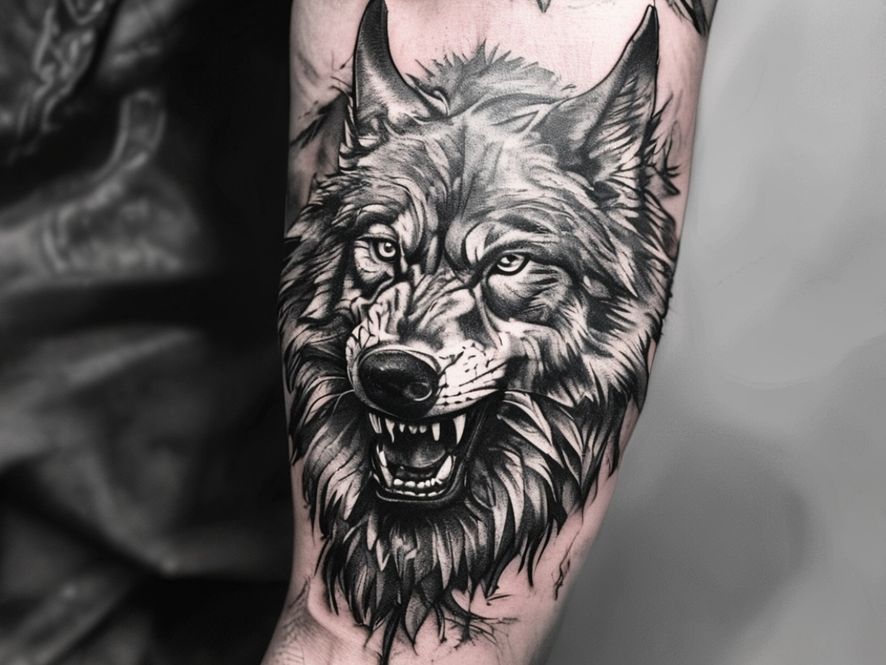
Fenrir: The Giant Wolf of Norse Mythology
📌 In Brief
- Fenrir is a gigantic wolf, son of Loki and the giantess Angrboða.
- A prophecy foretold that Fenrir would cause the destruction of the gods during Ragnarök.
- Gleipnir is the magical bond that holds Fenrir.
- The god Týr sacrificed his right hand to allow for Fenrir's binding.
- According to the Poetic Edda, during Ragnarök, Fenrir breaks free from his chains, his gaping maw between earth and sky, and devours Odin, the father of the gods.
Who is Fenrir, son of Loki and the giantess Angrboða
The wolf Fenrir, as Norse mythology dictates, cannot be reduced to a mere fairy-tale monster: he is one of the three children whom the god Loki fathered with the giantess Angrboða, and his fate was sealed long before he had committed the slightest fault. Two medieval texts reveal him to us: the Poetic Edda, a collection of anonymous poems preserved primarily in the Codex Regius manuscript copied around 1270, and the Prose Edda by the Icelander Snorri Sturluson, written around 1220. Everything that can be asserted seriously about the wolf comes from these two bodies of work, supplemented by a few skaldic poems and a handful of carved stones. The rest is a matter of modern interpretation.
Fenrir, Fenrisúlfr, Hróðvitnir: the names of the wolf
Texts call him sometimes Fenrir, sometimes Fenrisúlfr, "the wolf of Fenrir," as if Fenrir had initially designated a place or a lineage before becoming a proper name. The connection most often proposed is the Old Norse fen, "the marsh," from which we derive a reading along the lines of "the one from the marsh"; other hypotheses circulate, and none is unanimously accepted by specialists. Two nicknames complete the picture: Hróðvitnir, which is often rendered as "the famous wolf," and Vánargandr, "the monster of the Ván," named after the river born from his saliva. Common vocabulary preserves an unexpected trace: in Old Norse, the wrist is called úlfliðr, literally "the wolf's joint."
A trio of siblings
Snorri, in chapter 34 of the Gylfaginning (standard numbering), presents the siblings as a unit: the serpent Jörmungandr, the two-colored woman Hel, and the wolf. Their father is Loki, the god of malice, their mother a giantess whose name, Angrboða, means something like "she who announces sorrow"—a narrative program in itself. The gods, warned by prophecies, decide to act before the three children grow up. Odin has the serpent thrown into the ocean that surrounds the lands, banishes Hel to the realm of the dead, and keeps the wolf with him in Ásgarðr. It is this last choice that dictates the entire story.
Raising a wild beast among the gods is not an act of tenderness: it is keeping it under surveillance. Snorri specifies that the wolf cub grew very quickly and that only one god had enough courage to come and bring him his food: Týr. This detail, slipped in a single line, prepares the episode that posterity has remembered the most. To situate Ásgarðr and the other realms connected by the world-tree, our guide to the nine worlds and Yggdrasil provides a useful mental map before going further. A general summary of the character is also available on Fenrir's Wikipedia page, which refers to scholarly editions of the Eddas.
The prophecy: why the gods dread the wolf
The fear of the Aesir is not a fear of size or fangs. It is a fear of the calendar. The gods know, because prophecies have taught them, that the children of Angrboða will cause them great harm, and that this harm will come from their mother just as much as their father. In the Völuspá, the opening poem of the Poetic Edda, a seeress summoned by Odin unfolds the history of the world from its origin to its end, and this end includes a freed wolf. Odin therefore knows what awaits him. He acts despite everything, or rather: he acts because he knows.
A prophecy that comes true through the means used to prevent it
This is the tragic mechanism of the cycle, and it deserves to be clearly stated, for it explains everything else. Nothing in the texts says that Fenrir was born evil. He becomes dangerous as the gods treat him as a danger. They keep him at a distance, they test him, they deceive him, they immobilize him, they jam his maw with a blade—and it is a betrayed wild beast, not one born monstrous, that breaks free on the final day. Several modern commentators, including French translators of the Eddas, have pointed out that the narrative mechanics resemble those of a self-fulfilling prophecy: the gods' distrust creates the enemy it claims to contain.
Growth that nothing can stop
Snorri insists on a simple and effective point: the wolf grows so fast that the gods are reminded of the predictions every day. The text provides no figures or measurements here: the only description of his size comes much later, at Ragnarök, when his lower jaw scrapes the ground and the upper touches the sky. The image of a wolf already as big as a mountain during his youth in Ásgarðr belongs to modern imagery. What the source says is a rhythm: that of a threat gaining ground faster than the gods' ability to contain it. The Aesir then hold council and make a decision they refuse to take responsibility for in the end: they do not want to kill the wolf because the sanctuary of Ásgarðr must not be defiled by blood. They will therefore choose to bind him. The price for this scruple will be heavy. To place this episode in the complete chronology of the end of the world, see our article dedicated to the Ragnarök prophecy.
Lœðingr, Drómi, Gleipnir: the three bonds of Fenrir
The binding is not a single event but a series of three attempts, built like a crescendo. The gods never present the operation as a capture: they disguise it as a game of strength, a sporting challenge. Each time, they flatter the beast's pride and invite him to prove his power by breaking the bond. The first two times, the ruse works because the wolf does indeed have something to boast about. The third time, he smells the trap.
| Bond | Nature | Fenrir's Reaction | Outcome |
|---|---|---|---|
| Lœðingr | Very strong iron chain made by the gods | Allows himself to be bound without suspicion, sees it as a game | Broken on the first attempt |
| Drómi | Chain about twice as strong as the previous one | Accepts out of vanity: glory is worth the risk | Broken with effort, fragments fly far away |
| Gleipnir | Supple ribbon forged by dwarves from six impossible elements | Refuses, suspects a spell, demands a pledge | Holds until Ragnarök |
Two broken chains, a proverb born
The failure of the first two bonds left a mark on the language. Snorri notes that Icelanders still said in his time, regarding a feat accomplished with great struggle, that a man "frees himself from Lœðingr" or "breaks free from Drómi." The mythical account functions here as popular etymology: mythology provides the images that common language subsequently uses to describe effort and victory. It is a good indication of the actual familiarity medieval Scandinavians had with these stories.
Gleipnir, or the art of forging with what does not exist
Defeated by brute force, the gods change tactics. Odin sends a messenger—Skírnir, servant of the god Freyr—to the dwarves of Svartálfaheimr, those underground craftsmen whose forging skills surpass those of the Aesir. They deliver Gleipnir, a bond whose name is generally glossed as "the fetterer" or "the one that catches." Its description holds in two images: it is soft and supple like a silk ribbon, yet nothing breaks it. The contrast is deliberate. The first two bonds were massive and visible; this one is almost immaterial. Force did not work; magic will take over.
Its composition is undoubtedly the most cited passage of the entire account, and one of the most misunderstood. The six elements are not rare ingredients: they are things that do not exist. Snorri explicitly says so, and he draws a facetious conclusion—if you have never noticed that a cat walks without sound or that a mountain has no visible roots, it is because these realities were consumed in the manufacture of the bond.
| Element | Why it is untraceable |
|---|---|
| The sound of a cat's footsteps | Cats move in silence |
| The beard of a woman | Women do not wear them |
| The roots of the mountain | No roots protrude at the base of the rocks |
| The tendons of a bear | Snorri does not explain it: he classifies it among the details that cannot be verified |
| The breath of a fish | Fish do not breathe out of water |
| The spittle of a bird | Birds do not produce it visibly |
This list says something specific about Norse magic as Snorri conceives it: it does not consist of adding power, but of crafting an impossible object, and therefore one impossible to undo. One detail is amusing to note: these six elements are absences, yet they form the only object in the pantheon capable of restraining Fenrir. The Wikipedia page dedicated to Gleipnir details the translation variants for the six Old Norse terms.
Týr's hand: the pledge and the broken oath
Here is the scene that makes this story something other than a hunting tale. The gods take the wolf to an island and present Gleipnir as a new challenge. Fenrir examines the ribbon, finds it too light to be worth any glory, and above all, too light to be honest. He then poses a condition of formidable lucidity: if the bond is truly what the gods claim, let one of them place their hand in his mouth as a token of good faith. The wolf is not asking for a guarantee; he is asking for proof of sincerity, knowing that no sincere god will have any need to provide it.
The only one who steps forward
None move, until Týr offers his right hand. The aftermath is well-known: the bond holds, Fenrir realizes he has been played, and the hand remains in his mouth. The gods laugh, the text says, all except Týr. This sentence by Snorri is perhaps the harshest in the Prose Edda: the victory of the Aesir is immediately disqualified by the manner in which they welcome it. The only one who paid is the only one who does not laugh.
What Týr loses exactly
Týr is not a secondary god. His name traces back to an extremely ancient Indo-European root, the same that gave the Latin deus and the Greek Zeus, which suggests he once occupied a higher place in the Germanic pantheon before Odin took it from him. He is the god associated with oaths, the assembly, and the law—and the rune that bears his name, ᛏ, is the subject of explicit advice in the Eddic poem Sigrdrífumál: whoever desires victory must carve victory runes and name Týr twice. The Scandinavian runic poems, for their part, designate him by an unequivocal periphrasis: "the one-handed Aesir." Losing his hand, for such a god, is not merely losing a limb: it is losing the organ of the oath. He pledges his word knowing it is false, and pays in full.
The Poetic Edda confirms the episode through another channel. In the Lokasenna, the insult match where Loki humiliates the gods one by one, he taunts Týr by saying he can no longer serve as an arbitrator between two men, since he is missing a hand—and gleefully reminds him who took it. The allusion assumes an audience already familiar with the story. The French comparatist Georges Dumézil linked this mutilation to a recurrent Indo-European motif, that of the one-handed god or hero who guarantees legal order through the sacrifice of his hand, and compared it to the Roman duo of Mucius Scaevola and Horatius Coclès. A panorama of the god and his attributes is gathered in the Týr entry on Wikipedia, which lists the Eddic mentions of his mutilation.
Lyngvi, Gjöll, and the sword across the jaw
The geography of the scene is named with unusual precision. The island is called Lyngvi—the name evokes heather—and it is located in the middle of a lake called Ámsvartnir, "the gloomy, the black." Neither of these two places is identifiable on a map: they belong to mythical topography, like the river Ván or the plain of Vígríðr. But the fact that they are named changes the status of the narrative: it is not "somewhere," it is here.
Gjöll, Gelgja, Þviti: the complete mechanism
The locking mechanism consists of three parts, and it is worth distinguishing them, as confusion is common. Gelgja is the name of the tether, the end of the Gleipnir bond used for mooring—it is neither a sword nor an independent chain. The gods pass it through a large stone slab named Gjöll, which they sink deep into the ground. Over it, they drive in a rock called Þviti, which acts as an anchor peg. Three names for a single action: the myth insists, as if it had to convince the listener that this time, the knot will hold.
The nameless sword and the river of drool
What remains is the mouth. Fenrir, furious, tries to bite; the gods slide a sword into his mouth, the hilt braced against his lower jaw and the tip against his palate, which keeps it permanently open. This blade has no name in the sources, unlike the slab and the rock—it is a tool, not an object of glory. From this blocked maw flows endless foam that forms a river, the Ván, and that is where the nickname Vánargandr comes from. The image is one of cold cruelty: Snorri specifies that he howls horribly and the drool runs from his maw endlessly. He will wait in this position until the last day of the world.
The wolf shall swallow the father of men; Víðarr shall avenge him. He shall rend the cold jaws of the beast in the fight.— Poetic Edda, Vafþrúðnismál, stanza 53 (French translation based on the Old Norse text)
Fenrir at Ragnarök: the death of Odin and the vengeance of Víðarr
When the day comes, everything unravels at once. The bonds break, the ship Naglfar leaves its moorings, the Bifröst bridge gives way under the weight of the riders, and the wolf advances. Snorri describes his progress with an image that has remained famous: the lower jaw scrapes the ground, the upper jaw touches the sky, and he would open it further if there were room. Fire spills from his eyes and nostrils. It is a mouth on the scale of the world, and the world enters into it.
Odin devoured
Odin marches to meet him, gold helmet and Gungnir spear in hand. He has spent his entire existence preparing for this moment: he sacrificed an eye to drink from the well of wisdom, hung nine nights from the tree to grasp the runes, and gathered an army of dead warriors at Valhöll. None of it is enough. Fenrir swallows him. The wisest of gods, by his own admission in the poems, dies knowing the place, the hour, and the adversary in advance—perhaps that is what makes the scene so striking. Our complete guide dedicated to Odin revisits this journey and the sacrifices made to no avail in detail.
Víðarr, the silent god, and his shoe
The vengeance is immediate. Víðarr, son of Odin and the giantess Gríðr, steps forward and places his foot on the wolf's lower jaw. Snorri then explains the origin of a singular shoe: it was assembled from all the scraps of leather that men trim from their toes and heels when making their shoes, scraps that one must throw away if one wishes to help the gods on the last day. A daily workshop gesture becomes a contribution to the final battle—it is one of the rare moments where mythology gives the audience a concrete role.
As for the killing itself, the two Eddas diverge, and it is more honest to say so than to choose a side. In Snorri, Víðarr seizes the upper jaw and tears the wolf's maw apart. In the Völuspá, he drives his blade into the beast's heart. The Vafþrúðnismál, cited above, uses a verb that rather evokes the act of rending. These variations do not indicate an error: they show that several versions of the same episode were circulating, which is the rule rather than the exception in this literature. The same hesitation applies to the dog Garmr, tethered before the Gnipahellir cave and released at Ragnarök: many researchers see him as a doublet of Fenrir, others as a distinct creature. The Ragnarök synthesis on Wikipedia lists these discrepancies between the two Eddas.
After the battle, the earth rises again from the sea, the sons of the dead gods meet in the grass, and a human couple that emerged from Hoddmímir's wood repopulates the world. Fenrir, for his part, does not reappear. His role ends where the cycle begins anew: he is the instrument of the closure, not of what follows.
Sköll and Hati: the wolves that chase the sun and the moon
Fenrir is not alone of his kind. The texts describe a lineage of giant wolves fed in the east, in a forest named Járnviðr, "the iron wood," by an old giantess. Two of them have a precise cosmic role. Stanza 39 of the Grímnismál names Sköll, who follows the sun until the shelter of the woods, and Hati, described as the "son of Hróðvitnir," who runs before "the bright bride of heaven"—a periphrasis that most translators relate to the moon. It is Snorri, in chapter 12 of the Gylfaginning, who explains the hunt: Sköll pursues the sun and will eventually catch it, while Hati Hróðvitnisson runs before him and wants to seize the moon.
Probable rather than certain filiation
This is where one must be precise, because many summaries move too quickly. The poem does not say "son of Fenrir": it says "son of Hróðvitnir." Yet Hróðvitnir is one of the attested nicknames for Fenrir, which forms the basis for the traditional identification of the two wolves as his offspring. The reading is solid, widely accepted, but it rests on this equivalence of names and not on an explicit genealogy. Snorri, for his part, adds a complication: after naming Hati as the wolf that wants to seize the moon, he announces that the most powerful of the iron wood litter will be a certain Mánagarmr, "the moon-hound," who will swallow the star—many researchers see this as a second name for Hati. He also presents the old woman of the iron wood as the mother of the litter. The traditions overlap without perfectly superimposing.
What the pursuing wolves explain
The function of the motif is clear: it gives a reason for the movement of the sky. The sun and moon are not strolling; they are fleeing. They advance quickly because they are being hunted, and the day the race stops is the day the world stops. Several commentators have seen it as a mythical explanation for eclipses, the wolf's mouth momentarily swallowing the celestial body; the comparison with analogous motifs attested elsewhere in Eurasia is tempting, but no Norse source makes this link explicitly. What is certain is that stanzas 40 and 41 of the Völuspá evoke the old woman of the iron wood, her litter of wolves, and a "star-snatcher" who feeds on the flesh of the dead, and that the image of the light-swallowing wolf permeates the entire corpus.
Archaeological traces: Fenrir carved in stone
The Eddas were written down in the 13th century, a century and a half to two centuries after the end of the Viking Age, and by Christian authors. Hence a legitimate question: were these stories really circulating beforehand? Sculpture provides elements of an answer, with the necessary caution, as none of these stones bear a legend explaining the scene.
Thorwald's Cross, at Kirk Andreas
The most debated evidence is found on the Isle of Man, in the parish of Kirk Andreas. It is a fragment of a carved cross, dated to the 10th or 11th century, with a runic inscription mentioning a certain Thorwald. On one face, a standing male figure holds a spear pointed downward; a bird is perched on his shoulder; his foot is engaged in the mouth of a large beast with marked fur. The reading proposed by specialists for a long time is that of Odin—the Gungnir spear, the raven—devoured by Fenrir at Ragnarök. The reverse side shows a figure holding a cross and a book, crushing a serpent: a Christian scene. Both ends of the world coexist on the same monument, which says a lot about the period of religious transition in the Scandinavian colonies of the Irish Sea. The page dedicated to Thorwald's Cross gathers the bibliography and the records of the ornamentation.
Gosforth, Ledberg, Tullstorp
Other stones support the case. The Gosforth cross in Cumbria, just over four meters tall and dated to the 10th century, associates a crucifixion with a series of scenes read as episodes of Ragnarök, including a figure prying open the jaws of a monster. In Sweden, the Ledberg stone (Östergötland) shows an armed figure whose foot disappears into the mouth of a quadruped—the parallel with the Manx cross is striking. In Scania, the Tullstorp stone bears a large beast with open jaws, often compared to the wolf, above a ship.
These images do not prove that the narrative they evoke was identical to Snorri's, but they make the idea that the wolf devouring the god was invented in the 13th century highly improbable. The motif existed on public monuments among populations separated by several hundred kilometers. This continuity between the told myth and the depicted myth is exactly what we explore in our article on Viking statues and representations of the Norse gods.
Fenrir in today's culture
Rare are the medieval creatures to have crossed the threshold of the 21st century so successfully. Video games have offered him his most visible roles: God of War: Ragnarök makes him a full-fledged character, Assassin's Creed Valhalla summons him in its mythological sequences, and a long list of role-playing games has made him an end-game adversary. Fantasy literature has borrowed the name more than the character—the werewolf Fenrir Greyback from the Harry Potter saga has nothing in common with the Norse wolf but the sound and the threat. Marvel comics introduced him in the form of "Fenris," and the television series Vikings refers to him on several occasions in its characters' prophecies.
A symbol worn, not just told
Beyond the screen, Fenrir has become a common motif in tattoos and jewelry among those interested in Norse culture. The interpretation held by those who wear it is rarely that of a monster: they see it instead as untamed strength, betrayed loyalty, or rebellion against a deceptive authority. It is a modern reinterpretation, embraced as such, and it says as much about our own era as it does about the Icelandic Middle Ages. In our world, wolf iconography stands alongside that of the world tree and runes, for example on the rune-engraved steel Yggdrasil necklace or on items marked with the valknut like the gold-plated interlace valknut signet ring—two symbols associated with Odin, the very god the wolf devours.
Key Takeaways
Fenrir is no brute: he is one of the most tragic figures in the pantheon, one whose every act is a response to betrayal. Raised by those who fear him, tested twice, deceived a third time, gagged by a blade, and tethered to a stone in the middle of a lake, he only becomes the prophesied enemy after being treated as one. It is this reversal that makes the case of Fenrir—mythology, medieval sources, archaeology, and popular culture combined—as vivid today as it was for Snorri's listeners. The wolf says nothing of fate; he says a great deal about how we manufacture it.
Finally, here are the answers to the questions we are asked most often about the giant wolf.
Frequently Asked Questions about Fenrir
Who is Fenrir in Norse mythology?
Fenrir is a gigantic wolf, son of Loki and the giantess Angrboda. Feared by the gods for his uncontrollable growth, he was bound by trickery with the magical Gleipnir ribbon. During Ragnarök, he will break free and devour Odin before being killed by Odin's son, Víðarr.
Why did the gods bind Fenrir?
A prophecy foretold that Fenrir would cause the destruction of the gods during Ragnarök. As he grew, he became so powerful that only Tyr dared to feed him. The gods decided to bind him with Gleipnir, a magical restraint forged by the dwarves from six impossible elements.
What is Gleipnir?
Gleipnir is the magical tether that binds Fenrir. Forged by the dwarves, it is made of six impossible elements: the sound of a cat's footsteps, the beard of a woman, the roots of a mountain, the tendons of a bear, the breath of a fish, and the spittle of a bird. As thin as a silk ribbon but unbreakable.
What is the connection between Fenrir and Tyr?
The god Tyr sacrificed his right hand to allow Fenrir to be bound. When the gods invited Fenrir to test Gleipnir, the suspicious wolf demanded that a god place their hand in his maw as a pledge. Only Tyr had the courage—and he lost his hand when Fenrir discovered the trick.
Does Fenrir really devour Odin during Ragnarök?
Yes, according to the Poetic Edda, during Ragnarök, Fenrir breaks his chains, his jaws gaping between earth and sky, and devours Odin, the father of the gods. Immediately after, Odin's son Víðarr avenges his father by tearing the wolf’s jaw apart.
Has Fenrir inspired modern works?
Yes, Fenrir is omnipresent in popular culture: in God of War: Ragnarök, Marvel (under the name Fenris), Harry Potter (the werewolf Fenrir Greyback), and the series Vikings. The giant wolf remains one of the most iconic creatures in Norse mythology.
What are the delivery times and return conditions for the Thor statue?
For the Thor statue, as with any order, allow for 10 to 20 business days in total: 3 to 5 days for processing, then 7 to 15 days for delivery within mainland France, and 10 to 20 days within the European Union. Delivery costs €4.90 in France and the EU, and is free on orders over €49. After receipt, you have 14 days to change your mind and return the item: return shipping costs are your responsibility. If the received item is defective or does not match your order, we will refund the return shipping costs upon presentation of proof of postage.
"The fir tree withers that stands on the village green; neither bark nor needles shelter it. Such is the man whom no one loves: why should he live long?"
— Hávamál, stanza 50, Poetic Edda
May the Aesir guide you on the path of honor.
👉 Explore our collections of Viking jewelry and Viking decorations to wear the Viking spirit every day.
The chained wolf is one of the most worn figures: our Fenrir Wolf collection gathers pieces featuring his likeness.
📚 Read also
- The Norse Gods: Complete List of the Asgardian Pantheon
- The Kraken: The Sea Monster of Norse Legend, from Myth to Giant Squid
- 17 Viking Symbols and Their Deep Meanings
- Loki: The God of Mischief in Norse Mythology
- The 9 Worlds of Norse Mythology and Yggdrasil
- Odin the Supreme God: A Complete Guide to Norse Mythology
- Ragnarök: The Prophecy of the Norse End of the World

Leave a comment
All comments are moderated before being published.
This site is protected by hCaptcha and the hCaptcha Privacy Policy and Terms of Service apply.