
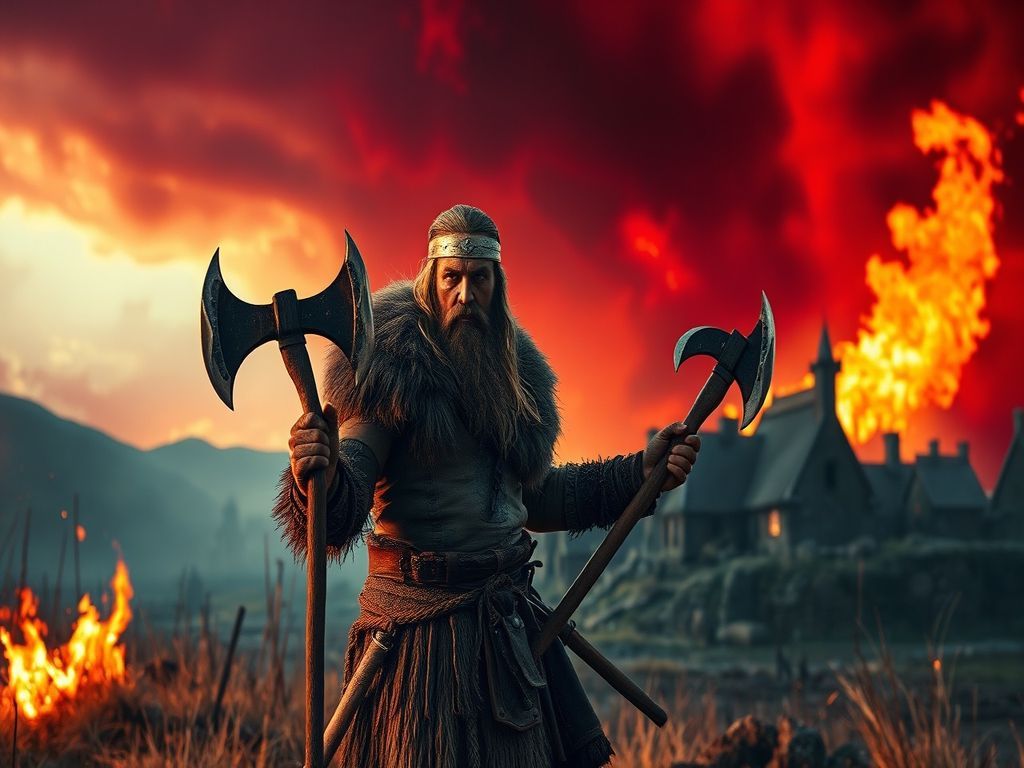
Ragnarök: The Prophecy of the End of the Norse World
📌 In short
- Ragnarök is the prophecy of the end of the world in Norse mythology.
- Odin is devoured by the wolf Fenrir, Thor kills the serpent Jörmungandr but succumbs to his venom, Freyr falls to the giant Surtr, and Tyr perishes while fighting the dog Garm.
- Ragnarök is not a definitive end. After the destruction, a new world emerges from the waters, greener and more fertile.
- Loki is the trigger for Ragnarök: freed from his chains, he leads the giants and the dead of Hel against the gods of Asgard, on the plain of Vígríd.
- The word Ragnarök comes from Old Norse and literally means the fate of the gods or the twilight of the divine powers.
The word, the poem, and what to expect from it
Let us begin with the word, because it already carries a famous misconception. Ragnarök is composed of regin, "the powers," that is, the gods, and rök, "destiny" or "sentence." The correct translation is therefore "the fate of the powers" or "the judgment of the gods."
The form Ragnarøkkr, with two k's, means something quite different: "the twilight of the gods." This is an attested variant, though a minority one, and it is the one Snorri Sturluson promoted in the 13th century. Wagner took it up in the 19th century to title the final installment of his tetralogy, Götterdämmerung, and the expression became established throughout Europe. We therefore commonly speak of a twilight where the Scandinavians spoke of a verdict.
The main source is a single poem: the Völuspá, "the prophecy of the seeress," which opens the Poetic Edda. A völva, or seeress, answers Odin, who has pulled her from her sleep, and unfolds the history of the world for him—from creation in the gaping void of Ginnungagap to destruction, and then to what comes after.
This text reached us via two Icelandic manuscripts, the Codex Regius, copied around 1270, and the Hauksbók, which is slightly later; their versions differ across several stanzas. The composition of the poem itself is generally situated in the 10th century, around the time Iceland was transitioning to Christianity. This chronological detail is not insignificant, and we will return to it.
Two and a half centuries later, Snorri organized all of this in the Gylfaginning. He quotes the Völuspá and the Vafþrúðnismál extensively, fills in the gaps, harmonizes contradictions—and it is his clear, sequential version that has shaped our image of Ragnarök. It is precious; it is also a reconstruction made by a literate Christian seeking to preserve a disappearing poetic knowledge.
Therefore, one must read what follows with this dual perspective: a 10th-century poem, dense and allusive, and a 13th-century synthesis that explains it. Where the two diverge, we will point it out.
The warning signs: from crime to the great winter
The prophecy begins not with a natural cataclysm but with a moral collapse. This is the most cited stanza in all of Eddic poetry: brothers fight and kill one another, children of sisters break blood ties, adultery becomes widespread. Then comes the formula that has spanned the centuries—an age of axes, an age of swords, shields splintered, an age of wind, an age of wolves, before the world collapses.
What this passage describes is the dissolution of what held Norse society together: kinship and oaths. Without obligation to one's kin or respect for one's word, there is no longer law, no longer a Thing, no longer any possible peace. The end of the world begins with the end of social bonds—and that is a thought of troubling modernity.
Next comes the Fimbulvetr, the "great winter": three consecutive winters with no summer in between. Provisions run out, and war breaks out everywhere. Some have wanted to see in this the memory of a real event, the climatic episode of 536 AD, documented by ice cores and tree rings, which effectively caused sunless summers in Scandinavia. The hypothesis is seductive and frequently cited; it remains a hypothesis.
Then the signs accelerate. The wolves Sköll and Hati, who had always pursued the sun and the moon, catch them and devour them; the stars vanish from the sky. Three roosters crow simultaneously in the three worlds—Gullinkambi, "gold-comb," wakes the warriors of Valhalla. The dog Garmr howls before the Gnipahellir cave.
Yggdrasil, the ash tree that supports the universe, begins to tremble and groan. All fetters yield at the same time: those of Loki, those of Fenrir, those of Garmr. The Völuspá repeats like a refrain that bonds break, both literally and figuratively.
Finally, Heimdallr, the guardian who sees for a hundred leagues and hears the grass grow, lifts the Gjallarhorn to his lips and sounds it. This is the signal. The gods gather in council, Odin goes to consult Mímir's head one last time, and they march toward the plain.
The protagonists: Loki, his children, and Surtr
At the center of the arrangement is Loki. He is not a god of evil in the Christian sense: he is an agent of disorder, sometimes useful to the Aesir, sometimes destructive. The tipping point occurs with the death of Baldr, of which he is the architect. This episode is worth recalling, as it arms the countdown. Baldr, the most beloved of the gods, dreams of his own death; his mother Frigg then makes everything in the world swear not to harm him, and the gods amuse themselves by throwing projectiles at him that spare him. But Frigg neglected the mistletoe, deemed too young to take an oath. Loki learns this, carves an arrow from this plant, and has it fired by Höðr, Baldr's blind brother, who kills without knowing. Hel agrees to return the dead man if everything in the nine worlds weeps for him—and only one giantess refuses, in whom the texts recognize Loki in disguise. The gods then chain him underground with the entrails of his own son, a serpent suspended above him dripping its venom onto his face. He will be freed at Ragnarök.
His three children, born of the giantess Angrboða, form the bulk of the threat. Fenrir, the wolf, whom the gods could only master with Gleipnir, a bond forged by the dwarves from six impossibilities—the sound of a cat's footfall, the beard of a woman, the roots of a mountain, the sinews of a bear, the breath of a fish, the spittle of a bird. For the wolf to agree to the test, Týr had to place his hand in its maw; he lost it.
Jörmungandr, the world-serpent, cast into the ocean by Odin, grew there until he encircled the entire earth and bit his own tail. He is the designated adversary of Thor, who has already faced him twice without success—notably during the famous fishing trip where the god nearly hoisted him out of the water before the giant Hymir cut the line. This serpent biting its own tail is also a jewelry motif: snake rings, necklaces, and earrings are gathered in our dragons and serpents section.
The third, Hel, rules the realm of the dead that bears her name. She will provide some of the troops, and the ship that transports them is one of the most striking images in the corpus: Naglfar, built from the nails of the dead. Snorri actually offers a practical recommendation from this—one must trim the nails of the deceased, lest they hasten the completion of the boat.
Finally, from the south comes Surtr, the fire giant who has guarded Muspellheim since the beginning, brandishing a sword brighter than the sun. He has no personal grievance against the gods: he is an elemental force, and it is he who will deliver the final blow to the world itself.
When the armies set out, they cross Bifröst, the rainbow bridge—which breaks under their weight. The only path between the worlds is destroyed in the very movement that uses it. Everything in this mythology is held together by bonds; Ragnarök is the moment they all give way together.
The Battle of Vígríðr: who kills whom
The place has a name: Vígríðr, a plain a hundred leagues wide. The texts emphasize its immensity, as if a vast space were needed to contain what is to play out there. And what plays out there is a series of paired duels—each god faces his designated adversary, the one that destiny had reserved for him from the beginning.
Odin versus Fenrir. The All-Father, armed with his spear Gungnir, marches first toward the wolf. He is devoured. This is the point that most modern adaptations soften: the most powerful god in the pantheon dies, and he dies knowing from the start that this would happen. All his activity—collecting the Einherjar, questioning the dead, sacrificing his eye for wisdom—served only to delay the inevitable.
His son Víðarr avenges him immediately. He places his foot—shod, Snorri specifies, with a sole made of all the leather scraps that men have trimmed since the beginning—on the wolf's lower jaw, grabs the upper one, and tears it apart.
Thor versus Jörmungandr. The most anticipated duel, and the only one where the god prevails: Mjölnir crushes the serpent's skull. But Thor, splashed by the venom, takes nine steps and falls dead. Nine, the number that structures all of this mythology—nine worlds, nine nights hanging from the tree.
Freyr versus Surtr. The god of fertility faces the fire giant without his sword: he had given it to his servant Skírnir in exchange for the hand of the giantess Gerðr. A bargain struck for love costs him his life. This is one of the rare times that Norse mythology allows itself an explicit irony.
Týr versus Garmr and Heimdallr versus Loki both result in mutual death—the guardian and the trickster cancel each other out, which is logically satisfying.
Only Surtr remains, victorious and standing alone. He casts fire upon the nine worlds. The flames rise to the sky, the stars fall, and the earth sinks into the sea. On this point, the two Eddas agree: this is not a defeat; it is a total extinction, and it is absolute.
One detail is worth noting because it illuminates the entire Norse conception of destiny. These pairings are not decided on the battlefield: they are known in advance. Odin has known for a long time that he will perish by Fenrir—it is the very reason he gathers the Einherjar, questions the dead, and sacrifices his eye to Mímir's spring. His entire existence is an attempt to delay an outcome of which he knows every detail.
This gives Ragnarök a very particular color, one that would be sought in vain in other eschatologies. There is no suspense, no judgment to earn, no side to choose to be saved. There is a foretold destiny, and the only question that remains open is that of bearing: how one presents oneself. It is exactly the logic that the Hávamál applies to ordinary existence—since everything dies, only the manner counts.
After the end: the world rising from the waters
And yet the poem does not end there. This is what distinguishes Ragnarök from most eschatologies: after the annihilation, the seeress sees the earth rise from the waters, verdant. Waterfalls flow, the eagle soars and fishes in the torrents. Fields unsown yield harvests.
Some gods survived. Víðarr and Váli, the avengers. Móði and Magni, Thor's sons, who inherit Mjölnir. And above all, Baldr returns from the realm of Hel, accompanied by Höðr, his blind brother who had killed him against his will. The murderer and his victim return together and reconcile: the new world begins with forgiveness.
They find each other on the plain of Iðavöllr, find in the grass the golden game pieces they used to play with at the dawn of time, and recall the ancient events. The image is one of unexpected gentleness after so much carnage.
Humanity itself survives through two people: Líf and Lífþrasir, "Life" and "The one who clings to life," who crossed the conflagration hidden in the Hoddmímir wood, feeding on the morning dew. All human descent will start again from them.
One final passage is open to discussion. The Völuspá mentions a hall more beautiful than the sun, covered in gold, named Gimlé, where the righteous will dwell forever—then, in some manuscripts, the coming of "a powerful one who comes from above," whom the text does not name. Many specialists see it as a Christian interpolation, or at least the imprint of a poet who already knew Christianity. The stanza is absent from the Codex Regius and present in the Hauksbók: the debate is not settled.
Moreover, there is stone evidence of this encounter, and it predates the manuscripts. The Gosforth Cross, in Cumbria, erected in the 10th century in a region under Scandinavian rule, bears scenes on its shaft that are identified as Ragnarök—Loki chained, Heimdallr with his horn, a character fighting a monster—carved on the same monument as a Crucifixion. On the Isle of Man, the Thorwald's Cross shows a figure armed with a spear, a raven on his shoulder, whose foot disappears into the jaws of a wolf: Odin devoured by Fenrir, carved on a Christian cross.
These stones say something that the texts do not. They were commissioned by people who, clearly, did not see an insurmountable contradiction between the two traditions, and who used one to talk about the other. The end of a world and the promise of renewal lent themselves to this convergence.
This uncertainty is instructive rather than bothersome. It reminds us that the Völuspá was composed at a turning point, by a culture that was in the process of changing religion, and that we are reading it through Christian copyists. The myth we call "Norse" is already, in its written form, a myth of encounter.
What remains is what, within it, continues to speak to us. A pantheon that knows its own end and walks towards it knowingly. Mortal, fallible gods who lose—and a world that begins again regardless. It is not a morality of consolation; it is a morality of endurance. It is understandable that it survived the religion that produced it.
Frequently Asked Questions about Ragnarök
What is Ragnarök in Norse mythology?
Ragnarök is the prophecy of the end of the world in Norse mythology. It refers to a series of catastrophes including a war between the gods and the giants, the death of Odin, Thor, and many gods, followed by the rebirth of a new and purified world.
Which gods die during Ragnarök?
Odin is devoured by the wolf Fenrir, Thor kills the serpent Jörmungandr but succumbs to its venom, Freyr falls to the giant Surtr, and Tyr perishes fighting the dog Garm. Heimdall and Loki kill each other during the final battle.
Is Ragnarök truly the end of the world?
No, Ragnarök is not a definitive end. After the destruction, a new world emerges from the waters, greener and more fertile. Two human survivors, Líf and Lífþrasir, repopulate the earth, and some gods like Baldr return to life.
What is Loki's role in Ragnarök?
Loki is the catalyst of Ragnarök. Freed from his chains after centuries of captivity, he leads the army of giants and the dead of Hel against the gods of Asgard on the battlefield of Vígríðr, piloting the ship Naglfar made from the nails of the dead.
What does the word Ragnarök mean?
The word Ragnarök comes from Old Norse and literally means the fate of the gods or the twilight of the divine powers. It is sometimes translated as Götterdämmerung in German, popularized by Wagner's opera.
Has Ragnarök inspired any films or series?
Yes, Ragnarök inspires many works: the Marvel film Thor: Ragnarok, the Netflix series Ragnarök set in Norway, the series Vikings, and the video game God of War: Ragnarök. It is one of the Norse myths most frequently used in popular culture.
What are the delivery times and return conditions for the wall-mounted bull skull?
For the wall-mounted bull skull, as with any order, allow 10 to 20 business days in total: 3 to 5 days for preparation, then 7 to 15 days for delivery in mainland France, 10 to 20 days in the European Union. Delivery costs €4.90 in France and the European Union, and is free on orders over €49. After receipt, you have 14 days to change your mind and return the item to us: return shipping costs are your responsibility. If the item received is defective or does not correspond to your order, we will refund the return costs upon presentation of proof of postage.
"Brothers will fight and kill each other; an age of axes, an age of swords, shields will be cloven; an age of wind, an age of wolves, before the world crumbles."
— Völuspá, stanza 45, Poetic Edda
May the Aesir guide you on the path of honor.
👉 Explore our collections of Viking decorations and Viking jewelry to wear the Viking spirit every day.
Sources
- Völuspá, Poetic Edda — preserved in the Codex Regius (Iceland, circa 1270) and the Hauksbók; the two manuscripts diverge on the ending, particularly the Gimlé stanza.
- Snorri Sturluson, Gylfaginning (Prose Edda), circa 1220 — the sequential ordering of Ragnarök, and the only source for Víðarr's shoe and the ship Naglfar.
- Vafþrúðnismál, Poetic Edda — the survivors Líf and Lífþrasir, and the fate of Thor's sons.

Leave a comment
All comments are moderated before being published.
This site is protected by hCaptcha and the hCaptcha Privacy Policy and Terms of Service apply.