
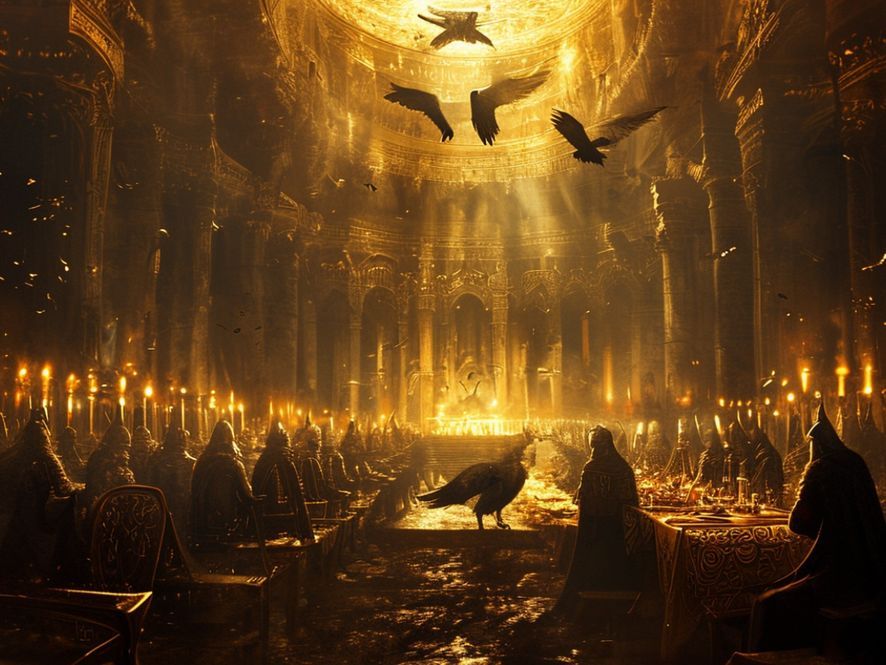
Valkyries: Odin's Warrior Women, Names and Legends
📌 In Brief
- Valkyries are Odin's divine warriors who fly over battlefields to choose the most valiant warriors among the dead.
- Norse sources mention varying numbers.
- Valkyries are mythological figures, but the concept of Norse female warriors has historical roots.
- Brynhild (Brunhilda) is the most famous.
- Ancient texts only mention male warriors being chosen for Valhalla.
Valkyrie: What the name truly means
Type "Valkyries Norse mythology" into a search engine and you will mostly see armored combatants with winged helmets and spears raised against a stormy sky. The medieval texts that have passed these figures down to us tell a story that is stranger, and far more interesting: supernatural women sent by Odin to designate who must die, escort the slain to Valhalla, and pour the drink of the dead. None of them wear wings in the medieval sources. None of them wear horns. This guide reviews the subject from the source: the Poetic Edda, Snorri Sturluson's Edda, skaldic poetry, Icelandic sagas, and artifacts unearthed from the ground.
Valr and kjósa: "she who chooses the slain"
The Old Norse word is valkyrja, plural valkyrjur. It breaks down into two perfectly legible elements. The first, valr, refers to the collection of corpses littering a battlefield after combat—not the dead in general, but specifically those killed in battle. The second comes from the verb kjósa, "to choose, elect." The meaning of Valkyrie is therefore literal and without mystery: she who chooses the slain.
The same element valr is found in Valhöll, "the hall of the slain," which French and English have termed Valhalla, and in Valföðr, "father of the slain," one of Odin's names. The vocabulary alone outlines a coherent system: a god who reigns over the violently dead, a hall that welcomes them, and messengers who select them. Nothing in this family of words relates to beauty, love, or protection.
A figure attested outside of Scandinavia
The term is not exclusive to Old Norse. Old English has wælcyrge, formed in exactly the same way, and Anglo-Saxon glossaries from the 8th–11th centuries use it to translate the Latin names of the Furies and Bellona, the Roman deity of war. In his Sermo Lupi ad Anglos, preached around 1014, Archbishop Wulfstan of York ranks the wælcyrian among the figures that a good Christian must avoid, alongside witches and murderers. The word there has already shifted toward an insult: it refers to women deemed malevolent.
Where our information comes from
Almost everything we know rests on three families of texts. First, the Codex Regius, an Icelandic manuscript copied around 1270 and rediscovered in 1643, which contains the twenty-nine poems we now call the Poetic Edda: this is where the Völuspá, the Grímnismál, and the heroic poems can be read. Then there is the Edda of Snorri Sturluson (1179–1241), written around 1220 as a manual for poets, which organizes the myths into prose. Finally, skaldic poetry, which is often older than the manuscripts that preserve it: the Eiríksmál dates to around 954, and the Hákonarmál by Eyvindr Finnsson to around 961.
A precaution is necessary and applies to the entire article: these texts were committed to writing by Christians, two to three centuries after the conversion of Iceland in the year 1000. They preserve ancient material, but it has been reorganized and sometimes reinterpreted. Where sources diverge, this guide will note it rather than settle it. To place Odin within this context, our portrait of the supreme god of Norse mythology provides a useful complement to what follows.
The Valkyries in Valhalla: choosing the dead, leading them there, and serving them drink
Snorri summarizes their function in one sentence in Chapter 36 of the Gylfaginning: Odin sends them to every battle; they designate men destined to die and decide the outcome of the combat. This second part is the one popular culture has forgotten. Valkyries do not just gather the dead after the fact, like celestial paramedics: in the texts, they attribute death and victory. They are an instrument of Odin's will on the battlefield, and that will is considered capricious. A warrior can be abandoned at the very moment he thinks he is triumphant, because the All-Father wants to reclaim him.
What awaits the chosen
The chosen slain become the einherjar. The Grímnismál describe their dwelling with accounting precision: a hall covered in shields, roofed with spear shafts, pierced with five hundred and forty doors through which eight hundred warriors can exit side-by-side on the day of Ragnarök. Their daily life consists of two repeated gestures: they fight each other to the death every day, then rise again to feast every night. The boar Sæhrímnir, boiled by the cook Andhrímnir, reconstitutes itself indefinitely; the goat Heiðrún, which grazes on the leaves of the tree Læraðr, fills a vat with mead that never runs dry.
This is where the second role of the Valkyries comes in, the one stated in black and white in stanza 36 of the Grímnismál.
Hrist and Mist, I want them to bring me the horn; Skeggjöld and Skögul, Hildr and Þrúðr, Hlökk and Herfjötur, Göll and Geirahöð, Randgríð, Ráðgríð and Reginleif: it is they who bring ale to the einherjar.— Poetic Edda, Grímnismál, stanza 36 (French translation from the Old Norse text of the Codex Regius)
The drink varies according to the sources, and the detail is revealing. The Grímnismál say öl, ale. Snorri speaks of mjöðr, Heiðrún’s mead. The Eiríksmál has Odin say: "Valkyries, bring the wine, as if a prince were arriving." The liquid varies, but the gesture does not: a woman steps forward and holds out a drinking horn. This gesture is likely the most documented of all Valkyrie lore, including outside of the texts, as we shall see with archaeology. It is not at all a subordinate role: in a Scandinavian feasting hall, serving the drink is the responsibility of the master of the house’s wife or the highest-ranking woman, and the act validates the status of the one receiving it. Our guide to Viking mugs and drinking vessels details this material background.
The case of Hákon: a Valkyrie for a real king
The Hákonarmál shows the concrete purpose of this imagery. Composed around 961 by the skald Eyvindr Finnsson upon the death of Hákon the Good, King of Norway, the poem sends Göndul and Skögul to choose the sovereign among the slain and escort him to Valhalla, where Odin welcomes him. Hákon had been raised Christian in England: the poet nevertheless offers him pagan funeral rites in verse. The Valkyries are therefore not just characters of mythological tales; they are a political tool of legitimation, mobilized upon the death of kings to transform a military defeat into a divine promotion.
The names of the Valkyries in the Grímnismál and the Völuspá
The question of the number keeps coming up, and there is no single answer. The two main lists do not even coincide. Stanza 36 of the Grímnismál, cited above, aligns thirteen. Stanza 30 of the Völuspá names six, seen by the seeress "coming from afar, ready to ride": Skuld holding a shield, Skögul, Gunnr, Hildr, Göndul, and Geirskögul. Snorri takes the list from the Grímnismál and adds Gunnr, Róta, and "the youngest of the Norns, named Skuld," who always ride to choose the slain. The þulur, those versified lists of synonyms appended to the Skáldskaparmál, accumulate about thirty others, many of which appear nowhere else. The number thirteen that one encounters everywhere thus comes solely from stanza 36 of the Grímnismál; the Valkyries cited most often—Brynhildr, Sigrdrífa, Göndul—are named elsewhere in the Poetic Edda, in the Völuspá, and in the heroic poems.
Functions rather than characters
By reading the Valkyrie names side-by-side, one fact stands out: they are almost never personal names, but common nouns. Battle, Combat, Clamor, Uproar, Mist, Strength. We are closer to a list of battlefield attributes than a catalog of individuals. Herfjötur, "army fetter," even designates a specific phenomenon: the sudden paralysis that seizes a warrior at the decisive moment, which the Scandinavians attributed to supernatural intervention. To name a Valkyrie this way is to put a face on a combat experience.
| Old Norse Name | Most common meaning | Where found |
|---|---|---|
| Gunnr | "battle" | Völuspá 30; Snorri; Darraðarljóð |
| Hildr | "combat" | Grímnismál 36; Völuspá 30; Darraðarljóð |
| Skögul | "she who rages" (meaning debated) | Grímnismál 36; Völuspá 30; Hákonarmál |
| Göndul | "wielder of the magic wand" (meaning debated) | Völuspá 30; Hákonarmál; Darraðarljóð |
A porous boundary with Norns and dísir
That Skuld appears in both categories is not a copyist's blunder. Skuld is one of the three Norns in the Völuspá, the one who answers for the future, and Snorri also places her among those who ride to choose the slain. Old Norse also uses the word dísir for a vague group of protective or baleful female entities, and the Völuspá calls the Valkyries "Herjann's women," Herjann, "the army leader," being another name for Odin. There is no neat, airtight classification: the Norse supernatural female world is a continuum, ranging from lineage protector to distributor of death. The reference entry in the collaborative encyclopedia dedicated to Valkyries details these cross-references source by source.
Valkyries who marry mortals
A second family of texts features individualized Valkyries, with a father, a proper name, and a love story. These are the heroic poems of the Edda, and the motif is surprisingly constant: the Valkyrie who attaches herself to a mortal loses what makes her a Valkyrie.
Sigrdrífa, the sleep-thorn, and Brynhildr
The Sigrdrífumál relate that Sigurðr, while climbing Mount Hindarfjall, spots a glow rising to the sky. There he finds a sleeper in armor, whose chainmail he must slit to wake them. It is a woman: Sigrdrífa. She explains her punishment. Two kings were clashing, Hjálmgunnarr and Agnarr; Odin had promised victory to the first, she gave it to the second. The god pricked her with a svefnþorn, a "sleep-thorn," and decreed she would never win another victory and would be married. She replies by swearing to marry only a man who knows no fear, then teaches him the runes.
The Völsunga saga, composed in the 13th century, identifies this Sigrdrífa as Brynhildr, daughter of Buðli and sister of Atli. The Poetic Edda does not state this explicitly—and for good reason: the Codex Regius has lost an entire quire at this spot, the famous "great lacuna" of eight leaves. Part of what we think we know about the most famous Valkyrie therefore rests on a late reconstruction, filling a material hole in the manuscript. Let us keep the principle in mind: Brynhildr is punished for having chosen the dead against Odin's will. Her crime is not having killed; it is having disobeyed.
Sváva, Sigrún, and the rebirth motif
The three poems dedicated to the heroes named Helgi unfold a variation of the same scenario. In Helgakviða Hjörvarðssonar, the Valkyrie Sváva, daughter of King Eylimi, gives his name to a young man who was until then mute and nameless, protects him in battle, and marries him. In Helgakviða Hundingsbana, Sigrún, daughter of Högni, crosses the skies at the head of a band of Valkyries and refuses the husband her family intends for her to unite with Helgi Hundingsbani. After his death, she enters his burial mound and spends the night beside the returned dead—one of the rare scenes of a lover revenant in Old Norse literature. Prose notes added by the compiler clarify that Sváva and Helgi were reborn as Sigrún and Helgi, then as Kára and Helgi. The very name of Valkyrie becomes here a burden one assumes from one life to the next.
The swan-maidens of the Völundarkviða
The Völundarkviða opens on a different scene. Three women are spinning by a lake, their swan garments laid beside them; three brothers seize them and marry them. The introductory prose names two of them daughters of King Hlöðvér, calls them Valkyries, and specifies that after seven winters they return to the fighting. This intersection between the Valkyrie and the swan-maiden links the Norse motif to a whole family of Eurasian narratives, which we revisit in our overview of creatures in Norse mythology.
The dark side: the Darraðarljóð and the loom of entrails
If we were to keep only one text to correct the romantic image of the Valkyrie, it would be this one. The Darraðarljóð is a poem of a dozen stanzas inserted in chapter 157 of Njáls saga. The framing narrative situates it on a Good Friday in 1014, in Caithness, at the far north of Scotland. A man named Dörruðr sees twelve horsewomen entering a stone hut. He approaches, looks through an opening, and discovers what they are doing.
What they are weaving
They are working on a vertical loom, the very same used in every Scandinavian farmhouse. Except that the warp is made of human entrails, the loom weights that tension the threads are severed heads, the batten is a spear, the shuttle is an arrow, and the comb that packs the fabric is a sword. They beat the cloth with blade-blows while singing a refrain: "Weave, weave the web of the spear." Then they name themselves: Hildr, Hjörþrimul, Sanngríðr, Svipul, Gunnr, Göndul. At the end of the poem, they tear the cloth, each takes her piece, mounts her horse, and rides away, six to the north, six to the south.
The web they are weaving is the Battle of Clontarf, fought on April 23, 1014, near Dublin, where the Irish king Brian Boru perished. The poem is a prophecy: by weaving, they are not predicting the outcome of the battle, they are manufacturing it. The act aligns with that of the Norns, who spin fate, and establishes one of the most tenacious metaphors in skaldic poetry, that of war as textile work. The philological file for this poem is presented in detail in the encyclopedic entry dedicated to the Darraðarljóð.
Why this image is so unsettling
The loom is, in the Scandinavian farm, the domestic female object par excellence. It occupies the wall of the common room; weaving rhythms the winter; producing vaðmál, wool cloth, is a major economic activity and a women's affair. The poem takes this familiar object and transforms it into a machine for carnage. This is not an image of gratuitous horror: it is the exact translation of what the Valkyrie represents. A female power that, instead of producing and protecting, measures and distributes death, with the same methodical seriousness.
The rest of the corpus points in the same direction: Valkyries are associated with the ravens and wolves that follow armies, to the point that skaldic kennings call these scavengers "the Valkyrie's swans." They do not comfort anyone.
Freyja, Fólkvangr, and the sharing of the dead
One detail contradicts the received idea that all the slain return to Odin. Stanza 14 of the Grímnismál is explicit: Fólkvangr is the ninth dwelling, Freyja distributes the places in the hall there, and she chooses half of the slain each day, the other half belonging to Odin. Snorri repeats the information in chapter 24 of the Gylfaginning, adds that Freyja's hall is called Sessrúmnir, "the one with many seats," and specifies that she rides to battle to take her share.
The sharing raises a question that no text answers: by what criterion is the distribution made, and who chooses first? The sources are silent, and one must accept this silence rather than fill it. One can simply observe that Freyja, without ever being called valkyrja in Old Norse, exercises exactly the function the word describes. Several scholars see in this the trace of an older figure of whom the Valkyries would be a multiplication, a solid hypothesis but one that cannot be proven in the current state of sources.
Freyja, moreover, carries all the attributes of a sovereign of the dead and of war: a chariot pulled by cats, the Brísingamen necklace, the boar Hildisvíni whose name means "battle-hog," and, according to the Ynglinga saga, mastery of seiðr, the magic she supposedly taught the Aesir. Egil's Saga adds precious testimony: in chapter 78, Þorgerðr announces that she will not eat again until she is Freyja's guest. The prospect of an afterlife with the goddess therefore truly existed and did not pass through Odin's hall. Regarding the general architecture of the nine worlds in which these dwellings fit, see our article on Yggdrasil and its significance.
Archaeology: the Hårby figurine and horn pendants
The texts date from the 13th century; the objects, however, are contemporary with the Viking Age. They state no names, but they show gestures, and these gestures overlap with the poems in disturbing ways.
Hårby, 2012
In 2012, amateur prospectors unearthed at Hårby, on the island of Funen in Denmark, a partially gilded silver figurine about 3.4 centimeters high. It depicts a standing woman, in a long dress, hair pulled into a knot at the back, holding a sword in her right hand and a round shield in her left. Dating places it around the year 800. The object is kept at the National Museum of Denmark, which presents it as the first three-dimensional representation known to date of an armed woman for the Viking period.
Caution is necessary on one point: no inscription says "Valkyrie." The identification rests on an iconographic argument—a woman, weapons, a ceremonial posture—and remains an interpretation. It is reasonable, but it is not proof. Two years later, in 2014, another female figurine was discovered at Revninge, also on Funen; this one is most often associated with Freyja, also without certainty.
The woman with the horn, a recurring motif
The gesture best attested materially is not fighting, but serving drink. We know of a series of small silver pendants representing a woman in a trailing dress handing over a drinking horn, found notably at Birka in Sweden, at Tuna i Alsike, at Klinta on the island of Öland, and at several Danish sites. The same motif appears, engraved, on Gotland picture stones: on the Tjängvide stone and on Ardre VIII, dated to the 8th-9th centuries, a woman raises a horn to a rider mounted on an eight-legged horse, generally recognized as Sleipnir. The customary reading is that of a welcome in the other world. It matches the Grímnismál, but it remains a hypothesis of interpretation.
One last point deserves to be noted: these pendants mostly come from female burials. They were worn by living women, probably as amulets. The motif of the woman who welcomes the dead was therefore not reserved for the masculine warrior imaginary—it circulated as jewelry, exactly as a Norse-motif necklace is worn today.
Wagner and popular culture: what has been distorted
The mental image we have of Valkyries does not come from Iceland. It comes from a 19th-century German opera. Richard Wagner composed Der Ring des Nibelungen between 1848 and 1874; Die Walküre, the second part of the cycle, premiered in Munich on June 26, 1870, and the entire work was performed in Bayreuth in August 1876. The Ride of the Valkyries, which opens Act III, became one of the most recognizable orchestral pieces in the repertoire.
Four deviations from the sources
The first concerns filiation. In Wagner, Brünnhilde is the daughter of Wotan and Erda. No Old Norse text makes Brynhildr the daughter of Odin: the Völsunga saga gives her King Buðli as a father. The father-daughter relationship, the dramatic engine of the entire opera, is an invention.
The second concerns the number. Wagner established a sisterhood of nine and invented almost all of their names—Gerhilde, Ortlinde, Waltraute, Schwertleite, Helmwige, Siegrune, Grimgerde, Rossweisse. The Eddas, as we have seen, do not agree on any total.
The third concerns the helmet. It was Carl Emil Doepler, the costume designer for the 1876 Bayreuth premiere, who adorned the characters with horned and winged helmets. The motif subsequently spread to illustrations, posters, and later cartoons. Yet the Viking Age helmets found during excavations—the most complete being the one from Gjermundbu, Norway, dating from the 10th century—bear neither horns nor wings.
The fourth, the most subtle, concerns temperament. The opera makes the Valkyrie a romantic heroine torn between love and duty. The Old Norse sources make her an executor of sentences. Between the two, the function has been reversed: from an agent of death, she has become a victim of fate.
Valkyrie or skjaldmær: a confusion to undo
Old Norse distinguishes between two things that modern French mixes up. The valkyrja is supernatural. The skjaldmær, literally "shield-maiden," is a human woman who fights, like Hervör in the Hervarar saga or the female warriors described by Saxo Grammaticus in his Gesta Danorum. Confusing the two amounts to addressing a historical question—did women fight?—with a mythological argument, which does not work. Archaeological evidence, notably the reinterpretation of the Bj 581 grave in Birka published in 2017, informs the first debate, not the second.
In the 20th century, the word continued to drift: the Ride accompanies the helicopter sequence in Apocalypse Now in 1979, and comic books, video games, and then metal music turned it into a visual archetype. Each of these layers is legitimate as a creative work. None of them is a source. An accessible academic synthesis of the subject is provided by the Encyclopædia Britannica.
What you need to remember
Placed back in their context, "Norse mythology valkyries" cease to be warrior angels and become once again what the texts describe them as: powers of selection. Their name speaks of sorting, their individual names speak of the din of battle, their loom speaks of woven fate, and their horn speaks of the welcome reserved for those who have been chosen. They belong to a conception of death where one does not die by accident but because someone decided it, and where the battlefield is the site of a selection whose stakes go beyond human life: building Odin's army before Ragnarök.
Three lines of reading withstand examination. The first: the function, choosing the slain, is stable from one source to another, while the names, numbers, and faces vary greatly. The second: the corpus is fragmentary and late, and a portion of what we recount as certainty relies on 13th-century, or even 19th-century, reconstructions. The third: the objects, the Hårby figurine foremost among them, confirm that an imagery of armed women and women who welcome the dead was indeed circulating in the Viking Age, without our being able to infer more from them.
A few questions come up more often than others regarding the valkyries—here are the short answers.
Frequently Asked Questions about Valkyries
Who are the Valkyries in Norse mythology?
The Valkyries are Odin's divine warrior women who fly over battlefields to choose the most valiant warriors among the dead. They take them to Valhalla where these einherjar feast and train for Ragnarök.
How many Valkyries are there?
Norse sources mention varying numbers. The Poetic Edda names 13, including Brynhild, Sigrdrífa, and Göndul. Other texts mention more. The exact number is not fixed—they form a troop whose size varies according to the tales.
Did Valkyries really exist?
Valkyries are mythological figures, but the concept of Norse warrior women has real foundations. The discovery of the Birka warrior (2017), a high-ranking woman buried with weapons, confirms that women could occupy warrior roles in Viking society.
Who is the most famous Valkyrie?
Brynhild (Brünnhilde) is the most famous. According to the sagas, Odin punishes her for disobedience by casting her into a magical sleep behind a wall of flames. Only Sigurd, the invincible hero, manages to awaken her. Their tragic story inspired Wagner's operas.
Did the Valkyries only choose men?
Ancient texts only mention male warriors chosen for Valhalla. However, modern interpretations and Ásatrú include the idea that valor in battle transcends gender. Sources are limited and reflect the perspectives of their time.
What is the role of the Valkyries in Valhalla?
In Valhalla, the Valkyries serve mead (the sacred drink) to the fallen warriors and watch over their eternal feasts. They are both formidable warriors and divine hostesses—a dual role that reflects the complexity of womanhood in Norse culture.
What are the delivery times and return policies for the Wolf Tooth necklace?
For the Wolf Tooth necklace, as with any order, allow 10 to 20 business days in total: 3 to 5 days for preparation, then 7 to 15 days for delivery in mainland France, 10 to 20 days in the European Union. Delivery costs €4.90 in France and the European Union, and is free on orders over €49. After receipt, you have 14 days to change your mind and return the item to us: return shipping costs are then your responsibility. If the item received is defective or does not correspond to your order, we will refund the return shipping costs upon presentation of proof of postage.
"Cattle die, kinsmen die, the self must also die; but I know one thing which never dies: the reputation of each dead man."
— Hávamál, stanza 76, Poetic Edda
May the Aesir guide you on the path of honor.
👉 Explore our collections of Viking jewelry and Viking statues to carry the Viking spirit with you every day.
📚 Read also
- Freya: Norse Goddess of Love, War, and Magic
- The 17 Viking Symbols and Their Deep Meaning
- Viking Tree of Life: Meaning, Jewelry, and Tattoos
- Yggdrasil: The World Tree of Norse Mythology
- Viking Tankards and Mugs: The Art of Drinking Like a Viking Warrior
- Norse Mythological Creatures: The Complete Guide

Leave a comment
All comments are moderated before being published.
This site is protected by hCaptcha and the hCaptcha Privacy Policy and Terms of Service apply.