
Filters
8 products
Collections similaires
You would also like

Frequently Asked Questions about our Viking Horns & Mugs
Can you drink from a Viking horn?
Our drinking horns are treated and varnished on the inside for safe food use. They are perfect for beer, mead, or wine. Avoid very hot or acidic drinks (pure lemon juice) which could damage the interior varnish over the long term.
How do you maintain a Viking drinking horn?
Rinse your viking horn with lukewarm water after each use. Never let it soak and do not put it in the dishwasher. Dry it immediately. To preserve its shine, occasionally apply a thin layer of food-grade linseed oil to the exterior.
Do stainless steel mugs keep drinks hot?
Our stainless steel Viking mugs have good heat retention. For hot coffee, they maintain the temperature longer than a standard cup. Some double-walled models offer even superior insulation — ideal for your warrior mornings.
What is the capacity of the drinking horns?
Our horns range from 200 ml for small shot horns, 350-500 ml for standard horns, up to 700 ml and more for large ceremonial horns. The exact capacity is indicated on each product page.
Did Vikings really drink from horns?
Yes, drinking horns were used during banquets and ritual ceremonies (blóts). The finest horns were adorned with metal and reserved for clan leaders. Drinking from a horn was a social and spiritual act, linked to libations offered to the Norse gods.
Drinking Horns & Viking Mugs — en savoir plus
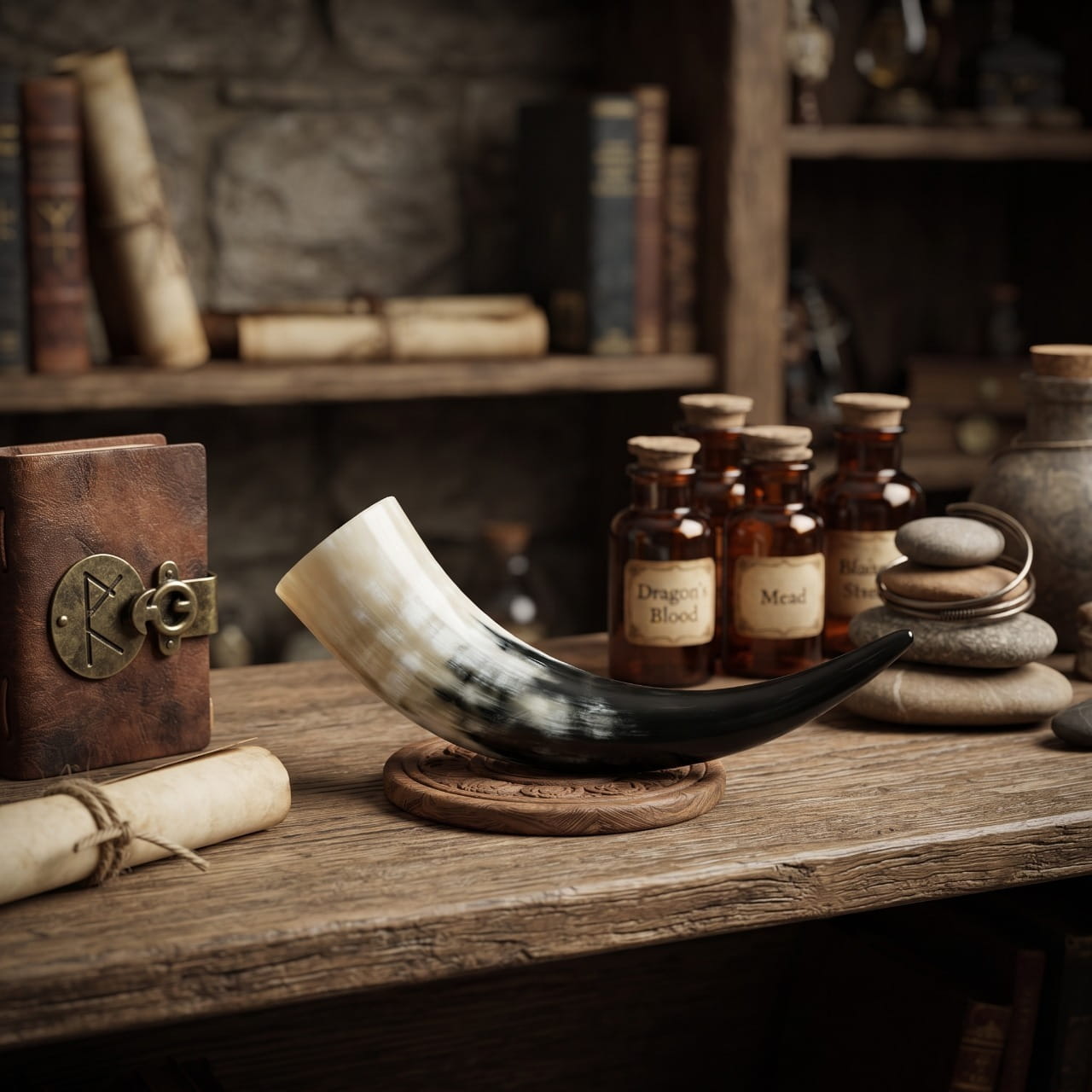
This collection brings together our Viking drinking horns and mugs. Ox horn, light or dark buffalo horn, yak horn, horn-shaped blown glass: most of these are pieces made from real natural materials, shaped and polished by hand. This changes everything—the object, its maintenance, and even how its capacity is stated.
Why capacity is given as a range
You will notice that many of our horns do not show a precise number but an interval: "420 to 480 ml", "501 to 550 ml", "300 to 400 ml". This is not commercial imprecision; it is the direct consequence of the material.
A horn grows on an animal. Its curvature, thickness, diameter at the base, and length vary from one beast to another, and no workshop can make them identical without machining them to the point of denaturing them. Two horns from the same batch can differ by several tens of milliliters. We prefer to announce the actual range rather than an average capacity that half the pieces would not meet.
| Capacity | Equivalent | Usage |
|---|---|---|
| 380 to 410 ml | half a liter | table horn, held in one hand |
| 420 to 500 ml | half a liter | the most common format |
| 500 to 700 ml | more than a pint | banquet horn, placed on a stand |
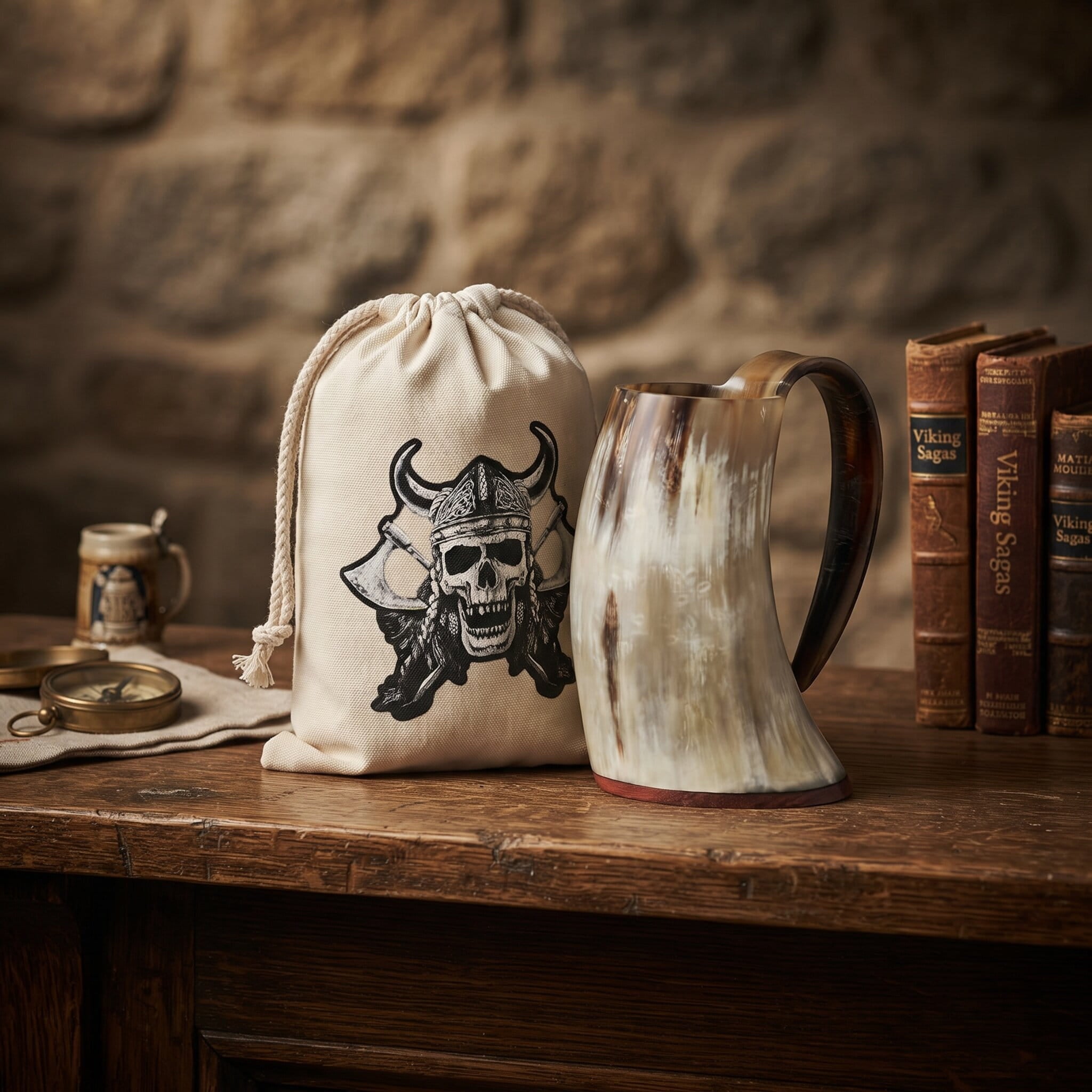
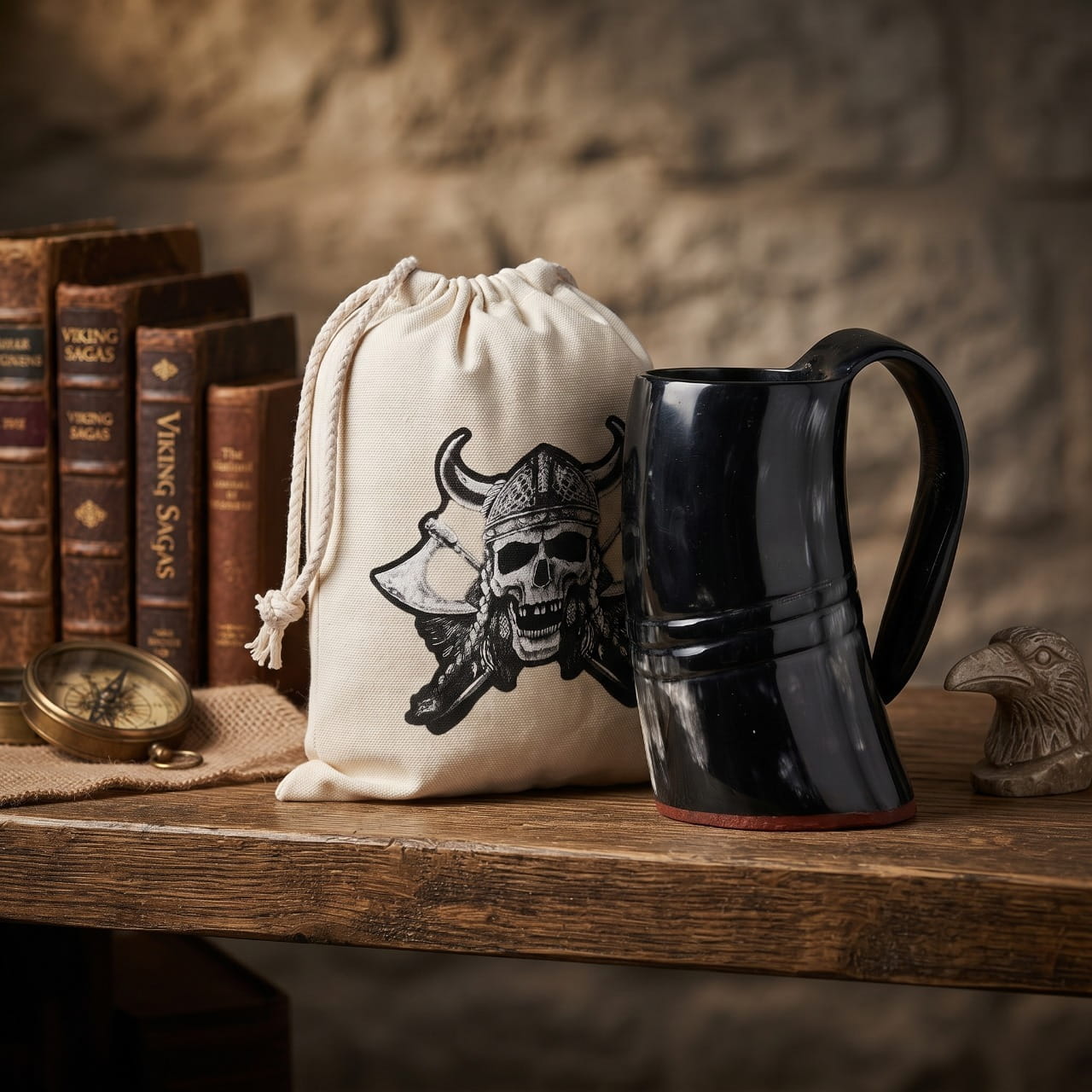
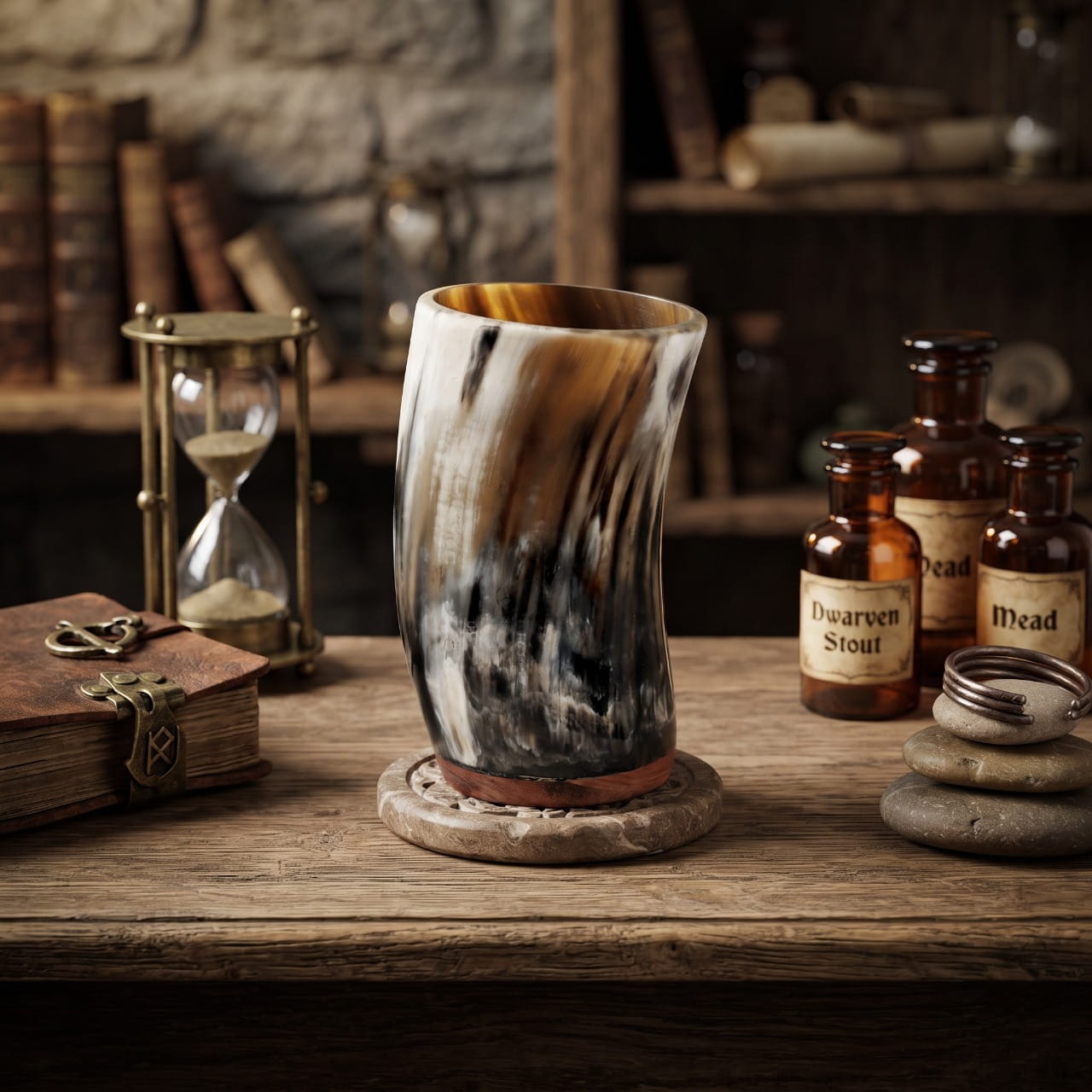
The same logic applies to the color: a light buffalo horn leans toward ivory with amber veins, while a dark horn turns brownish-black with translucent areas. These marblings are not an applied decoration; they are the animal's growth streaks. None of our horns is identical to the one in the photo—it will look like it, without being a copy.
Maintenance: the rule of natural horns
This is the part you must read before buying, because a poorly maintained horn will warp or crack, and none of this damage is repairable.
Never use hot water. Horn is keratin: above about forty degrees Celsius, it softens and deforms. Rinse with cold or lukewarm water, never boiling. Never use a dishwasher, which combines everything it hates: heat, steam, and alkaline detergents. No hot drinks either, for the same reason—the horn is made for beer, mead, and cider, served chilled.
After use, rinse and dry immediately, tip down, and never let a residue of drink stagnate overnight. Two or three times a year, apply a drop of neutral food-grade oil to the inside with a cloth: this nourishes the material and prevents it from drying out. Finally, if your new horn gives off a slight odor in the first few days—which is common and normal—a rinse with cold water mixed with baking soda or lemon juice will make it disappear.
The drinking horn: the object and its history
Of all the Viking objects sold today, the drinking horn is the one whose ancient use is best documented—and by far the most interesting. It was not just one container among others: it was the instrument of a ceremony.
What archaeology has revealed
A problem arises immediately: horn is keratin, and keratin decomposes. What lasts through the centuries are the metal fittings—the mouthpiece, the tip, the reinforcing bands—found alone in graves, drawing the outline of the vanished object.
The most spectacular pieces come from England. The Sutton Hoo burial yielded horns mounted with gilded silver, fashioned from aurochs horns—the wild ancestor of our oxen, which disappeared in the 17th century—the capacity of which is estimated at several liters. Obviously, one did not drink that alone: the horn was passed around.
On the Scandinavian side, the picture stones of Gotland show the scene recurrently: a woman standing, handing a horn to an arriving rider. It is the image of welcome par excellence, and it has fueled the iconography of the valkyries receiving warriors—a motif detailed in our dossier on the valkyries of Odin.
Drinking was not just drinking
The Nordic banquet had its rules and a name: the sumbl. One did not drink freely; one drank in turn, reciting formulas. Three usages stood out.
The minni, the memory cups, raised to the gods—to Odin for victory, to Njörðr and Freyr for a good year—then to deceased relatives. The bragarfull, the "oath cup": the one who took it had to publicly announce a feat they pledged to accomplish. A word spoken over the horn was as binding as a written contract. Finally, during a funeral banquet, the heir only formally took possession of the paternal property after having emptied his father's cup and sat on his seat: the gesture made the succession.
A practical consequence follows, and it explains a habit that still intrigues: most horns do not stand upright. This is not a design flaw. A horn that is set down must be empty—so you drink it in one go, or you pass it. The object imposes its own ritual. Regarding what happened to the drinker afterward, our article on Valhalla describes the hall where mead flows endlessly.
Ox, buffalo, and yak horn
Our models are divided into three materials, and the differences are visible to the eye.
Ox horn is the closest to what the Scandinavians used: relatively thin walls, a tint ranging from honey to brown, moderate curvature. Buffalo horn provides the most contrasted pieces—the light version leans toward ivory with amber veins, the dark version turns brownish-black with translucent areas when held against the light. Finally, yak horn comes from the high mountain plateaus: thicker walls, denser material, and a more rustic look.
In all three cases, it is the same substance—keratin, exactly the same as your nails and hair. This explains all its behavior: it is lightweight, insulating, and rot-proof, but it softens in heat and dries out if neglected. A well-treated horn lasts for decades; a horn put in the dishwasher is lost in one cycle.
The horn-shaped glass
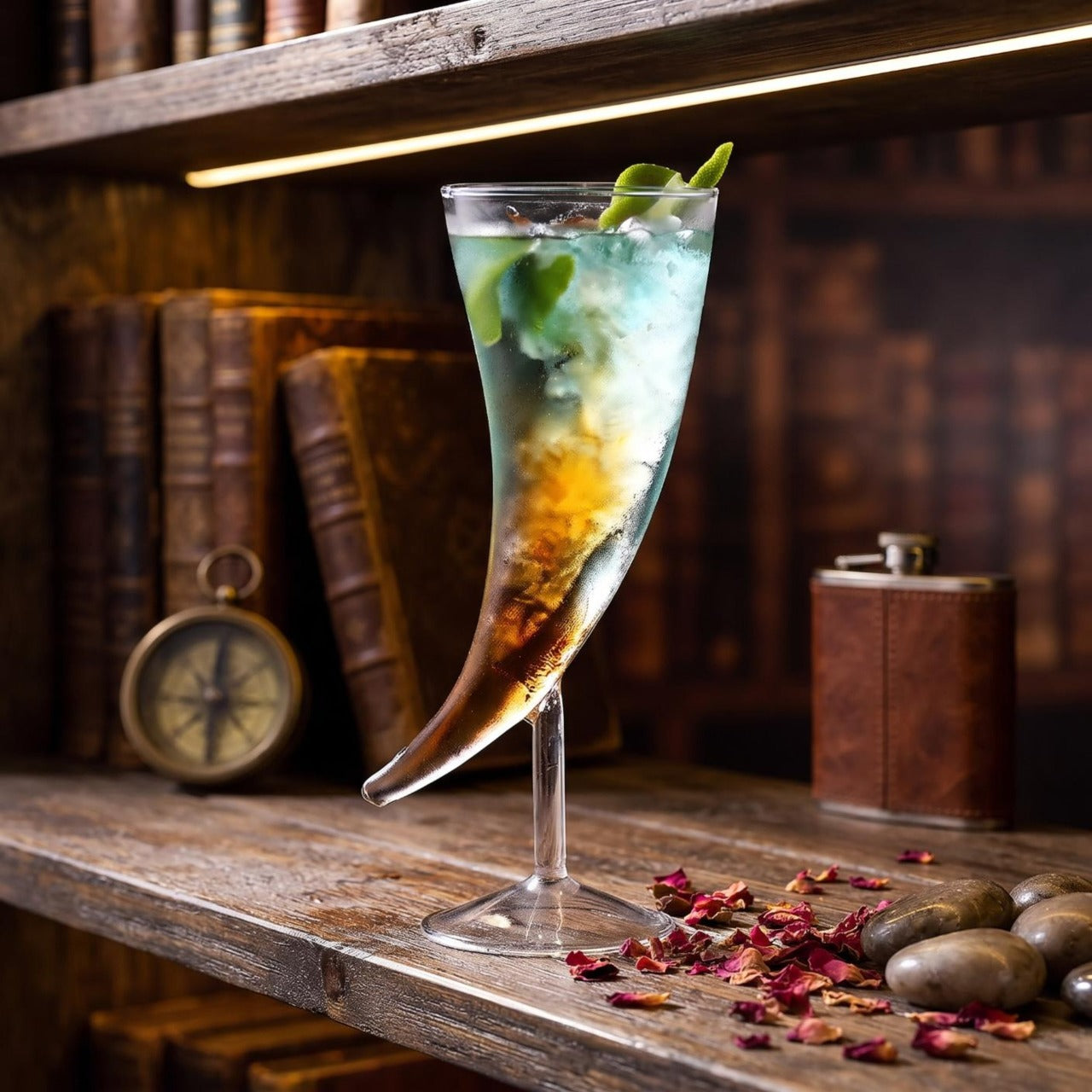
The blown glass model might seem like a modern invention. It is not. Frankish glass workshops produced glass drinking horns as early as the Merovingian period, as well as conical or gadrooned goblets that also could not be set down. These pieces were exported far to the north and are found in Scandinavian graves: glass was a luxury item brought from afar, reserved for the wealthiest.
In other words, choosing glass rather than natural material is not a betrayal—it is embracing the other branch, the prestigious branch, of the same tradition. With a modern advantage: you can see the drink, and the maintenance is that of an ordinary glass.
Sculpted mugs
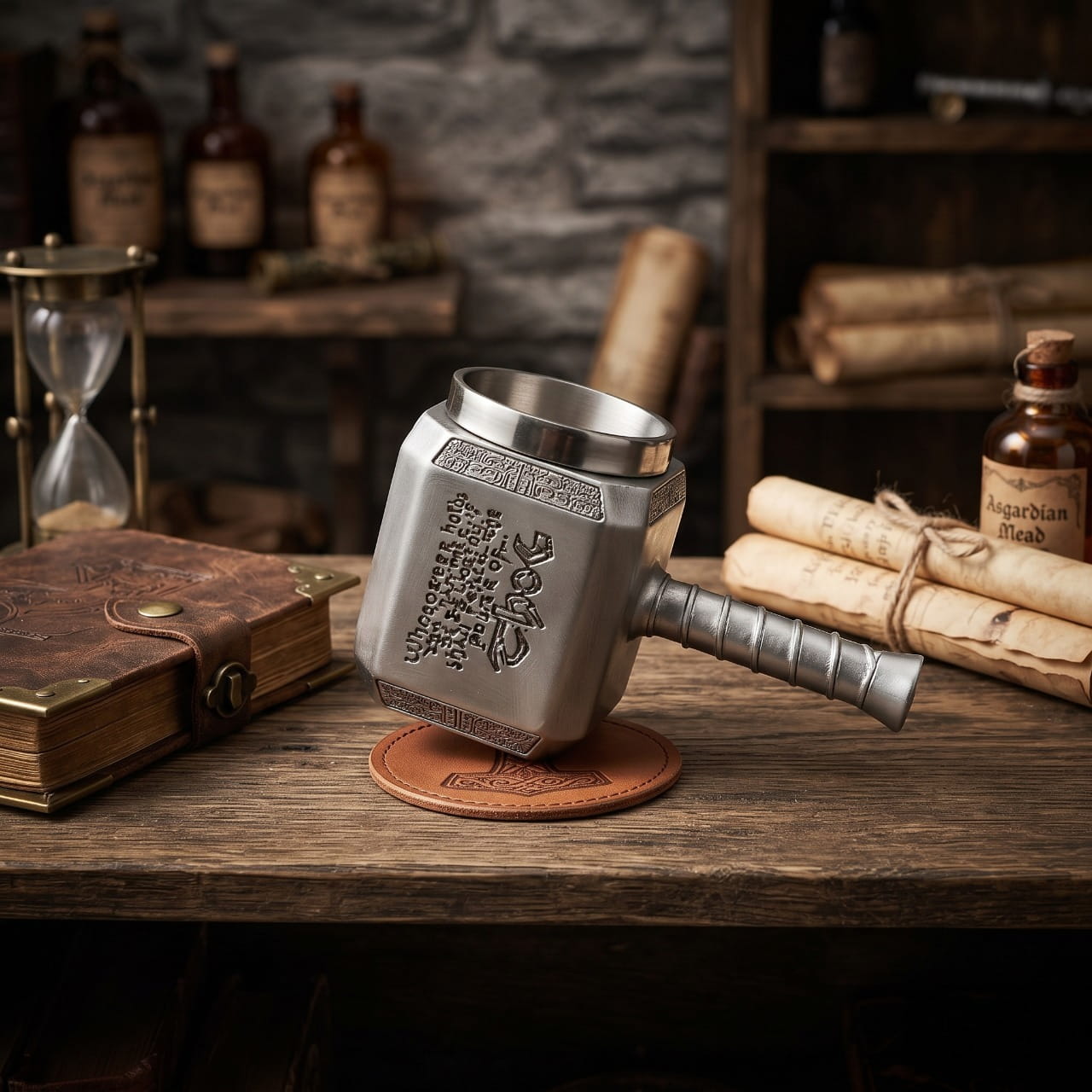
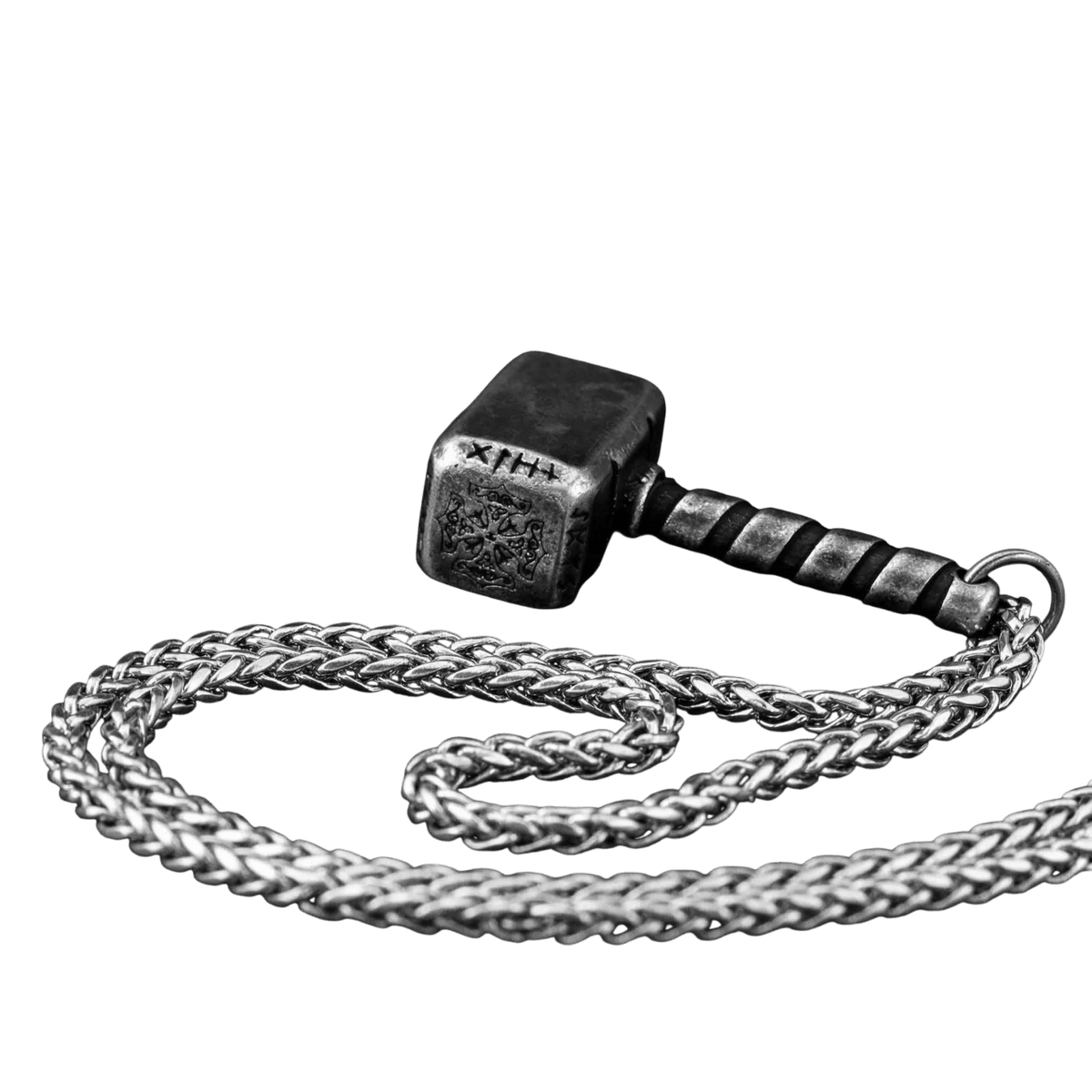
Finally, a few pieces made of molded resin, including a Thor's hammer with a built-in bottle opener, built like our tankards: a decorative shell and a food-grade 304 stainless steel cup inside. These are not horns and do not pretend to be. Their appeal is different: no maintenance constraints, no capacity variation, and the possibility of a sculpted design that a natural horn does not allow.
Which horn for which use
The capacity table gives the volume; three questions decide the rest.
Will you really drink from it? This is the first thing to decide, because it separates everything. For real and regular use, the natural horn requires an immediate rinse after each serving—it is little, but it is systematic. If you know you will not do it, the horn-shaped glass or the steel-lined mug will give you the same pleasure without the discipline.
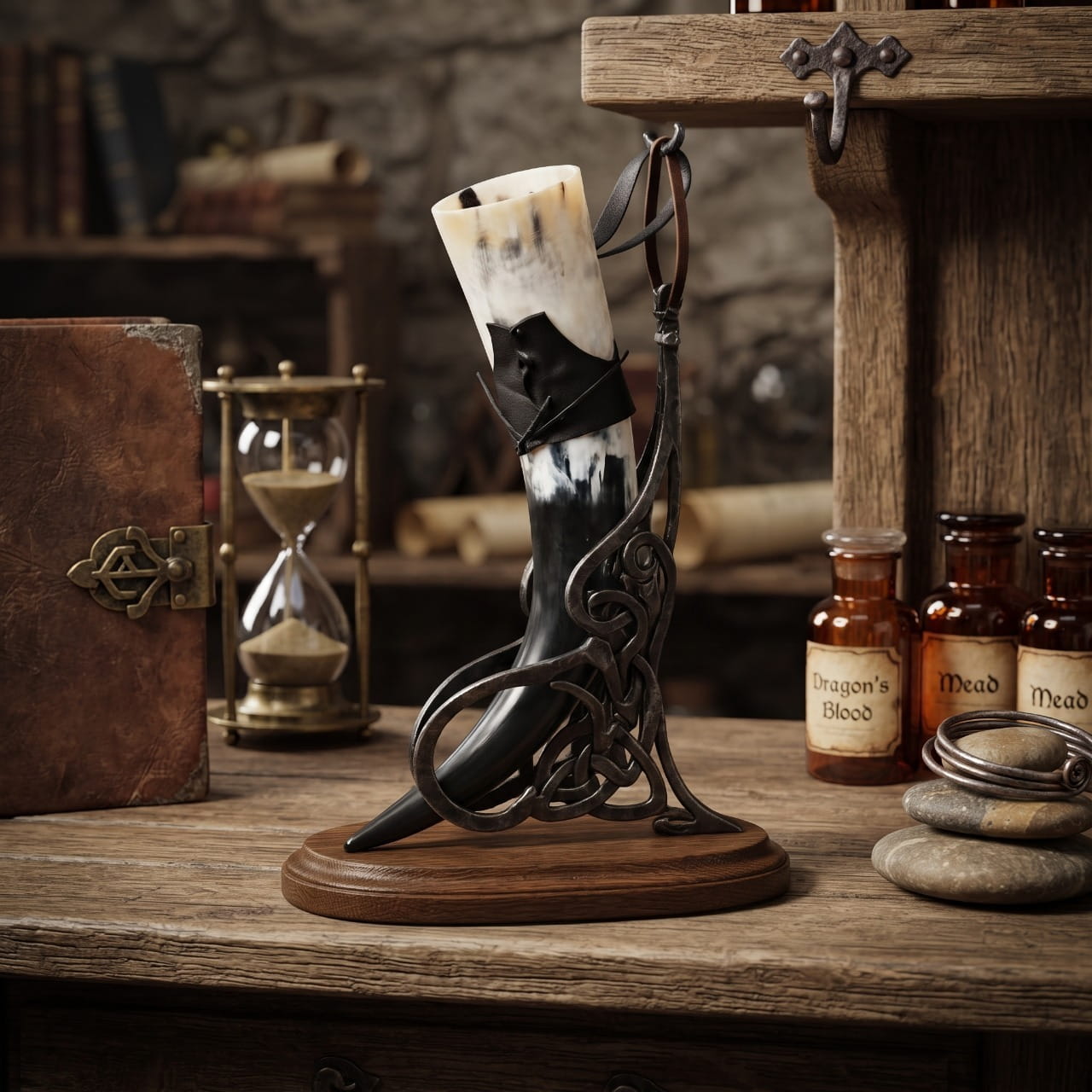
To stand or not to stand. Models mounted on a wooden base can be placed on a table and become everyday objects. Raw horns are placed on a stand or passed from hand to hand—they are made for the banquet table, not the office.
The intended drink. Beer, cider, mead: everything works, served chilled. However, natural horn definitely excludes hot drinks, and it is better to avoid letting a strong, aromatic alcohol age in it, as it will permeate the material. For coffee or tea, look toward a steel-lined mug.
Giving a drinking horn as a gift
It is one of the most striking gifts in the department—it has a story to tell the moment you give it—but it requires a precaution.
Warn them about maintenance. A natural horn given without a word will one day end up in the dishwasher, and it will be lost. One sentence is enough: cold water, immediate drying, never hot. Slip it into the card; it's worth more than a long speech.
Variation is part of the gift. Tint, veining, and curvature differ from one piece to another: the one you are giving exists in only one copy. This is a point to highlight, not hide—many people are sensitive to it.
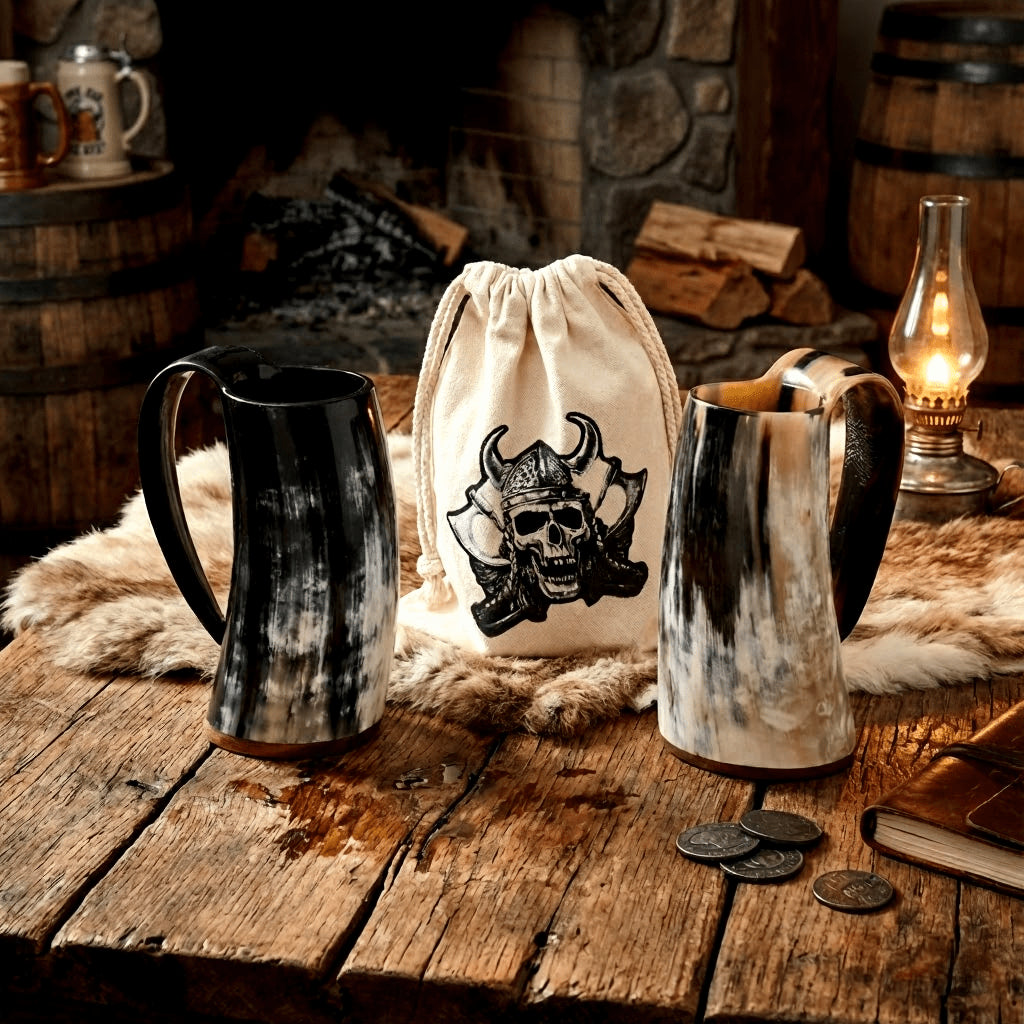
The model with a jute bag is the most complete. It can be carried over the shoulder, stored, and gives the object a use beyond the table—festivals, reenactments, evenings with friends. For a gift where you are hesitating, it is the safest choice in the department.
Frequently Asked Questions
Can you really drink from a natural horn? Yes, that is their use. The inside is polished and treated for food contact. Keep it for cold drinks.
Why is capacity announced as a range? Because horn is a natural material whose dimensions vary from one animal to another. We prefer to announce the actual interval rather than a misleading average.
Will the horn I receive be identical to the photo? No, and that is normal. Tint, veining, and curvature differ from one piece to another. The photo shows a representative example.
Can you serve a hot drink in it? No. Above about forty degrees, the keratin softens and the horn deforms permanently.
My new horn has an odor, is that normal? Yes, it is common for a natural material. A rinse with cold water with a little baking soda or lemon removes it in one or two goes.
Does a horn stand up on its own? Some models are mounted on a wooden base that allows it. Others are placed on a stand or emptied before being set down—which is, incidentally, the origin of the tradition of drinking a horn in one go.
What are the delivery times and costs? Tracked delivery is free for orders over €49, regardless of the country of delivery.
Also explore: discover our Viking tankards, our entire collection of Nordic tableware, and our best sellers. To choose between horn, tankard, and chalice, read our guide to Viking tankards and mugs.