
Filters
22 products
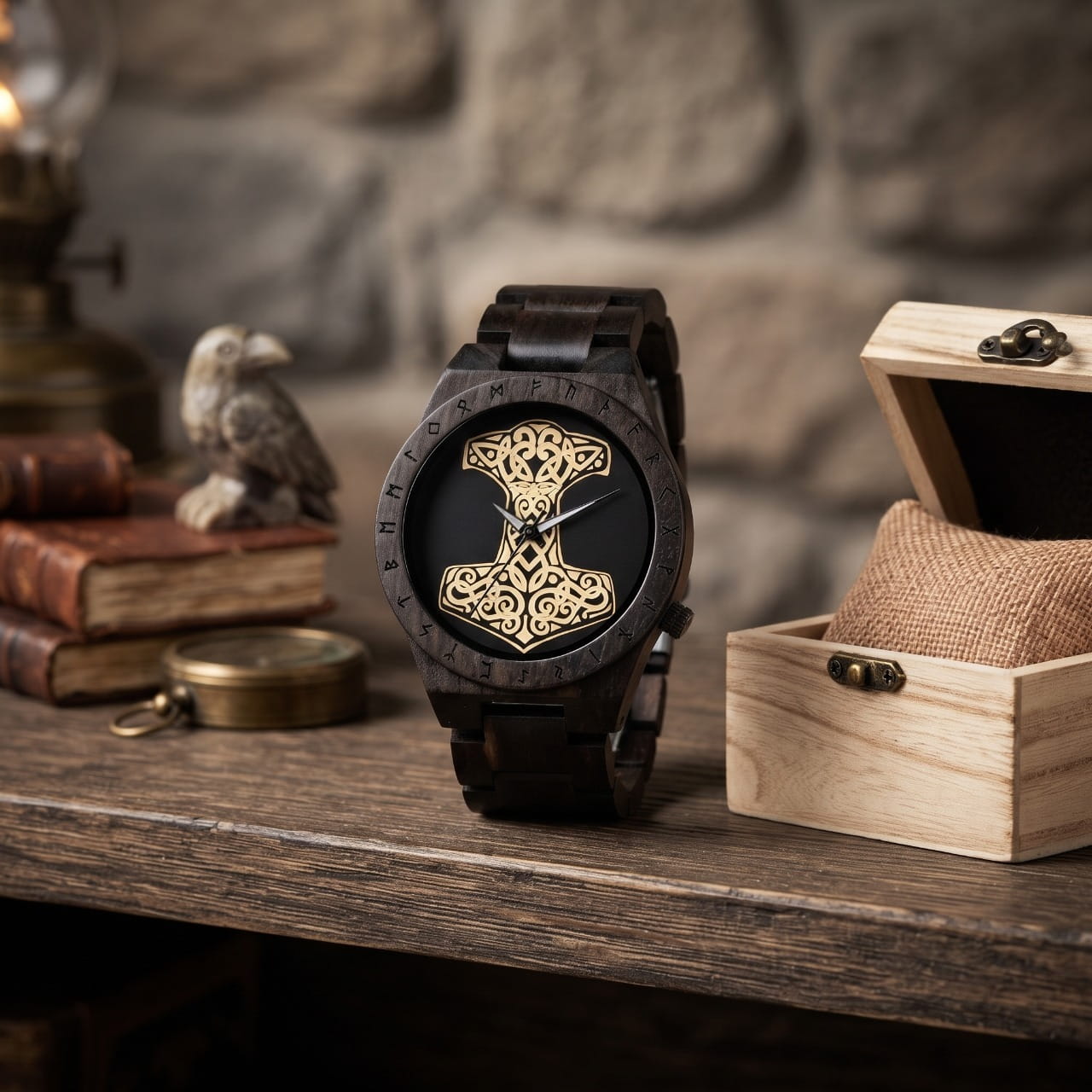
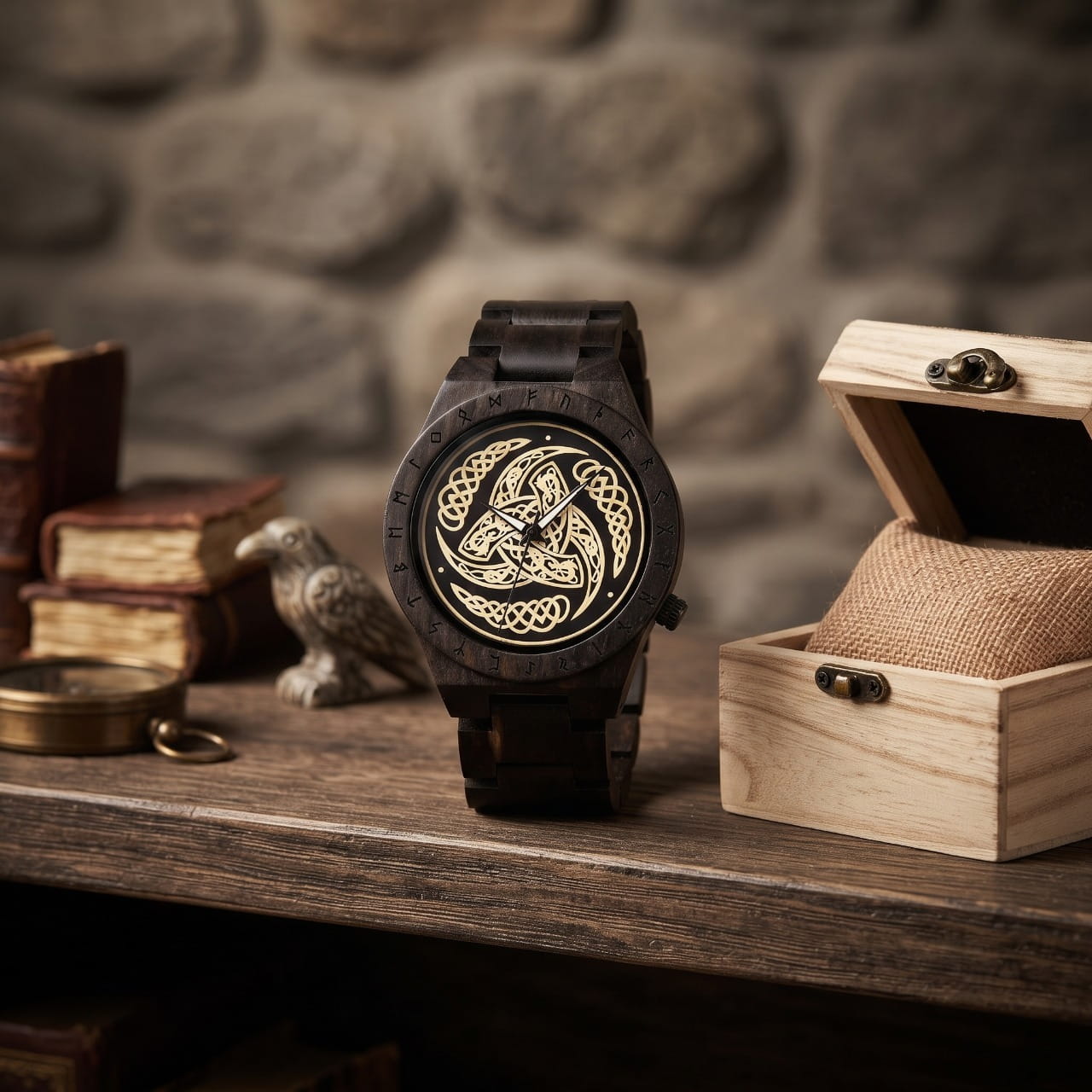
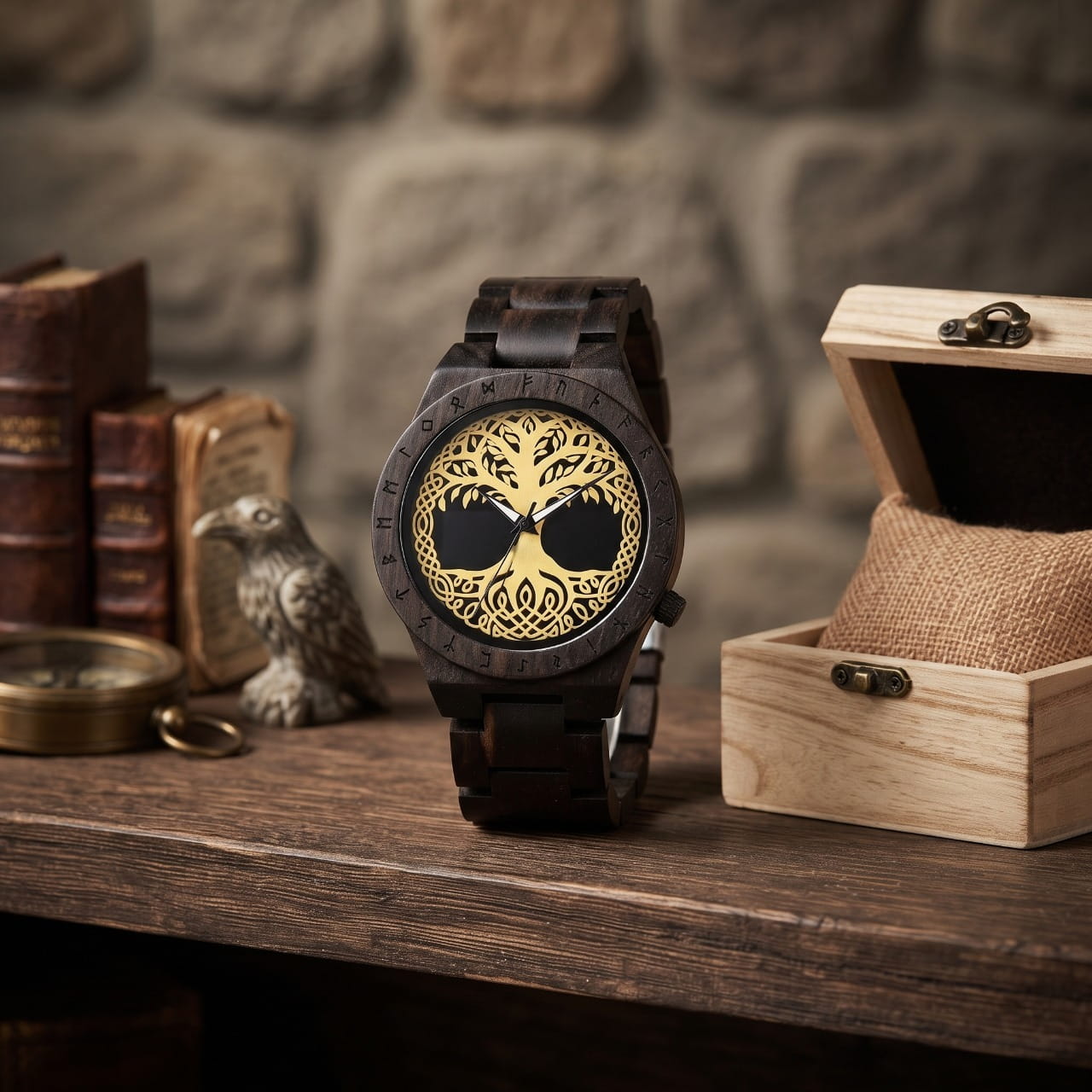
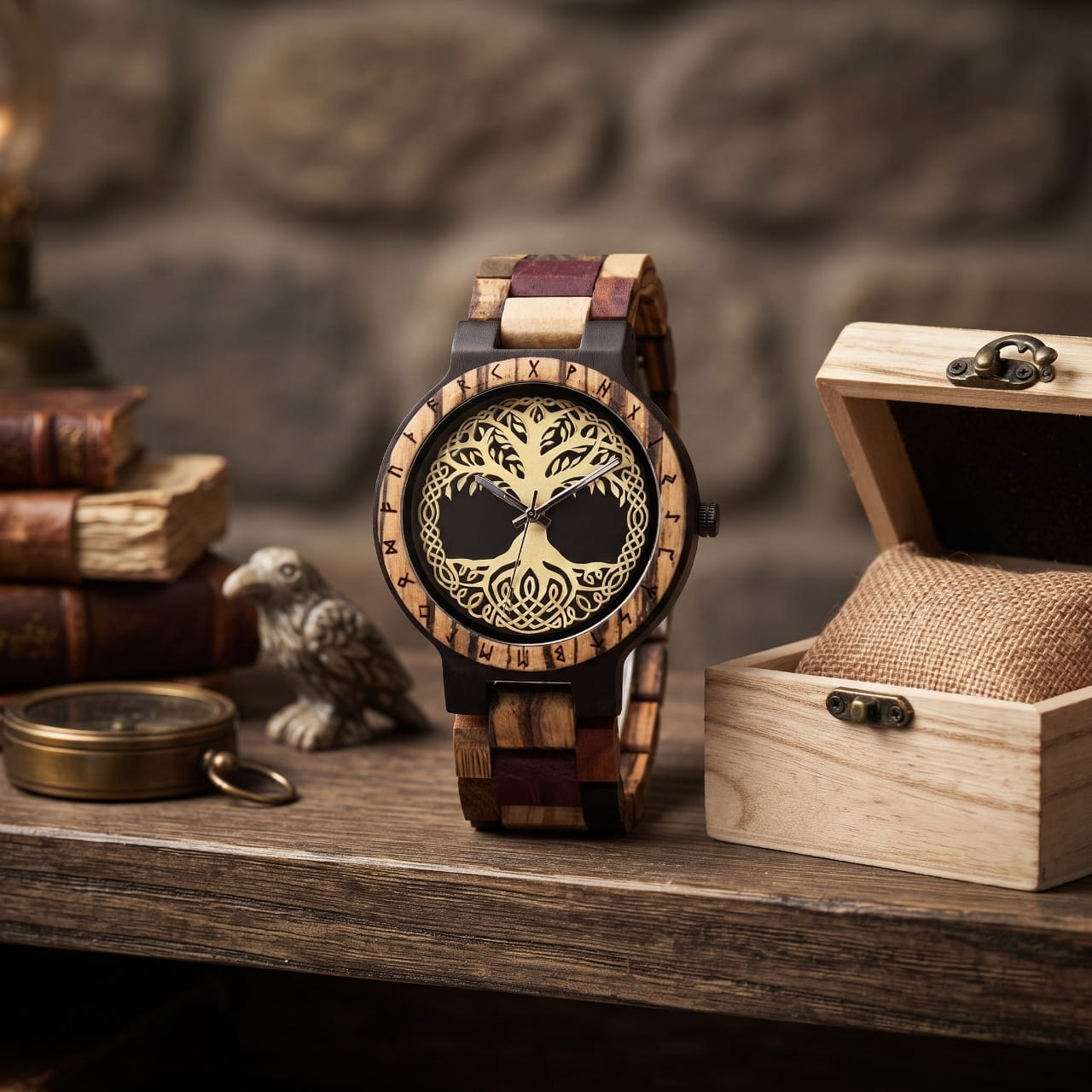

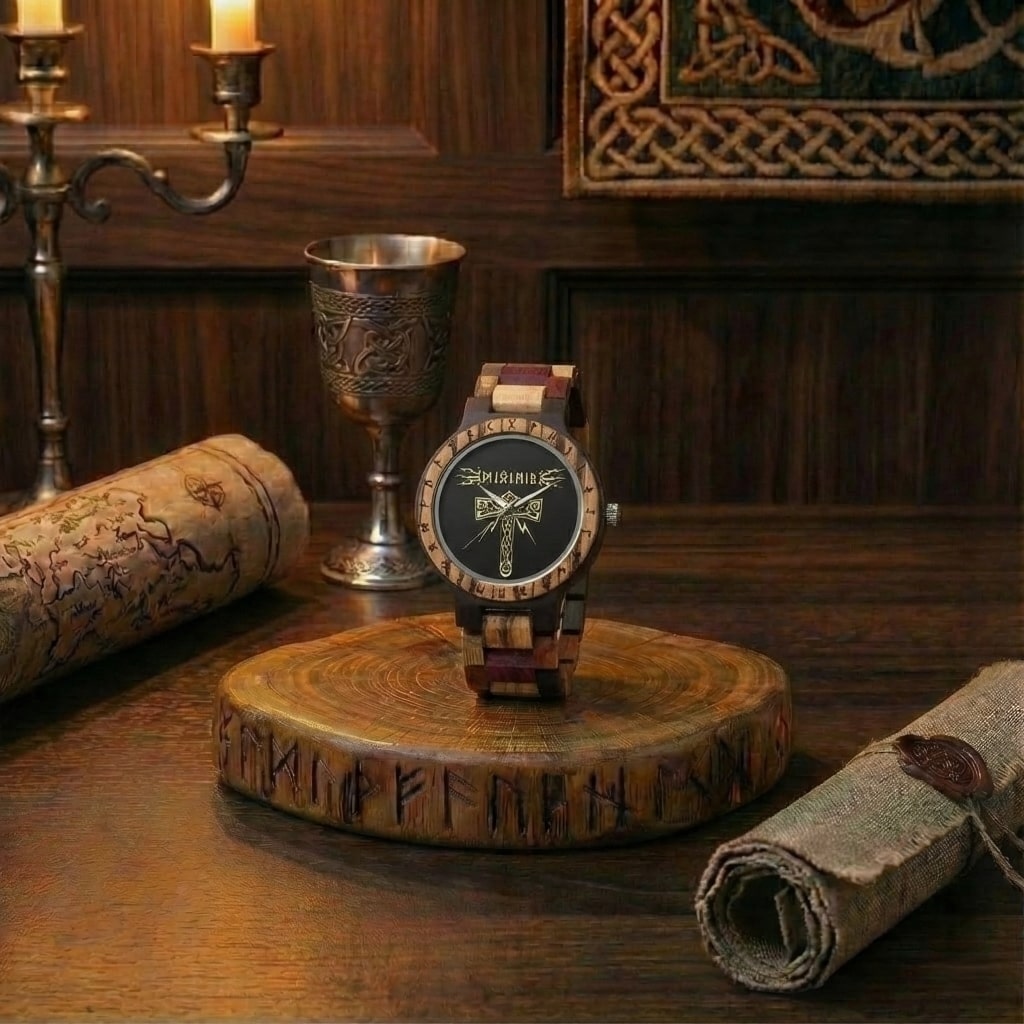
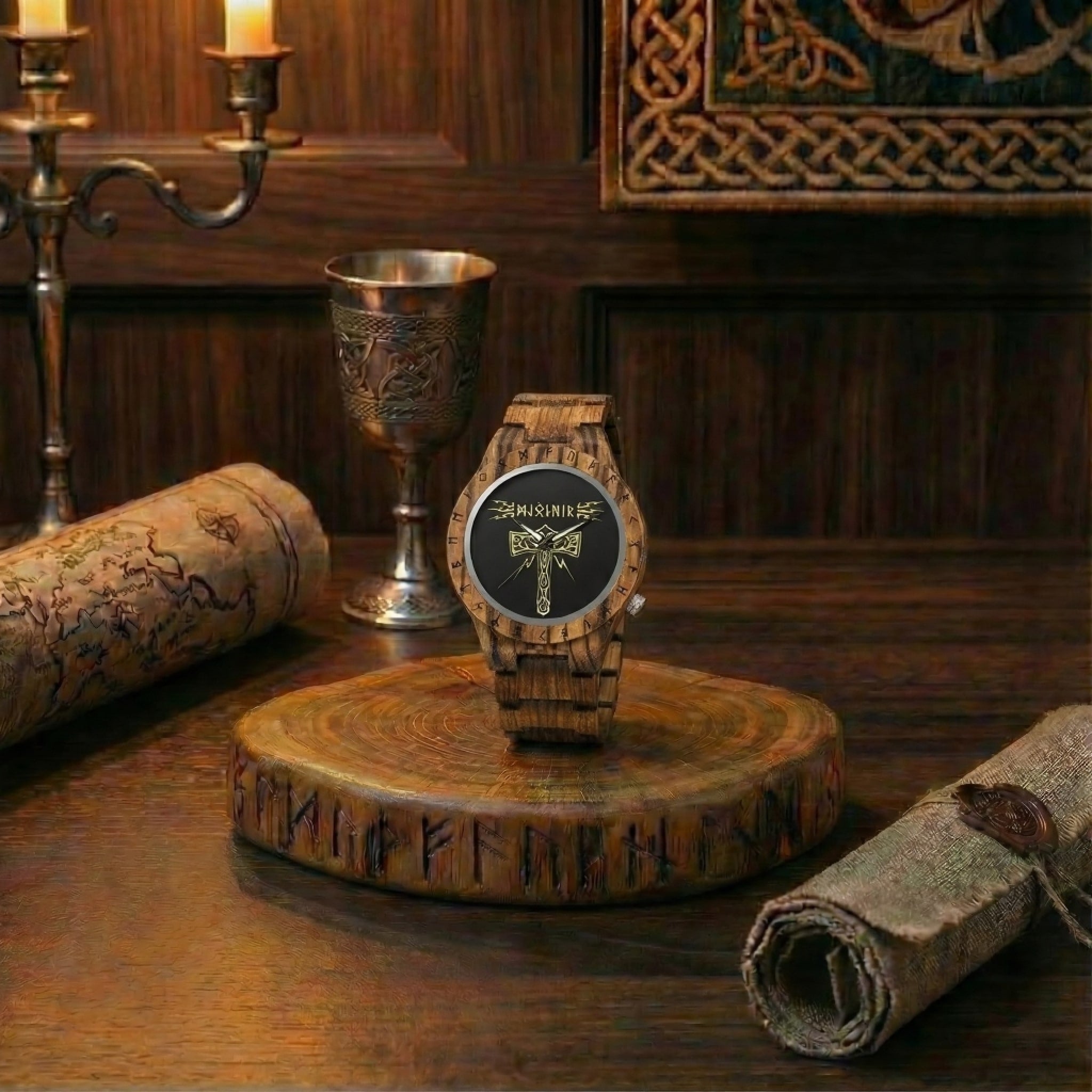
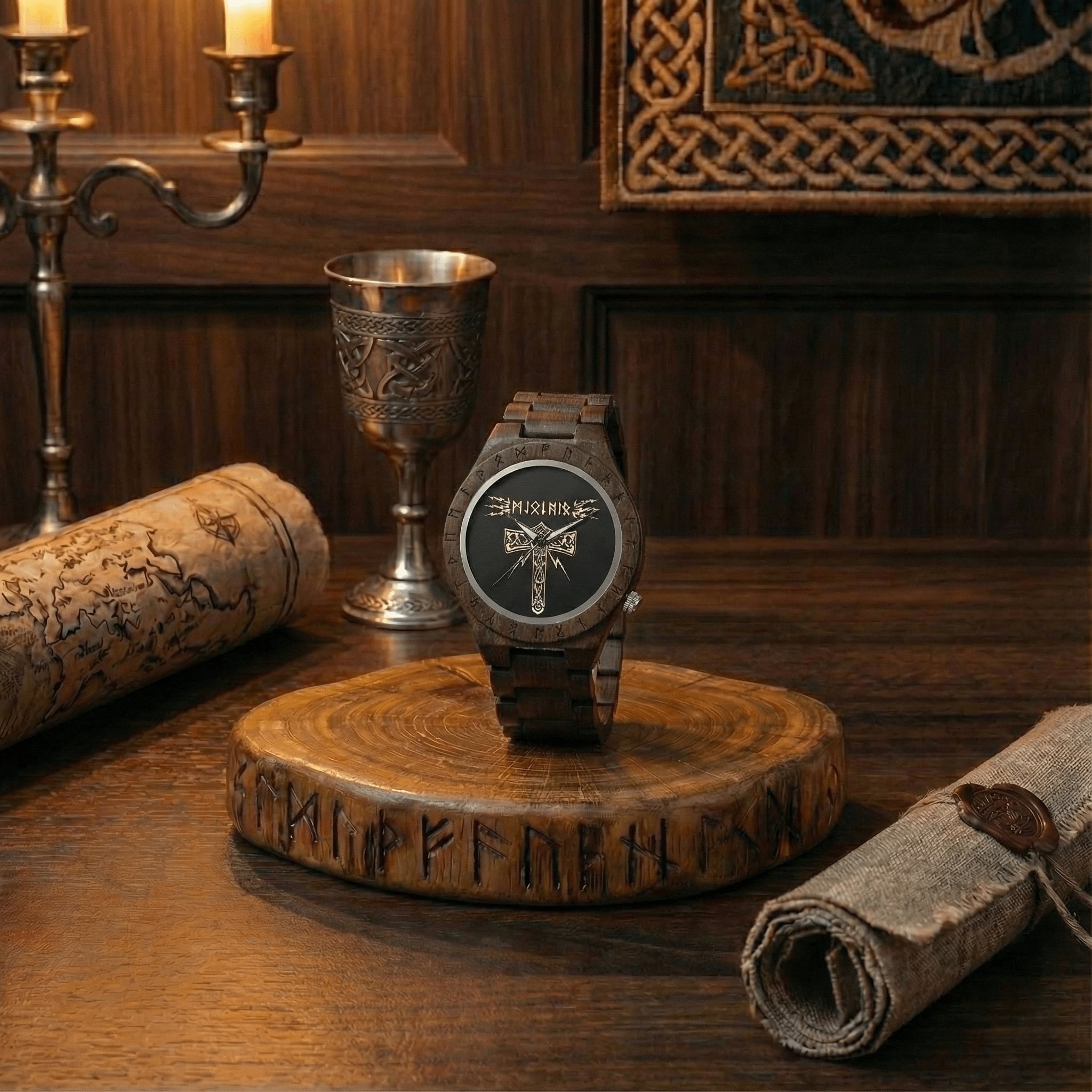
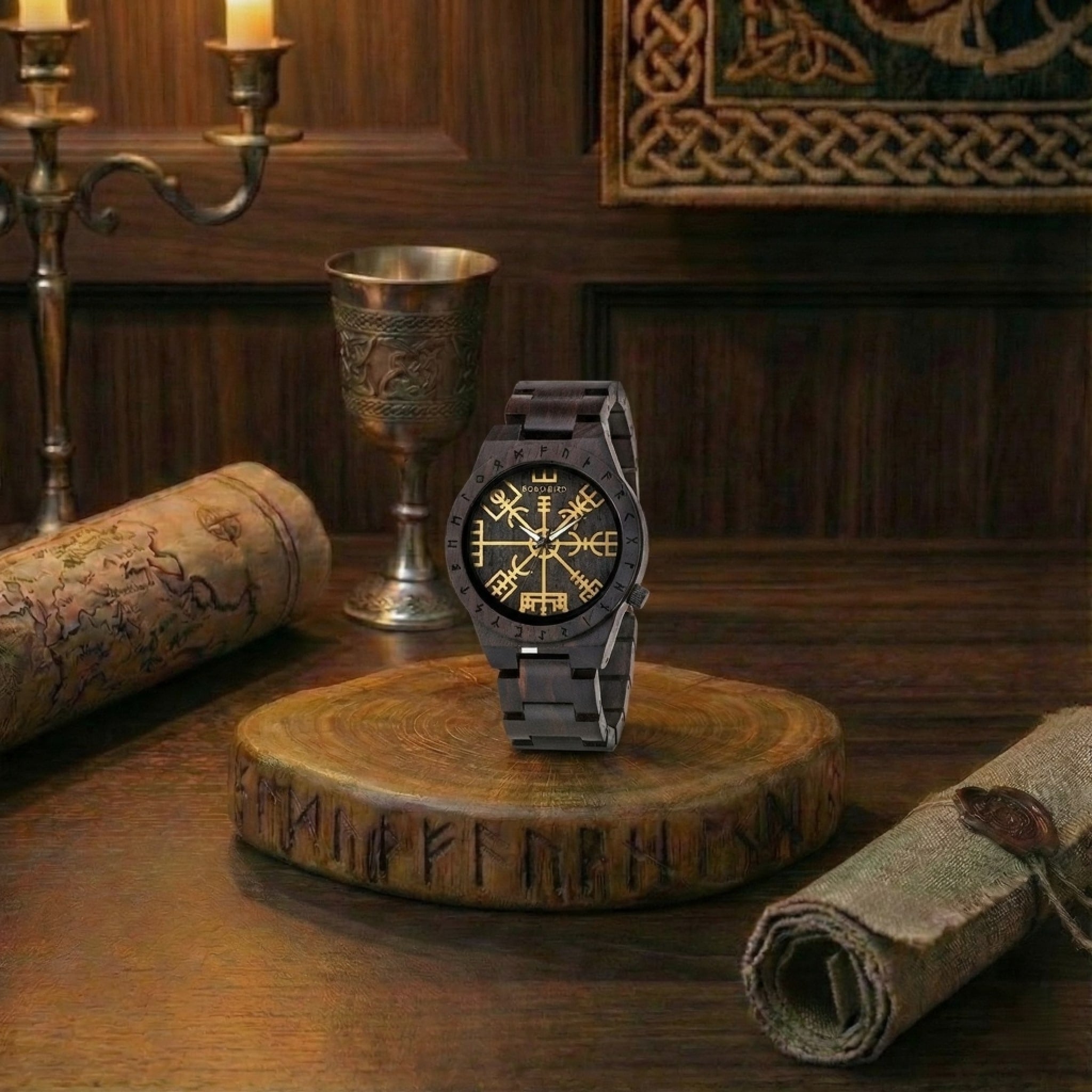
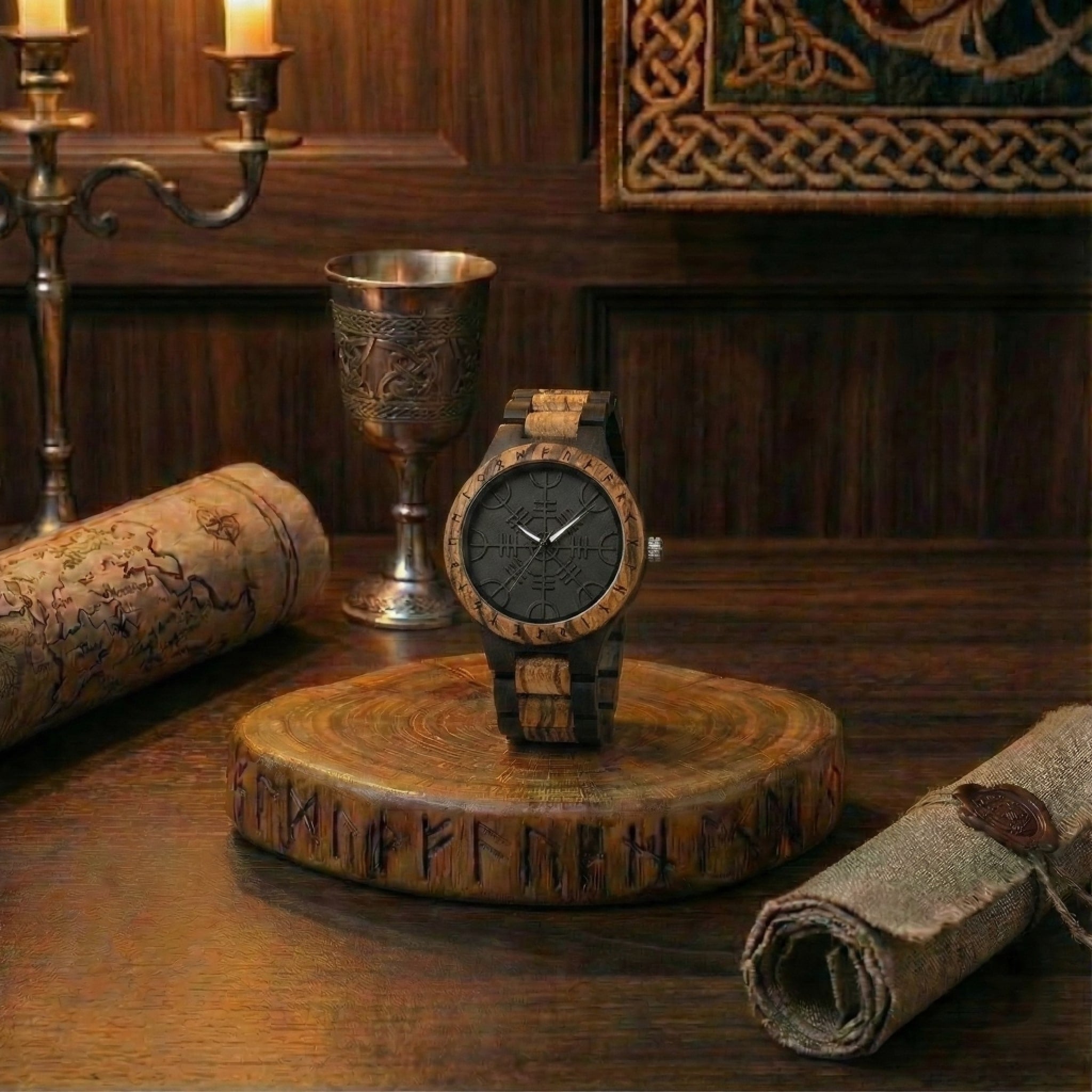
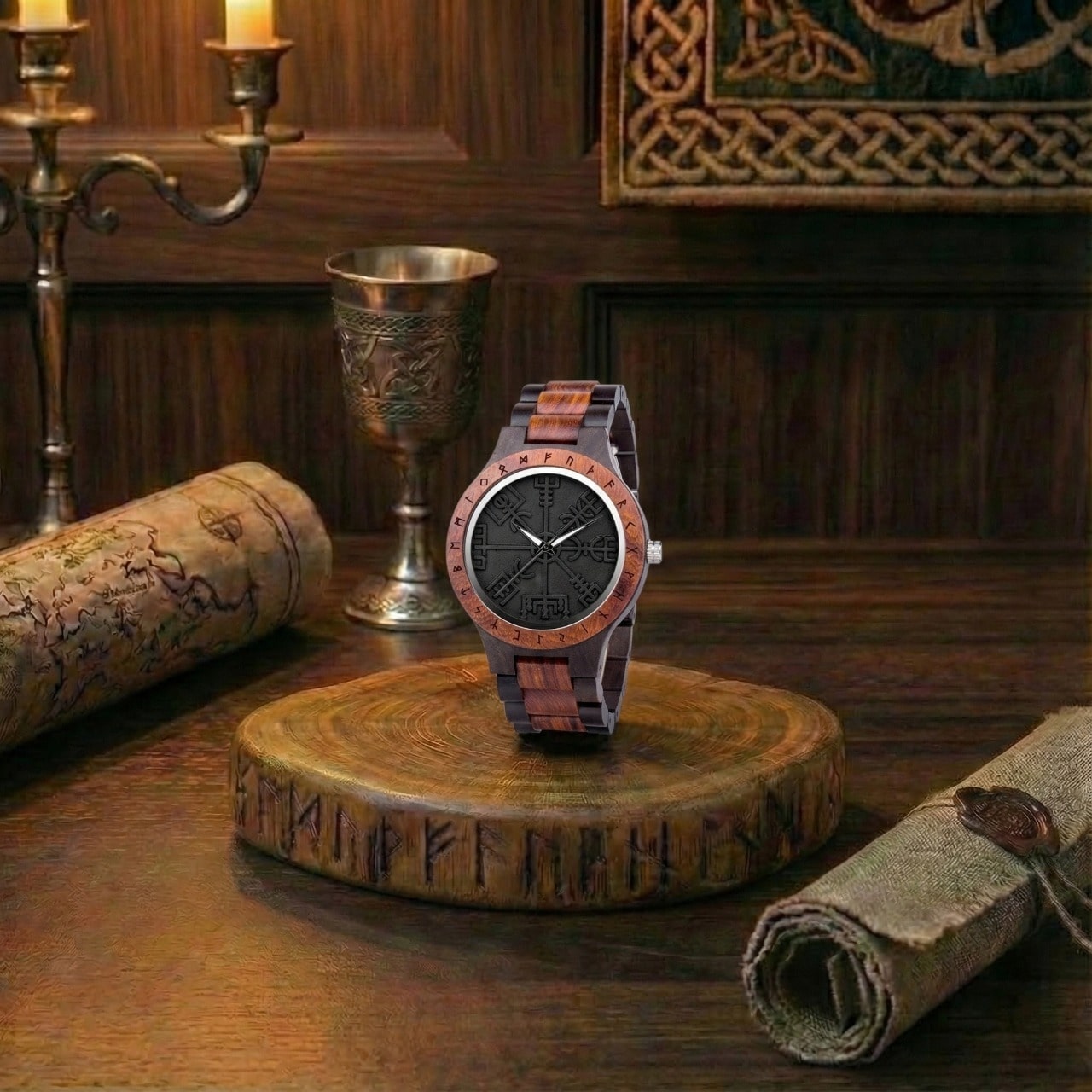
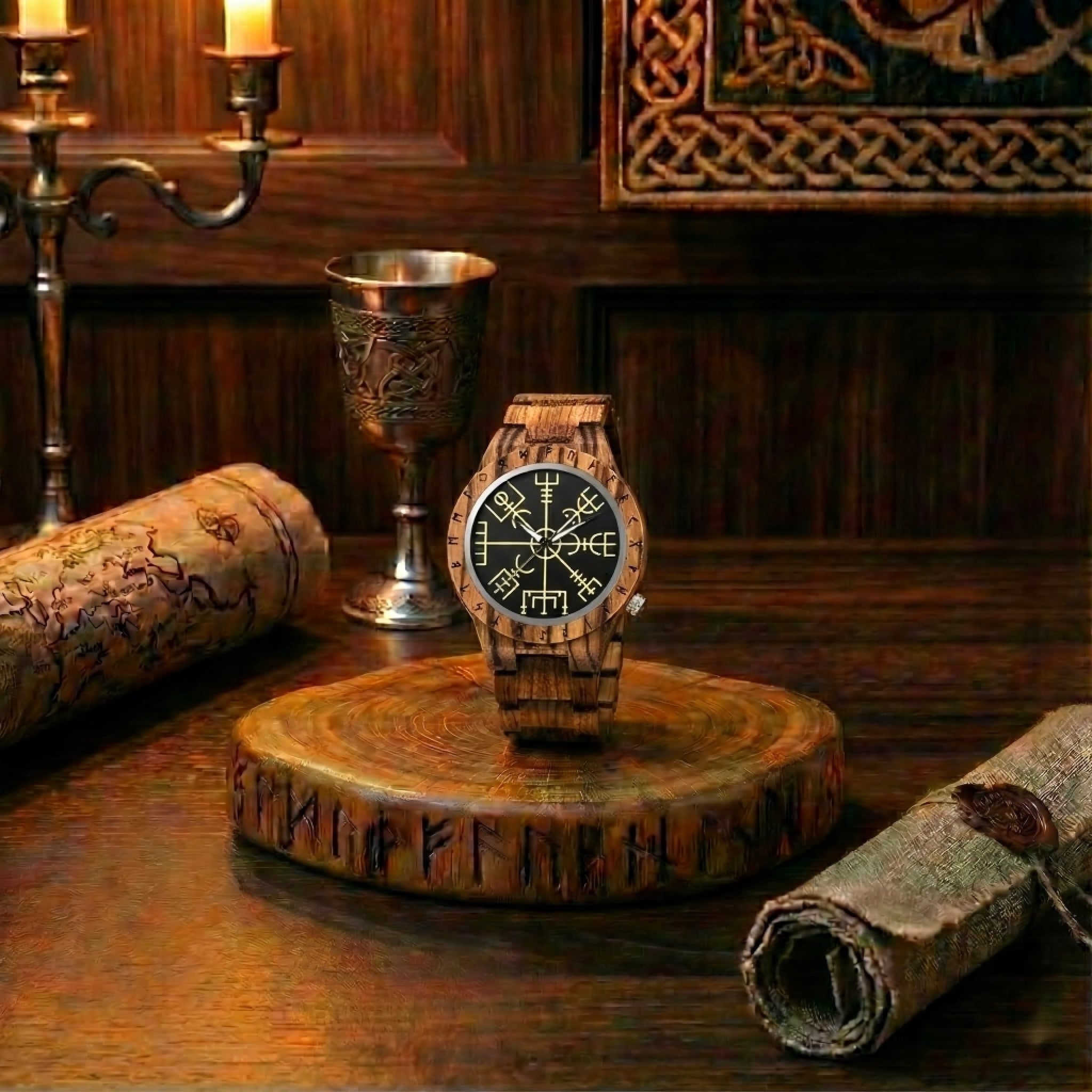
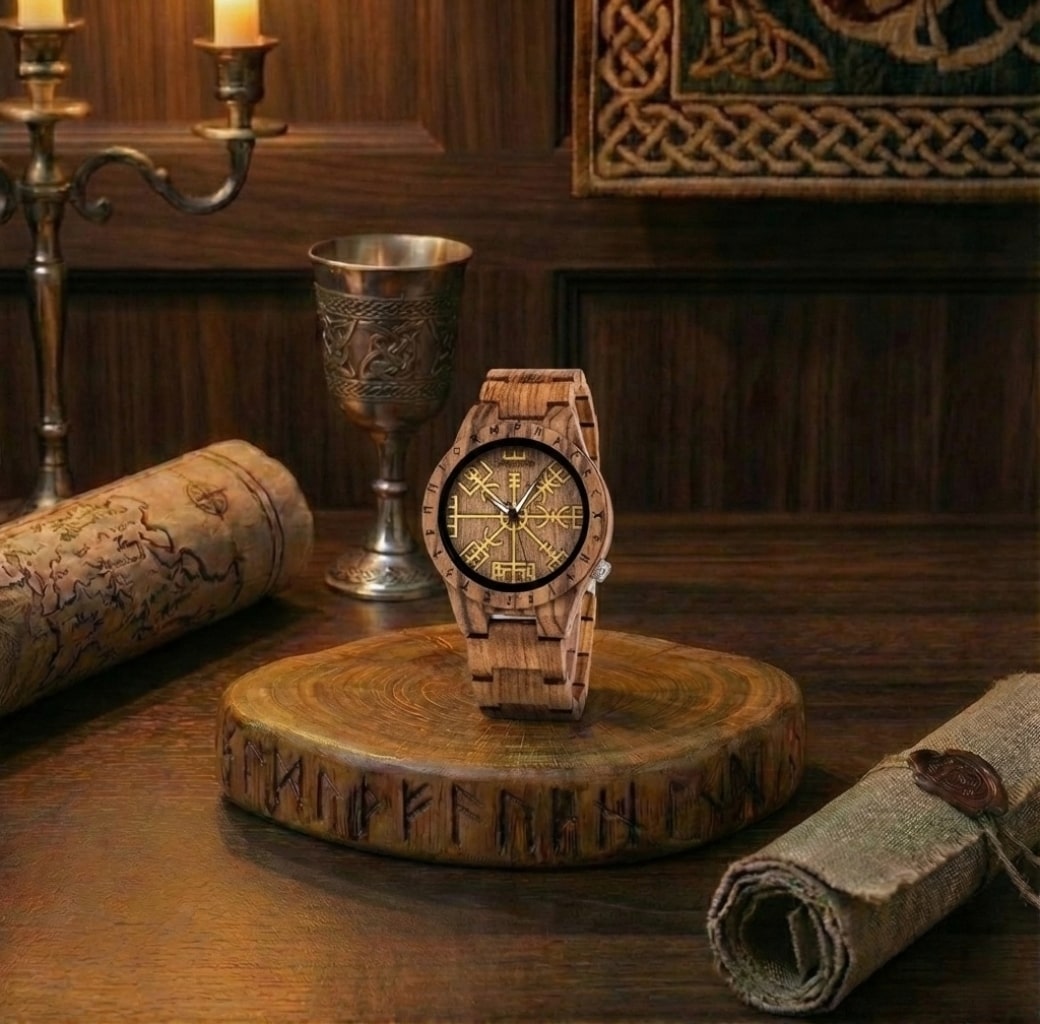
Collections similaires
You would also like
Frequently Asked Questions about our Viking Watches
What movement do your Viking watches use?
Our Viking watches use precision quartz movements, which are reliable and durable. Certain premium models feature automatic (mechanical) movements. The quartz movement offers superior precision and only requires a battery change every 2-3 years.
Are Viking watches waterproof?
Most of our watches offer 3 ATM water resistance, sufficient for hand washing and splashes. They are not designed for swimming or diving. Check the product page for the specific water resistance rating of each model.
What do the symbols on the dials represent?
Our dials feature symbols from Norse mythology: Futhark runes as numerals, the Valknut at the center, the Vegvisir as the main motif, or the Yggdrasil. Each watch is a piece of Viking symbolism for your wrist.
How do I change the battery in a Viking watch?
Visit a watchmaker who will open the case back to replace the battery (type SR626SW for most of our models). The cost is generally between €5 and €10. If you prefer, our customer support can guide you through the process.
Can you wear a Viking watch every day?
Yes, our watches are designed for daily use. The stainless steel case is scratch-resistant, the mineral glass protects the dial, and the strap (leather or steel) withstands everyday wear and tear. It is the ultimate Viking accessory for every day.
Viking watch — en savoir plus
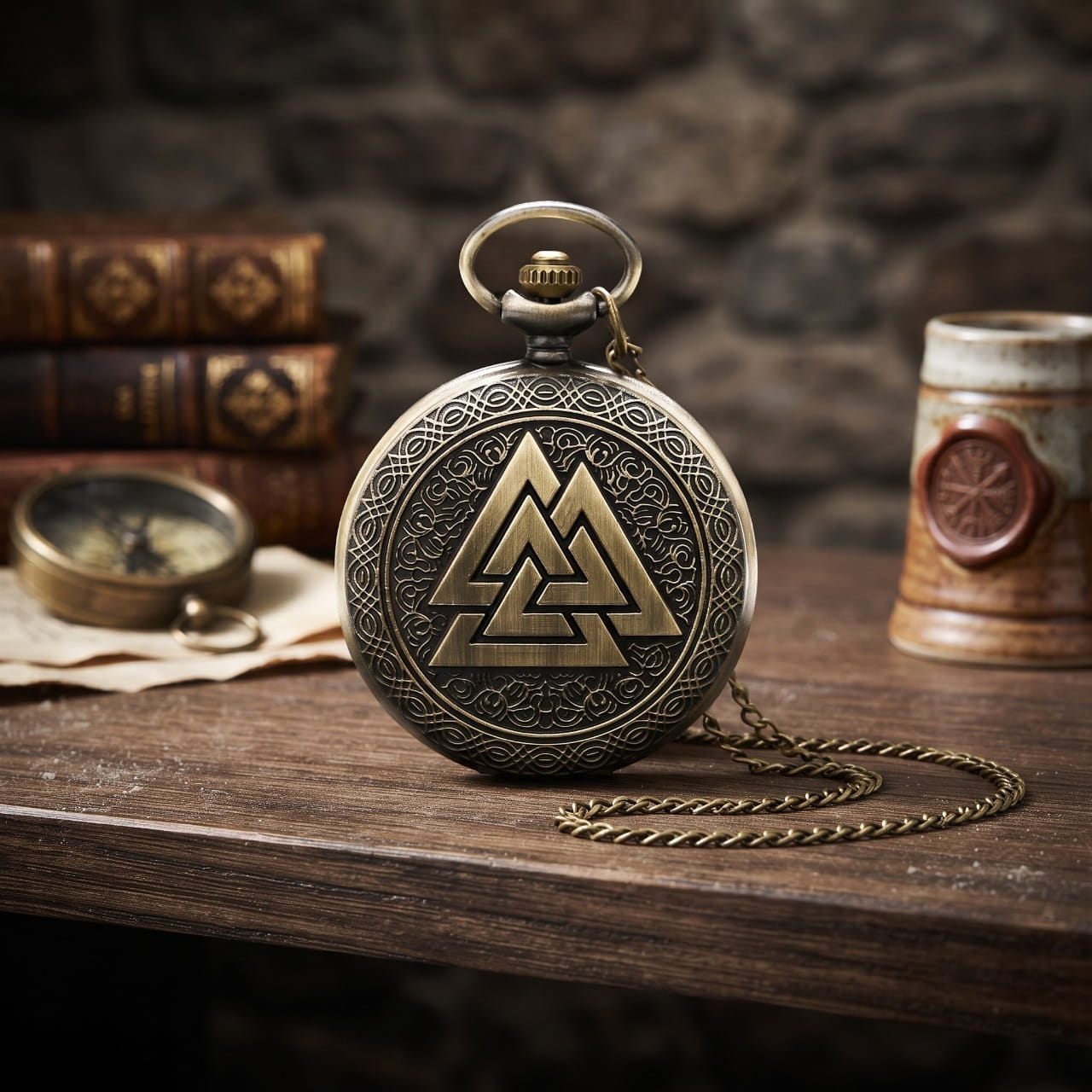
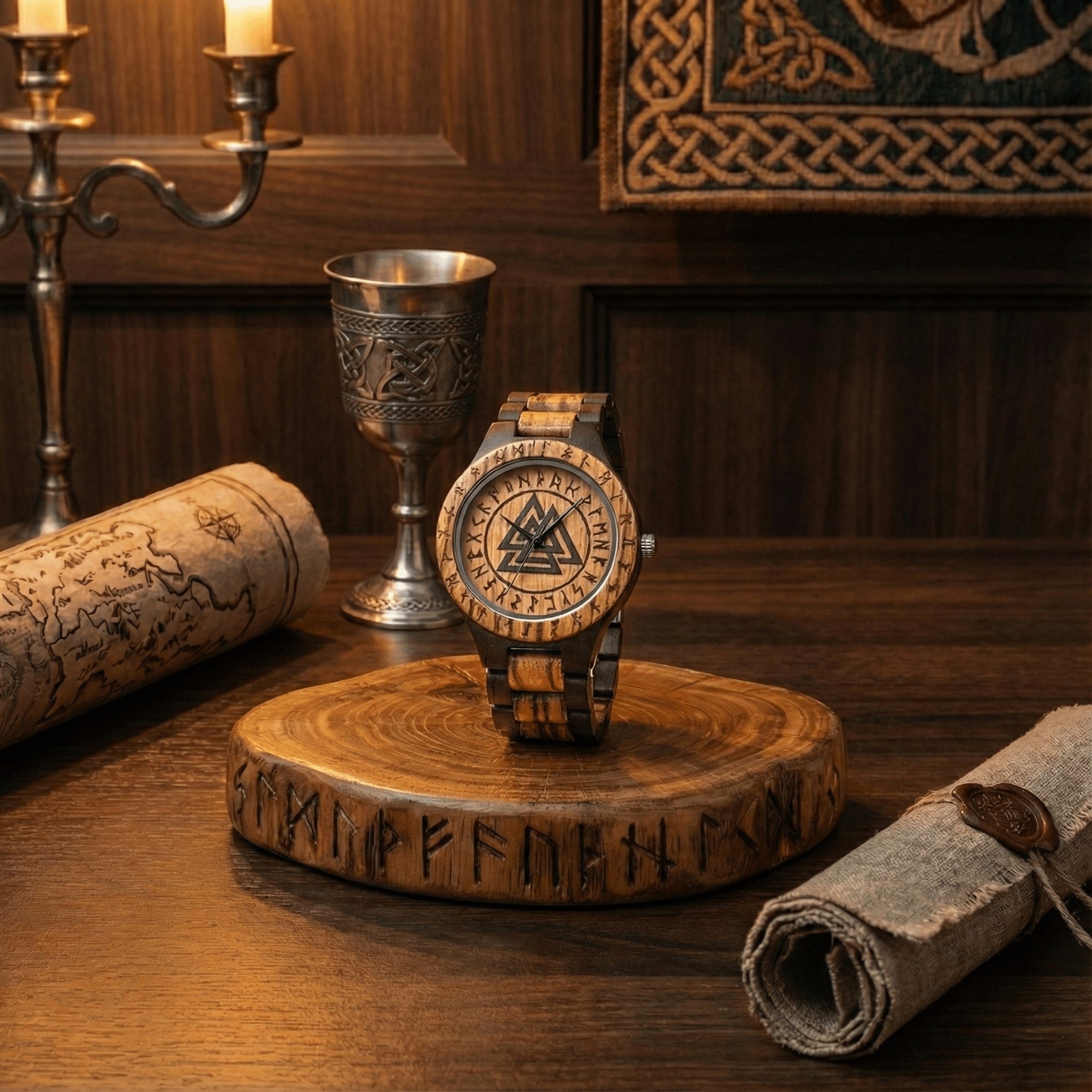
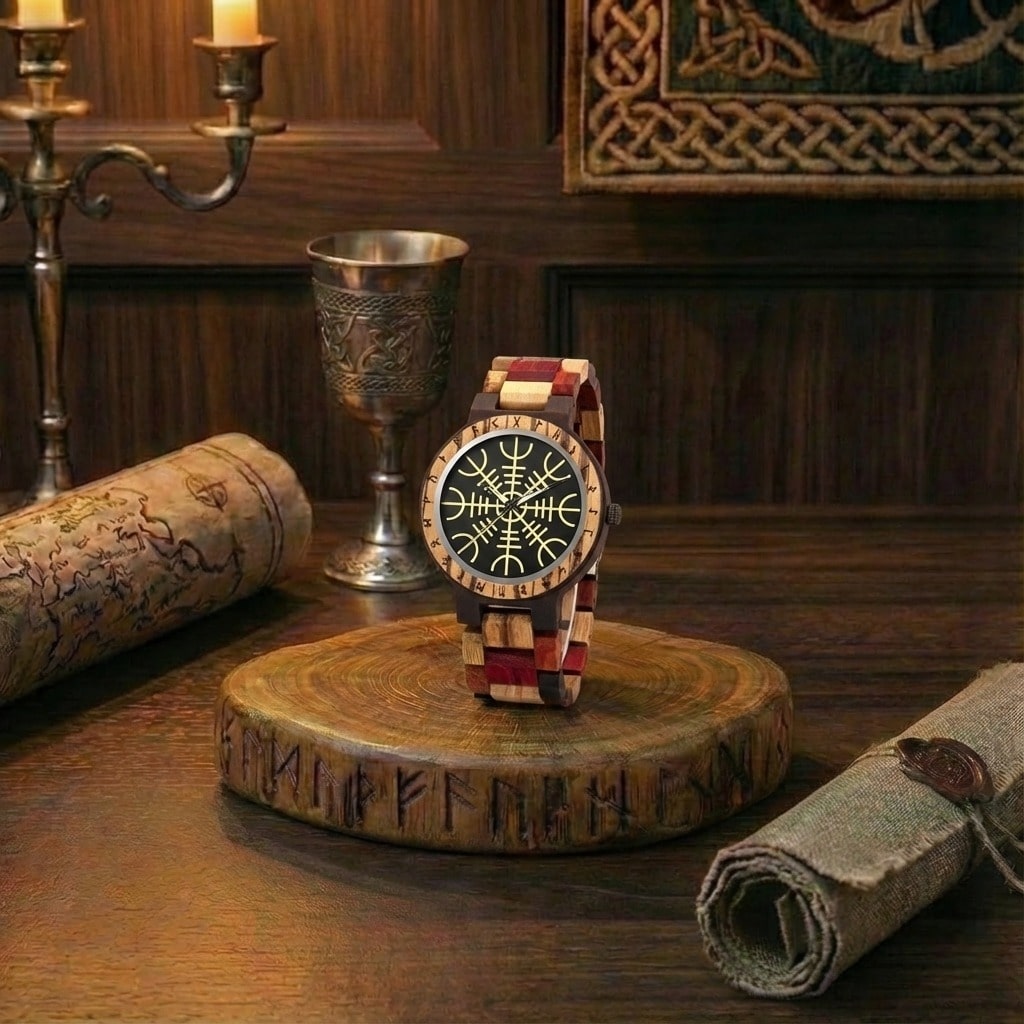
Viking watches with runic dials: real wood wristwatches engraved with a Vegvísir, a Mjölnir, or Odin's face, and pocket watches in steel or antique bronze. All are powered by quartz, and all feature a 44 mm dial.
44 mm: what it looks like on the wrist
The diameter of the dial is the measure that determines the look of a watch, and 44 mm is a large format. This is an intentional choice for this collection: there must be space to engrave a legible Vegvísir or the branches of Yggdrasil. But it is better to know what to expect.
| Wrist size | Look of a 44 mm dial |
|---|---|
| less than 16 cm | clearly imposing, the case overhangs |
| 16 to 17.5 cm | present and visible, a bold effect |
| 17.5 to 19 cm | just right, the ideal format |
| more than 19 cm | perfectly balanced, never small |
To measure, wrap a flexible tape measure around your wrist just above the bone, without tightening it. The wooden strap is shortened by removing links—an operation that any watchmaker can do in minutes, and which can also be done yourself with the tool provided with some models.
Telling time on a runic dial
One question comes up often, and it deserves a frank answer: the runes that replace the numbers on our dials are decorative. They do not correspond to any Norse timekeeping system.
And for good reason: Scandinavians of the Viking Age did not divide the day into twelve hours. They used eyktir, eight segments of approximately three hours each, marked by the position of the sun relative to fixed points on the horizon from their farm. A dial with twelve divisions is a late medieval invention, created much later.
Concretely, reading the time remains immediate: the runes occupy the usual positions of the numbers, and the hands do the rest. After a few days, you stop reading the signs and start reading the positions—just like on a Roman numeral dial.
Wood: what it changes, and what it demands
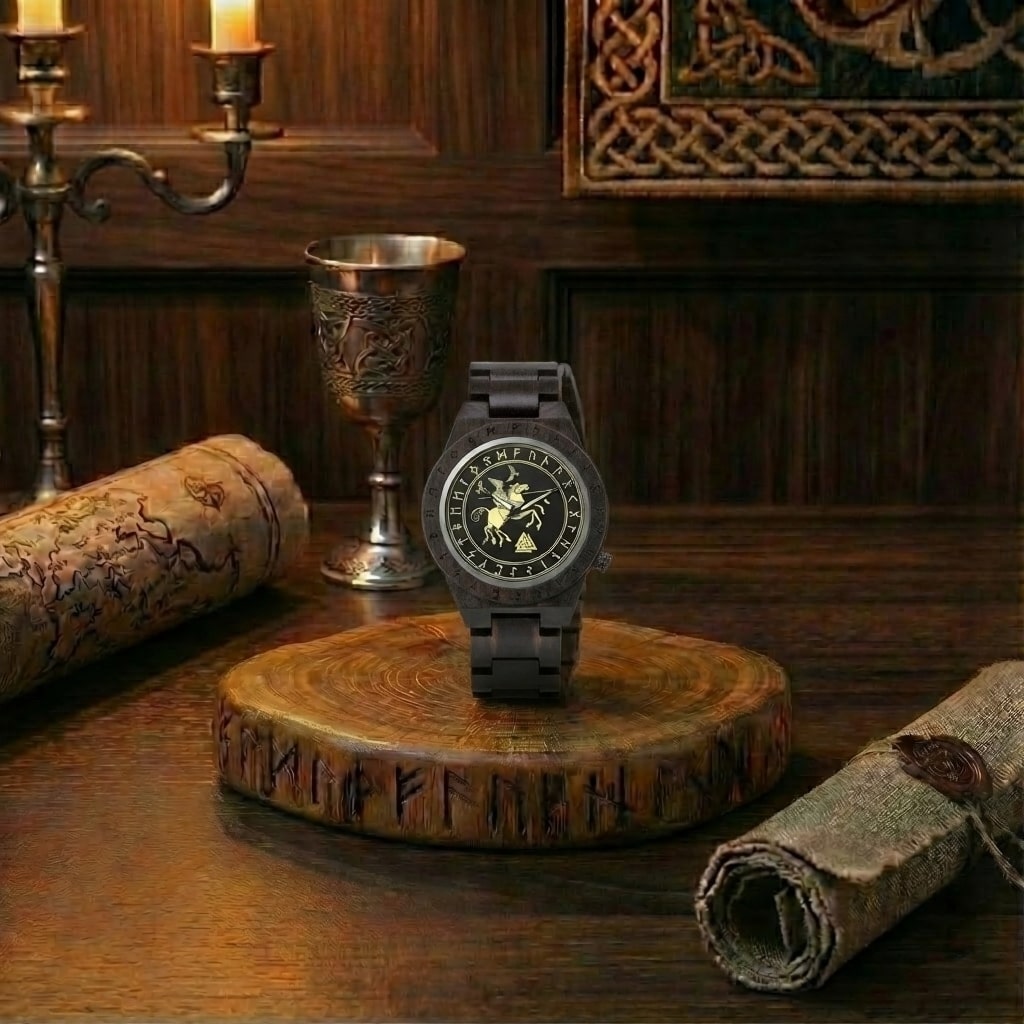
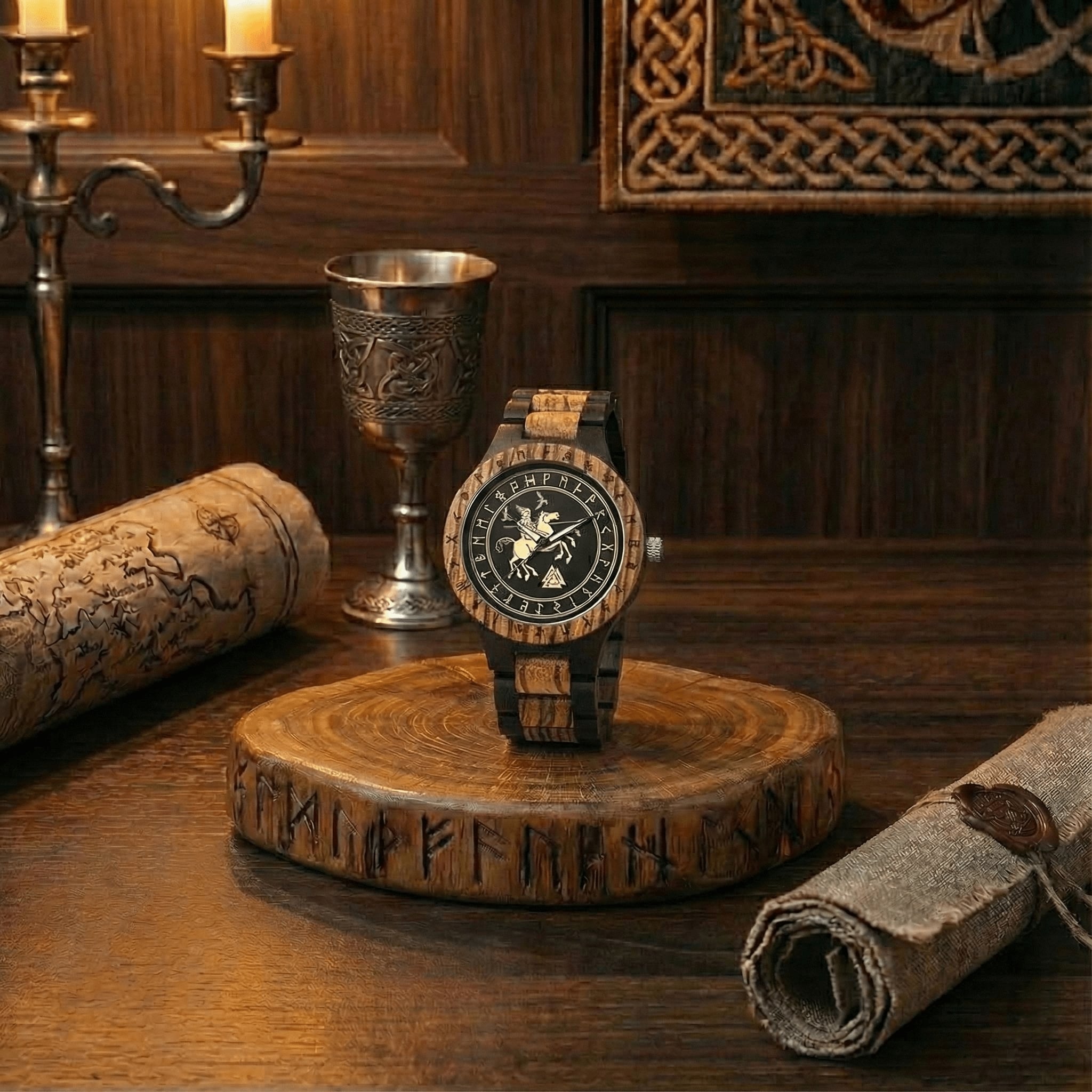
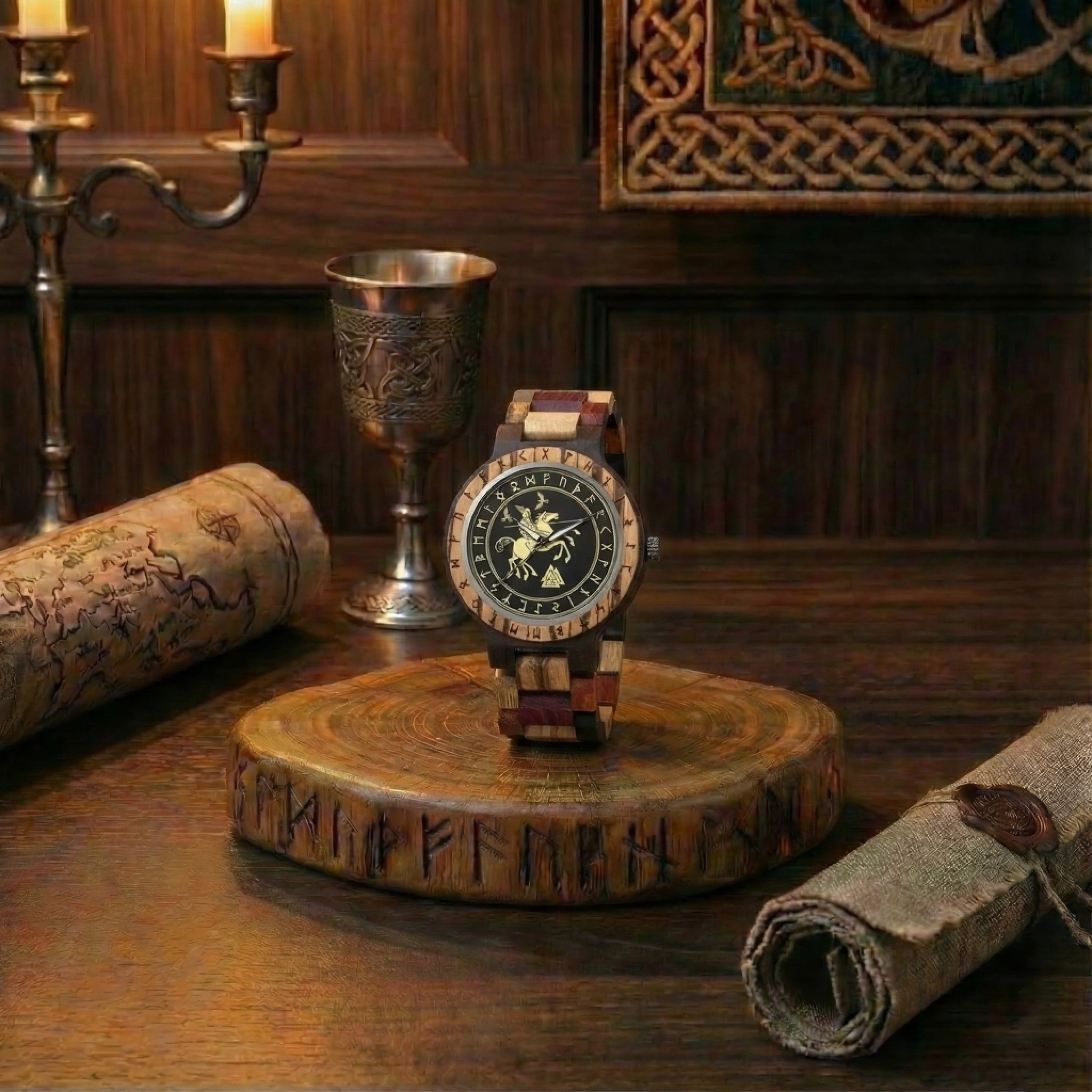
The bulk of the collection has a case and strap made of real wood—black wood, light wood, zebrawood, red wood, or a patchwork assembly of several species. Two pleasant consequences: the weight, which is much lower than an equivalent steel watch, and the temperature, as the wood takes on the warmth of the skin instead of remaining cold.
A constraint follows from this, and it is important: none of our product pages declare a water-resistance rating. Treat these watches as non-water-resistant. No showering, no swimming, and do not wash dishes without taking them off. A splash can be wiped off without damage, but immersion makes the wood swell and then crack, and this is irreversible.
Wood also lives with light: light-colored woods darken slightly with use, while dark woods lighten in direct sunlight. A watch stored in its box will keep its original color longer than one left on a windowsill.
The pocket watches, in steel or bronze, are less sensitive but are not guaranteed to be water-resistant either.
Wristwatch or pocket watch
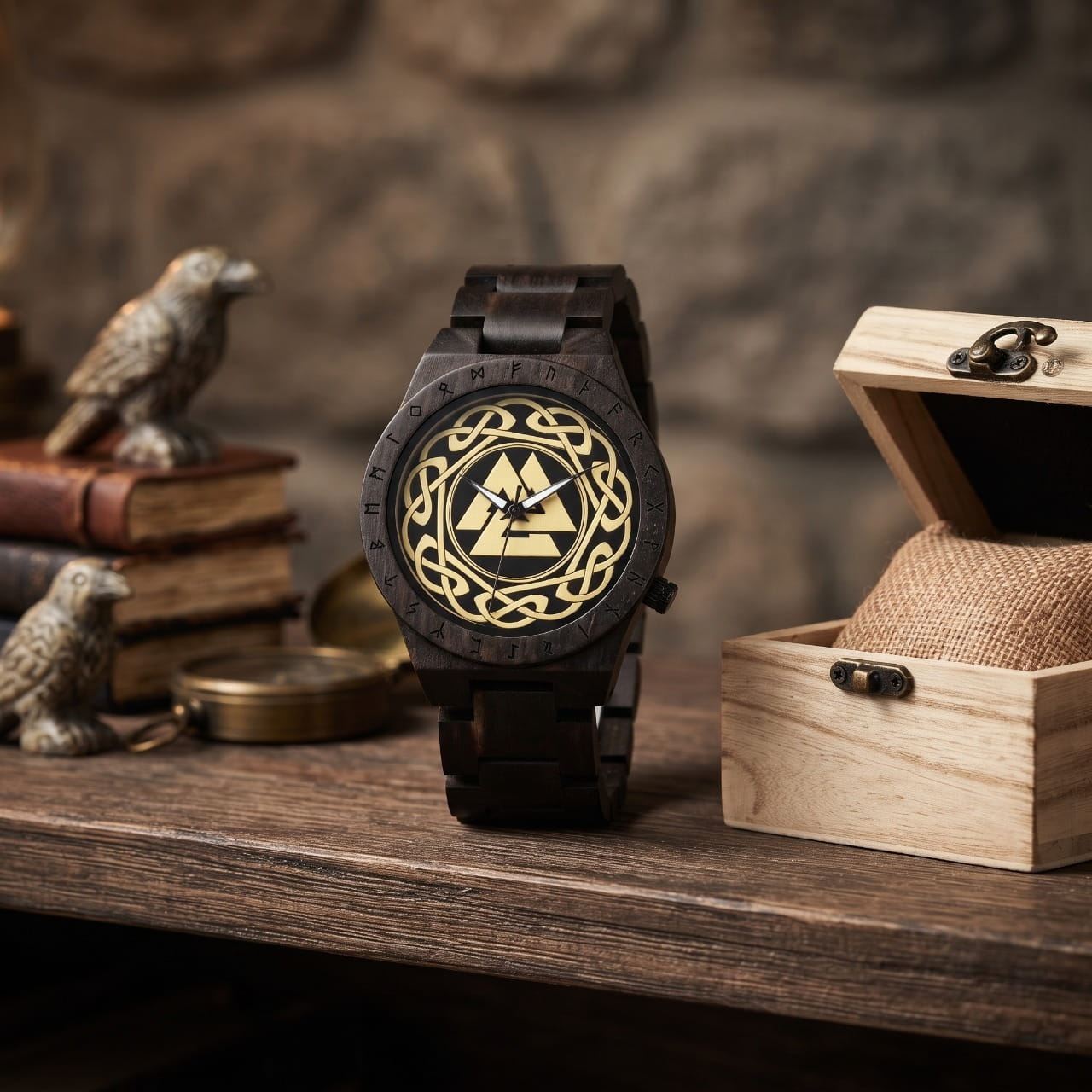
The wristwatch makes up the majority of the collection: a 44 mm round dial, runic indices or numbers, a symbol engraved or inlaid in the center, and a wooden link strap. Several models come in a wooden box, which solves the gift-wrapping issue.
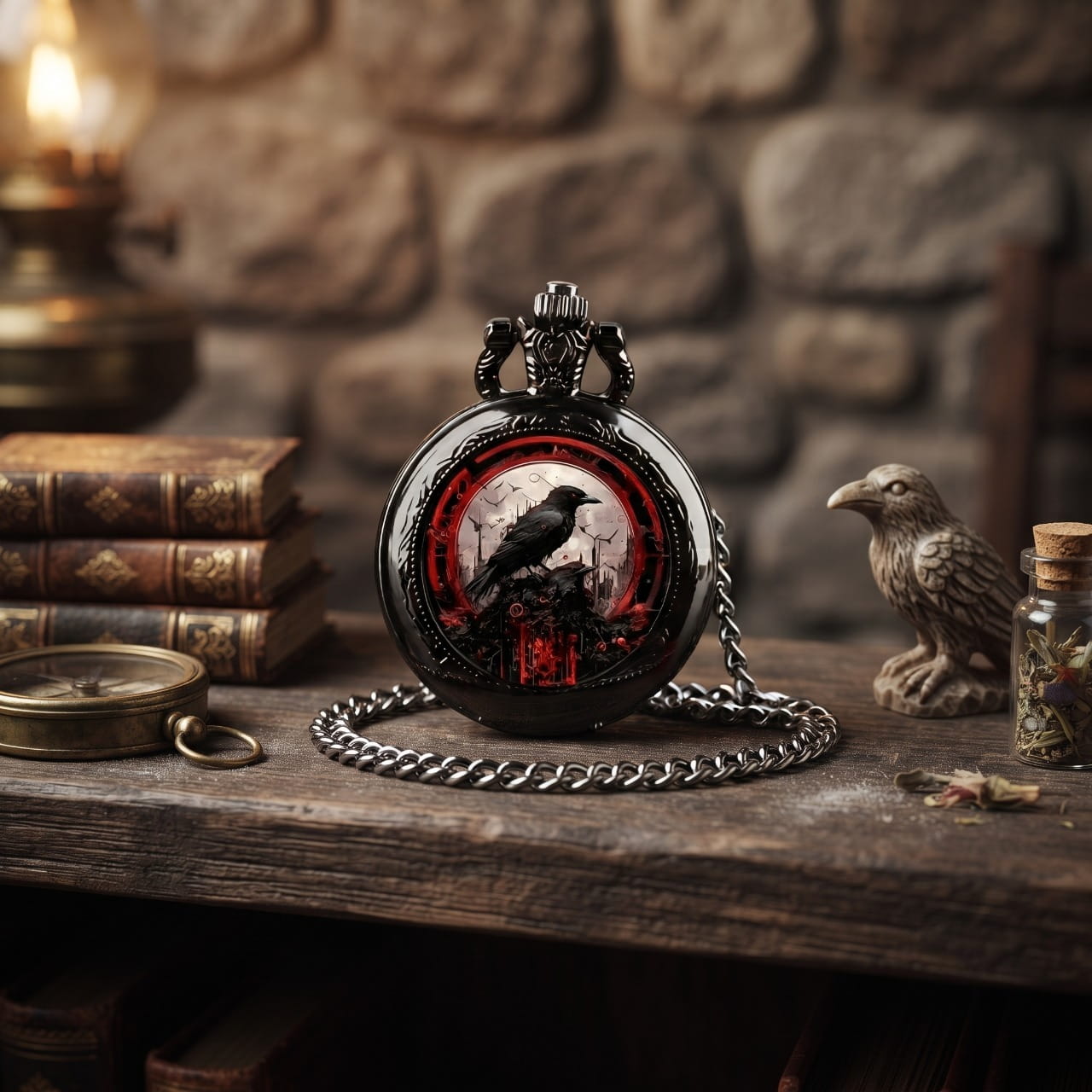
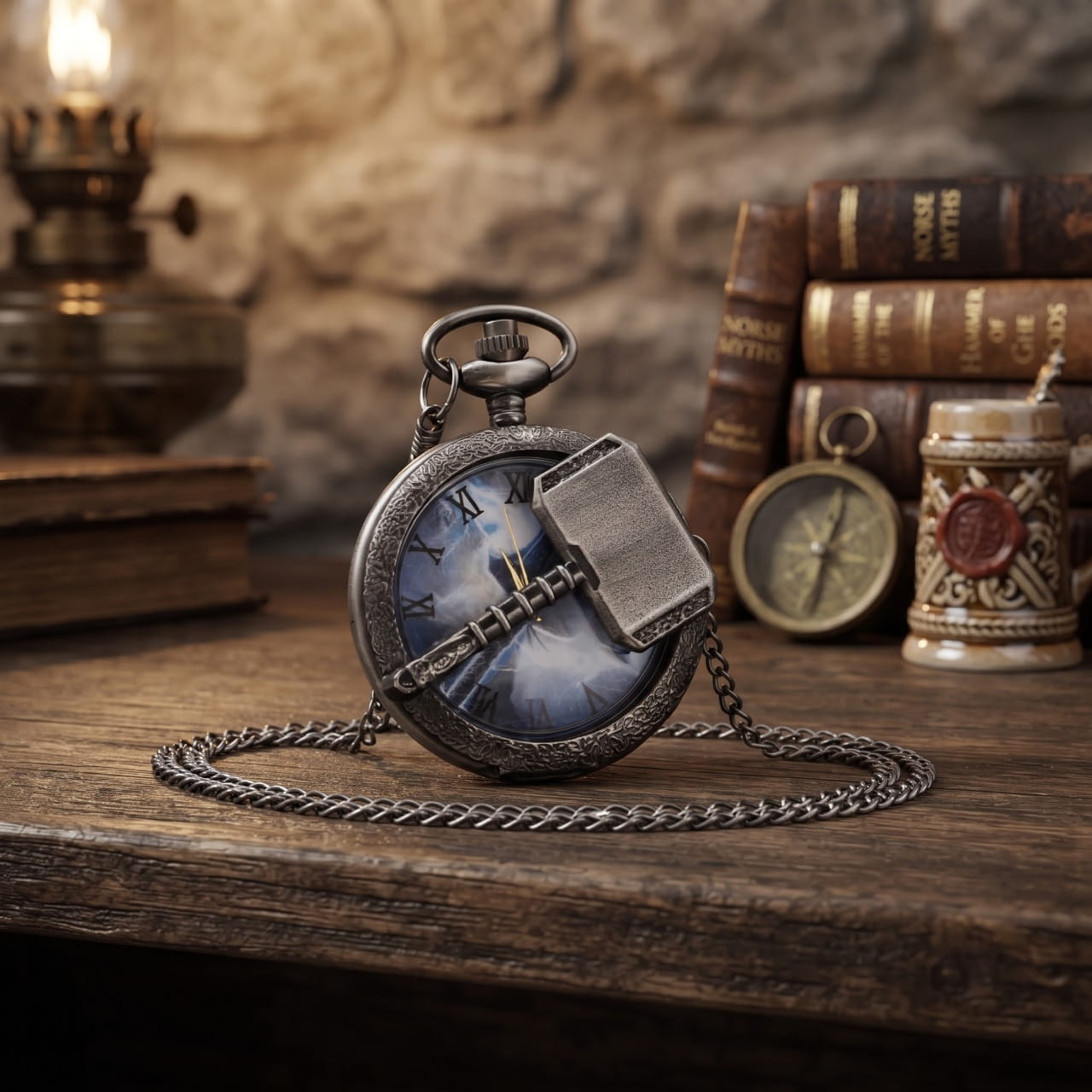
The pocket watch plays a different role: a case closed by a sculpted relief lid—Mjölnir, Valknut, Odin's raven—that opens to reveal the dial, with a matching chain included. It is the entry-level item of the collection, and the object can be worn in a vest, in a pocket, or simply placed on a desk.
The pocket watch has a discreet advantage over the wristwatch: it requires no measurement. This makes it the default choice when giving a gift without knowing the recipient's wrist size.
The engraved symbols
The motif in the center of the dial is what distinguishes one model from another. Here are the main ones, and what historical sources allow us to say about them.
The Vegvísir
The eight-branched runic compass is the most represented motif in the collection: its circular geometry naturally fits a round dial. A clarification is necessary, however—the Vegvísir appears in a 19th-century Icelandic grimoire, the Huld, and not in the Viking Age. It is a late Icelandic symbol, magnificent and charged with meaning, but not a Viking symbol in the strict sense. Our article on the Vegvísir details what we know about it.
The Mjölnir
Thor's hammer is, conversely, the best-attested Norse symbol: hundreds of hammer-shaped amulets have been found in Scandinavian graves from the 9th and 10th centuries. On a dial, its short, stocky shape occupies the center well without obstructing the hands.
Odin's face
Depicted bearded and one-eyed—he gave an eye to Mímir's well in exchange for wisdom—sometimes accompanied by his ravens Huginn and Muninn (Thought and Memory) or his eight-legged horse, Sleipnir. It is the most figurative motif in the collection, the one that can be seen from a distance.
The Valknut and Yggdrasil
The three intertwined triangles of the Valknut are attested on Gotlandic picture stones and on the Oseberg ship, associated with Odin and the fallen in battle; their exact meaning remains debated. Yggdrasil, the world tree, occupies the entire dial with its branches and roots: this is the motif to choose for the idea of connection rather than war.
To understand what you are wearing, our guide to Viking symbols covers the subject, and our complete guide to Norse watches goes into detail on the models.
Which watch for which use
For daily wear, light wood fits better under a shirt sleeve and shows fewer scratches than black wood, which reveals them like a lacquered piano.
For a slim wrist, prefer a dial with simple indices rather than a dense motif: a full Vegvísir on a 44 mm dial visually accentuates the diameter, whereas a sober dial softens it.
For gifting, the pocket watch avoids the size question, and the models delivered in a wooden box avoid the wrapping question.
For coordinating, a wooden watch naturally pairs well with a leather Viking bracelet worn on the other wrist—but avoid layering wood and leather on the same arm, as the look can become cluttered.
Maintenance
A dry cloth is enough for the wood: it requires neither wax nor oil, and especially no furniture polish, which would leave a greasy film. If the watch has been in the rain, wipe it off immediately and let it dry in the open air, never on a radiator.
The battery of a quartz watch lasts on average two years and can be replaced by any watchmaker for a few euros. Ask them to check the case back seal when reassembling: this is when a wooden watch is most easily damaged if the case is snapped back on crookedly.
Store it in its box rather than flat among other objects: the mineral glass will scratch upon contact with keys and belt buckles.
Frequently asked questions
Are these watches waterproof? No. None of our product pages declare a water-resistance rating: consider them non-waterproof and remove them before showering, swimming, or washing dishes.
What movement powers these watches? A quartz movement, on all models. Precise, requires no winding, and has a battery to be changed approximately every two years.
Do the runes on the dial really indicate the hours? No, they are decorative. Scandinavians divided the day into eight eyktir marked by the sun, not into twelve hours. Reading remains that of a classic dial, based on the position of the hands.
Is the 44 mm dial too big for a slim wrist? It will be noticeably imposing on a wrist under 16 cm. This is not a defect if the effect is desired, but you should be aware of it before ordering.
Can the strap be shortened? Yes, by removing links, just like a steel strap. A watchmaker can do this in minutes.
Does the wood deteriorate over time? It develops a patina, which is quite beautiful. What actually damages it is water immersion and prolonged dry heat.
Is a Viking watch suitable for a woman? Nothing stands in the way; the motifs are not gendered. The 44 mm format remains prominent, however: it is an aesthetic choice rather than a question of size.
Are these watches historical replicas? No. Horology did not exist in the Viking Age. These are contemporary watches whose decoration is inspired by Norse symbols.
What are the delivery times and shipping costs? Tracked delivery is free on orders over €49, regardless of the delivery country.
Also explore: match your watch with our Viking bracelets or browse all our Viking jewelry. Also see our Viking jewelry for men.