Vegvisir Tattoo: The Viking Compass and its Meaning
The Vegvisir tattoo has become one of the most sought-after symbols in the world of Norse tattooing. This Viking compass, also known as the runic compass, fascinates with its hypnotic geometry and the powerful meaning of protection and guidance it carries within it. But behind the striking aesthetic of this symbol lies a more nuanced history than is generally thought, a history that takes us into 19th-century Icelandic grimoires and Northern magical traditions.
In this article, we dive into the heart of the Vegvisir's true origin, decode its deep meaning, clarify the frequent confusion with the Aegishjalmur, and explore the best styles and placements to turn this symbol into a tattoo that will accompany you for life.
📌 In Brief
- The Vegvisir is an Icelandic symbol literally meaning way-finder.
- It is debated. The Vegvisir first appears in the Huld Manuscript dating from 1860, well after the Viking Age.
- The Vegvisir (8 different branches) is a navigation compass and a protection against getting lost.
- The most common placements are the forearm, the chest near the heart for protective value, the back, and the shoulder.
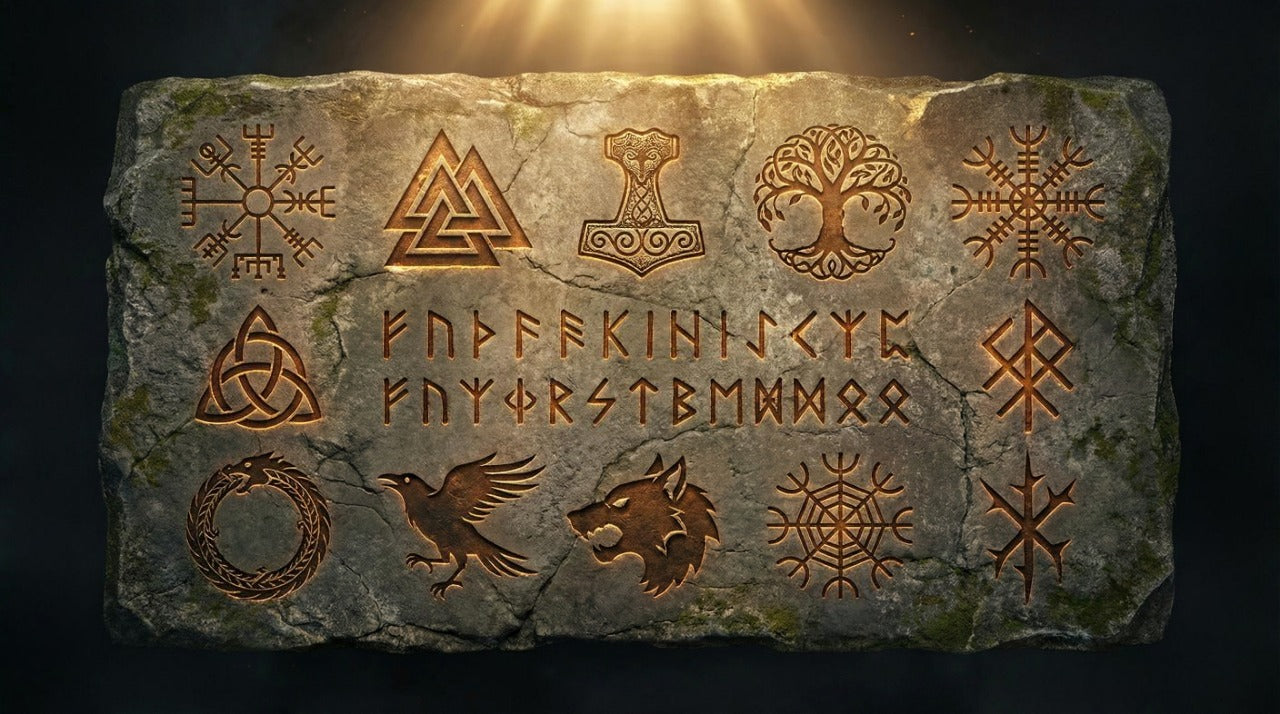
- It is very common: the Vegvisir is often surrounded by a circle of runes from the Futhark, sometimes completed with protective bindrunes.
The Vegvísir is late-coming, and that is only a defect if you ignore it. Our Viking tattoo guide applies the same frankness to every symbol and helps you choose with full knowledge of the facts.
The symbol is also worn as jewelry: Vegvísir necklaces, rings, and watches are collected in our Vegvísir section.
The Origin of the Vegvisir: Between Icelandic Magic and Norse Tradition
Contrary to what many sites claim, the Vegvisir is not a symbol directly originating from the Viking Age (793-1066). Its first documented appearance is in the Huld Manuscript, an Icelandic grimoire compiled by Geir Vigfusson in 1860. This manuscript brings together galdrastafir — magic staves or power symbols — from the Icelandic magical tradition, which draws its roots from a mix of pre-Christian Norse beliefs and medieval influences.
The Huld Manuscript is not an isolated case. Related symbols are found in other Icelandic grimoires, such as the Galdrabók, a 17th-century manuscript that constitutes one of the most important sources on Icelandic magic. These grimoires bear witness to a living tradition that persisted long after the Christianization of Iceland in the year 1000, incorporating runic elements, Christian symbols, and local magical practices into a unique syncretic system.
What this means for your Vegvisir tattoo is that you are wearing a symbol that testifies to the continuity and adaptation of Norse beliefs through the centuries. The Vegvisir is not a fossil frozen in time: it is a living symbol, heir to a tradition that was able to endure through the ages by reinventing itself without ever losing its essence — that of protection and guidance.
"If this sign is carried, one will never lose one's way in storms or bad weather, even if the path is unknown."— Huld Manuscript, 1860, description accompanying the Vegvisir
Meaning of the Vegvisir: "He Who Shows the Way"
The word Vegvisir is composed of two Icelandic elements: vegur (path, road) and visir (guide, one who shows). Its literal meaning is therefore "he who shows the way" or "road indicator." This etymology reveals the very essence of the symbol: the Vegvisir is above all a talisman for protecting travelers.
Protection against getting lost
The primary function of the Vegvisir, as described in the Huld Manuscript, is to protect the wearer from getting lost. In the Icelandic context, where snowstorms can render any landscape unrecognizable in minutes, where sea fogs swallow up coasts and landmarks, and where the vast interior expanses of the island are volcanic deserts without marked trails, such a symbol of guidance was not a luxury but a necessity.
For a Vegvisir tattoo, this meaning translates into a broader sense: protection against losing one's way does not only concern physical travel. The Vegvisir becomes a permanent reminder of your ability to find your way, even in moments of confusion, doubt, or crisis. It is a particularly evocative symbol for those who have gone through difficult times and wish to wear a reminder of their resilience.
The inner compass
Beyond physical navigation, the Vegvisir is interpreted as an inner compass. Its eight radiating branches, each ending with a different symbol, point in all directions, suggesting that the bearer of the symbol possesses the resources to find their way, regardless of the direction from which adversity comes.
This interpretation makes the Vegvisir tattoo a powerful choice for those at a crossroads in their life: a career change, a breakup, a departure into the unknown, a fresh start. The symbol affirms that even without a map, even without a plan, you will find your route.
A link with supernatural forces
In the tradition of Icelandic galdrastafir, symbols like the Vegvisir do not function passively. They are designed to establish a link between the bearer and supernatural forces — the spirits of nature, ancestors, or cosmic forces that govern destiny. Getting a Vegvisir tattooed can thus be seen as an act of invocation, a call to these forces to guide your steps through life's storms.
Vegvisir vs Aegishjalmur: How to Distinguish Them
One of the most widespread confusions in the world of Norse tattooing is between the Vegvisir and the Aegishjalmur (the Helm of Awe). Both symbols are Icelandic galdrastafir, both feature eight branches radiating from a central point, and both are frequently associated with Viking culture. Yet, they are fundamentally different, both in appearance and in their meaning.
Visual differences
The Vegvisir is distinguished by its eight different branches. Each branch ends with a unique symbol — forks, hooks, perpendicular lines, dots — and none is identical to another. This asymmetry is the most obvious visual hallmark of the Vegvisir. The whole evokes a compass rose where each direction carries a distinct power.
The Aegishjalmur, on the other hand, is perfectly symmetrical. Its eight branches are identical, each ending in a trident or fork-like pattern. The result is a symbol of almost hypnotic regularity, which evokes a snowflake or a star more than a compass. If you wish to learn more about this fascinating symbol, check out our article dedicated to the Aegishjalmur tattoo and the Viking Helm of Awe.
Meaning differences
- Vegvisir: traveler's protection, guidance, ability to find one's way. It is a symbol of navigation and passive protection.
- Aegishjalmur: warrior protection, intimidation of the enemy, invincibility in combat. It is a symbol of strength and active protection.
In simple terms, the Vegvisir keeps you from getting lost, while the Aegishjalmur keeps others from defeating you. The former is a guide; the latter is a shield. This distinction is essential when you choose your tattoo, as it determines the message you carry on your skin.
Can they be combined?
Absolutely. Combining the Vegvisir and the Aegishjalmur in the same tattoo creates a complete protection system: the guidance of the first and the strength of the second. A popular composition places the Vegvisir in the center, surrounded by a ring of runes, with the Aegishjalmur positioned above or below, creating a vertical column of Icelandic magical symbols.
"The Vegvisir guides the traveler through the storm; the Aegishjalmur makes them invincible to those who stand in their path. Together, they form the complete armor of the Norse warrior: the wisdom to know where to go, and the strength to achieve it."— Traditional interpretation of Icelandic galdrastafir
The Best Placements for a Vegvisir Tattoo
The circular and radiating shape of the Vegvisir gives it remarkable versatility in terms of placement. Unlike a vertical motif like a tree or a sword, the Viking compass naturally adapts to the flat and rounded surfaces of the body. Here are the most popular and successful placements for this tattoo.
The wrist: discreet but powerful
The wrist is one of the most requested placements for a Vegvisir tattoo. In a small size (4 to 6 cm in diameter), the symbol retains its legibility perfectly thanks to the clarity of its geometric lines. The wrist also offers a symbolic advantage: it is the part of the body you look at most often, making the Vegvisir a constant and intimate reminder of your path.
Tip: for a wrist placement, favor a style with clean lines and minimal fine details. Since the wrist is an area where the skin moves a lot, overly subtle details risk blurring over time. A clean blackwork or precise line-work style will be the most durable.
The forearm: the ideal placement
The forearm is arguably the best compromise between visibility, size, and aesthetic for a Vegvisir tattoo. The flat surface of the inner forearm perfectly accommodates the circular format of the symbol, and the available size (8 to 12 cm) allows for integrating additional details: a circle of runes around the Vegvisir, Norse interlace, or complementary elements like ravens or Celtic knots.
The outside of the forearm works just as well and offers immediate visibility when your arms are at your sides. It is a placement particularly appreciated by those who wish to proudly display their connection to Nordic culture.
The chest: near the heart
Wearing the Vegvisir on the chest, at the center of the sternum or slightly off-center toward the heart, is a choice charged with symbolism. The symbol of guidance is literally placed near your heart, suggesting that your inner compass is fueled by your deepest convictions and most sincere emotions.
The chest allows for generous formats (10 to 18 cm) that permit an impressive level of detail. Dotwork and geo-dotwork styles are particularly spectacular in this area, creating a Nordic mandala effect that draws the eye. It is also a placement that is relatively easy to conceal under clothing, which suits those who wish to keep their tattoo to themselves.
Other popular placements
- The shoulder or deltoid: an ideal rounded surface for the circular format of the Vegvisir. Very visible in a T-shirt, easy to cover in a shirt.
- The upper back (between the shoulder blades): a powerful placement that evokes the idea of having the Vegvisir on your back, protecting you where you cannot see.
- The calf: a flat surface that accommodates the symbol well, with moderate pain during the session.
- The hand: a bold and highly visible placement. Be careful, however: hand tattoos fade faster due to constant exposure and friction.
- Behind the ear: for a minimalist and discreet micro-Vegvisir. Only the initiated will notice it.
Tattoo Styles for the Vegvisir
The geometric nature of the Vegvisir makes it a symbol that lends itself to a wide variety of artistic styles. Each approach reveals a different facet of the symbol and subtly alters its visual significance.
Traditional blackwork
Blackwork is the style most faithful to the spirit of Icelandic grimoires, where the Vegvisir was drawn in black ink on parchment. Sharp black lines, saturated solid areas, and the absence of color create a timeless tattoo that ages remarkably well. This style highlights the complex geometry of the symbol and ensures perfect readability at any distance.
Dotwork and geo-dotwork
Pointillism gives the Vegvisir an almost mystical dimension. Gradients of dots create subtle shadows that give depth to the symbol, as if it were emerging from the skin rather than simply being drawn on it. Geo-dotwork, which combines sacred geometry and pointillism, is particularly suitable: concentric circles of dots surround the Vegvisir, creating a Nordic mandala of striking beauty.
Expanded runic style
This style integrates the Vegvisir into a larger runic set, surrounded by a circle of Elder Futhark runes or Icelandic magic formulas. The result is a tattoo that looks like a complete magic seal, as if it had been torn directly from the pages of the Huld manuscript. To carry the spirit of these runes daily, discover our Braided Leather Viking Vegvisir Bracelet adorned with Nordic runes.
Realistic style with natural elements
A more illustrative approach surrounds the Vegvisir with elements inspired by the Icelandic landscape: volcanic mountains, northern lights, a stormy sea, or a starry sky. This composition creates a narrative scene where the Vegvisir appears as the lighthouse that guides the traveler through the unleashed elements. It is an ideal choice for those who want a more pictorial and less strictly geometric tattoo.
Minimalist and fine-line style
Minimalism reduces the Vegvisir to its essential lines, without shading or filling. This style is perfectly suited for small formats (wrist, ankle, behind the ear) and appeals to those who prefer a clean and contemporary aesthetic. Fine-line uses very thin needles to create lines of extreme delicacy, giving the symbol an almost calligraphic elegance.
Bjork's Vegvisir and its Modern Popularization
If the Vegvisir has become a global tattoo phenomenon, it is in large part thanks to the Icelandic singer Bjork. The artist wears a Vegvisir tattoo on her upper left arm, which she made visible during numerous public appearances and photo shoots starting in the 1990s. This tattoo has become one of the most recognizable in the music industry and has contributed decisively to making the symbol known beyond circles specialized in Nordic mythology.
Bjork has explained that her Vegvisir tattoo represented for her a protective talisman for her journeys—both physical and artistic. As an Icelandic artist deeply attached to her culture and roots, she chose a symbol from the magical tradition of her native country rather than a generic Viking motif. This choice demonstrates a fine understanding of the distinction between symbols of the Viking Age proper and those of the subsequent Icelandic magical tradition.
Bjork's influence sparked a wave of interest in the Vegvisir that has never waned. Television series like Vikings (2013-2020) and video games like God of War (2018) later amplified this popularity by integrating similar Nordic symbols into their visual universe. Today, the Vegvisir is one of the three most tattooed Nordic symbols in the world, alongside the Valknut and the Yggdrasil world tree.
The Vegvisir in contemporary popular culture
Beyond Bjork, the Vegvisir has penetrated many spheres of contemporary culture. It can be found in graphic design, fashion, jewelry, and even interior design. Streetwear clothing brands integrate the symbol into their collections, and digital artists reinterpret it in styles ranging from cyberpunk to neo-sacred.
This omnipresence raises a question that every Nordic tattoo lover should consider: how to make your Vegvisir tattoo unique and personal? The answer lies in customization. By integrating elements that are specific to you—specific runes, references to your personal history, an artistic style that suits you—you transform a popular symbol into a truly unique piece. Complete your Nordic look with our Steel Viking Vegvisir Necklace adorned with runes, a piece of jewelry that carries the same meaning of guidance and protection.
"The Vegvisir is my Icelandic anchor. In all my travels across the world, it reminds me of where I come from and shows me where I am going. It is a sign that says: you will not get lost, even if you do not know the path yet."— Bjork, regarding her Vegvisir tattoo
Combinations and Compositions with the Vegvisir
The Vegvisir tattoo gains depth and originality when combined with other elements of the Nordic tradition. Here are the most successful combinations and their symbolism.
Vegvisir and Futhark runes
Surrounding the Vegvisir with a circle of Elder Futhark runes is the most classic and requested combination. The 24 runes form a protective ring around the compass, amplifying its symbolic power. You can choose the entire Futhark for a maximal visual effect, or select specific runes whose meaning resonates with your personal intention—for example, Algiz (protection), Raidho (travel), or Ansuz (divine wisdom).
Vegvisir and Odin's ravens
The ravens Huginn and Muninn, Odin's emissaries, add a dimension of wisdom and clairvoyance to the tattoo. Placed on either side of the Vegvisir, they symbolize thought and memory—two essential tools for never losing one's way. The contrast between the precise geometry of the Vegvisir and the organic shapes of the birds creates a visually dynamic composition.
Vegvisir and the Knot of the Dead (Valknut)
Combining the Vegvisir with the Valknut creates a tattoo charged with mystery. The Valknut, a symbol linked to Odin and warriors fallen in battle, adds a dimension of courage in the face of the unknown. This combination is particularly suitable for those who view life as a journey whose final destination is uncertain, and who choose to move forward bravely nonetheless.
Vegvisir and Nordic interwoven motifs
Nordic knotwork wrapping the Vegvisir creates a design of fascinating visual complexity. Lines that cross and uncross endlessly evoke the eternal cycle, while the Vegvisir in the center remains the fixed point, the constant in the midst of perpetual movement. To wear this aesthetic as jewelry, our Black Steel Wide Band Viking Vegvisir Signet Ring perfectly captures this spirit.
Practical Advice Before Getting a Vegvisir Tattoo
Before committing to a Vegvisir tattoo, here are some essential recommendations to ensure a result you will be proud of for decades.
Choosing the right tattoo artist
The Vegvisir is a geometric symbol that requires absolute precision. The eight branches must radiate in a balanced manner from the center, the angles must be constant, and the endings of each branch must be sharp and distinct. Look for a tattoo artist whose portfolio demonstrates mastery of straight lines, symmetry, and geometric work. A specialist in blackwork, dotwork, or line-work will generally be the best choice.
Checking the accuracy of the design
Due to the frequent confusion between the Vegvisir and the Aegishjalmur, ensure that the design proposed by your tattoo artist is indeed an authentic Vegvisir, with its eight different branches. Bring a reliable reference (photo of the Huld manuscript) and compare it with the stencil before starting the session. A good tattoo artist will never be offended by this verification—on the contrary, they will appreciate your attention to detail.
Reflecting on the size
The Vegvisir features fine details, especially at the ends of its branches. For these details to remain legible over time, respect a minimum size of about 4 cm in diameter for a simple design, and 7 cm or more if you add a circle of runes or additional elements. Tattoos that are too small risk blurring over the years, especially in high-friction areas like the hands or feet.
Maintenance and durability
As with any geometric tattoo, potential touch-ups must be performed with the same precision as the original work. Protect your tattoo from the sun with high-protection sunscreen, as UV rays degrade fine lines faster than solid areas. A well-executed and well-maintained Vegvisir will remain sharp and legible for many years.
Conclusion: The Vegvisir, Your Personal Compass
The Vegvisir tattoo is much more than an aesthetic motif from Nordic culture. It is a symbol of protection, guidance, and resilience that spans centuries, from 19th-century Icelandic grimoires to contemporary tattoo studios. Whether you are drawn to its fascinating geometry, its significance as an inner compass, or its connection to the magical tradition of the North, the Vegvisir carries a promise: never to lose your way.
By choosing an authentic design, thoughtful placement, and a tattoo artist who masters geometric precision, you will turn this Viking compass into a lifelong companion that will remind you, day after day, that the path always exists—even when the storm is raging. The Vegvisir is there to show it to you.
Frequently Asked Questions about the Vegvisir Tattoo
What does the Vegvisir mean?
The Vegvisir is an Icelandic symbol literally meaning path guide. It is traditionally considered a magic compass that protects its wearer from getting lost, even in the worst weather conditions or in unknown terrain.
Is the Vegvisir really a Viking symbol?
That is debated. The Vegvisir appears for the first time in the Huld Manuscript dating from 1860, well after the Viking Age. However, it is inspired by Nordic runic and magical traditions. Some experts consider it post-Viking but of Nordic heritage.
What is the difference between the Vegvisir and the Aegishjalmur?
The Vegvisir (8 different branches) is a navigation compass and a protection against getting lost. The Aegishjalmur (8 identical branches, Helm of Awe) is a symbol of protection in battle and intimidation of enemies.
Where should you place a Vegvisir tattoo?
The most popular placements are the forearm (visible and symbolic), the chest (near the heart for protection), the back between the shoulder blades, or the shoulder. Björk popularized the Vegvisir with her tattoo on her left arm.
Can you combine the Vegvisir with runes?
Yes, it is very common. Popular combinations include the Vegvisir surrounded by a circle of Futhark runes, with protective bindrunes at the ends, or integrated into a larger design with Yggdrasil or Nordic knotwork.
Does the Vegvisir really bring good luck?
In Icelandic tradition, the Vegvisir is a galdrastafur (magic stave) meant to guide its wearer. Today, many wear it as a tattoo as a symbol of direction in life, confidence in one's path, and spiritual protection.
👉 Explore our collections of Viking necklaces and Viking bracelets to wear the Viking spirit every day.
Many prefer to wear the symbol before inking it: our Vegvisir collection brings together pieces engraved with the runic compass.

Leave a comment
All comments are moderated before being published.
This site is protected by hCaptcha and the hCaptcha Privacy Policy and Terms of Service apply.