
Viking Tattoos for Women: Subtle Ideas and Hidden Meanings
The north wind slaps against the cliffs of Helgafjell. On the shore, a woman stands facing the grey sea. Her braided hair whips against her bare shoulders, and on the pale skin of her left wrist, a delicate interlace of black ink draws the Algiz rune — the sign of protection. Her name is Sigrid, and she is a Völva: prophetess, healer, and keeper of the secrets the gods whisper in the cracking of the ice. Before every voyage, before every battle, the warriors come to consult her. And this symbol etched into her flesh tells the entire story of her lineage.
Today, Viking tattoos for women are experiencing unprecedented popularity. Thousands of women are choosing to wear Nordic symbols charged with meaning on their skin: runes of protection, winged Valkyries, Celtic knots, and runic compasses. But contrary to popular belief, Viking tattoos for women are neither massive nor aggressive. They can be subtle, elegant, and deeply personal. A simple line on the nape of the neck, a tiny rune on the finger, a fine interlace on the ankle — these tattoos whisper rather than shout, and that is precisely their strength.
This guide explores the best ideas for subtle Viking tattoos for women, their ancestral meanings, and the most suitable placements. Whether you are drawn to the power of the Valkyries or the wisdom of the runes, you will find inspiration here for a Nordic tattoo that truly reflects you.
📌 In brief
- Historical sources do not specifically mention tattoos on women, and the only commonly cited account, that of Ahmad Ibn Fadlan, describes the Rus of the Volga without distinguishing by gender — an ambiguous text that offers no firm conclusion.
- The most sought-after designs are the Valkyrie, fine Nordic interlacing, the minimalist Vegvisir, and individual runes.
- Subtle placements include the wrist for a rune or small Vegvisir, the ankle for a fine interlace, and behind the ear.
- The Valkyrie symbolizes feminine strength, courage, and the power to choose one's destiny.
- Fine line and dotwork styles transform Viking symbols into elegant and feminine designs.
For the full subject — choosing a symbol, graphic styles, pricing, and aftercare — see our Viking tattoo guide.
Were Viking women tattooed? What the sources say
The question comes up constantly: did women of the Viking Age really wear tattoos? The most honest answer is probably yes, even if direct evidence remains rare. The most famous account comes from the Arab explorer Ahmad Ibn Fadlan, who encountered Viking Rus' along the Volga around 921 AD. He described men tattooed "from the tips of their fingers to their necks" with patterns of trees, figures, and dark interlacing. While he does not explicitly mention women in this passage, other Arab sources mention Nordic women wearing ornamental marks on their hands and faces.
"I have never seen bodies more perfect than theirs. Tall as palm trees, blond and red-skinned, each of them bears, from the tips of their nails to their necks, figures of green trees and other patterns."-- Ahmad Ibn Fadlan, Risala, circa 921 AD
Icelandic sagas and archaeological discoveries complete the picture. Viking women held major roles in Nordic society: Völvas (prophetesses), healers, merchants, and occasionally warriors. The Birka grave, long attributed to a man, was revealed to be that of a woman buried with a full arsenal of a warrior. If men marked their skin with symbols of strength and lineage, it would be surprising if women — who shared the same beliefs and the same symbols — did not do the same.
The modern Viking tattoo for women is part of this continuity. It is not a passing trend, but the rediscovery of a feminine heritage long ignored by official history. Every rune traced on contemporary skin echoes the marks that women like Sigrid wore over a thousand years ago.
Most popular Viking symbols for women
Certain Nordic symbols resonate particularly well with the feminine world — not because they are "soft," but because they embody forms of power that Viking women mastered: protection, prophecy, transformation, and the link between worlds.
The Valkyrie: celestial warrior and guide of souls
The Valkyrie is arguably the most powerful Viking symbol for women. These divine warriors, sent by Odin to the battlefields, chose the warriors worthy of entering Valhalla. A subtle Valkyrie tattoo can represent a stylized winged silhouette, a winged helmet, or simply a pair of fine wings on the shoulder blade or behind the ear. This motif embodies inner strength, courage in the face of destiny, and the ability to choose one's own path.
For women who identify with the energy of Nordic warriors, the Valkyrie is a constant reminder: you are the one who decides. Modern depictions range from detailed realism to geometric minimalism — a fine-line Valkyrie on the forearm or a black-ink silhouette on the ankle.
Runes: a sacred alphabet on the skin
The runes of the Elder Futhark are ideal for a subtle women's rune tattoo. Each character carries deep meaning, and a single rune is enough to pack a powerful message into a tiny space. Here are the most requested runes:
Algiz (ᛉ) — Protection and divine connection. The rune resembles a hand raised toward the sky, a gesture of invocation and defense. Perfect for the wrist or finger.
Berkana (ᛒ) — Rebirth, fertility, new beginnings. Linked to the goddess Frigg and the birch tree, this rune symbolizes growth and motherhood. It suits the nape of the neck or the ribcage.
Sowilo (ᛊ) — Sun, victory, vital energy. Shaped like a lightning bolt, this rune evokes the light that pierces the darkness. Ideal for a tattoo behind the ear.
Fehu (ᚠ) — Wealth, abundance, prosperity. The first rune of the Futhark, linked to livestock and fortune. Elegant on the inside of the wrist.
Ansuz (ᚨ) — Wisdom, communication, Odin's breath. The rune of the sacred word and poetic inspiration. Perfect for women who make a living with their voice and their words.
To delve deeper into each rune and its history, discover our complete guide on Viking rune tattoos and their meanings.
The moon and the triquetra: femininity and sacred cycles
The crescent moon appears frequently in Viking tattoo designs for women. Although the moon is not an exclusively Nordic symbol, it naturally fits into Viking iconography thanks to Máni, the moon god, and the seasonal cycles that paced the lives of the northern peoples. Paired with runes or a Vegvisir, the crescent moon creates a subtle and enchanting motif, particularly beautiful as an ankle or nape tattoo.
The triquetra, or three-pointed knot, is another symbol deeply linked to the sacred feminine. Representing the birth-life-death cycle (or the three aspects of the goddess in Celto-Nordic traditions), this motif tattoos beautifully in small format. To carry this heritage in daily life beyond a tattoo, a steel triquetra Viking necklace can complete your Nordic style with elegance.
Vegvisir and Aegishjalmur: compasses and protection
The Vegvisir, the runic compass, is one of the most requested Nordic tattoos — regardless of gender. Its promise is simple and universal: "He who bears this sign will never lose his way, even in the storm." For women, the Vegvisir comes in a minimalist version: fine line, black ink, sometimes enriched with small floral or lunar details that soften its geometric lines without betraying its essence.
The Aegishjalmur (Helm of Awe) is its protective cousin. More angular, it projects an aura of an invisible shield around the wearer. A 3cm Aegishjalmur on the inside of the wrist constitutes a subtle Viking tattoo of considerable symbolic power.
To explore the history and variations of the Vegvisir in detail, check out our article on Vegvisir tattoos: the Viking compass and its meaning.
"Better to be armed and never need it, than to need it and not be armed."-- Hávamál, stanza 38, Poetic Edda
Nordic knots and interlacing: ornamental art on the skin
Celtic and Norse knots are among the most suitable tattoo styles for the female body. These interlaces with no beginning and no end symbolize eternity, the cycles of life, and the interconnection of all things. Unlike angular runic motifs, knots offer fluid curves that naturally embrace the body's forms.
The witch's knot is particularly popular among women who claim a connection with Norse magic. This symbol of four intertwined loops was associated with Völvas and seiðkonur (practitioners of seiðr, the Norse magic). As a discreet tattoo, it is ideally placed on the finger, the wrist, or behind the ear. If this symbol fascinates you, you can also wear it in jewelry form with this stainless steel Viking witch's knot ring, a perfect complement to a tattoo on the opposite hand.
The Norse ornamental style, inspired by engravings found on Gotland runestones and the prows of longships, offers infinite possibilities. Contemporary tattoo artists reinterpret these ancient motifs by creating fine armbands, sinuous lines along the spine, or intricate details that frame a central symbol like Yggdrasil or the Valknut.
Yggdrasil: the world-tree, symbol of connection
The Yggdrasil tree of life is a deeply feminine motif in Norse mythology. This cosmic tree connects the nine worlds, its roots plunging into the wells of wisdom while its branches touch the sky. For Sigrid, our Völva, Yggdrasil was not just a symbol: it was the map of her spiritual journeys between worlds, the backbone of all existence.
As a female Viking tattoo, Yggdrasil can be rendered in a thousand ways: a minimalist fine-line tree on the forearm, a silhouette framed in a runic circle on the shoulder blade, or a detailed version with roots and branches forming a Celtic interlace. The most discreet versions—a 4 to 5 cm tree on the inner wrist—are among the most elegant feminine Norse tattoos.
To learn everything about this central symbol, read our article dedicated to the Yggdrasil tattoo and the meaning of the world-tree.
Discreet placement: where to get a female Viking tattoo?
Placement is at least as important as the design itself. A discreet female Viking tattoo draws its beauty from its subtlety: it reveals itself at the right moment to those who deserve to see it. Here are the most prized locations:
The inner wrist -- The classic location for a Viking wrist tattoo. Ideal for a single rune, a small Vegvisir, or a Celtic knot. Visible whenever you wish, concealable under a watch or bracelet. The pain is moderate and the result always elegant.
The ankle -- The Viking ankle tattoo is one of the most feminine and discreet options. A bracelet of Norse interlaces around the ankle, a rune on the malleolus, or a small Yggdrasil tree on the side of the foot: these motifs remain hidden in winter and are gracefully unveiled in summer.
The nape of the neck -- An intimate space par excellence, the nape is perfect for protective symbols like the Aegishjalmur or the Vegvisir. A tattoo in this area evokes the guardian who watches, even when her back is turned.
Behind the ear -- For lovers of absolute minimalism. A Sowilo rune, a crescent moon, or a tiny Valknut. Invisible in daily life, this placement reveals itself when hair is pulled back—a secret known only to the initiated.
The finger -- A female Viking tattoo on the finger (inner or side) is the quintessence of discretion. Algiz rune, Norse dot, or simplified witch's knot: these micro-tattoos have become a true phenomenon.
The ribs / side -- For those who want a more elaborate motif while maintaining discretion, the ribs offer a long and narrow space perfect for a runic quote, a vertical interlace, or a stylized Valkyrie.
Most of these placements have their equivalent in jewelry, which is reversible, and the ear placement is the most immediate: a small stud or engraved hoop earring reveals itself just like a motif placed behind the ear when hair is pulled back. Our Viking earrings feature the same symbols—Vegvisir, Norse interlaces, Odin's ravens, Valkyrie wings—and several models can be worn as cuffs, without piercing, to try out a motif before deciding to engrave it into the skin.
Viking tattoo styles adapted for women
The female Norse tattoo comes in several artistic styles, each offering a different atmosphere:
Fine line -- Thin and precise lines, without filling. This is the king of styles for discreet tattoos. A fine-line Vegvisir on the wrist or a Valkyrie drawn in delicate strokes on the forearm: elegance guaranteed.
Dotwork -- Norse motifs in dotwork are spectacular. Each point creates a texture similar to stone carving, evoking original runic inscriptions. This style works particularly well for Norse mandalas and complex interlaces.
Minimalist blackwork -- Pure black ink, clean geometric shapes. This style is suitable for symbols like the Valknut, the Vegvisir, or bindrunes (combinations of runes). The absence of gray shades gives a timeless and powerful appearance.
Norse ornamental -- Inspired by runestone engravings and Icelandic stave art. This style mixes curves and angles, creating motifs that seem both ancient and contemporary. Ideal for armbands, placements along the spine, or motifs framing a central symbol.
To accompany and enhance your tattoo daily, a Futhark runes Viking bracelet with Vegvisir beads creates a natural harmony between jewelry and ink, visually reinforcing your Norse style.
Small rune tattoos: which symbol to choose?
If you are still hesitating, here is a quick guide to choosing the rune that best fits your intent. Because in the Norse tradition, a symbol is not just a drawing—it is an engraved intention, a pact between you and ancient forces.
For protection: Algiz (ᛉ) or Thurisaz (ᚦ). Algiz is the divine shield, Thurisaz is active defense—the thorn that repels adversity.
For a new beginning: Dagaz (ᛞ) or Berkana (ᛒ). Dagaz is the dawn, the luminous breakthrough. Berkana is the sprouting seed, renewal.
For inner strength: Uruz (ᚢ) or Tiwaz (ᛏ). Uruz is the raw power of the aurochs, Tiwaz is the courage of the god Tyr who sacrificed his hand.
For love and joy: Wunjo (ᚹ) or Gebo (ᚷ). Wunjo is pure joy, Gebo is the sacred gift—the exchange between two beings.
For wisdom: Ansuz (ᚨ) or Kenaz (ᚲ). Ansuz is the breath of Odin, inspired speech. Kenaz is the torch of knowledge.
A strong trend involves creating a bindrune—a combination of two or three runes merged into a single unique symbol. For example, Algiz + Berkana = protection and rebirth. These personalized creations make excellent discreet tattoos because they carry a message that only the owner can decipher.
"I know that I hung on a windy tree, nine long nights, wounded with a spear, dedicated to Odin, myself to myself, on that tree of which no man knows from where its roots run."-- Hávamál, stanza 138, Poetic Edda -- Odin's sacrifice to obtain the runes
Female empowerment through Viking tattooing
Let's return to Sigrid. Standing on the cliff, her gaze fixed toward the horizon where the sea meets the leaden sky. Her Algiz rune is not an ornament—it is a declaration. In a society where Norse women could own land, request a divorce, trade freely, and even lead expeditions, body markings were a language of sovereignty. Every female Viking tattoo worn today is part of this tradition of feminine strength.
Viking women were neither victims nor extras. They were Völvas whose words made kings tremble. Shieldmaidens whose exploits are sung in the sagas. Matriarchs whose wisdom guided entire clans. The contemporary female Norse tattoo is not a superficial cultural appropriation: it is the reactivation of a female power that has never truly disappeared.
When a woman chooses to engrave a Valkyrie on her skin, she is not simply wearing a drawing. She is asserting that she is she who chooses. When she traces a Berkana rune on her wrist, she invokes the strength of the earth and of renewal. When she draws a Vegvisir on the nape of her neck, she declares that no storm will make her stray from her path.
Practical advice before starting
Before stepping through the door of a studio, a few recommendations to ensure your discreet female Viking tattoo is perfect:
Choose a specialized artist. Norse symbols require geometric precision that not all tattoo artists master. Look for an artist with experience in dotwork, geometry, or Norse blackwork.
Verify the meaning. The internet is full of erroneous interpretations of runes and Viking symbols. Cross-reference your sources, consult reference works (the Poetic Edda, Snorri Sturluson's Prose Edda), and do not hesitate to discuss it with your tattoo artist.
Think about evolution. A discreet tattoo can be the starting point for a larger composition. A small Vegvisir on the wrist could one day become the center of a complete runic armband. Plan for this possibility from the start with your artist.
Respect the healing time. Fine and discreet tattoos are more sensitive to fading. Scrupulously follow your tattoo artist's care instructions, especially for high-friction areas (fingers, ankles, wrists).
Conclusion: your mark, your saga
Sigrid descends from the cliff. The sun finally pierces the clouds and strikes the rune on her wrist, which seems to glow with its own light. In a few hours, she will join the council circle, and her voice will carry the weight of a thousand ancestors. What she wears on her skin is not a decoration. It is a living heritage.
The female Viking tattoo is much more than an aesthetic trend. It is a thread that connects you to the most powerful women in Scandinavian history—the prophetesses, the warriors, the mothers of kings, and the navigators of the unknown. Whether you opt for a discreet rune on your finger, a Valkyrie in fine ink on your shoulder, or a Norse interlace around your ankle, each symbol is a saga seed planted in your skin.
Choose your symbol. Choose your placement. Choose your artist. And above all, choose your meaning. Because in the Norse tradition, it is the intention that gives the symbol its power. Like Sigrid on her cliff, let your mark tell your story—that of a woman who knows exactly who she is and where she comes from.
Skál.
Frequently Asked Questions about Female Viking Tattoos
Did Viking women get tattoos?
Historical sources do not specifically mention female tattoos, and the only often-cited account, by Ahmad Ibn Fadlan, describes the Rus of the Volga without distinguishing genders—an ambiguous text that does not allow for a definitive conclusion. Archaeological discoveries of warrior women and noblewomen suggest that women of high rank could also bear body markings.
Which Viking tattoos are popular among women?
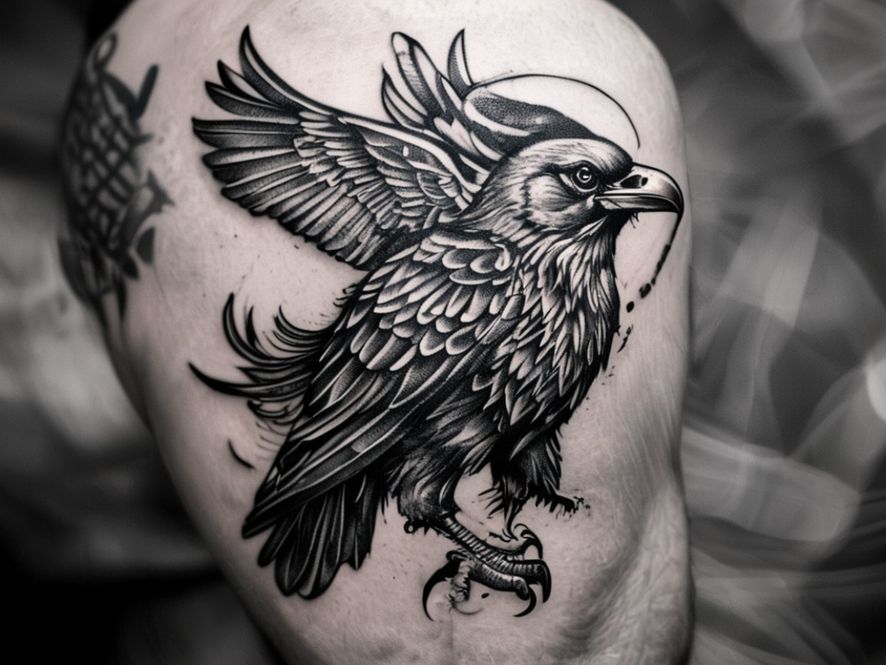
The most popular designs are: the Valkyrie (warrior of Odin), fine Norse interlaces, the minimalist Vegvisir, individual runes, Yggdrasil in a refined style, and Odin's ravens in flight.
Where to place a discreet Viking tattoo for women?
Popular discreet placements are: the wrist (a rune or a small Vegvisir), the ankle (fine interlace), behind the ear (single rune), the nape (Valknut or small bindrune), or along the collarbone (runic inscription).
What does the Valkyrie symbolize as a tattoo?
The Valkyrie symbolizes feminine strength, courage, and the power to choose one's destiny. In mythology, Valkyries chose the warriors worthy of Valhalla. As a tattoo, it represents an independent woman, a warrior at heart, who masters her own life.
Can a Viking tattoo be feminine and delicate?
Absolutely. The fine line and dotwork styles transform Norse symbols into elegant and feminine designs. Norse interlaces lend themselves particularly well to a fine and detailed rendering, reminiscent of lace or jewelry.
Which runes are most chosen by women?
Runes popular among women include: Berkano (fertility, renewal), Ansuz (wisdom, communication), Laguz (intuition, flow), Kenaz (creativity, inner light), and Wunjo (joy, harmony). Each carries a deep and personal meaning.
👉 Explore our collections of Viking jewelry and Viking necklaces to carry the Viking spirit in your daily life.

Leave a comment
All comments are moderated before being published.
This site is protected by hCaptcha and the hCaptcha Privacy Policy and Terms of Service apply.