
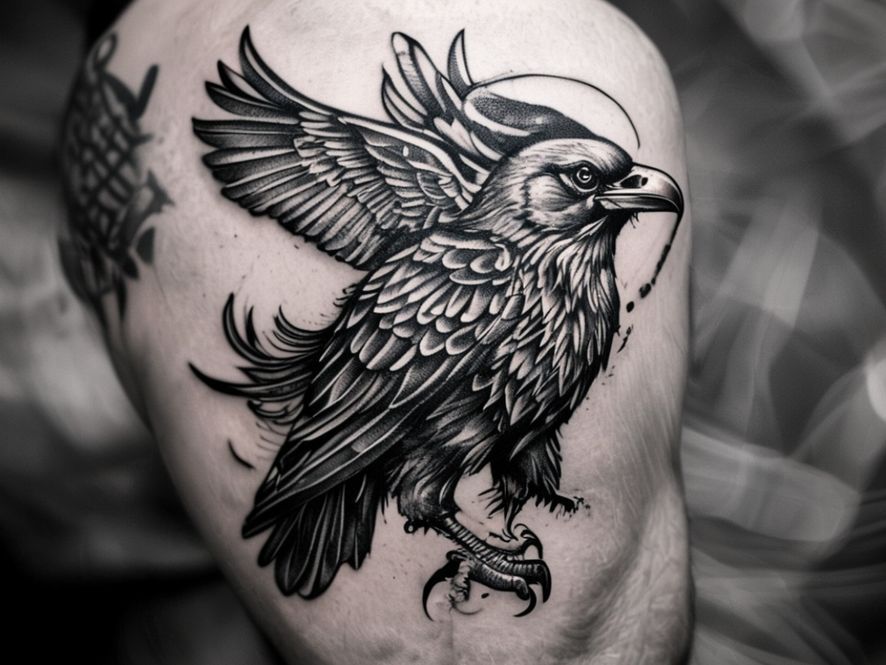
Huginn and Muninn Tattoo: Odin's Ravens
Huginn and Muninn are Odin's two ravens, and their names translate straightforwardly: "Thought" and "Memory" — hugr and munr in Old Norse. Every morning, the Grímnismál reports, they fly over Midgard, traverse the world, and return in the evening to perch on the god's shoulders to tell him what they have seen. The Huginn Muninn tattoo replicates this exact arrangement: two birds on either side of the body, thought on one side, memory on the other.
Stanza 20 of the Grímnismál adds an unexpected note, which is rarely cited: in it, Odin confesses his fear of not seeing them return — and he specifies that the loss of Muninn would worry him more than that of Huginn. The god who knows everything thus fears losing his memory even more than his thought. This divine anxiety is what gives the motif its true depth: these are not merely two symmetrical ornaments, but two unequal faculties, one of which is more precious and more fragile than the other. This is also what explains the enduring popularity of the Huginn Muninn tattoo.
If you are reading these lines, it is undoubtedly because you are considering wearing these two winged messengers on your own skin. You are right. The Huginn and Muninn tattoo, Odin's ravens, is one of the deepest and most meaningful motifs in the entire universe of Nordic tattooing. Let us dive together into their history, their meaning, and the designs that honor them best.
📌 In Brief
- Huginn (thought) and Muninn (memory) are Odin's two ravens.
- An Odin's ravens tattoo symbolizes wisdom, memory, and consciousness.
- The most common placements are the two ravens mirrored on the pectorals, one on each shoulder, or in flight across the upper back.
- A single raven is a valid choice. Choose Huginn if you value thought and analysis, or Muninn if you value memory and intuition.
- In the Grímnismál, Odin expresses more fear for Muninn (memory) than for Huginn (thought).
Odin's ravens are just one motif among many. To compare symbols, their sources, and the formats that suit them, see our Viking tattoo guide.
Huginn and Muninn in the Eddas: Thought and Memory in the service of the All-Father
To understand the power of the Huginn Muninn tattoo, one must go back to the foundational texts of Norse mythology. It is in the Poetic Edda, and more specifically in the Grímnismál (The Sayings of Grímnir), that we find the most famous stanza dedicated to Odin's two ravens.
« Huginn ok Muninn fljúga hverjan dag— Grímnismál, stanza 20, Poetic Edda
Jörmungrund yfir;
óumk ek of Hugin, at hann aptr né komi-t,
þó sjámk meir of Munin. »
Which can be translated as: "Huginn and Muninn fly every day over the vast earth. I fear for Huginn that he may not return, yet I am more worried for Muninn." This stanza has dizzying depth. Odin, the supreme god, the All-Father, here confides his vulnerability. He who sacrificed an eye for wisdom, he who hung nine days from the Yggdrasil world tree to obtain the runes, fears losing his memory above all else. For without memory, thought itself has no foundation.
Huginn — whose name comes from the Old Norse hugr, thought, spirit — represents the capacity to analyze, reason, and plan. It is active intelligence, the kind that decides and discerns. Muninn — from munr, memory, recollection — embodies the link to the past, accumulated experience, and wisdom drawn from what has been lived. Together, they form the two pillars of consciousness. Each morning, at dawn, Odin sends them to fly over Midgard, the world of men. Each evening, they return to perch on his shoulders to bring him everything they have seen and heard.
In Snorri Sturluson's Prose Edda, in the Gylfaginning chapter, it is stated that Odin gave them the power of speech. They are not mere birds: they are extensions of the god himself, fragments of his consciousness sent to explore the nine worlds. This is why Odin, the supreme god of Norse mythology, bears the kenning Hrafnaguð, the Raven-God.
Their role as Odin's spies across the nine worlds
This informant role is taken seriously in the texts: Odin bears the nickname Hrafnaguð, "the raven-god." The association is by no means gratuitous. Ravens actually followed armies, and their presence on a battlefield signaled death. When a skaldic poet writes that Odin feeds his birds, he is stating a perfectly raw truth — the dead serve as their meal.
Huginn and Muninn do not merely fly over Midgard. The texts suggest that they travel through all nine worlds linked by Yggdrasil: from the icy Niflheim to the furnaces of Muspellheim, from the golden halls of Asgard to the depths of Hel. They are omniscient by proxy, offering Odin a total vision of the universe. It is this omniscience that the wearer of a Huginn Muninn tattoo seeks to invoke: the capacity to see all, understand all, and remember all.
Odin's ravens also appear in other sources. The poem Völuspá mentions them indirectly when it discusses the omens of Ragnarök. The Icelandic sagas often refer to ravens as messengers or guides for navigators. The legendary Flóki Vilgerðarson, who discovered Iceland, took three ravens on his ship to find land. This link between the raven, navigation, and discovery reinforces the exploratory dimension of the Odin's ravens tattoo.
Significance of the Huginn Muninn tattoo: intelligence, wisdom, and inner vision
When a man or woman chooses to get a Huginn Muninn tattoo, he or she is not just choosing a beautiful animal motif. It is a philosophical commitment. Here are the deepest meanings associated with this tattoo:
The thought-memory duality. The tattoo reminds us that intelligence without memory is blind, and that memory without thought is sterile. Wearing Huginn and Muninn is an affirmation that one cultivates both. It is the sign of a complete spirit, capable of drawing lessons from the past to enlighten the decisions of the present.
The quest for knowledge. Odin sacrificed everything for knowledge. His eye, his comfort, his security. The Huginn and Muninn tattoo honors this unquenchable thirst to understand the world. It is suitable for those who place knowledge above brute force.
Vigilance and vision. The ravens see what others do not. They perceive threats before they manifest. The tattoo symbolizes a heightened state of consciousness, a constant attention to the world around us. For those who wear a Viking raven pendant, this symbolism extends into everyday objects.
The link to Odin. More than an abstract symbol, the Huginn Muninn tattoo is a devotion to the All-Father. It belongs to the same family as the Valknut tattoo, the sacred symbol of Odin. Together, these motifs form a visual language of loyalty to the god of wisdom and war.
The resilience of the spirit. Odin fears losing his ravens, but every day he sends them back out. This is an act of courage: risking what one holds most precious because stagnation would be worse than loss. The tattoo embodies this philosophy of calculated risk and intellectual courage.
« Thought without memory is a ship without a rudder. Memory without thought is a port without a ship. He who wears both ravens on his skin navigates between worlds with the blessing of the All-Father. »— Le Comptoir Viking
Ravens in Viking culture: from banner to battlefield
The raven occupies a central place in Nordic civilization far beyond mythology. On battlefields, it was the first to arrive and the last to leave. Viking warriors considered the presence of ravens before a fight to be a favorable sign: Odin himself was sending his messengers to observe the scene.
The most striking example is the Hrafnsmerki, the raven banner. This war flag, described in several sagas and Anglo-Saxon chronicles, bore the image of an embroidered black raven. The Orkneyinga Saga recounts that the mother of Jarl Sigurd Hlodvirsson wove such a banner and prophesied: whoever carried it into battle would win victory, but the bearer of the banner would die. It was a pact with Odin — victory in exchange for sacrifice, exactly as the god himself had practiced throughout his life.
The Anglo-Saxon Chronicles mention that the sons of Ragnar Lodbrok used a raven banner during their invasions of England. It is said that when the banner fluttered in the wind and the raven appeared to be flapping its wings, victory was assured. If the banner hung limp, defeat was certain. The raven thus became a living war oracle.
This omnipresence of the raven in warrior culture gives an additional dimension to the Huginn Muninn tattoo. It is not just an intellectual symbol: it is also an emblem of combat, strategy, and destiny. The warrior who wore the raven on his shield or banner identified with Odin's companions. Those who wear it on their skin today perpetuate this thousand-year-old tradition.
To deepen this connection between tattooing and Nordic warfare, discover our article on full-back Viking tattoos, where ravens often find their place in vast narrative compositions.
Design styles for a Huginn and Muninn tattoo
That leaves the question of style. Tattoo artists today have a palette infinitely broader than what can be reconstructed from any ancient Nordic tattoo — the very existence of which, let us recall, is not established. Here are the most common approaches to bringing Huginn and Muninn to life.
The realistic style. The ravens are depicted with photographic realism, each feather detailed, their eyes shining with intelligence. This style highlights the natural beauty of the common raven (Corvus corax), the species that actually populated Scandinavia and accompanied Viking armies. A realistic Huginn Muninn tattoo is spectacular in large format, particularly on the back, chest, or a full arm.
The traditional Nordic style. Inspired by Viking art itself — the interlaces, knots, and stylized animal motifs found on rune stones and jewelry. The ravens become sinuous shapes, their bodies blending with knotwork patterns. This style is ideal for those who want a tattoo of Odin's ravens that is authentically rooted in historical aesthetics. Wear this aesthetic daily with a Viking Odin ring to complement your ink.
The geometric style. The ravens are constructed from pure geometric shapes: triangles, circles, and straight lines. This modern style creates a striking contrast between ancestral symbolism and contemporary aesthetics. Sacred elements like the Valknut or the Vegvísir can be integrated into the geometric composition to strengthen the mythological connection.
The minimalist style. For those who prefer discretion, a minimalist Huginn Muninn tattoo reduces the ravens to their essential lines. A few strokes of black ink are enough to evoke the two silhouettes in flight. This style works remarkably well in small format on the wrist, the nape of the neck, or behind the ear.
The rune style. The ravens are accompanied by inscriptions in Elder Futhark runes. The Ansuz (ᚨ) rune, associated with Odin and communication, and Mannaz (ᛗ), linked to human intellect, are particularly relevant choices to frame a Huginn and Muninn tattoo. Some artists incorporate the 20th stanza of the Grímnismál in runes, creating a piece of exceptional textual and visual richness.
The dotwork style (pointillism). The dotwork technique, composed of thousands of meticulously placed dots, gives the ravens an almost spectral texture. The gradients obtained by the varying density of the dots evoke the mist of the Nordic lands and the "between-worlds" nature of Odin's messengers. This style lends itself beautifully to large pieces.
The best placements for a Huginn Muninn tattoo
The choice of placement is as important as the design itself. Each placement tells a different story.
The shoulders and shoulder blades. This is the placement most faithful to the mythology. Odin carried his ravens on his shoulders: Huginn on the left, Muninn on the right (or vice-versa depending on the interpretation). Getting a raven tattooed on each shoulder blade replicates this arrangement exactly. The wings can extend toward the spine, creating a bridge between the two birds — between thought and memory.
The chest. A Huginn Muninn tattoo centered on the chest, with the ravens facing each other or in symmetrical flight on either side of the sternum, creates a composition of remarkable visual power. The heart beats between the two ravens, as if thought and memory were protecting the wearer's life essence.
The full arm (sleeve). Integrated into a Nordic sleeve, the ravens can be part of a larger visual narrative: Yggdrasil in the background, runes along the forearm, Odin enthroned at the shoulder, and his ravens descending in flight along the bicep. This type of ambitious composition makes the arm a true mythological parchment.
The forearm. For a tattoo visible daily, the forearm is an excellent choice. The two ravens can be arranged as a mirror image on the inner or outer face, or a single raven can occupy each forearm. This placement allows the tattoo to be shown or hidden depending on the circumstances.
The nape of the neck and upper back. A discreet but powerful placement. The ravens seem to watch behind the wearer, silent guardians of their past. This placement evokes protection, a vigilance of what comes from behind — just like Muninn, who keeps the memory of what has passed.
To complement your tattoo and assert your belonging to the Nordic heritage in your daily life, explore our Odin's Ravens collection: necklaces, rings, clothing, and decor featuring the messengers of the All-Father.
Composing your tattoo: complementary elements to Huginn and Muninn
A Huginn and Muninn tattoo gains depth when paired with other symbols from Norse mythology. Here are the elements that best pair with Odin's ravens:
The Valknut. Odin's triple knot, a symbol of fallen warriors and the passage between worlds. Placed between the two ravens, it forms a triptych dedicated to the All-Father with perfect symbolic coherence.
Gungnir the spear. Odin's legendary weapon, which never misses its target. The ravens perched on the shaft of Gungnir form an image drawn directly from the descriptions in the Eddas.
Yggdrasil. The world-tree upon which Odin sacrificed himself. The ravens in flight around its branches evoke their daily journey through the nine worlds.
Odin's Eye. A single eye, often represented with runes or flames, recalling Odin's sacrifice at Mímir's well. Combined with the ravens, it forms a complete symbolic portrait of the Raven God.
The Ansuz and Mannaz runes. Ansuz (ᚨ) is the rune of Odin, divine wisdom, and communication. Mannaz (ᛗ) is the rune of humanity and intelligence. Etched around the ravens, they reinforce the spiritual dimension of the Huginn Muninn tattoo.
The legacy of the scout: what the ravens whisper
A word, in closing, on what this motif truly entails. The two ravens are not a neutral ornament: they belong to Odin, the god who paid for his knowledge with an eye and nine nights of hanging. Choosing it means choosing a profoundly ambivalent figure — the god of wisdom is also the god of trickery, war, and broken oaths.
This is perhaps what explains the longevity of the Huginn Muninn tattoo: it does not proclaim "I am strong," it says "I watch and I remember." Placed on the shoulders, the two birds occupy exactly the position they hold with Odin — one for what we think, the other for what we must not forget. Few Nordic motifs are as faithful to the text while remaining so readable to those unfamiliar with the mythology.
It is this power of transmission that every Huginn and Muninn tattoo carries today. This is not a motif one chooses lightly. It is a commitment to oneself: to always think with acuity, to always remember with fidelity, to always send one's mind to explore the unknown even when the fear of not seeing it return grips us.
"I fear for Huginn that he will not return, but I am more anxious for Muninn." Whoever carves these words into their flesh accepts the oldest truth of the Northern peoples: memory is more precious than thought, for it is what gives meaning to everything else.— Grímnismál, stanza 20, Poetic Edda
Whether you are drawn to Norse mythology, passionate about the art of tattooing, or simply looking for a symbol that carries centuries of wisdom within it, the Huginn Muninn tattoo is a choice of rare depth. Odin's two ravens are not mere birds. They are thought and memory incarnate, the spies of the supreme god, the guardians of the universe's knowledge. Wearing them on your skin means becoming a messenger yourself — a bridge between the ancient world and the modern world, between what was and what will be.
Send your ravens. Do not fear that they will not return. For it is in the flight that they find their purpose, and it is in the ink that they find eternity.
Frequently Asked Questions about Huginn and Muninn
Who are Huginn and Muninn?
Huginn (Thought) and Muninn (Memory) are Odin's two ravens. Each morning, they fly over Midgard to observe the world and report everything they have seen and heard to Odin in the evening. They symbolize the supreme god's perpetual quest for knowledge.
What does a Huginn and Muninn tattoo symbolize?
A tattoo of Odin's ravens symbolizes wisdom, memory, and consciousness. Huginn represents analytical thought and reflection; Muninn represents memory and intuition. Together, they embody the balance between reason and instinct.
Where should a Huginn and Muninn tattoo be placed?
The most popular placements are: the two ravens mirrored on the pectorals, one on each shoulder, in flight on the upper back, or together on one forearm. The duo design naturally lends itself to symmetrical placements.
Can you tattoo only one of Odin's ravens?
Yes, a single raven is a valid choice. Choose Huginn if you value thought and analysis, or Muninn if you value memory and intuition. Odin himself says in the Edda: I fear for Huginn that he will return, but I fear more for Muninn.
Why does Odin fear losing Muninn more?
In the Grímnismál, Odin expresses more fear for Muninn (memory) than for Huginn (thought). The interpretation is that losing one's memory — one's identity, history, and bonds — is more terrifying than losing the capacity to reflect. It is a profound reflection on human nature.
Is the raven a negative symbol?
Not in Nordic culture. The raven is a symbol of wisdom, battle, and prophecy. The Vikings used the Hrafnsmerki (raven banner) in combat. The raven was respected as a messenger between worlds, not feared as a symbol of misfortune.
👉 Explore our collections of Viking necklaces and Viking jewelry to carry the Viking spirit every day.
The two ravens can be worn just as they can be tattooed: our Huginn & Muninn collection gathers pieces featuring them.

Leave a comment
All comments are moderated before being published.
This site is protected by hCaptcha and the hCaptcha Privacy Policy and Terms of Service apply.