
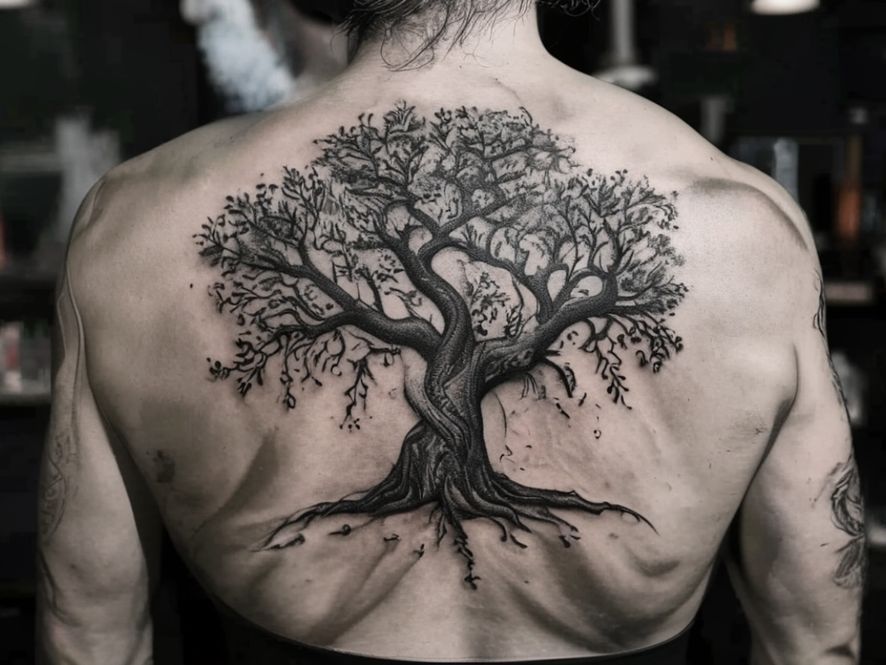
Full Back Viking Tattoo: Ideas and Designs
There was a jarl they called Sigurd Back-Carved. When he removed his wool tunic before battle, his men no longer saw a man: they saw a saga. From his shoulder blades to his loins, his back told the tale of a longship falling in a storm, the fury of Odin riding Sleipnir through the nine worlds, and the roots of Yggdrasil plunging into the darkness of Niflheim. Every line of ink had been earned in iron and blood. Every motif was an oath carved into his flesh. That is what a full back Viking tattoo is: not just a mere decoration, but an epic narrative worn on the largest canvas the human body can offer.
If you are reading these lines, it is because you, too, feel the call. The desire to transform your back into a fresco worthy of the runestones of Gotland or the tapestries of Oseberg. This guide is designed to accompany you step by step: from the most striking compositions to artistic styles, including the time, budget, and maintenance necessary to see this monumental project through. Prepare yourself: the road to a full back Viking tattoo is as intense as Odin's quest for the runes.
📌 In Brief
- The most spectacular designs for the back are Yggdrasil unfurling its roots and branches, a longship on the open sea, or a battle scene.
- A full back Viking tattoo generally requires 30 to 60 hours of work, spread over 6 to 12 sessions of 4 to 6 hours.
- A full back costs between 3,000 and 8,000 euros in France depending on the artist and the level of detail.
- Pain varies depending on the area of the back. The spine, shoulder blades, and ribs are the most sensitive areas.
- It is even recommended to start with a central piece—Vegvisir, Yggdrasil, or Mjölnir—on the upper back, then expand with knotwork and runes.
The back is the most engaging format, but it is not the only one. Our Viking tattoo guide compares placement options and explains what motifs each allows.
The Most Epic Full Back Compositions
The back offers an area of approximately 3,000 cm², making it the ideal playground for complex narrative scenes. When it comes to full back Viking tattoos, three major families of composition dominate the Norse imagination and the portfolios of the best tattoo artists.
The Battle Scene: Ragnarök on Your Back
Nothing embodies the Viking spirit better than a titanic battle scene displayed across the entire back. Imagine Ragnarök itself: in the center, Odin wielding Gungnir against the wolf Fenrir, while Thor confronts the serpent Jörmungandr in an outburst of lightning. On the flanks, einherjar warriors emerge from Valhalla, shields raised, axes in hand. The sky tears open, Surtr's flames set the horizon ablaze.
This type of composition works in successive planes. The foreground features the main combatants with maximum detail. The second plane houses the armies, longships, and mythological creatures. The background, often lighter in ink, suggests cosmic chaos: smoke, lightning, ruins of Asgard. For a Viking backpiece centered on battle, plan for a tattoo artist specialized in large figurative pieces who masters depth and perspective.
"Brothers will fight and kill each other, sisters' children will defile the bonds of blood. Hard times it is, an age of the axe, an age of the sword, shields are cloven."— Völuspá, The Seeress's Prophecy
The Longship in a Storm: The Legendary Crossing
The longship is the quintessential symbol of Viking adventure. On a full back, it takes on a spectacular dimension. The classic composition places the ship in the center, prow sculpted with a dragon's head, cutting through monstrous waves. The crew rows relentlessly, the square sail flapping in the spray-laden wind. Above, a stormy sky where Odin's ravens—Huginn and Muninn—are outlined, guiding the sailors toward unknown lands.
What makes this type of Norse backpiece so powerful is its ability to use the natural movement of the body. The waves follow the curves of the ribs, the mast follows the spine, and the sail spreads majestically between the shoulder blades. Experienced tattoo artists exploit this anatomy to create a striking illusion of movement. To delve deeper into the symbolism of Odin's ravens that often adorn the sail or the sky of these compositions, discover our article on the Huginn and Muninn tattoo.
Yggdrasil: The World Tree Covering the Entire Back
Among all possible compositions, Yggdrasil is undoubtedly the one that adapts most naturally to the morphology of the back. The massive trunk of the cosmic ash tree aligns with the spine. Its tentacular branches extend toward the shoulders and neck, connecting the upper worlds—Asgard, Vanaheim, Alfheim. Its roots plunge toward the loins and hips, reaching Niflheim, Muspellheim, and Helheim.
An Yggdrasil backpiece allows for the integration of a multitude of narrative elements. In the branches, one can place the stag Eikthyrnir, the nameless eagle, or the runes of wisdom that Odin tore away after hanging for nine days. Around the roots, the dragon Nidhogg tirelessly gnaws at the sacred wood, while the squirrel Ratatoskr runs along the trunk, a messenger of discord between the eagle and the serpent. To deeply explore the meaning of this sacred tree, consult our complete guide on the Yggdrasil and World Tree tattoo.
Lovers of Norse mythology who wish to wear Yggdrasil daily, even outside the tattoo parlor, will appreciate our Viking Yggdrasil Wolf Steel Necklace, a tangible reminder of the tree that connects all worlds.
How to Structure a Viking Backpiece: The Art of Composition
A successful full back Viking tattoo is not just an accumulation of symbols. It is a work structured with the rigor of a master builder of stave churches. Here are the fundamental principles for structuring your backpiece.
The central focal point. Every backpiece needs a dominant element that immediately catches the eye. It usually occupies the center of the back, between the shoulder blades and the middle of the back. It is your main subject: Odin's face, a longship prow, the trunk of Yggdrasil, a Fenrir wolf head, or a monumental Valknut. This focal point must be the most detailed, the most contrasted, and the most imposing of the entire piece.
Secondary elements. Around the focal point, supporting elements enrich the narrative. Ravens in flight, intertwined serpents, warriors in combat positions, runes arranged in a crescent. These elements occupy the lateral areas—flanks, sides of the shoulder blades—and create movement around the center. For a design integrating Odin's sacred symbol, the Valknut tattoo makes for a particularly powerful focal point or secondary element.
Background and fill. This is what separates an amateur backpiece from a masterpiece. The background can be composed of Celtic knotwork patterns, runestone textures, smoke, stormy clouds, or Norse geometric motifs. Filling ensures visual cohesion: it connects the elements and eliminates unsightly empty spaces. A good tattoo artist uses gray shading, dotwork, or hatching to create depth without overloading the design.
Framing. The borders of your tattoo define its territory on the body. A full back Norse tattoo can stop abruptly at the shoulders and waist for a "panel" effect, or conversely, fade gradually toward the arms and hips for an organic transition. Some tattoo artists create an ornamental knotwork frame that surrounds the entire piece, similar to the illuminations of Viking manuscripts.
"I know that I hung on a windy tree, nine nights long, wounded with a spear and given to Odin, myself to myself, on that tree of which no man knows from where its roots run."— Hávamál, The Sayings of the High One
Recommended Styles for Large Viking Pieces
The choice of artistic style is a crucial decision for a full back Viking tattoo. Each style brings a radically different atmosphere to the same mythological scene.
Neo-Norse (Neo-Norse). This modern style is directly inspired by historical Viking art—runestones, bronze brooches, stave church carvings—but reinterprets them with a contemporary technique. Thick, geometric lines, complex knotwork patterns, stylized beasts in the Urnes or Mammen style. Neo-Norse is ideal for those who want a tattoo that is both authentic in its aesthetic and legible from a distance. On a full back, it produces the effect of a monumental tapestry. Black/skin contrasts are usually sufficient, without the need for color.
Black and gray realism. For narrative scenes—battles, landscapes, portraits of gods—black and gray realism is king. It allows for the creation of metal textures on armor, striking facial expressions on warriors, and plays of light in storms. This style requires a technically exceptional tattoo artist, as the slightest error in proportion on such a large piece will be visible. Realism excels particularly for compositions centered on the longship or the battle scene, where depth and movement are essential.
Nordic Trash Polka. This bold style blends realism, abstract graphics, ink splashes, and typography. Applied to the Viking universe, it produces striking results: a hyper-realistic portrait of the one-eyed Odin juxtaposed with runes in raw lettering, blood-red brushstrokes cutting through a black-and-grey battle scene. Trash polka is for those who want a Viking backpiece that stands out, shocks, and refuses convention. Beware: this style ages differently and requires a tattoo artist who perfectly masters the balance between chaos and structure.
Blackwork and dotwork. For a sacred and hypnotic effect, blackwork (intense solid black areas) combined with dotwork (dotted patterns) creates compositions of remarkable visual power. Nordic mandalas, geometric interlace, and sacred motifs come to life in this style. The Aegishjalmur (Helm of Awe), the Vegvisir, and endless knots become meditative works when executed in dotwork on an entire back.
Whatever style you choose, complete your Nordic warrior look with a symbolic piece of jewelry. The stainless steel Odin's Ravens Viking bracelet perfectly matches the aesthetic of a Nordic backpiece and extends the mythology beyond the skin.
Time and Budget: What You Really Need to Plan For
Let's be direct: a full-back Viking tattoo is a major investment, both in time and money. It is better to know this in advance to plan correctly and avoid unpleasant surprises.
Session duration. A full backpiece represents an average of 40 to 80 hours of work, spread over 10 to 25 sessions. Sessions generally last between 3 and 6 hours, depending on your pain tolerance and skin resistance. You must allow for a minimum of 2 to 3 weeks of healing between each session. In total, a full-back project spans 12 to 24 months, sometimes longer for the most ambitious compositions.
Overall budget. In France, a tattoo artist specializing in large pieces charges between 100 and 200 euros per hour. For a 50-hour backpiece at 150 euros/hour, the total budget reaches 7,500 euros. The most renowned artists may exceed 250 euros/hour, bringing the total to 12,000 euros or more. Do not try to save money on this project: a mediocre Nordic backpiece will follow you for life, while a masterpiece will be a source of eternal pride.
The creative process. Even before the first needle, plan for several consultation appointments with your tattoo artist. The preparatory drawing (the "stencil") for a full back can require 10 to 20 hours of artistic work beforehand. Some tattoo artists charge for this design work separately; others include it in the hourly rate. Always ask for a detailed quote and a projected schedule for the sessions.
Practical budget tips:
Set aside a fixed amount each month to build up your "war chest." Pay session by session rather than paying everything upfront. Some tattoo artists offer payment plans. Do not hesitate to start with the central part (the focal point) and gradually expand: this allows you to spread out the expenses while already wearing a coherent and standalone piece.
While waiting for your backpiece to take shape, proudly wear your Nordic passion with the antique steel hammered Valknut signet ring, a symbol of commitment to the warrior's path.
Care and Healing of a Full-Back Tattoo
A full-back Viking tattoo does not end when the needle stops. The healing phase is just as crucial as the tattoo artist's work. And on a surface as vast as the back, the challenges are amplified.
The first 48 hours. Your tattoo artist will apply a protective film (like Dermalize or Saniderm) to the tattooed area. Keep it on for 24 to 48 hours. Since the back is a zone of constant contact — chair backs, mattresses, clothing — this film is your best ally. Sleep on your stomach or side. Wear loose cotton clothing, preferably dark to mask any potential ink stains.
The first two weeks. After removing the film, gently wash the area with lukewarm water and pH-neutral soap, two to three times a day. Pat dry, never rub. Apply a thin layer of healing cream (like Bepanthen or an ointment recommended by your artist). The back will itch intensely: never scratch. Tap gently if the itching is unbearable. Avoid baths, swimming pools, saunas, and sun exposure.
The specific challenge of the back. Unlike the arm or leg, the back is a difficult area to reach yourself. You will need help applying the cream, especially in the middle and upper back. Arrange for a partner, friend, or family member ready to play nurse two to three times a day for two weeks. This is a logistical detail that is often overlooked but essential for the quality of healing for your large Viking piece.
Healing between sessions. Since your backpiece will be done in several sessions over several months, each new session will involve working next to already healed areas. Strictly respect the minimum delay of 3 to 4 weeks between two sessions on adjacent areas. The skin must be completely regenerated before receiving ink nearby. A professional tattoo artist will plan the sessions to alternate between areas of the back: upper part, then lower part, then the sides.
Long-term maintenance. Once the backpiece is finished and healed, maintenance becomes simpler but remains fundamental. Regularly hydrate the skin on your back with an unscented cream. Protect the tattoo from the sun with at least SPF 50 sunscreen when you are shirtless. UV rays are the number one enemy of ink: they fade blacks, yellow grays, and blur details. A well-protected Viking backpiece will retain its sharpness for decades.
"The coward believes he will live forever if he avoids the fight; but old age will grant him no peace, even if the spears spare him."— Hávamál, stanza 16
Choosing the Right Tattoo Artist for Your Backpiece
A full-back Viking tattoo project deserves an exceptional artist. Here are the non-negotiable criteria for selecting your tattoo artist.
The portfolio of large pieces. Specifically ask to see finished backpieces, not just medium-sized ones. A tattoo artist who is excellent at A5 formats might be unsuited for the proportions of a full back. Check for the consistency of compositions on large surfaces, the quality of gradients, and readability from a distance.
Nordic specialization. The Viking style has its own codes: interlace, runes, longship anatomy, morphology of mythological creatures. A generalist tattoo artist, however talented, risks producing an Yggdrasil that looks like an ordinary oak tree or a Mjölnir with awkward proportions. Look for an artist who knows and respects the Nordic aesthetic. Look at their references, their inspirations, their visual culture.
In-depth consultation. A good tattoo artist will ask you questions before drawing. Which saga inspires you? Which symbols have personal meaning for you? What is your pain threshold? Do you have professional constraints? This conversation is the foundation of your project. Beware of tattoo artists who offer you a standard design without seeking to understand your story. To get inspiration from other Viking tattoo placements, consult our guide on men's Viking arm tattoos, which can wonderfully complement a backpiece extending onto the shoulders.
The Full Back: A Commitment Worthy of a Viking Oath
A full-back Viking tattoo is not an aesthetic whim. It is a deep commitment, comparable to the blood oaths sworn by brothers-in-arms in the sagas. Months of sessions, thousands of euros invested, dozens of hours of endured pain — all this to carry a story on yourself that will outlive you.
But it is precisely this intensity that makes the Viking backpiece so powerful. When the last line is drawn, when the last scab has fallen off, and you look at yourself in the mirror, back turned, you will no longer simply see tattooed skin. You will see Ragnarök rumbling between your shoulder blades. You will see the roots of Yggdrasil plunging toward the unknown. You will see a longship cutting through the primordial ocean, carried by the wind of your breathing.
You will see your saga. And like Sigurd Dorsacré, you will know that every line of ink was earned.
May the Norns weave a design worthy of your courage. Skál.
Frequently Asked Questions About Viking Back Tattoos
Which Viking designs are suitable for a full back?
The most spectacular designs for the back are: Yggdrasil (World Tree with roots and branches spread out), a longship on the open sea, a Viking battle scene, or the Vegvisir centered and surrounded by interlace and runes covering the entire back.
How long does a full-back Viking tattoo take?
A Nordic-style full-back tattoo generally requires 30 to 60 hours of work, spread over 6 to 12 sessions of 4 to 6 hours each. Complex Nordic interlace and shaded details are particularly time-consuming.
How much does a full-back Viking tattoo cost?
A full back costs between 3,000 and 8,000 euros in France depending on the tattoo artist and the level of detail. Artists specializing in the Nordic style may charge more for their expertise. It is a significant investment that spans several months.
Is a back tattoo painful?
Pain varies depending on the areas of the back. The spine, shoulder blades, and ribs are the most sensitive areas. The center of the back and the fleshy areas are more bearable. Long sessions require good resistance to pain.
Can you start with a partial piece and enlarge it later?
Yes, it is even recommended. Start with a central piece (Vegvisir, Yggdrasil, or Mjölnir) on the upper back, then enlarge it by adding interlace, runes, and narrative elements over the sessions. A good tattoo artist will plan the extension from the start.
What style should I choose for a Viking full back?
The most impactful styles are blackwork (intense black, strong contrasts), neo-Nordic (realistic details + traditional interlace), and dotwork (geometric pointillism). Blackwork is the most popular for large Viking pieces because it ages well.
👉 Discover our collection of Viking jewelry and carry the Viking legacy with you every day.

Leave a comment
All comments are moderated before being published.
This site is protected by hCaptcha and the hCaptcha Privacy Policy and Terms of Service apply.