
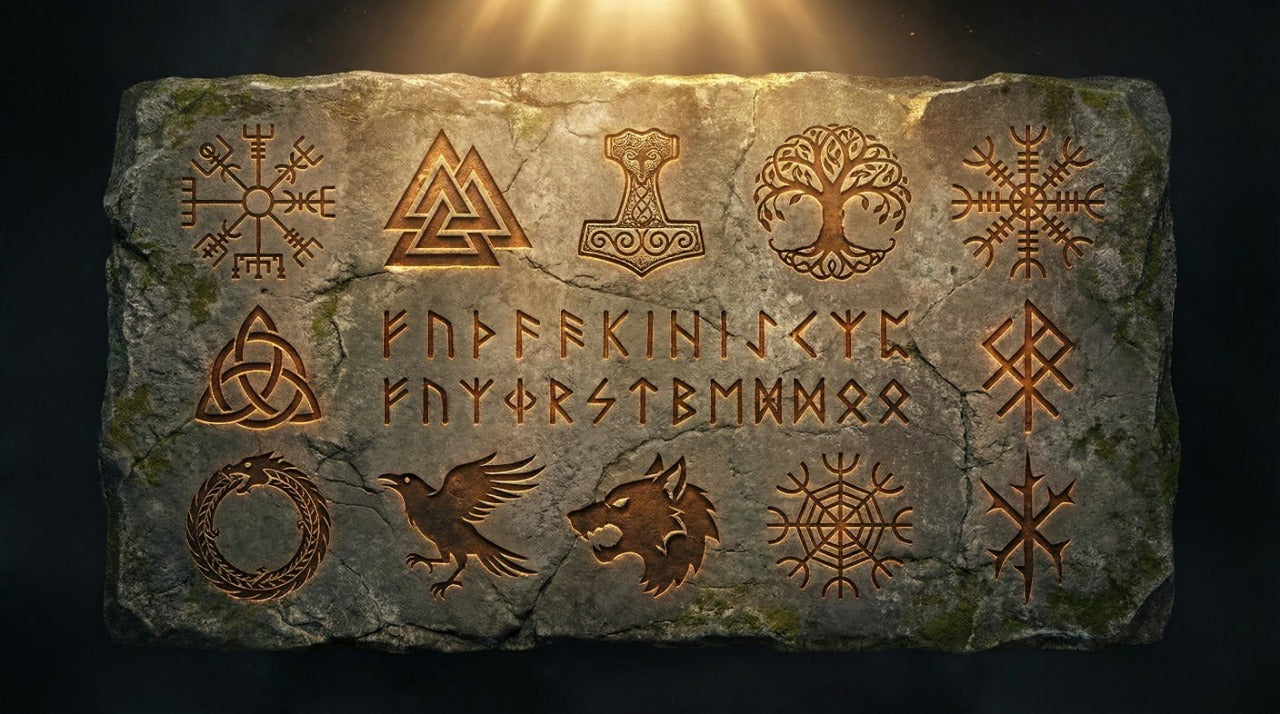
The 17 Viking Symbols and Their Profound Meaning
Viking symbols are everywhere: tattooed on arms, engraved in Viking jewelry, embroidered on clothing. But do you know their true meaning? Behind every motif lies a millennium of mythology, magic, and deep-seated Nordic beliefs. This guide unveils the 17 most iconic symbols of Viking culture.
Historical sources: Norse mythology — Wikipedia | Runes — Wikipedia | Viking art — Wikipedia
📍 To explore where these symbols traveled with the Vikings, discover our interactive map of Viking raids and expeditions (793-1066, 42 sites mapped).
📌 In Brief
- The Ægishjálmur (Helm of Awe) was considered the most powerful protective symbol.
- The Vegvisir is an 8-pronged magic compass that guides the traveler — it is a symbol of navigation and orientation.
- Viking symbols were deeply linked to galdrastafir, the magic of runic staves.
- Vikings often combined symbols with each other (bindrunes).
- It depends on what you are looking for: the Vegvisir for guidance, the Valknut for fate and the memory of warriors, Mjölnir for strength and protection.
1. The Vegvisir — The Viking Compass

Origin and history of the Vegvisir
The Vegvisir (pronounced "veg-vee-seer") means "path finder" in Old Norse. This magic 8-pronged compass appears in the 19th-century Icelandic Huld manuscript with this inscription: "The bearer of this sign shall not lose his way, even in storms and bad weather, even if the destination is unknown."
Each of the eight branches of the Vegvisir points toward a cardinal or intercardinal direction, forming a mystical compass rose. Viking sailors engraved it on the bows of their drakkars to ensure they would never lose their way while crossing the North Atlantic.
Profound meaning
Meaning: Guidance, protection of travelers, the ability to find one's way through adversity. The Vegvisir is currently one of the most popular Viking symbols to have tattooed globally — it embodies the quest for meaning and determination in the face of life's challenges.
Wearing the Vegvisir as jewelry
The Vegvisir Necklace and the Vegvisir Signet Ring allow you to wear it around your neck or on your finger. Discover our entire collection of Viking jewelry inspired by this symbol.
2. The Valknut — The Knot of the Slain

Origin and history of the Valknut
Three interlocked triangles, nine points — the Valknut (literally "knot of the slain") is the most sacred symbol of Odin. It is found engraved on funerary stones on the island of Gotland and on ritual objects linked to the cult of the dead.
Archaeologists have discovered the Valknut on the famous Stora Hammars stone in Sweden, depicted alongside scenes of human sacrifice. The nine points of the symbol relate to the Nine Worlds of Nordic cosmology — a reminder that death is only a transition to another realm.
Profound meaning
Meaning: Transition between life and death, courageous acceptance of fate, link to Valhalla. Wearing the Valknut is to affirm that one does not fear death and fully embraces one's warrior destiny.
Wearing the Valknut as jewelry
The Gold Valknut Signet Ring or the Valknut Dragon Necklace.
3. Mjölnir — The Hammer of Thor

Origin and history of Mjölnir
Mjölnir is likely the oldest and most widespread Viking symbol. Hundreds of hammer-shaped pendants have been found throughout Scandinavia, from the Faroe Islands to Russia. Thor used his hammer to protect gods and men against the ice giants.
According to the Eddas, Mjölnir was forged by the dwarves Sindri and Brokkr during a bet with Loki. Its handle is shorter than intended (Loki, transformed into a fly, distracted the blacksmith), but its power is unmatched: it always returns to Thor's hand after being thrown, and every strike triggers lightning.
Profound meaning
Meaning: Strength, protection, blessing (Viking weddings were blessed with Mjölnir), fertility. During the Christianization of Scandinavia, Vikings wore Mjölnir pendants in response to Christian crosses — it was a cultural identity symbol of resistance.
Wearing Mjölnir as jewelry
The Mjölnir Valknut Necklace, the Mjölnir Bracelet, and the Mjölnir Triquetra Signet Ring allow you to wear this sacred symbol daily. To learn everything about the meaning, choice, and wearing of this Nordic amulet, check our complete guide to the Mjölnir necklace. For some fun, check out our Mjölnir Bottle Opener for your feasts.
4. Yggdrasil — The World Tree

Origin and history of Yggdrasil
The cosmic ash tree Yggdrasil connects the Nine Worlds of Norse cosmology. Its roots reach into the wells of wisdom, its trunk passes through Midgard (the world of men), and its crown touches Asgard (the realm of the gods).
At the foot of Yggdrasil reside the three Norns (Urd, Verdandi, and Skuld), who weave the fate of all living beings. The tree is also home to the squirrel Ratatoskr, who constantly runs along the trunk to spread discord between the eagle perched in the crown and the dragon Nídhögg, who gnaws at the roots. Yggdrasil is the central axis of all Norse cosmogony.
Deep meaning
Meaning: Universal interconnection, cycle of life, cosmic wisdom, balance between worlds. Yggdrasil teaches us that everything is connected — every action has repercussions in all realms of existence.
Wearing Yggdrasil as jewelry
The Yggdrasil Necklace and the Oval Yggdrasil Signet Ring. Discover also our Viking decorations and Viking statues representing the World Tree.
5. The Ægishjálmur — The Helm of Awe

Origin and history of the Ægishjálmur
The Ægishjálmur (pronounced "eye-gis-hyal-mur") is composed of eight tridents radiating from a center. Viking warriors would trace it on their foreheads with blood or soot before battle. The sagas state that it made its wearer invincible and terrified their enemies.
In the Saga of Fáfnir, the dragon Fáfnir wore the Ægishjálmur between his eyes, which made him so terrifying that no one dared face him — until the hero Sigurd killed him by guile. This symbol belongs to the galdrastafir, the Icelandic magic tradition of staves (magical staffs), a practice inherited from ancient Norse sorcery.
Deep meaning
Meaning: Ultimate protection in battle, psychological dominance, invincibility. The Ægishjálmur is often confused with the Vegvisir — but while the Vegvisir guides, the Ægishjálmur protects and terrifies.
Wearing the Ægishjálmur as jewelry
The Ægishjálmur Necklace and the Ægishjálmur Watch. Discover also our Viking watches adorned with symbols of protection.
6. The Triquetra — The Celtic Knot
The Triquetra — three interlocking arcs forming an endless knot — is a symbol shared between Celtic and Norse cultures. Vikings used it on their jewelry, weapons, and rune stones. It represents the three interconnected aspects of existence.
Meaning: Trinity (earth/sea/sky, birth/life/death, past/present/future), eternal cycle, unity in diversity.
Worn as jewelry: The Triquetra Ring, the Triquetra Necklace, or the Triquetra Anti-Stress Spinner Ring.
7. The Futhark Runes — The Sacred Alphabet
The 24 runes of the Elder Futhark are not mere letters. According to mythology, Odin hung for nine days on Yggdrasil, pierced by his own spear, to tear the secret of the runes from the cosmic forces. Each rune carries a name, a sound, and above all, a unique magical power:
- ᚠ Fehu — Wealth and prosperity → Vegvísir & Futhark Runes Necklace
- ᛉ Algiz — Divine protection → Aegishjalmur Necklace
- ᚨ Ansuz — Odin's wisdom, communication → Elder Futhark Runic Ring Necklace — Read the article
- ᛊ Sowilo — Victory and sun → Gold Runic Ring Necklace
- ᛟ Othala — Heritage and lineage → Runic Ring Necklace on cord
To wear the entire alphabet, the Futhark Runes Bangle Bracelet has the 24 runes engraved all around the wrist. And for runic divination, our 25-piece Wooden Rune Set with guide is ideal.
8. Jörmungandr — The World Serpent
The Midgard Serpent, Jörmungandr, is so immense that it encircles the entire earth by biting its own tail — forming an ouroboros. Son of Loki, he is the sworn enemy of Thor, and their final battle will decide the fate of the world during Ragnarök.
Meaning: Infinite cycle, destruction and renewal, primal power.
Worn as jewelry: The Jörmungandr Serpent Ring wraps around the finger like the serpent around the world. Other serpent and dragon jewelry and items can be found in our Norse dragons and serpents section.
9. Huginn and Muninn — Odin's Ravens
Huginn ("Thought") and Muninn ("Memory") are Odin's two ravens. Every morning, they fly over the Nine Worlds and report everything they have seen and heard to the All-Father. Odin feared losing Muninn more than anything — for without memory, even thought loses its meaning.
Meaning: Wisdom through observation, ancestral memory, knowledge of the world.
Worn as jewelry: The Prestige Odin's Raven Necklace and the Odin's Ravens Bracelet.
10. Fenrir — The Giant Wolf

Origin and history of Fenrir
Fenrir, the monstrous wolf son of Loki, was so powerful that even the gods feared him. Chained by the gods' ruse at the cost of Týr's hand, he will break free during Ragnarök to devour Odin himself.
The Aesir had the dwarfs forge the magical chain Gleipnir, woven from six impossible ingredients: the sound of a cat's footfall, the beard of a woman, the roots of a mountain, the tendons of a bear, the breath of a fish, and the spittle of a bird. Only the god Týr, through an act of supreme bravery, dared to place his hand in Fenrir's mouth as a gesture of good faith — and lost it when the wolf realized the trickery.
Deep meaning
Meaning: Indomitable strength, inevitable fate, wild freedom. Fenrir represents the forces of chaos that even the gods cannot control forever — a reminder that nature always reclaims its rights.
Wearing Fenrir as jewelry
The Wolf Head Plate Bracelet and the Wolf Tooth Necklace. Also explore our Viking relics and artifacts related to mythological creatures.
11. The Web of Wyrd — The Web of Fate
The Web of Wyrd is formed of nine interlocking lines that contain all the shapes of the runes. It represents the fabric of fate as the Norns — the three Norse spinners of fate — weave it at the foot of Yggdrasil.
Meaning: Interconnection of all events, fate and free will intertwined, consequences of past actions on the present.
12. The Svefnþorn — The Sleep Thorn
The Svefnþorn is one of the most mysterious symbols in Norse magic. Mentioned in several sagas, it was used to plunge an enemy into a deep sleep. In the Saga of the Volsungs, Odin uses it to put the valkyrie Brynhildr to sleep.
Meaning: Magic of sleep, nocturnal protection, power over the unconscious.
13. Gungnir — Odin's Spear
Gungnir ("The Swaying One") is the legendary spear of Odin, forged by the sons of Ivaldi dwarfs — the same craftsmen who created Sif's golden hair and the ship Skidbladnir. According to the Eddas, Gungnir never misses its target once thrown. Odin cast it during the first war of the world to trigger the conflict between the Aesir and the Vanir. Viking warriors had the custom of throwing a spear over their enemies before combat, shouting "Odin has you all!", thus imitating the supreme god's gesture.
- Meaning: Authority, precision, determination, command power
- Associated god: Odin — All-Father
- Worn as jewelry: Rediscover the spirit of Gungnir in our Viking necklaces adorned with Odin's spear and runic motifs.
14. The Norse Triskel — The Triple Spiral
The Triskel (or triskelion) is an ancestral symbol composed of three spirals radiating from a common center. Although often associated with the Celtic world, archaeologists have found triskels on Scandinavian rune stones and Viking brooches dating back to the 8th century. In the Norse tradition, the three branches represent the fundamental cycles: birth, life, and death — or the three roots of Yggdrasil. The triskel embodies perpetual motion and the energy of transformation.
- Meaning: Eternal motion, life/death/rebirth cycles, spiritual evolution
- Associated god: The Norns (Urd, Verdandi, Skuld) — spinners of fate
- Worn as jewelry: Explore our Viking rings with Norse spiral motifs.
15. The Ouroboros — The Serpent Eating Its Own Tail
The Norse Ouroboros is intimately linked to Jörmungandr, the Midgard Serpent that encircles the entire world. This symbol of the serpent devouring its own tail represents the infinite cosmic cycle: destruction engenders creation, the end nourishes the beginning. Vikings carved the ouroboros onto their shields and funerary stelae to remind them that even Ragnarök — the end of the gods — is but a prelude to the rebirth of a new and purified world.
- Meaning: Eternal cycle, renewal after destruction, unity of the cosmos
- Associated god: Jörmungandr / Loki (by lineage)
- Worn as jewelry: Discover our Viking bracelets with intertwined serpent motifs.
16. Sleipnir — Odin's Eight-Legged Horse
Sleipnir, Odin’s eight-legged steed, is the fastest mount in all the worlds. Born from the unlikely union of Loki (metamorphosed into a mare) and the stallion Svadilfari, Sleipnir can gallop on land, through the air, and even across the realms of the dead. Odin rode him to descend to Hel or to lead the Wild Hunt across the winter skies. His eight legs symbolize the transcendence of the boundaries between the Nine Worlds.
- Meaning: Travel between worlds, transcendence, speed, and absolute freedom
- Associated god: Odin (rider) / Loki (parent)
- Worn as jewelry: Embody the traveling spirit of Sleipnir with our Viking necklaces featuring Nordic equestrian motifs.
17. The Viking Boar (Gullinbursti)
Gullinbursti ("Golden Bristles") is the magical boar of the god Freyr, forged by the dwarves Sindri and Brokkr during their famous wager with Loki. His golden mane glows so intensely that it illuminates the deepest darkness, and he runs faster than any horse—on land as well as at sea. The boar was sacred to Viking warriors: boar-crested helmets (svinfylking) were worn in battle, and the "boar-snout" formation was their favorite charge tactic.
- Meaning: Courage in battle, divine protection, prosperity, and spiritual authority
- Associated god: Freyr — god of fertility and abundance
- Worn as jewelry: Rediscover the strength of the Viking boar in our Viking rings featuring Nordic animal motifs.
Summary Table of the 17 Viking Symbols
Frequently Asked Questions About Viking Symbols
What is the most powerful Viking symbol?
The Ægishjálmur (Helm of Awe) was considered the most powerful symbol of protection. Viking warriors would draw it on their foreheads before battle to terrify their enemies and make themselves invincible. The Vegvisir and the Valknut are also symbols of great power.
What is the difference between the Vegvisir and the Ægishjálmur?
The Vegvisir is a magical 8-armed compass that guides the traveler—it is a symbol of navigation and direction. The Ægishjálmur is a symbol of protection composed of 8 tridents radiating from a center—it is used to terrify and repel enemies. Visually, the two look similar, but their functions are very different.
Are Viking symbols linked to magic?
Yes, Viking symbols were deeply linked to galdrastafir, the magic of runic staves. The Vikings believed that certain symbols, drawn correctly with the appropriate incantations, could invoke the protection of the gods, attract luck, or curse enemies.
Can you combine multiple Viking symbols?
Absolutely. The Vikings often combined symbols with each other (bindrunes). For example, the Vegvisir is often surrounded by Futhark runes to strengthen its power. On jewelry, it is common to see Valknut + Triquetra or Mjölnir + associated Runes.
Which Viking symbol should I get tattooed?
It depends on what you are looking for: the Vegvisir for guidance and protection during travels, the Valknut to honor warriors and accept fate, Mjölnir for daily strength and protection, Yggdrasil for wisdom and balance, and Runes for a personalized message.
"I know that I hung on a wind-swept tree nine long nights, wounded by a spear, dedicated to Odin, myself to myself."
— Hávamál, stanza 138
May the Aesir guide you on the path of honor.
👉 Browse our Viking jewelry, Viking rings, and Viking necklaces to complete your Viking collection.
👉 These same symbols are featured in large format on our tapestries and wall plaques.
👉 Wear these ancient symbols daily: every piece in our Viking shop is inspired by these sacred Nordic symbols.
📚 Read also
🛒 Discover in the shop
- Viking Sleipnir Signet Ring Odin's Horse Steel
- Triquetra Rotating Anti-Stress Viking Ring Black Steel
- Viking Odin's Runes Celtic Knot Gold Steel Ring
- Viking Odin's Runes Celtic Knot Black Steel Ring
- Viking Odin's Trinity Pendant Necklace Steel
- Viking Triquetra Celtic Knot Gold Steel Necklace
- Viking Triquetra Tiger's Eye Stone Steel Necklace
- Viking Black Wood Watch Valknut Gold Dial Futhark Runes
- Viking Odin Zebra Wood Watch: The Ancestors' Imprint
- Viking Celtic Cross Knot Runes Steel Keychain
- Viking Kolovrat Runes Stainless Steel Keychain
- Viking Runic Medallion & Paracord Keychain

Leave a comment
All comments are moderated before being published.
This site is protected by hCaptcha and the hCaptcha Privacy Policy and Terms of Service apply.