
Norse Mythological Creatures: The Complete Guide
📌 In Brief
- Major creatures include Fenrir the giant wolf, Jörmungandr the world-serpent, Nídhögg the dragon gnawing on Yggdrasil, giants, and elves.
- Jörmungandr (the Midgard serpent) is a serpent so gigantic that it encircles the entire world by biting its own tail.
- Tolkien was directly inspired by Norse mythology for his dwarves.
- The Kraken is a colossal sea creature from Scandinavian mythology, likely inspired by real giant squids.
- Norse elves are divided into Ljósálfar (light elves, beautiful and divine, living in Alfheim) and Dökkálfar (dark elves, closely associated with dwarves).
Loki's Children: Fenrir, Jörmungandr, and Hel
Three creatures dominate the Norse bestiary, and they share the same mother: the giantess Angrboða, "she who heralds sorrow," with whom Loki had three children raised in Jötunheim.
Fenrir, the wolf. The gods first welcomed him to Asgard, but he grew so rapidly that they decided to bind him. Two chains failed. The third, Gleipnir, was forged by the dwarves from six things that do not exist: the sound of a cat's footsteps, the beard of a woman, the roots of a mountain, the nerves of a bear, the breath of a fish, and the saliva of a bird. It appeared as a silk ribbon. Suspicious, the wolf only accepted the challenge on the condition that a god place their hand in his jaws as a pledge: Týr stepped forward and lost his hand.
Jörmungandr, the serpent. Odin cast him into the ocean surrounding Midgard; he grew there until he encircled the entire earth and bit his own tail. Thor faced him twice without a final resolution—notably during the fishing trip where he nearly hauled him out of the water before the giant Hymir, terrified, cut the line. We find him, along with the dragons of mythology, on numerous pieces of jewelry and items gathered in our Norse dragons and serpents section.
Hel, the daughter, received the realm of the dead from Odin, which would bear her name. Snorri describes her as half-living and half-corpse, her body divided between flesh and putrefaction. She is not a creature of evil: she is an administrator, and she keeps her word—it is she who set the condition for returning Baldr.
A fourth creature came to Loki, but by another path. To prevent a giant builder from winning his wager, Loki transformed into a mare and distracted the builder's stallion; he gave birth to Sleipnir, the eight-legged horse that would become Odin's mount. Norse mythology has no modesty regarding such details.
One confusion worth clearing up, as it circulates widely: not all Norse wolves are Fenrir. Sköll and Hati pursue the sun and the moon across the sky, respectively, and will devour them at Ragnarök; they are sometimes identified as his sons. Garmr, the dog chained before Gnipahellir cave, howls as the end approaches and will kill and be killed by Týr—several scholars actually wonder if he isn't a doublet of Fenrir under another name. And Geri and Freki, "the Voracious" and "the Greedy," are Odin's two familiar wolves, to whom he gives all his portion of meat since he himself consumes only wine.
What to remember from this group: the monsters of Ragnarök are not external forces that came to besiege the gods. They are the children of one of their own, born into the family, cast aside as a precaution—and it is precisely that precaution that triggered what it sought to prevent.
The Jötnar: Why "Giants" is a Poor Translation
The word jötunn is commonly translated as "giant," and this translation is misleading. It suggests stupid colossi crushing villages, whereas the term designates a category of beings—the oldest one—whose size is almost never the defining trait.
The jötnar are often as powerful and much more learned than the Aesir. Mímir, whose head Odin keeps in order to consult, belongs to this people. Vafþrúðnir engaged Odin in a contest of knowledge that the god won only through an unfair question. They are holders of knowledge, not brutes.
Above all, they are the family of the gods. Bestla, Odin's mother, is a giantess. Jörð, Thor's mother, is as well. Freyr married the giantess Gerðr, Njörðr married Skaði—who came to Asgard to demand compensation for her murdered father, obtained a husband and a place, and would give her name to Scandinavia according to a debated etymology. The Aesir and the jötnar clash, but they marry just as often.
In the beginning, there was, moreover, a giant. Ymir, born of frost and fire in the Ginnungagap, was killed by Odin and his brothers, who fashioned the world from his corpse: his flesh became the earth, his blood the sea, his bones the mountains, his skull the celestial vault, and his brains the clouds. The Norse universe is literally built upon the body of a jötunn.
A few figures return often. Þrymr, who stole Mjölnir and demanded Freyja in exchange—hence the comical episode where Thor had to disguise himself as a bride. Útgarða-Loki, who humiliated Thor through illusions: the god believed he was wrestling an old woman, it was Old Age; he believed he was drinking from a horn, it was the ocean. Suttungr, who guarded the mead of poetry that Odin stole from him.
The relationship between gods and giants is therefore not a clash of Good versus Evil—that framework is Christian and later. It is a tension between order and excess, between the organized world and the forces that preceded it, with which one must compose, negotiate, and sometimes ally.
Dwarves and Elves: The Smiths and the Undefined
Dwarves—dvergar—were born in a rather unflattering way: Snorri recounts that they formed like maggots in the flesh of Ymir, before the gods gave them intelligence and human form. They live underground, in stone, and their function is unique in the entire corpus: they create.
The list of their works is the very catalog of divine power. The hammer Mjölnir, the spear Gungnir, the ring Draupnir that multiplies every nine nights, the ship Skíðblaðnir that folds into a pocket, Sif's golden hair, the necklace Brísingamen belonging to Freyja, and the binding Gleipnir. No god ever forged anything: everything came from below.
The motif of the dwarf petrified by the sun, so present in modern fantasy, rests on a single text—the Alvíssmál, where Thor detained the dwarf Alvíss by questioning him endlessly until dawn surprised him. It is a ruse in one specific poem, not a general rule of the corpus.
Elves pose a more interesting problem. The word álfar appears frequently, almost always paired with the gods in a fixed formula—"the Aesir and the elves"—as if naming two halves of the same supernatural whole. What exactly they are, the ancient texts never state clearly.
The famous distinction between Ljósálfar, light elves more beautiful than the sun, and Dökkálfar, dark elves blacker than pitch, comes from a single source: Snorri, in the 13th century. No earlier text attests to it, and several scholars see it as a systematization on his part, perhaps influenced by the Christian opposition between angels and demons. Handle with caution, therefore, despite its omnipresence on the Internet.
The disorder is compounded by a third category, the svartálfar, "black elves," which Snorri places in Svartálfaheimr. Yet that is precisely where he sent Loki to commission the treasures of the gods—from beings that the same author calls dwarves elsewhere. Dark elves, black elves, and dwarves therefore seem to designate sometimes three groups, sometimes only one, depending on the passage. Philologists have not reached a consensus, and it is more honest to say that Norse taxonomy was not fixed than to invent a classification that never existed.
Finally, a word on the legacy. Tolkien, a philologist by trade, drew his dwarf names directly from a list in the Poetic Edda—Dvalinn, Durinn, Þráinn, Fíli, Kíli, Óinn, and even Gandálfr, "the elf with the wand." He then cemented for a century the image of the stocky dwarf and the slender elf, a separation that owes much to him and which the Norse sources did not know in that form.
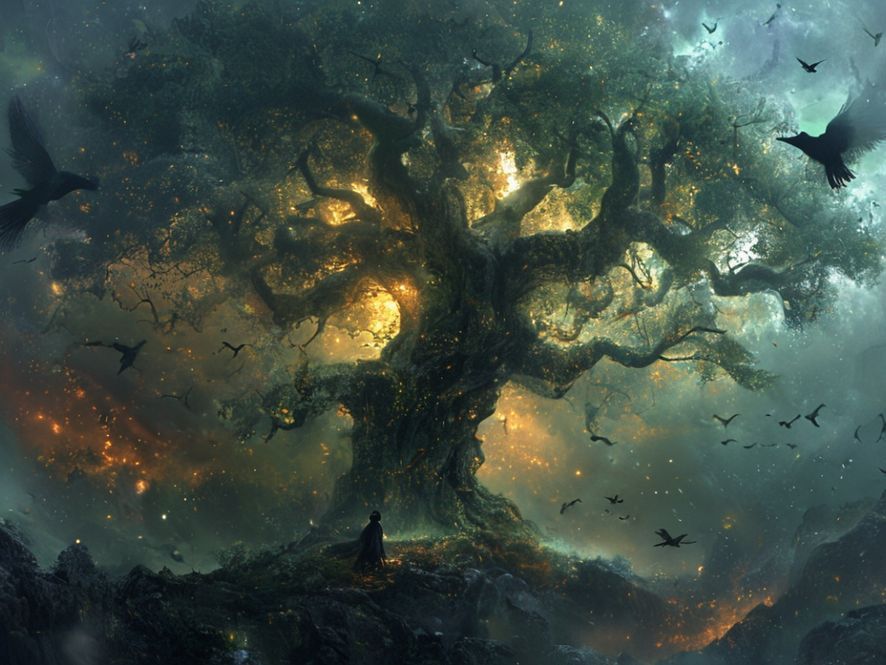
The Yggdrasil Bestiary: A Tree Devoured from Every Side
The Grímnismál devotes several stanzas to a detail often overlooked: the world-tree is inhabited, and its inhabitants devour it.
At the top perches an eagle that the text does not name, and between its eyes sits a falcon, Veðrfölnir. At the roots, the dragon Níðhöggr—"he who strikes with hate"—gnaws at the wood, accompanied by a troop of serpents that the poem lists by name.
Between the two runs Ratatoskr, the squirrel, who climbs up and down the trunk carrying insults from the eagle to the dragon and from the dragon to the eagle. It is one of the rare characters in Norse mythology whose sole function is to poison relationships—a gossip, residing in the axis of the world.
On the branches graze four stags with alliterative names—Dáinn, Dvalinn, Duneyrr, and Duraþrór—who tear at the young shoots. A goat, Heiðrún, eats the foliage from the roof of Valhalla and provides the mead for the Einherjar; the stag Eikþyrnir, on the same roof, lets water flow from his antlers that feeds all the rivers of the world.
Add it up: a dragon at the roots, serpents, four stags in the branches, a goat and a stag on the roof. Yggdrasil is being eaten from all sides constantly, and the poem states it explicitly—the tree suffers more than men know. Three norns draw from the well of Urðr every day to daub the trunk and keep it alive.
The image is of considerable power, and it summarizes Norse cosmology better than a long speech. The world is not a stable edifice that a catastrophe will one day destroy: it is an organism constantly being eroded, maintained with great effort, and whose collapse at Ragnarök is merely the culmination of a process already underway.
Draugr and Haugbúi: The Returning Dead
The creatures we have just discussed belong to the mythological corpus. The Icelandic sagas provide others of a different kind—and those haunted the nights of real people.
The draugr is not a ghost. It is a walking corpse, material, heavy, endowed with immense strength. The texts describe it as bloated, with blue-black skin—hel-blár, "death-blue"—capable of growing, wielding objects, and killing beasts and men. It does not pass through walls: it breaks down doors.
The model of the genre is Glámr, in the Saga of Grettir. A shepherd who died mysteriously one Christmas night, he returned to ride the roofs, terrorize the farm, and break backs. Grettir faced him in hand-to-hand combat in a scene that remains famous, decapitating him—but Glámr, before dying, cursed him with a fear of the dark that would follow him his entire life. The hero won the fight and lost something definitive.
The sagas also describe the precautions taken against them, and these were concrete, ritualized actions. The body was sometimes removed through an opening broken in the wall rather than through the door, so the dead would not find their way back. Stones were placed on the chest. In the event of a proven return, the body was exhumed, decapitated, the head placed against the buttocks, burned, and the ashes scattered at sea.
A distinction is useful: the haugbúi does not leave its burial mound, which it guards fiercely along with its treasure — it is the typical adversary for a hero who has come to pillage a tomb. The draugr, on the other hand, goes out and roams the countryside.
These tales do not belong to the same register as the Edda. They do not recount the structure of the cosmos but the anxieties of a society of isolated herders during the Icelandic winter, where an improperly buried corpse and an epidemic among livestock could be explained in the same way. It is literature, but it is also involuntary ethnography.
The vocabulary itself is revealing. The texts also use aptrganga, literally “the one who walks again,” and the emphasis on walking says it all: what is frightening is not a wandering soul but a body that moves about. Where medieval Christian tradition imagines spirits in distress pleading for prayers, the Iceland of the sagas imagines a dead neighbor kicking down the barn door.
Here we can measure a fundamental difference between the two religious universes. The Norse dead remain attached to their place and their possessions — they guard their mound, their gold, and sometimes their grudge. They ask for nothing from the afterlife: they simply refuse to leave. The measures taken against them are, moreover, physical and not spiritual, which further distinguishes them from the ghosts of later traditions.
Sorting it out: what is medieval, what is modern
There remains a sorting process that most guides omit, and which yet changes everything: not all these creatures date from the same era. Three layers are superimposed, and confusing them amounts to lumping a 10th-century god and an 1890 illustration into the same bag.
The Eddic and skaldic layer is the oldest. It contains the jötnar, the dvergar, the álfar, Fenrir, Jörmungandr, Níðhöggr, Ratatoskr, and the fauna of Yggdrasil. These are beings attested in poems composed before or around the time of Christianization, even if we only read them in 13th-century manuscripts.
The saga layer, from the 13th century, brings the draugar and the haugbúar. It is more recent, more literary, and above all of a different nature: it describes a lived folklore rather than a cosmology.
The modern layer, finally, is the one that burdens us the most. The Kraken is not a Viking creature: it appears under this name in the 18th century, described in 1752 by Erik Pontoppidan, Bishop of Bergen, in his natural history of Norway. Eight centuries separate the Vikings from this monster that is attributed to them everywhere.
The troll poses a similar problem. The word exists in ancient sources, but with a vague and broad meaning, close to "maleficent creature." The troll as we imagine it — bulbous nose, tail, Norwegian forest — is a 19th-century construct, born from the folklore collections of Asbjørnsen and Moe and fixed forever by the illustrations of Theodor Kittelsen.
As for the winged and scaly dragon that adorns so many "Viking" products, it owes more to medieval Christian iconography and contemporary fantasy than to Norse sources. Fáfnir, the most famous dragon in the corpus, is a man transformed by the lust for gold, and the texts designate him with the word ormr — serpent. Scandinavian representations from the Viking Age, on the Ramsund or Gotland stones, show a long, crawling reptile, without wings or legs.
None of this invalidates modern creations, which have their own beauty. But knowing which layer one is in makes it possible not to attribute to 9th-century Scandinavians figures they would not have recognized — and that is what we strive to do here, source by source.
Frequently Asked Questions About Norse Creatures
What are the main creatures of Norse mythology?
Major creatures include: Fenrir (giant wolf), Jörmungandr (world serpent), Nídhögg (dragon gnawing at Yggdrasil), dwarves (blacksmiths), elves (light and dark), giants (jötnar), and Valkyries (divine warriors).
What is Jörmungandr?
Jörmungandr (the Midgard Serpent) is a serpent so gigantic that it encircles the entire world by biting its own tail. Son of Loki, he is the sworn enemy of Thor. During Ragnarök, they will kill each other — Thor will slay him but succumb to his venom nine paces later.
Are Norse dwarves like Tolkien's?
Tolkien was directly inspired by Norse mythology for his dwarves. Norse dwarves (dvergar) are extraordinary craftsmen living underground who forged Mjölnir, the ship Skidbladnir, and Sif's golden hair. Tolkien even borrowed their names from the Poetic Edda (Durin, Thorin, Gandalf).
What is the Kraken in Norse mythology?
The Kraken is a colossal sea creature of Scandinavian mythology, likely inspired by real giant squids. Norse sailors described it as a monster capable of swallowing ships. It does not appear in the Eddas but in medieval Scandinavian maritime accounts.
Are Norse elves different from fantasy elves?
Yes. Norse elves are divided into Ljósálfar (light elves, beautiful and divine, living in Alfheim) and Dökkálfar (dark elves, close to the dwarves). Modern fantasy (Tolkien, D&D) merged and reinterpreted these concepts to create the elves we know today.
What is Ratatösk?
Ratatösk is a squirrel that runs along the trunk of Yggdrasil, carrying messages (and insults) between the eagle perched at the top and the dragon Nídhögg in the roots. He symbolizes communication, gossip, and chaos — an agent of discord who stirs up conflict between the two creatures.
"The tree suffers more than men know: the stag grazes it from above, its side rots, and Níðhöggr gnaws it from below."
— Grímnismál, stanza 35, Poetic Edda
May the Aesir guide you on the path of honor.
👉 Explore our collections of Viking statues and Viking jewelry to carry the Viking spirit with you every day.
Sources
- Grímnismál, Poetic Edda — the fauna of Yggdrasil: the eagle, Veðrfölnir, Ratatoskr, Níðhöggr, the four stags, Heiðrún, and Eikþyrnir.
- Snorri Sturluson, Gylfaginning and Skáldskaparmál, c. 1220 — origin of the dwarves, distinction between Ljósálfar / Dökkálfar (attested only in his work), and the treasures forged for the gods.
- Grettir's Saga, 14th century — the confrontation with the draugr Glámr, a reference account for Icelandic revenants.
- Erik Pontoppidan, Det første Forsøg paa Norges naturlige Historie, Copenhagen, 1752 — first scholarly description of the Kraken, eight centuries after the Viking Age.
📚 Read Also
- Kraken: The Sea Monster of Norse Legends, from Myth to Giant Squid
- The 17 Viking Symbols and Their Profound Meaning
- Viking Decor: Create an Authentic Nordic Interior
- The Norse Gods: Complete List of the Asgardian Pantheon
- Erling Haaland, the Viking of Modern Times
- Fenrir: The Giant Wolf of Norse Mythology

Leave a comment
All comments are moderated before being published.
This site is protected by hCaptcha and the hCaptcha Privacy Policy and Terms of Service apply.