
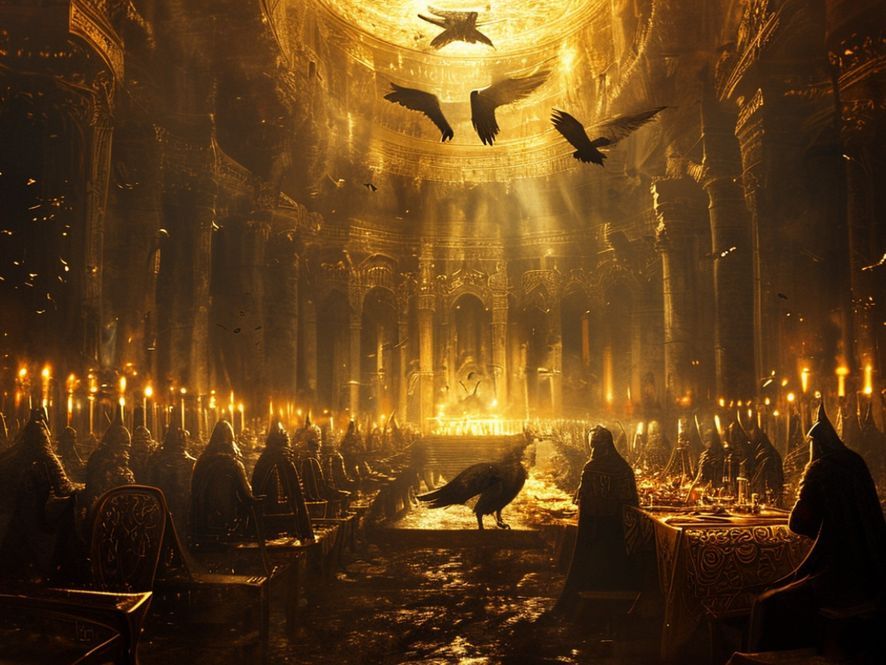
Odin: The Supreme God of Norse Mythology

Odin, the All-Father — King of the Gods of Asgard
Odin (or Óðinn in Old Norse) is the supreme god of Norse mythology. King of Asgard, father of Thor and master of the Valkyries, he is the god of wisdom, war, poetry, and death alike. One-eyed by choice—having sacrificed an eye for infinite knowledge—Odin embodies the quest for wisdom pushed to its extreme.
Historical sources: Odin — Wikipedia | Poetic Edda — Wikipedia | Prose Edda — Wikipedia
📌 In Brief
- Odin is the All-Father in Norse mythology.
- Odin voluntarily sacrificed his right eye at Mímir's Well in exchange for cosmic wisdom.
- Odin is accompanied by Huginn and Muninn (two ravens representing thought and memory), Geri and Freki (two wolves), and Sleipnir (his eight-legged horse, son of Loki).
- Odin hanged himself from Yggdrasil for nine days and nights, pierced by his own spear Gungnir, to discover the secret of the runes.
- Odin is morally ambiguous: he prepares Valhalla for Ragnarök, but manipulates men, provokes wars to recruit the dead, and betrays his own favorites.
Odin in Norse Mythology: The All-Father
The origins of Odin and the creation of the world
According to Snorri Sturluson's Prose Edda, Odin is the son of Borr and the giantess Bestla. With his brothers Vili and Vé, he slays the primordial giant Ymir and uses his body to create the world: his flesh becomes the earth, his blood the oceans, his bones the mountains, and his skull the celestial vault.
The three brothers then find two tree trunks washed up on the shore—Ask and Embla—and breathe life into them, thus creating the first humans. Odin grants them breath (önd), Vili grants them consciousness (óðr), and Vé grants them appearance and speech.
The sacrifice of an eye for wisdom
One of the most famous myths concerns Mímir's Well, located under one of the roots of Yggdrasil. This well contains cosmic wisdom. Odin, obsessed with knowledge, agrees to sacrifice his right eye to drink a draught from this sacred water.
This voluntary sacrifice is central to Norse mythology: it shows that Odin is willing to pay any price for knowledge. Since then, he is depicted as one-eyed—an old man in a dark cloak, his lost eye sparkling at the bottom of Mímir's Well for eternity.
The god with many names
Odin has over 200 names in Norse sources, each reflecting an aspect of his personality:
- Allfather — King of the Gods
- Valföðr (Father of the Slain) — Lord of Valhalla
- Hrafnaguð (Raven God) — Master of Huginn and Muninn
- Gangleri (The Wanderer) — He roams Midgard disguised as a traveler
- Sigföðr (Father of Victory) — God of strategic warfare

The Quest for the Runes: The Sacrifice of Yggdrasil
Nine nights hanging from the World Tree
The Eddic poem Hávamál (stanzas 138-141) recounts how Odin hanged himself from Yggdrasil for nine days and nine nights, pierced by his own spear Gungnir, without food or drink. It is a sacrifice of self to oneself—a shamanic ritual of extreme intensity.
"I know that I hung on a windy tree, nine long nights, wounded with a spear, dedicated to Odin, myself to myself, on that tree of which no man knows from where its roots run."— Hávamál, stanza 138 (Poetic Edda)
The discovery of the runes and magic
At the end of this ordeal, the runes revealed themselves to Odin. These symbols are not merely an alphabet—they are cosmic forces that allow one to heal the sick, dull enemy weapons, break chains, extinguish fires, calm storms, and bring the dead back to speech.
Odin then passed this knowledge on to the gods, the elves, and humans. This is why Viking symbols and runes are so deeply linked to magic in Norse culture.

Odin's Attributes and Companions
Gungnir, the spear that never misses its mark
Gungnir is the legendary spear of Odin, forged by the dwarf Ívaldi (the same craftsmen who created Sif's golden hair and the ship Skíðblaðnir). This spear possesses a magical property: once thrown, it never misses its target and always returns to its master.
Before every battle, Odin throws Gungnir over the enemy armies while shouting "Óðinn á yðr alla!" (Odin possesses you all). This ritual consecrates the warriors killed to Valhalla. Vikings mimicked this gesture by throwing a spear over the enemy before combat.
Discover our Odin Amulet Necklace, inspired by the power of the supreme god.
Huginn and Muninn, the ravens of thought and memory
Each morning, Odin's two ravens—Huginn (Thought) and Muninn (Memory)—fly over Midgard to observe the world. They return in the evening to whisper everything they have seen into Odin's ear. The Grímnismál reveals that Odin fears losing Muninn (memory) more than Huginn (thought).
Wear Odin's ravens with our Prestige Odin's Ravens Necklace or our Odin's Ravens Bracelet.
Geri and Freki, the faithful wolves
Geri (the Greedy) and Freki (the Ravenous) are the two wolves that stand at Odin's feet in Valhalla. According to the Grímnismál, Odin never eats: he gives all the food from the feast to his wolves and sustains himself only on wine. This detail underscores his ascetic nature—a god who prioritizes knowledge over physical pleasures.
Sleipnir, the eight-legged horse
Sleipnir is Odin's legendary steed, a grey horse with eight legs capable of galloping both on land and through the air and across the nine worlds. His origin is surprising: he is the son of Loki, who had transformed into a mare to seduce the stallion Svaðilfari.
| Companion | Type | Role |
|---|---|---|
| Huginn & Muninn | Ravens | Spies — fly over Midgard and bring back news |
| Geri & Freki | Wolves | Guardians — receive all of Odin's food |
| Sleipnir | 8-legged horse | Mount — travels between the 9 worlds |
| Gungnir | Magic spear | Weapon — never misses its target |
| Draupnir | Gold ring | Wealth — multiplies by 9 every 9 nights |
These attributes are also the most frequently used motifs in Nordic metalwork: the two ravens have their own range of Odin's raven jewelry, and the knot of the slain has its own, the Valknut range.
Odin and Valhalla: The Lord of the Slain in Battle
The Valkyries, messengers of Odin
Odin sends the Valkyries to the battlefields to choose the most valiant warriors among the dead. These divine warrior women take the chosen to Valhalla, Odin's palace with 540 doors, where they become Einherjar (eternal warriors).
This choice is not arbitrary: Odin needs an army of dead warriors to fight by his side during Ragnarök. Every death in battle is a recruitment for the final battle.
The eternal feast of the Einherjar
In Valhalla, the Einherjar live a perfect warrior existence: they fight each other every day, their wounds heal every evening, and they feast all night on the meat of the boar Sæhrímnir (which is reborn every morning) and endless mead from the goat Heiðrún.
This warrior paradise reflects Viking values: combat, honor, and brotherhood are eternal. Toast like a Viking with our Odin Viking Tankard.

Ragnarök: The Death of Odin at the Hands of Fenrir
The prophecy of the end of the world
Ragnarök is the twilight of the gods — the apocalyptic battle that will destroy the world as the Vikings knew it. Odin has known this prophecy from the beginning. Everything he does — sacrificing his eye, discovering the runes, recruiting the Einherjar — is a desperate preparation for this inevitable day.
The omens: the Fimbulvetr (three winters without a summer), the sun and moon devoured by the wolves Sköll and Hati, and the rooster Gullinkambi who crows to awaken the Einherjar.
The final battle against the wolf Fenrir
During the final battle, Odin advances with Gungnir and the entire army of Einherjar against the forces of chaos. Facing him: the giant wolf Fenrir, whose gaping maw extends from earth to sky. Despite all his power and wisdom, Odin is devoured by Fenrir.
His son Víðarr the Silent immediately avenges his death: he places his foot on Fenrir’s lower jaw and tears the wolf in two. It is a tragic and heroic moment — the god who knew everything could not escape his destiny.

Odin in Popular Culture
Comparison table: Mythology vs. Modern depictions
| Aspect | Norse Mythology | Popular Culture |
|---|---|---|
| Appearance | One-eyed old man, dark cloak, wide-brimmed hat | Marvel: warrior in golden armor (Anthony Hopkins). God of War: muscular giant |
| Personality | Ambiguous, manipulative, obsessed with knowledge | Often simplified into a wise father figure or a tyrant |
| Weapon | Gungnir (spear) | Often confused with Thor and the hammer |
| Death | Devoured by Fenrir at Ragnarök | Marvel: killed by Hela (Thor: Ragnarok, 2017) |
| Vikings Series | Invisible god, acts through signs | Appears as a mysterious one-eyed old man to Ragnar |
Odin in video games and cinema
The figure of Odin has seen a spectacular revival:
- God of War: Ragnarök (2022) — Odin is the main antagonist, presented as a charismatic manipulator obsessed with knowledge
- Assassin's Creed Valhalla (2020) — The player embodies Eivor, who experiences visions linked to Odin
- Marvel / MCU — Anthony Hopkins portrays a benevolent but authoritarian Odin in the Thor films
- Vikings Series (2013-2020) — Odin appears as a mysterious one-eyed old man who guides Ragnar's fate
Wear the power of the all-father with our Yggdrasil Odin's Ravens Necklace or our Odin Allfather Figurine.
Frequently Asked Questions about Odin
Who is Odin in Norse mythology?
Odin is the Allfather in Norse mythology. God of wisdom, war, poetry, and death, he rules from Asgard on his throne Hlidskjalf. He is one-eyed, having sacrificed an eye at Mímir's well to gain infinite knowledge.
Why does Odin have only one eye?
Odin voluntarily sacrificed his right eye to Mímir's well in exchange for cosmic wisdom. This sacrifice illustrates his obsessive quest for knowledge — he was willing to give up anything, even a part of himself, to understand the mysteries of the universe.
What are Odin's animals?
Odin is accompanied by Huginn and Muninn (two ravens representing thought and memory), Geri and Freki (two wolves), and Sleipnir (his eight-legged horse, son of Loki). The ravens fly over Midgard every day and bring news to Odin.
Why did Odin hang himself from Yggdrasil?
Odin hanged himself from Yggdrasil for nine days and nine nights, pierced by his own spear Gungnir, to discover the secret of the runes. It is a sacrifice of self to oneself — a shamanic act that granted him mastery of runic magic.
Is Odin good or evil?
Odin is morally ambiguous. He protects the gods and prepares Valhalla for Ragnarök, but he manipulates humans, provokes wars to recruit dead warriors, and sometimes betrays his allies. He embodies complexity rather than absolute good or evil.
What is the link between Odin and Wednesday?
The English word Wednesday comes from Wōden's day (day of Wōden, the Germanic form of Odin). Similarly, the French word mercredi comes from Mercury, the Roman god whom the Romans associated with Odin for their shared role as guides of souls.
How does Odin die at Ragnarök?
During Ragnarök, Odin faces the giant wolf Fenrir in a final battle. Despite his spear Gungnir and all his power, Odin is devoured by Fenrir. His son Víðarr immediately avenges his death by tearing the wolf's jaw apart.
What is the difference between Odin, Thor, and Loki?
Odin is the king of the gods, the god of wisdom and strategic war. Thor, his son, is the god of thunder and protector of humanity — he fights giants with Mjölnir. Loki is a frost giant adopted by the gods, the god of mischief and chaos, both an ally and an enemy of Asgard.

Leave a comment
All comments are moderated before being published.
This site is protected by hCaptcha and the hCaptcha Privacy Policy and Terms of Service apply.