
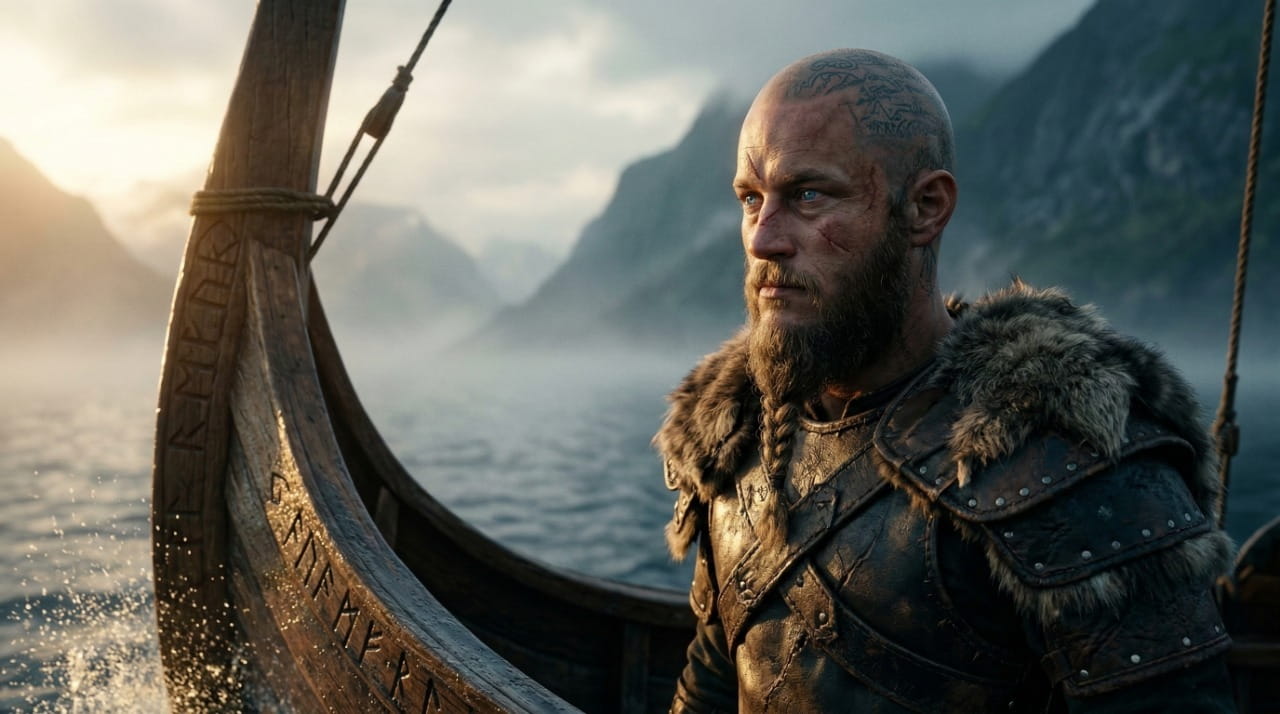
Ragnar Lothbrok: Did the Viking King Really Exist?

Ragnar Lothbrok, the legendary 9th-century Viking king
Ragnar Lothbrok is a legendary 9th-century Viking king and warrior, known mainly through Nordic sagas and Saxo Grammaticus's Gesta Danorum. A semi-historical figure, he is said to have led the Siege of Paris in 845 and died in King Ælla of Northumbria's snake pit. His sons—Bjorn Ironside, Ivar the Boneless, Sigurd Snake-in-the-Eye—are better documented historically than their father.
📌 In short
- Ragnar Lothbrok is not an attested historical figure: the consensus is that he is a composite figure, whose most likely real nucleus is the leader Reginheri, named in the Annals of Saint-Bertin during the 845 Siege of Paris.
- No contemporary source names him: the first complete accounts—Saxo Grammaticus's Gesta Danorum (c. 1200) and the Ragnars saga loðbrókar (13th century)—date from more than three centuries after the events.
- The 845 Siege of Paris is attested: 120 ships led by Reginheri, a 7,000-pound silver ransom paid by Charles the Bald—the first danegeld.
- His death in King Ælla's snake pit, around 865, comes from the sagas; a Frankish account attributes the death of the leader Reginheri to illness shortly after 845.
- His sons are better attested than him: the Great Heathen Army landed in England in 865, York fell in 866, and King Ælla died in March 867.
- The Vikings series compresses 52 years of events (Lindisfarne 793 → Paris 845) and invents connections: Rollo was not his brother.
Chronology: From historical leader to legend
| Date | Event | Status |
|---|---|---|
| June 8, 793 | Raid on Lindisfarne | Attested — no source names Ragnar; attribution comes from the series |
| 845 | Siege of Paris: 120 ships of leader Reginheri, 7,000-pound ransom — the first danegeld | Attested (Annals of Saint-Bertin) |
| Shortly after 845 | Death of leader Reginheri, taken by illness | Reported (Miracles of Saint Germain) |
| c. 865 | Death of Ragnar in Ælla's snake pit | Legendary (sagas) |
| 865 | Landing of the Great Heathen Army in England | Attested (Anglo-Saxon Chronicle) |
| 866–867 | Fall of York; death of King Ælla (March 867) | Attested |
| 878–886 | Establishment of the Danelaw | Attested |
| c. 1200 | Saxo Grammaticus's Gesta Danorum | Legend written down |
| 12th–13th century | Krákumál then Ragnars saga loðbrókar | Legend established |
| 2013–2020 | Michael Hirst's Vikings series | Fiction |
Ragnar Lothbrok: The Historical Truth
Ragnar Lothbrok is most likely a composite character: most specialists in the Scandinavian period see him as a legend aggregating the exploits of several real 9th-century Viking leaders—including the Reginheri attested at Paris in 845 by the Annals of Saint-Bertin—mixed over centuries of oral transmission.
The two main sources are the Saga of Ragnar Lodbrok (Ragnars saga loðbrókar), written in Old Norse in the 13th century, and the Gesta Danorum ("Deeds of the Danes") by Danish historian Saxo Grammaticus, composed around 1200. These texts, written several centuries after the events they describe, mix historical facts, poetic embellishments, and supernatural episodes. Saxo presents Ragnar as a heroic Danish king, while the Icelandic saga focuses more on his fantastic adventures and successive wives.
To delve deeper into the mythological context surrounding Ragnar, discover our comprehensive guide on Viking symbols and their meanings, as well as our article on Odin, the supreme god of Norse mythology, from whom Ragnar claimed descent. To carry this legacy, discover our Odin's Ravens Viking bracelet adorned with sacred runes.
The Wives of Ragnar Lothbrok
The sagas and Saxo Grammaticus attribute three successive wives to Ragnar: Lagertha the warrior, Thora Borgarhjört, and Aslaug, mother of his most famous sons. No source mentions both Lagertha and Aslaug: each belongs to a distinct tradition.
| Wife | Source | Children | In the series |
|---|---|---|---|
| Lagertha | Saxo Grammaticus only (Gesta Danorum, c. 1200) | Fridleif and two daughters | Seasons 1–6, Queen of Kattegat |
| Thora Borgarhjört | Ragnars saga (13th century) | Eirekr and Agnar | Absent |
| Aslaug (Kráka) | Ragnars saga, Ragnarssona þáttr (13th century) | Ivar, Bjorn, Sigurd, Hvitserk, Ubbe | Seasons 1–4 |
Lagertha, the legendary shieldmaiden

Lagertha, the legendary shieldmaiden and first wife of Ragnar
According to Saxo Grammaticus, Lagertha (Hlaðgerðr) was a shieldmaiden of extraordinary beauty and courage. Ragnar reportedly met her while she was fighting among the women defending Norway against an invading king. Impressed by her valor, Ragnar courted her and made her his first wife. Together, they had a son, Fridleif, and two daughters—her full portrait is in our article on Lagertha.
Lagertha has become a symbol of the Viking woman warrior. Recent archaeological discoveries, notably the Birka female warrior’s grave in Sweden, suggest that Viking women could indeed fight alongside men. To learn more about the role of women in Nordic society, read our article on Nordic mythological figures and creatures.
Thora Borgarhjört, the jarl's daughter
After leaving Lagertha, Ragnar married Thora Borgarhjört, daughter of Jarl Herrauðr of Gotaland. According to the saga, a giant serpent guarded Thora in her home, and Ragnar had to kill it to free her. It was to face the reptile that he wore his famous "shaggy breeches" (loðbrók)—pants coated in pitch to protect against the venom—which gave him his nickname. From this union were born Eirekr and Agnar.
Aslaug (Kráka), descendant of Sigurd
Aslaug is not a verified historical figure: she is a literary figure from the sagas, designed to link Ragnar's lineage to that of the hero Sigurd.
His third wife, Aslaug (also called Kráka, "the Crow"), claimed to be the daughter of the legendary hero Sigurd the Dragon Slayer and the valkyrie Brynhild. She bore Ragnar his most famous sons: Ivar the Boneless, Bjorn Ironside, Sigurd Snake-in-the-Eye, Hvitserk, and Ubbe. According to legend, she warned Ragnar that their son Ivar would be born deformed if he did not wait three nights before consuming their marriage—a warning Ragnar ignored.
Ragnar's Legendary Raids
Two raids are associated with the name of Ragnar: the looting of Lindisfarne (793), which only the series attributes to him, and the Siege of Paris (845), the only one confirmed by a contemporary source. Here is what the sources say.
📍 Visualize all Viking raids on our interactive map of Viking raids and expeditions (793-1066, 42 mapped events).
The looting of Lindisfarne (793)
On June 8, 793, Nordic warriors landed on the island of Lindisfarne, off the coast of Northumberland in England. They sacked the monastery, killed monks, and seized sacred treasures. This event, which shocked all of Christendom, traditionally marks the beginning of the Viking Age. Although sources do not explicitly mention Ragnar for this raid, the series attributes it to him.
The Siege of Paris (845)

The Siege of Paris in 845 — longships sailing up the Seine
📖 The full account, with sources, is in our article on the 845 Siege of Paris.
The most reliably documented event associated with Ragnar is the 845 Siege of Paris. The Annals of St. Bertin record that a fleet of 120 Viking ships sailed up the Seine under the command of a leader named Reginheri. The Norsemen looted everything in their path, forcing King Charles the Bald to pay a massive ransom of 7,000 pounds of silver—the first danegeld in the history of France.
The fake coffin ruse shown in the series is a pure dramatic invention. In reality, the Vikings took Paris by brute force and terror.

Map of Viking raids attributed to Ragnar — from Scandinavia to Paris and England
Ragnar's Sons and the Great Heathen Army
Sources name at least eight of Ragnar's sons, born of his three wives; the five most famous—Ivar, Bjorn, Sigurd, Hvitserk, and Ubbe—are the sons of Aslaug (their full history is in our article on the sons of Ragnar Lothbrok). Paradoxically, they are much better attested than their father: the Anglo-Saxon Chronicle attests to the invasion of the Great Heathen Army in 865—the motive of revenge and the filiation with Ragnar come only from late Scandinavian sources.

Ragnar's sons at the head of the Great Heathen Army invading England
Björn Ironside
Björn Järnsida is probably the most adventurous of Ragnar's sons. With the leader Hástein, he led a major expedition to the Mediterranean (859–862), looting the coasts of Muslim Spain, Morocco, Southern France, and Italy. The Hervarar saga makes him the ancestor of a royal Swedish dynasty (House of Munsö)—his full portrait is in our article on Björn Ironside. His nickname "Ironside" likely comes from his legendary resistance in battle, as if no weapon could wound him. Enthusiasts can immortalize this warrior with our resin Bjorn Ironside figurine.
Ivar the Boneless
Ivar the Boneless (Ívarr Beinlauss) is the most formidable of Ragnar's sons. As the strategic leader of the Great Heathen Army, he conquered the Kingdom of Northumbria: York fell in 866 and King Ælla died in March 867 (Anglo-Saxon Chronicle). According to the sagas, Ivar had him executed by the blood eagle ritual—the historicity of which is debated. His nickname remains mysterious: some believe he suffered from a bone disease (osteogenesis imperfecta), while others suggest he was simply extraordinarily flexible in combat. His full story is in our article on Ivar the Boneless.
Sigurd Snake-in-the-Eye and the other sons
Sigurd Snake-in-the-Eye (Sigurðr ormr í auga) bore this nickname because he was said to be born with a snake-shaped mark in his eye—a sign of his divine ancestry through Aslaug. Hvitserk and Ubbe also fought alongside their brothers. Together, the sons of Ragnar transformed England forever by establishing the Danelaw, the zone of Scandinavian dominance covering the north and east of the island.
Ragnar's Death in the Snake Pit

Ragnar Lothbrok facing his destiny in King Ælla's snake pit
According to Ragnars saga, Ragnar died around 865, thrown into a pit of snakes by King Ælla of Northumbria after shipwrecking on the English coast. No contemporary source confirms this episode.
The death of Ragnar is one of the most famous episodes in Norse mythology. According to the saga, after being captured by King Ælla of Northumbria during a disastrous expedition to England, Ragnar was thrown into a pit filled with venomous snakes. This snake symbol is omnipresent in Norse mythology — discover it in our Viking Jörmungandr Serpent ring.
The Krákumál poem: Ragnar's last words
Faced with an agonizing death, Ragnar is said to have recited the Krákumál, a death song of incredible bravery. This 29-stanza skaldic poem is one of the most poignant texts in Norse literature. In it, Ragnar recalls his past battles and rejoices at the prospect of joining Valhalla:
"We struck with our swords! [...] The little piglets would grunt if they knew how the old boar suffers."
— Krákumál, stanza 29 (Ragnar's death song)
This chilling phrase was a thinly veiled threat — his sons would come to avenge him. And that is exactly what happened, making Ragnar's death the catalyst for the Great Heathen Army and one of the greatest Viking invasions in history.
The only words that historical sources attribute to Ragnar are those of the Krákumál; the famous lines from the series are the work of the scriptwriters.
The other version: the death of the chieftain Reginheri according to the Franks
Frankish tradition recounts a very different end. According to the Miracles of Saint Germain, a hagiographic account written at Saint-Germain-des-Prés shortly after the siege of 845, the chieftain Reginheri returned to the Danish king Horik boasting of his pillaging of Paris — before dying suddenly of an illness, struck down, the monks wrote, by divine vengeance. If Ragnar and Reginheri are one and the same, the "real" Ragnar did not die a hero in a snake pit, but was taken by an epidemic upon returning from his greatest raid. Two irreconcilable accounts — a contradiction that alone illustrates the composite nature of the character.
Ragnar in the Vikings Series vs History
Michael Hirst's Vikings series (2013–2020, History Channel) compresses 52 years of real events and invents family ties: the table below lists the major discrepancies between the television account and the sources. Brought to life by the performance of Travis Fimmel, the series introduced Ragnar to millions of viewers — pay tribute to the character with our resin Ragnar Lothbrok figurine.
🎵 "If I Had A Heart" by Fever Ray — The iconic opening theme of the Vikings series
Comparative table: Vikings Series vs Historical Sources
What the series succeeded in — and what it sacrificed
It would be unfair to reduce the series to its inaccuracies. Michael Hirst accomplished something remarkable: making Viking civilization accessible and fascinating to a global audience. The depiction of Norse society — its relationship with the sea, its pagan spirituality, the role of women, the politics of the Things (assemblies) — is often more nuanced than in most Hollywood productions.
The series excels particularly in its depiction of the tension between paganism and Christianity, a central theme of the Viking age. The dialogues between Ragnar and Athelstan regarding the nature of the gods, although fictional, reflect a real cultural clash documented by the chroniclers of the era.
On the other hand, the chronological compression is the biggest sacrifice made for the sake of the narrative. By merging events separated by decades (or even centuries, in Rollo's case), the series creates narrative coherence at the expense of historical accuracy. Characters like Floki, inspired by the Icelandic settler Flóki Vilgerðarson (see our article on Floki, the boat builder), are moved by several decades to serve the plot.
Despite these liberties, the Vikings series has had an undeniable cultural impact. It has inspired a new generation to take an interest in Scandinavian history, stimulated tourism in Scandinavia and Ireland, and contributed to the growing popularity of Viking tattoos and Norse symbols in contemporary culture.
The sequel Vikings: Valhalla (Netflix) takes place a century after the death of Ragnar, who has become a legend that the characters invoke — see our article on Vikings Valhalla.
Discover also our detailed article on the differences between the Vikings series and true history, and to relive his warrior exploits, read the 5 legendary battles of Ragnar.
Frequently Asked Questions about Ragnar Lothbrok
Did Ragnar Lothbrok really exist?
The existence of Ragnar Lothbrok remains debated among historians. The Norse sagas describe him as a legendary Viking king of the 9th century, but he could be a composite character merging the exploits of several real Viking chieftains.
What are the historical sources on Ragnar Lothbrok?
The main sources are the Saga of Ragnar Lodbrok, the Gesta Danorum by Saxo Grammaticus (c. 1200), and the Annals of Saint-Bertin which mention a Viking chieftain named Reginheri during the siege of Paris in 845.
Did Ragnar really besiege Paris?
Frankish chronicles confirm that a Viking chieftain besieged Paris in 845. Some historians identify this chieftain as Ragnar, but the coffin ruse shown in the series is a dramatic invention.
How did Ragnar Lothbrok really die?
According to the saga, Ragnar died c. 865 in a snake pit belonging to King Ælla of Northumbria, while reciting the Krákumál, his death song. This spectacular end is likely legendary — a Frankish account otherwise attributes to the chieftain Reginheri a death by illness shortly after 845.
What are the main differences between the series and history?
The series compresses events separated by several decades and invents relationships. The Lindisfarne raid (793) and the siege of Paris (845) are 52 years apart in reality.
Did Ragnar's sons really exist?
Yes, Ragnar's sons are better documented than their father. Ivar the Boneless and Bjorn Ironside are mentioned in multiple sources as leaders of the Great Heathen Army that invaded England in 865.
Who was Lagertha, Ragnar's first wife?
Lagertha is a legendary warrior mentioned by Saxo Grammaticus. Described as a shieldmaiden of exceptional beauty and courage, she reportedly fought alongside Ragnar before becoming his first wife.
What is the Krákumál?
The Krákumál is a 29-stanza skaldic poem attributed to Ragnar Lothbrok, presented as his death song in the snake pit. It contains the famous phrase: "The little piglets would grunt if they knew how the old boar suffers."
How many sons did Ragnar Lothbrok have?
The sources name at least eight sons from his three wives: Fridleif (with Lagertha), Eirekr and Agnar (with Thora), then Ivar, Bjorn, Sigurd, Hvitserk, and Ubbe (with Aslaug). Some late traditions count more — the details are in our article on the sons of Ragnar.
Where is Ragnar Lothbrok buried?
No tomb of Ragnar is known or even mentioned: the character is semi-legendary and no source describes his burial. The "tombs of Ragnar" mentioned online come from fiction and video games, not archaeology.
Was Ragnar king of Denmark or Norway?
The sources describe him as a Danish king: Saxo Grammaticus presents him as the son of King Sigurd Ring, also ruling over part of Sweden. The Norwegian farmer of Kattegat is an invention of the series.
Who played Ragnar Lothbrok in the Vikings series?
The Australian actor Travis Fimmel portrays Ragnar in seasons 1 to 4 (2013–2016) — see our complete series summary.
“Cattle die, kinsmen die, and one dies the same; but the reputation never dies, for he who has won a good one.”
— Hávamál, stanza 76, Poetic Edda
Sources
- Annals of Saint-Bertin, year 845 — contemporary source: fleet of 120 ships led by the chieftain Reginheri, 7,000 pounds of silver paid by Charles the Bald.
- Miracles of Saint Germain (Saint-Germain-des-Prés, 9th century) — hagiographic account of the siege of 845; attributes to Reginheri a death from illness shortly after his return.
- Anglo-Saxon Chronicle, years 865–878 — invasion of the Great Heathen Army (865), fall of York (866–867), death of King Ælla (867).
- Krákumál (12th century) — skaldic poem of 29 stanzas, death song attributed to Ragnar.
- Saxo Grammaticus, Gesta Danorum, book IX (circa 1200) — only source to mention Lagertha.
- Ragnars saga loðbrókar (13th century) — legendary account: Thora, Aslaug, the snake pit.
- Hedenstierna-Jonson et al., “A female Viking warrior confirmed by genomics,” 2017 — grave Bj 581 in Birka.
May the Aesir guide you on the path of honor.
⚔️ Gear up like a true Viking: discover our Odin’s Gungnir spear necklace, our authentic Viking drinking horn, and our Odin Viking tankard to relive the spirit of Norse feasts.
Read also
📚 Read also
- How Tall Were the Vikings? The Answer from Skeletons and Data
- Viking Names: Over 130 Authentic Norse Names, Meanings and Pronunciations
- Vikings: The Impact of the Series on Popular Culture
- Vikings TV Series: Complete Season-by-Season Summary (1 to 6)
- Vikings Series vs. True History: The Differences
- Vikings Valhalla Netflix: Sequel and New Heroes

Leave a comment
All comments are moderated before being published.
This site is protected by hCaptcha and the hCaptcha Privacy Policy and Terms of Service apply.