
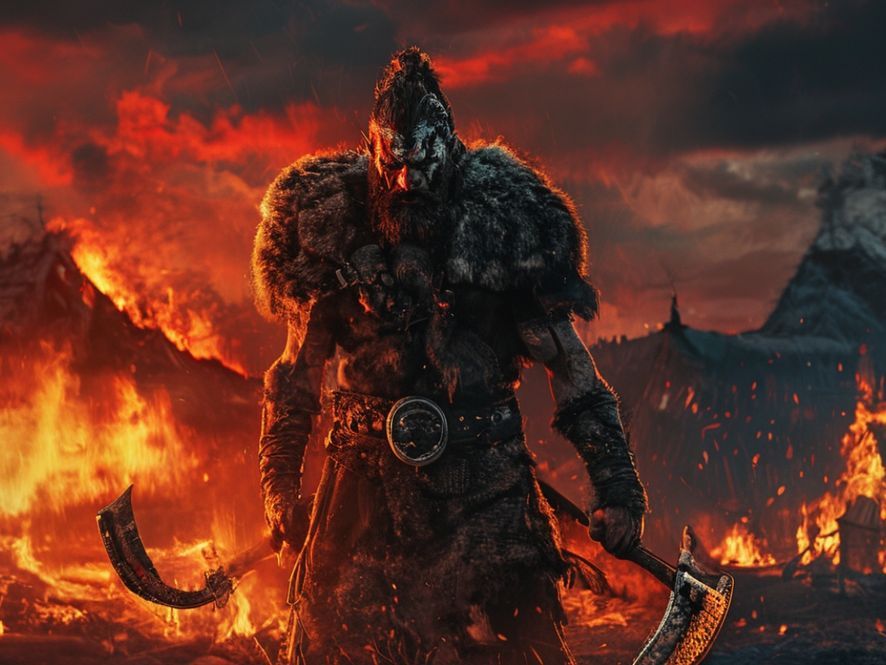
Ivar the Boneless: The Most Feared Viking
📌 In Brief
- Ivar the Boneless (Ívarr hinn Beinlausi) is one of the sons of Ragnar Lothbrok, renowned as the most brilliant and cruel strategist of his siblings.
- The origin of the nickname remains debated: brittle bone disease (osteogenesis imperfecta), extreme flexibility in combat, or a metaphor for his cruelty.
- Ivar the Boneless is well-documented historically.
- Ivar and his brothers captured King Ælla of Northumbria and subjected him to the ordeal of the blood eagle.
- Ivar the Boneless is played by Danish actor Alex Høgh Andersen.
Ivar the Boneless: Birth of an Extraordinary Son of Ragnar
Among all the sons of Ragnar Lothbrok, none has sparked as much fascination, terror, and debate as the one the sagas call Ivar the Boneless. Born with a broken body but gifted with a mind sharper than any blade forged in the North, Ivar embodies one of the most striking paradoxes of the Viking Age: absolute power imprisoned within the fragility of flesh. His story, passed down through Anglo-Saxon chronicles, Icelandic sagas, and more recently by Michael Hirst's Vikings series, spans the centuries without losing an ounce of its impact.
According to the Saga of Ragnar Lothbrok (Ragnars saga loðbrókar), written in the 13th century in Iceland, Ivar was the son of Ragnar Lothbrok and the legendary princess Aslaug, herself a descendant of the hero Sigurd and the Valkyrie Brynhild. The saga tells that Aslaug had warned Ragnar to wait three nights before consummating their union, for the Norns had warned her that a child conceived in haste would bear the mark of a curse. Ragnar, consumed by desire, ignored this warning. When the child was born, his bones were soft like cartilage, his legs unable to support any weight. Thus was born Ivar, nicknamed beinlausi in Old Norse, literally "without bones" — Ivar the Boneless.
This mythical tale immediately establishes the foundation of the character: a man whose physical weakness is merely the flip side of extraordinary warrior intelligence. For if Ivar's body refused to obey him, his mind knew no limits. The sagas describe him as the wisest and most cunning of all Ragnar's sons, the one to whom his brothers turned whenever a strategic decision had to be made. Where Bjorn Ironside relied on the power of his arm and Sigurd Snake-in-the-Eye on the favor of the gods, Ivar relied on the only weapon no one could take from him: his ability to think several moves ahead, like a hnefatafl player facing an opponent doomed from the start.
The Medical Mystery: What Does "Boneless" Mean?
The nickname Ivar the Boneless has caused as much ink to be spilled among historians as blood on Anglo-Saxon battlefields. What did beinlausi actually mean? The question has divided specialists for decades, and several theories clash with the same ferocity as the Norse warriors themselves.
The first hypothesis, and the one most widely cited in popular culture, is that of osteogenesis imperfecta, commonly known as "brittle bone disease." This genetic condition, which makes bones so fragile they break at the slightest impact, would correspond perfectly to the description in the sagas. A man with this condition could not effectively walk or fight in a conventional manner, but his intelligence and mental faculties would remain perfectly intact. It is this interpretation that the Vikings series chose for its character, played with remarkable intensity by actor Alex Høgh Andersen.
Other historians propose a different reading. Some argue the nickname could designate extraordinary physical flexibility, making Ivar a fighter with unpredictable and bewildering movements — a man "without bones" in the figurative sense, capable of contortions his opponents could not anticipate. Others suggest a metaphorical origin linked to sexual impotence, an interpretation supported by certain passages in the Ragnars saga that mention Ivar never had direct descendants. Regardless of the truth, the nickname has survived the centuries because it crystallizes the very essence of the character: a man who was underestimated because of his body, and who proved his superiority through his mind.
To discover the battles of his father that started it all, read the 5 legendary battles of Ragnar in the Vikings series.
"My bones may be broken, but my mind is not. And it is the mind that wins wars."
— Le Comptoir Viking
The Great Heathen Army: Ivar at the Head of the Conquest
The year 865 marks a turning point in the history of medieval Europe. An immense fleet, which Anglo-Saxon chronicles call the mycel hæþen here — the Great Heathen Army — lands on the shores of East Anglia. At its head, the sons of Ragnar Lothbrok, and among them, the mastermind of the entire operation: Ivar the Boneless. This invasion was not an opportunistic raid like the dozens the English had already suffered. It was a planned, coordinated, and ruthless military campaign — and it would change the face of England forever.
The primary motivation, according to the sagas and chronicles, was revenge. Ragnar Lothbrok had been captured by King Aella of Northumbria and thrown into a pit filled with venomous snakes, where he perished in excruciating agony. Legend tells that, in his death throes, Ragnar uttered these prophetic words: "The piglets would grunt if they knew what the old boar suffers." These piglets were his sons. And among them, Ivar was the one who transformed raw anger into military strategy. Rather than rushing headlong into Northumbria, he orchestrated an indirect approach: land in East Anglia, a weak and isolated kingdom, secure horses and supplies, and then move methodically northward.
The capture of York (Jorvik in Norse) in 866 was Ivar's tactical masterpiece. The Vikings seized the city on November 1st, All Saints' Day, while the garrison was reduced and the population occupied with religious celebrations. When the Northumbrian kings Aella and Osberht attempted to retake the city in the spring of 867, Ivar was waiting for them. The battle was a massacre. Both English kings were killed there, and the saga specifies that Aella suffered the terrible ordeal of the blood eagle (blodörn), a ritual execution where the victim's ribs were severed from the spine to form wings, with the lungs spread out over the shoulders. To learn more about this campaign that reshaped England, discover our article dedicated to Ivar's conquest in England.
The Ruthless Strategist: The Art of War According to Ivar
What distinguishes Ivar the Boneless from all other Viking leaders of his time is the profoundly intellectual nature of his martial approach. Where most Norse jarls relied on the ferocity of their berserkers and the superiority of their weaponry, Ivar understood that wars were won before the first charge, in the silence of planning and the art of disinformation.
Anglo-Saxon chronicles testify to Ivar's ability to use diplomacy as a weapon. In East Anglia, rather than ravaging the region, he negotiated a peace agreement with King Edmund, obtaining horses and provisions without shedding a drop of blood. This strategic patience was unprecedented in Viking warfare. Ivar did not seek the glory of combat for its own sake: he sought victory, regardless of the method. He knew how to divide his enemies, exploit rivalries between Anglo-Saxon kingdoms, strike where defenses were weakest, and retreat when conditions were not in his favor.
After the fall of York, Ivar did not stop. The Great Heathen Army turned toward Mercia, then East Anglia a second time. In 869, King Edmund of East Anglia, the very same who had once provided provisions to the Vikings, was defeated and killed. According to Christian tradition, Edmund refused to renounce his faith and was riddled with arrows before being beheaded, which led to his canonization as a saint and martyr. For the Vikings, this execution was a clear message: no one was safe from the wrath of Ragnar's sons. Anyone wearing a steel Viking axe pendant today carries on this legacy of unwavering determination that characterized the warriors of the North.
Ivar's military genius also lay in his understanding of logistics. Maintaining an army of several thousand men in enemy territory for years required an organization that few leaders of that era could master. Ivar the Boneless established fortified camps, secured supply lines along waterways, and transformed York into a true Viking capital in English territory. Under Scandinavian rule, Jorvik would become one of the most prosperous trading centers in Northern Europe, a legacy that still persists in the toponymy and culture of Yorkshire.
"The piglets would grunt if they knew what the old boar suffers."
— Last words of Ragnar Lothbrok, Ragnars saga loðbrókar
Ivar in the Vikings Series: Between Fiction and Historical Truth
The Vikings series (2013-2020) created by Michael Hirst for the History Channel gave Ivar the Boneless a second life, propelling this historical figure into the imagination of millions of viewers around the world. Played by Alex Høgh Andersen from season 4 onwards, Ivar quickly became the most complex, disturbing, and captivating character in the entire series — an antagonist whose cruelty was matched only by his strategic brilliance.
The series chooses to represent Ivar's condition as a form of osteogenesis imperfecta, showing him crawling on the ground during his childhood before finding ingenious ways to move on the battlefield, whether carried on a shield by his warriors or dragged in a war chariot. This portrayal, while embellished for the needs of fiction, captures the essence of the historical figure: a man whom fate had broken physically but who refused to be defined by his weakness. The scenes where Ivar directs his troops from a position overlooking the battlefield, reading enemy movements like an open book, are among the most memorable moments of the series.
Ivar's narrative arc in the series is both a loose adaptation of historical sources and a deep psychological exploration. The rivalry with his brothers, particularly with Bjorn, the quest for recognition from their father Ragnar, the megalomaniacal drift that drives him to proclaim himself a god in Kattegat—all these elements, while largely fictional, resonate with the fundamental themes of the Norse sagas: honor, vengeance, hubris, and the inevitable downfall of those who challenge the order of things. The series succeeds particularly well in showing how Ivar's physical suffering forged an inner rage which, channeled into war, made him the most dangerous of all Ragnar's sons.
It is, however, important to note the differences between fiction and history. The character in the series is far more violent and unstable than what historical sources suggest. The murder of his brother Sigurd, for example, is an invention of the series. Similarly, the proclamation of divinity in Kattegat and the subsequent civil war have no historical basis. The real Ivar the Boneless appears to have been a cold and calculated military leader, respected rather than feared by his own men, a strategist whose effectiveness relied on intelligence rather than terror. It is this duality between the myth and the real man that makes Ivar so fascinating.
The Death of Ivar and His Legacy in the Viking World
The end of Ivar the Boneless remains as mysterious as his life was spectacular. Sources differ considerably. The Anglo-Saxon Chronicle, the most reliable historical document, mentions Ivar's death in 873, without providing details on the circumstances. Some historians suggest that he died in Ireland, where he may have led campaigns after leaving England. Others place him in Great Britain, perhaps in York, the city he had conquered. The Ragnars saga also remains evasive, simply mentioning that he died of illness—an almost ironic ending for a man who had defied illness his entire life.
A particularly fascinating legend surrounds his burial. The saga relates that Ivar asked to be buried at a strategic location on the English coast, claiming that as long as his remains rested in English soil, no foreign invader could conquer the country. This legend finds a haunting echo in the Anglo-Saxon tradition which claims that William the Conqueror, before invading England in 1066, had Ivar's bones exhumed and burned to break this supernatural protection. Myth or reality, this story testifies to the terrifying reputation that Ivar the Boneless still held two centuries after his death.
Ivar's legacy goes far beyond the military sphere. The conquest he initiated led to the establishment of the Danelaw, that vast region in the North and East of England where Scandinavian law prevailed over Anglo-Saxon law. The Danelaw profoundly transformed England's culture, language, and genetics. Hundreds of English toponyms still bear the mark of Old Norse: every town ending in -by (Whitby, Derby, Grimsby), every place ending in -thorpe (Cleethorpes, Scunthorpe) is a direct echo of the Viking colonization of which Ivar was the architect. The English language itself owes to Old Norse words as fundamental as sky, egg, window, knife, and they.
York, transformed into Jorvik, became a center of primary commercial and cultural importance under Viking rule. Archaeological excavations in Coppergate, conducted in the 1970s and 1980s, revealed a city teeming with artisans, merchants, and warriors, connected by trade networks extending from the Baltic to Byzantium. Raising your Viking conqueror tankard in honor of Ivar is to salute the man who made all this possible, the one who saw in York not just a city to pillage, but a capital to build.
Ivar the Boneless: The Eternal Symbol of Viking Resilience
What remains of Ivar the Boneless today, more than a thousand years after his death? Much more than just a name in medieval chronicles. Ivar has become a universal symbol of resilience, living proof that the greatest battles are won with the mind before they are won with the body. In a Viking world where physical strength was revered as the highest of virtues, a man incapable of walking became the most feared conqueror of his time. There is something profoundly Norse in this irony of fate—the Norns weave threads that no one can foresee.
The figure of Ivar continues to inspire contemporary culture far beyond the Vikings series. Video games (Assassin's Creed Valhalla, Crusader Kings), historical novels, comic books: wherever the Viking Age is invoked, the Boneless holds a central place. This is because his story touches on something fundamental to the human condition: the capacity to transcend one's own limits, to transform an apparent weakness into a decisive strength, to refuse the role that fate seems to have written for you.
Wearing a Valknut ring, the symbol of those who defy death, is to claim this legacy. It is to affirm, as Ivar the Boneless proved twelve centuries ago, that true strength does not lie in muscles or bones, but in the indomitable will of one who refuses to bend. The sagas understood this. History has confirmed it. And the legend of Ivar, son of Ragnar, strategist of the Great Army, conqueror of England, continues to resonate in every story, every symbol, and every artifact that perpetuates the spirit of the North.
"He who fights with his mind knows no defeat. Ivar did not walk, but the whole world trembled at his passing."
— Le Comptoir Viking
May Ivar's spirit guide your path, and may the wisdom of the North forge your destiny.
Frequently Asked Questions About Ivar the Boneless
Who is Ivar the Boneless?
Ivar the Boneless (Ívarr hinn Beinlausi) is one of the sons of Ragnar Lothbrok, renowned as the most brilliant and cruel strategist among his brothers. He led the Great Heathen Army that invaded England in 865 to avenge his father's death.
Why is Ivar called the Boneless?
The origin of the nickname remains debated: brittle bone disease (osteogenesis imperfecta), extreme flexibility in combat, or a metaphor for his cruelty. The Vikings series chooses the physical disability interpretation, showing Ivar unable to walk without help.
Did Ivar the Boneless really exist?
Yes, Ivar the Boneless is well-documented historically. Anglo-Saxon chronicles mention him as one of the leaders of the Great Heathen Army. He is said to have ruled the Kingdom of Northumbria and established the Danelaw in England.
How does Ivar avenge Ragnar's death?
Ivar and his brothers capture King Ælla of Northumbria and inflict the punishment of the blood eagle upon him. Chronicles describe this ritual as opening the back to spread the ribs into the shape of wings—one of the most terrifying executions in Viking history.
Who plays Ivar in the Vikings series?
Ivar the Boneless is played by Danish actor Alex Høgh Andersen. His intense and terrifying performance, transitioning from vulnerability to cruelty, made his Ivar one of the most memorable antagonists of the series.
What is the Danelaw?
The Danelaw is the region of England conquered and governed by the Vikings starting in 865. It covered northern and eastern England, including York (Jórvík). Danish laws were applied there, and Viking culture deeply marked these regions.
What are the delivery times and return policies for the Celtic Interlace Axe necklace?
For the Celtic Interlace Axe necklace, as for any order, allow 10 to 20 business days in total: 3 to 5 days for preparation, then 7 to 15 days for delivery within mainland France, 10 to 20 days in the European Union. Delivery costs €4.90 in France and the European Union, and is free for purchases over €49. After receipt, you have 14 days to change your mind and return the item to us: return shipping costs are then your responsibility. If the received item is defective or does not match your order, we will refund the return shipping costs upon proof of postage.
👉 Explore our collections of Viking jewelry and Viking decorations to wear the Viking spirit every day.

Leave a comment
All comments are moderated before being published.
This site is protected by hCaptcha and the hCaptcha Privacy Policy and Terms of Service apply.