
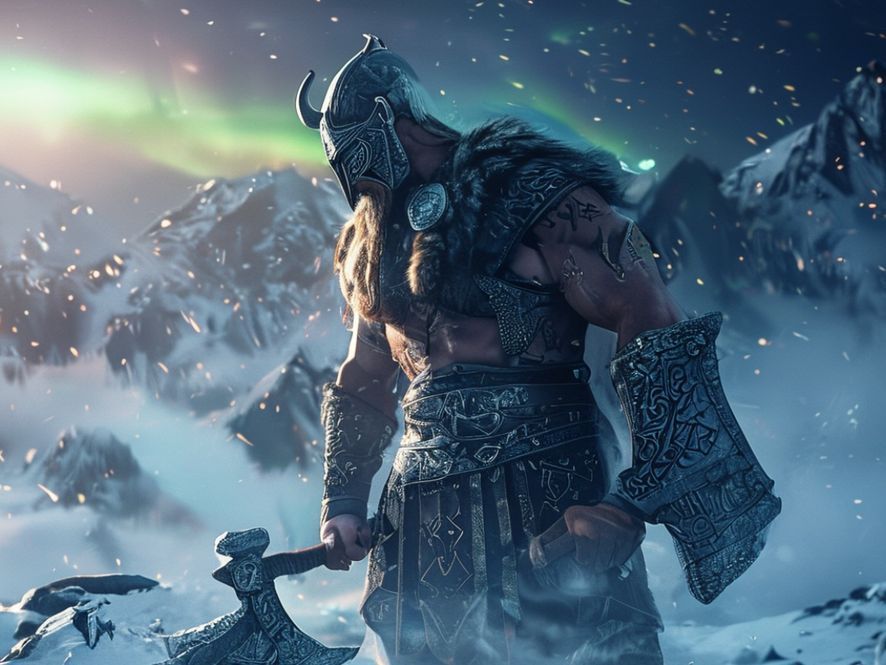
Bjorn Ironside: The Viking King of Sweden
📌 At a glance
- Bjorn Ironside (Björn Járnsíða) is the eldest son of Ragnar Lothbrok and Lagertha in the Vikings series.
- Historical sources mention Bjorn as a real 9th-century Viking chieftain who led an expedition to the Mediterranean (859-862) with Hastein.
- The nickname Járnsíða (Ironside) is said to come from his exceptional resistance in battle, as if his sides were made of iron.
- In the series, Bjorn grows from a farmer's son into the King of Kattegat.
- Bjorn dies in season 6 after a duel with Ivar.
Bjorn Ironside: Origins and Lineage of a Viking Prince
Among all the figures who populate the Scandinavian sagas, few have left an imprint as deep as Bjorn Ironside. As the eldest son of the legendary Ragnar Lothbrok, he embodies that rare alliance between the audacity of the warrior and the vision of a ruler, between the fury of raids and the patience of a builder. His nickname, Járnsíða in Old Norse, literally translating to "Ironside," evokes an almost supernatural resistance to the blows dealt in combat, as if his very flesh refused to yield under the edge of enemy blades.
The primary sources that mention Bjorn are the Saga of Ragnar Lothbrok (Ragnars saga loðbrókar), the Tale of Ragnar's Sons (Ragnarssona þáttr), and the Gesta Danorum by Saxo Grammaticus. These texts, written between the 12th and 14th centuries, blend plausible historical facts with epic exaggerations, making it often difficult to draw a clear line between the real man and the legendary hero. What we know with some certainty is that Bjorn belonged to a brotherhood of fearsome warriors, including Ivar the Boneless, Sigurd Snake-in-the-Eye, Hvitserk, and Ubbe. Each of these brothers would shape European history in his own way, but it was Bjorn who set his course for the sea to the south, where no one before him had dared to lead the Norse drakkars.
His mother, according to tradition, was Aslaug, herself a descendant of the hero Sigurd the Dragon Slayer and the Valkyrie Brynhild. This doubly legendary ancestry—paternal through Ragnar and maternal through the blood of the Völsungs—placed Bjorn Ironside at the pinnacle of Norse warrior nobility. He was not merely a king's son; he was the heir to two mythical lineages, the bearer of a destiny that skalds would sing of for centuries.
The Legendary Mediterranean Expedition
The feat that etched Bjorn's name into the annals of European history is undoubtedly his expedition to the Mediterranean, a journey of unprecedented audacity carried out around 859-862 AD. Accompanied by the Viking chieftain Hastein (or Hasting), Bjorn gathered a fleet estimated at sixty-two ships and departed the shores of the Loire to venture beyond the Strait of Gibraltar, entering waters that the Norsemen had never sailed before.
This journey was initially marked by a series of devastating raids along the Iberian coast. The Vikings sailed up the Guadalquivir, looted the surroundings of Seville—then under Umayyad rule—and clashed with the forces of the Emir of Córdoba. Arab chroniclers, notably Ibn al-Athir and Al-Bakri, mention these al-Majus (the pagans of the north) with a mixture of dread and fascination. The fleet then continued toward the Balearic Islands, then the southern coasts of France, where Narbonne and Arles suffered their fury. The Vikings sailed up the Rhône for a considerable distance, spreading terror throughout Languedoc and Provence.
But it was in Italy that the expedition reached its most spectacular dimension. According to the legend reported by Dudo of Saint-Quentin and other chroniclers, Bjorn Ironside and Hastein conceived an extraordinary ruse to capture the city of Luna (Luni) in Liguria, which they perhaps mistook for Rome itself. Hastein posed as a dying Viking chieftain who wished to receive Christian baptism before passing away. The inhabitants of Luna, moved by this apparent conversion, opened their gates to receive the funeral procession. That was when Hastein sprang from his coffin, sword in hand, while the warriors hidden beneath the mourning cloaks fell upon the stunned defenders. The city fell within hours. This ruse, worthy of a Norse Odysseus, has become one of the most famous episodes of the entire Viking Age.
The fleet continued its journey toward the south, perhaps reaching the coasts of North Africa before sailing back toward Provence and finally returning to the Atlantic. The return was not without losses: sources mention clashes with the navy of the Emirate of Córdoba as they passed the Strait of Gibraltar, which destroyed part of the fleet with Greek fire. Despite these setbacks, Bjorn returned with considerable loot and, above all, imperishable glory. No Viking leader before him had led a campaign of such geographical scale, linking Scandinavia to the Mediterranean in an unprecedented arc of conquest.
To relive the battles alongside his father, discover the 5 legendary battles of Ragnar in the Vikings series — including the siege of Paris where Bjorn distinguished himself.
"Where others saw the end of the known world, Bjorn saw the beginning of a saga. The Mediterranean was not his frontier, but his battlefield."
— Le Comptoir Viking
Bjorn, King of Sweden and Founder of the Munsö Dynasty
If the Mediterranean expedition forged the legend of the warrior, it was his reign in Sweden that defined the political legacy of Bjorn Ironside. According to the Ragnarssona þáttr and several medieval Scandinavian sources, Bjorn was granted the kingdom of Sweden and Uppsala after Ragnar's death, while his brothers divided other territories among themselves: Ivar the Boneless dominated part of England and Denmark, Sigurd ruled over Zealand, and Hvitserk headed east.
Bjorn's reign in Sweden marked a fundamental transition in Scandinavian history. He was not merely a warrior king maintaining power through the force of arms; he laid the foundations for a dynasty that would rule Sweden for several generations, known as the Munsö Dynasty. This name refers to the island of Munsö in Lake Mälaren, not far from Birka, the largest trading center in Scandinavia during the Viking Age. On this island still stands an imposing burial mound called Björnshögen, the "Mound of Bjorn," which local tradition identifies as the burial place of the Viking king. Archaeological excavations carried out in the 19th century revealed a burial chamber containing artifacts consistent with a high-ranking interment dating back to the 9th or 10th century, although formal identification with Bjorn remains a subject of debate.
The Munsö Dynasty, descended from Bjorn, is mentioned in several sources, including the Hervarar saga ok Heiðreks, which draws up a genealogy linking Bjorn to later kings of Sweden, up to Eric the Victorious and Olof Skötkonung, the first Christian king of Sweden in the early 11th century. While the reliability of these genealogies is debated by modern historians, they testify to the symbolic importance of Bjorn Ironside in Swedish collective memory: he was the founder, the prestigious ancestor whose lineage legitimized the power of the rulers who succeeded him. Wearing a Nordic runic bracelet engraved with ancient symbols means perpetuating this connection to the founding dynasties of Scandinavia.
The Nickname "Ironside": Myth and Interpretations
The nickname Járnsíða, "Ironside," is one of the most evocative in all of Norse tradition. Several interpretations have been put forward to explain its origin, and each reveals a different facet of the character.
The first explanation, the most romantic, is the one reported in the Ragnars saga loðbrókar. According to this version, Bjorn's mother, Aslaug, used her knowledge of magic to protect her son before he left for battle. She supposedly prepared an enchanted shirt for him or performed a runic ritual that made his sides impervious to sword and spear blows. During his first battles, Bjorn's enemies observed with astonishment that their weapons slid off his torso as if on a metal plate, hence the nickname that remained with him his whole life.
A more prosaic yet equally plausible interpretation suggests that Bjorn Ironside simply wore chainmail of exceptional quality, perhaps reinforced with metal plates on the sides—armor that made him practically invulnerable in the melee. At a time when most warriors protected themselves with wooden shields and leather clothing, a man in full iron armor must have appeared literally indestructible.
A third reading, more metaphorical, sees this nickname as a reference to the tenacity and physical endurance of Bjorn. A man whose sides are "made of iron" is a man who does not bend, who takes blows without wavering, who always rises again. This interpretation is consistent with what sources tell us of his character: a warrior of extraordinary resilience, capable of leading military campaigns for several years across unknown seas and hostile lands without ever giving up. Regardless of the exact origin of the nickname, it has helped make Bjorn Ironside one of the most recognizable characters of the Viking Age, a name that still resonates today as a symbol of unshakable strength.
"Iron does not break under blows; it absorbs them. Such was Bjorn, forged by the blood of Ragnar and the magic of Aslaug, hard as the blade that knows no defeat."
— Le Comptoir Viking
Bjorn in the Vikings Series: Between Fiction and Heritage
The television series Vikings, created by Michael Hirst and aired from 2013 to 2020 on the History Channel, propelled the character of Bjorn Ironside into contemporary popular culture with considerable force. Played by Alexander Ludwig (and by Nathan O'Toole as a child), Bjorn is depicted there as the eldest son of Ragnar and Lagertha, and not of Aslaug as in the sagas. This creative choice, while departing from medieval sources, strengthens the bond between Bjorn and the figure of the shieldmaiden, making him the heir to two warrior traditions.
In the series, Bjorn's narrative arc spans all six seasons. He is first seen as a young boy fascinated by his father, then as a teenager searching for his identity during his solitary stay in the Scandinavian mountains, and finally as an accomplished warrior who leads his own expedition to the Mediterranean, faithful to historical legend. The journey south, including raids in Spain, France, and Italy, constitutes one of the most spectacular arcs of the series, paying tribute to medieval chronicles while adding personal and political intrigue.
The series also shows Bjorn becoming King of Kattegat after Ragnar's death, a trajectory that condenses and reinterprets his historical role as King of Sweden. His reign in Kattegat is marked by fragile alliances, betrayals, and a constant rivalry with his half-brother Ivar the Boneless, whose consuming ambition threatens Ragnar's legacy. This sibling dynamic, absent from historical sources in this form, constitutes one of the most powerful dramatic elements of the series and poses a universal question: how can the sons of a legendary man agree to preserve his legacy when each believes he is the worthiest heir?
The death of Bjorn Ironside in the series is also memorable. In the final season, mortally wounded, he has himself strapped to his horse in armor and rides one last time against the Kievan Rus' army, terrifying the invaders who believe he is invincible. This scene, invented for the series, nevertheless recalls El Cid Campeador riding while dead at the Battle of Valencia, a literary echo that the writers likely intended to invoke. It condenses in a single shot everything the character represents: a warrior who refuses to die on his knees, whose legend is stronger than death itself. Wearing a Norse symbol around your neck means carrying a fragment of this indomitable spirit, a reminder that bravery transcends the centuries.
Bjorn's Legacy: From the Munsö Burial Mound to Collective Memory
The legacy of Bjorn Ironside extends far beyond his death, whether it is that of the historical 9th-century king or the fictional character. Historically, the dynasty he founded shaped the destiny of Sweden for generations. The Munsö burial mound, whether it is truly his or a monument attributed to his memory by tradition, remains a place of pilgrimage for enthusiasts of Viking history. The island of Munsö, its proximity to Birka (a UNESCO World Heritage site), and the landscape of Lake Mälaren form an exceptional archaeological site that testifies to the power of the Viking kingdoms of central Sweden.
Culturally, Bjorn embodies an archetype that goes beyond the Scandinavian framework: that of the explorer-conqueror who pushes the boundaries of the known world. His Mediterranean expedition, undertaken at a time when Christian Europe viewed the Vikings as mere raiders from the cold, demonstrates a capacity for navigation, logistics, and military strategy that compels the respect of modern historians. Traveling thousands of nautical miles, from Scandinavia to Italy and perhaps North Africa, with square-sailed ships and no sophisticated navigation instruments, was a maritime feat comparable to the great explorations of subsequent centuries.
Bjorn Ironside also reminds us that the Viking Age was not just about raids on English and Irish monasteries. The Norsemen were also kingdom-builders, founders of dynasties, and men capable of moving from pillaging to diplomacy, from war to governance. Bjorn was all of that: a pirate in the Mediterranean, a king in Sweden, the father of a royal lineage, and the hero of a saga that storytellers passed on around campfires from the shores of Uppland to the fjords of Norway. Wearing a runic steel torque means inscribing oneself in this millennial tradition, affirming one's bond with a world where courage, exploration, and loyalty to one's clan were the supreme virtues.
Today, whether we discover Bjorn through medieval sagas, archaeological excavations at Birka, or the gripping episodes of the series Vikings, we touch on something universal. The story of a man who refuses to be defined by the borders of his world, who takes to the sea toward the unknown and returns to build a kingdom, resonates with undiminished force across the centuries. Bjorn Ironside is not just a Viking King of Sweden. He is the very embodiment of the Norse spirit: fearless, resilient, and forged in an iron that time itself cannot rust.
"The world belongs to those who dare to cross unknown seas. Bjorn didn't just sail to the Mediterranean. He opened a route no one dared to imagine."
— Le Comptoir Viking
May the spirit of Bjorn Ironside guide your path, and may your ribs remain as hard as the iron of Munsö.
Frequently Asked Questions about Bjorn Ironside
Who is Bjorn Ironside?
Bjorn Ironside (Björn Járnsíða) is the eldest son of Ragnar Lothbrok and Lagertha in the series Vikings. Historically, he is described as a warrior and explorer who supposedly led raids in the Mediterranean and founded the Swedish royal dynasty.
Did Bjorn Ironside really exist?
Historical sources mention Bjorn as a real 9th-century Viking leader who led an expedition to the Mediterranean (859-862) with Hastein. According to Swedish tradition, he is the founder of the Munsö dynasty that ruled over Sweden.
Why is Bjorn nicknamed Ironside?
The nickname Járnsíða (Ironside) is said to come from his exceptional resistance in battle, as if his flanks were made of iron. Some interpretations suggest he wore particularly strong armor or had a supernatural ability to withstand blows.
What does Bjorn do in the Vikings series?
In the series, Bjorn grows from a farmer's son into King of Kattegat. He explores the Mediterranean, fights in numerous battles, and attempts to surpass his father's legacy. His narrative arc covers all 6 seasons, making him the character with the longest tenure in the show.
How does Bjorn die in the Vikings series?
Bjorn dies in season 6 after a duel with Ivar. Mortally wounded, he has himself strapped upright onto his horse at the entrance to Kattegat, terrifying the Rus' army who believe they see him alive and invincible — a final trick worthy of his father Ragnar.
Did Bjorn really sail in the Mediterranean?
Yes, historical chronicles confirm that a Viking fleet led by Bjorn and Hastein sailed in the Mediterranean between 859 and 862, attacking Spain, Morocco, southern France, and Italy. They allegedly even mistook the city of Luna for Rome.
What are the delivery times and return conditions for the Odin's Ravens bracelet?
For the Odin's Ravens bracelet, as with any order, allow for 10 to 20 business days in total: 3 to 5 days for processing, then 7 to 15 days for delivery in mainland France, and 10 to 20 days in the European Union. Delivery costs €4.90 in France and the EU, and is free on orders over €49. After receipt, you have 14 days to change your mind and return the item: return shipping costs are then your responsibility. If the received item is defective or does not match your order, we will refund the return costs upon presentation of proof of postage.
👉 Discover our collection of Viking bracelets and carry the legacy of the Vikings daily.
📚 Read also
- How Tall Were the Vikings? Answers from Skeletons and Statistics
- Viking Names: Over 130 Authentic Norse Names, Meanings and Pronunciations
- The Sons of Ragnar: Ivar, Bjorn, Ubbe, and Sigurd
- Floki in Vikings: The Viking Boat Builder
- Ivar the Boneless: The Most Feared Viking
- Lagertha in Vikings: Warrior, Queen, and Legend

Leave a comment
All comments are moderated before being published.
This site is protected by hCaptcha and the hCaptcha Privacy Policy and Terms of Service apply.