
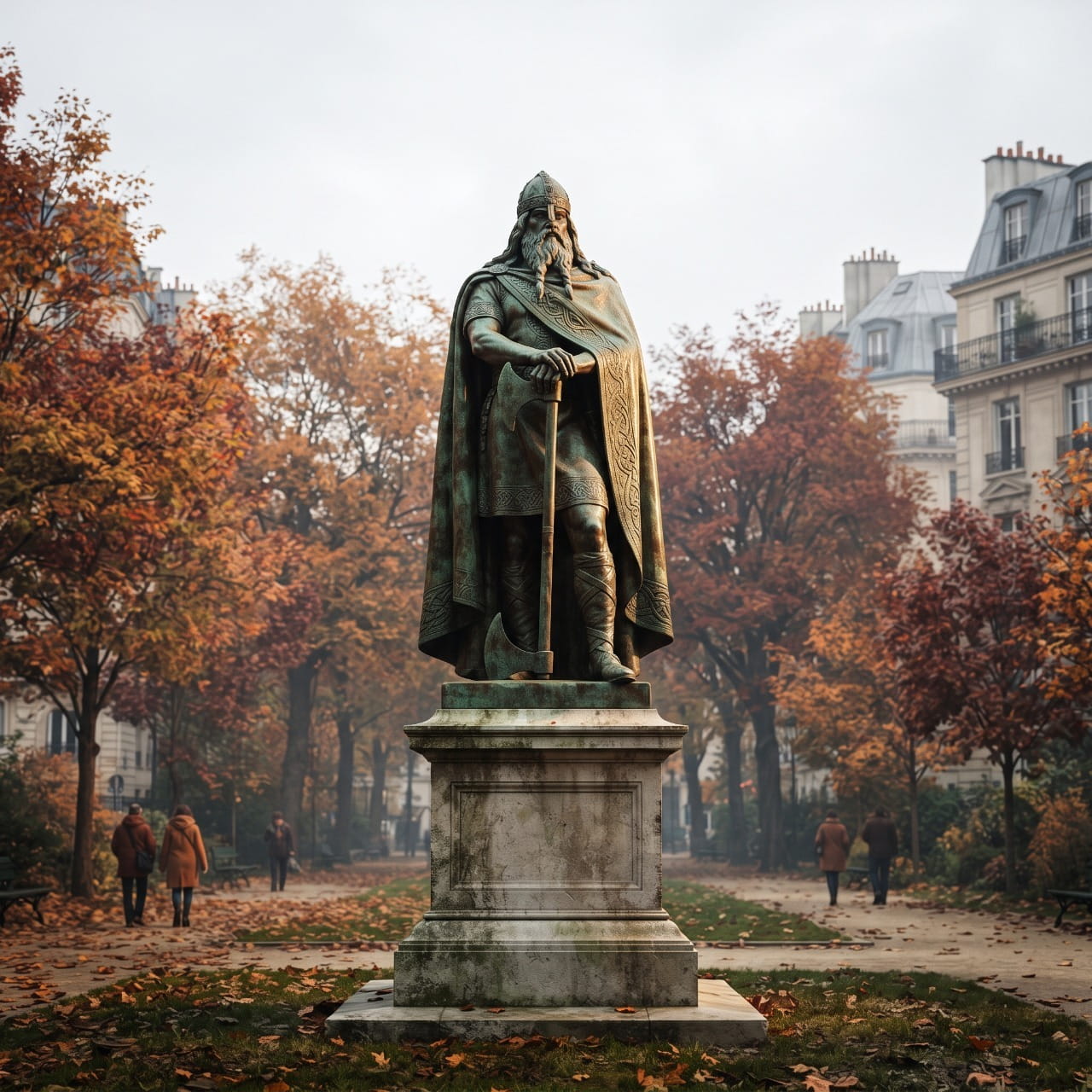
Rollo in Vikings: The True Story of Rollo, Founder of Normandy
📌 In short
- Rollo did indeed exist. His Norse name is Hrólfr, nicknamed Göngu-Hrólfr, or "Rollo the Walker." The Franks called him Rollo.
- He was not the brother of Ragnar Lothbrok. This is an invention of the series: no source links them.
- The Treaty of Saint-Clair-sur-Epte dates from autumn 911, not 918. Charles III the Simple ceded him the lands between the Epte and the sea.
- He was baptized in Rouen around 912 under the Christian name Robert.
- Gisla, the Frankish princess, is likely an invention. Rollo’s documented partner was named Poppa of Bayeux.
- William the Conqueror was his fifth-generation descendant. Rollo was the ancestor of the House of Normandy, and through it, of European monarchs.
In the series Vikings, Rollo is the jealous brother of Ragnar, the one who betrays his kin for a Frankish crown. The character has left a mark on viewers—but behind him lies a real man, whose story is both duller and infinitely more consequential. Without him, Normandy would not exist. Without Normandy, William the Conqueror would never have crossed the English Channel in 1066, and the history of England would be different.
This article separates the fictional character from the Viking leader attested to in the chronicles. We will look at what the sources actually say, what they remain silent about, and why a large portion of what is repeated about Rollo comes from a monk writing eighty years after his death.
Did Rollo really exist?
Yes, without ambiguity. Rollo is mentioned by several independent sources from the 10th and 11th centuries, and his existence is corroborated by a royal act: a diploma of Charles III the Simple dated March 14, 918 mentions lands granted "to the Northmen of the Seine, that is to say, to Rollo and his companions." This is an archival document, not a narrative—the best evidence a historian can have.
Hrólfr the Walker, the man behind the character
His Scandinavian name is Hrólfr. Norse tradition nicknames him Göngu-Hrólfr, literally "Rollo the Walker." The explanation given in Snorri Sturluson’s Heimskringla is amusing: he was so tall and heavy that no horse could carry him, and he had to walk. The anecdote may be a later embellishment, but it has the flavor of Viking nicknames, which always described something very concrete.
The Franks Latinized the name to Rollo. Both forms refer to the same man: the first comes from Latin chronicles and the series, the second from French historical usage.

Hrólfr the Walker: too heavy for a horse, the sagas say
Norwegian or Danish? Two sources, two versions
Regarding his origins, the sources contradict each other, and it must be said frankly rather than trying to arbitrarily decide.
The Norwegian tradition, carried by Snorri Sturluson in the 13th century, makes him the son of Rognvald Eysteinsson, Jarl of Møre. It was young Hrólfr himself—not his father—who was reportedly banished from Norway by King Harald Fairhair for raiding the coasts of the kingdom: an unforgivable crime in the eyes of a king who specifically sought to eradicate internal raids. The Norman tradition, carried by Dudo of Saint-Quentin, calls him a Dane and the son of a Danish nobleman.
Today, historians mostly lean toward the Norwegian origin, but no evidence closes the debate. What we know for sure is that he belonged to that generation of Scandinavian leaders driven from their lands by the centralization of Northern kingdoms, who found a profession and a fortune in raiding. Viking society mechanically produced these landless younger sons.
The problem with sources: everything comes from a single monk
Before going further, we must address a difficulty that most articles about Rollo gloss over, yet which changes the interpretation of everything else: we have no detailed contemporary chronicles for the years 901 to 918. It is a documentary black hole, exactly during the period that interests us.
Dudo of Saint-Quentin, the only detailed account
Most of what is told about Rollo—his origins, his prophetic dream, the kissing of the foot, the marriage to Gisla—comes from a single text: the De moribus et actis primorum Normanniae ducum by Dudo of Saint-Quentin, a canon from Picardy.
Three facts about this author are enough to understand why he must be read with caution:
- He wrote around 994-1015, which is eighty to one hundred years after the events.
- He wrote on commission for Duke Richard II, Rollo’s great-grandson.
- His stated goal was to celebrate the Norman dynasty, not to establish facts.
He is not a historian in the sense we understand; he is a panegyrist. He composed a founding epic, with its omens, reconstructed speeches, and edifying scenes. Some of his accounts are likely true; others are flourishes. The work of historians over the last century has been to sort through this, and the millennium in 2011 led to a comprehensive re-examination of the question.
— Diploma of Charles III the Simple, March 14, 918: the earliest mention of Rollo in an official act"To the Northmen of the Seine, namely to Rollo and his companions."
| Source | Date | Reliability |
|---|---|---|
| Diploma of Charles III | March 14, 918 | Archival document. Direct and indisputable proof. |
| Annals of Flodoard | c. 919-966 | Contemporary of his successors. Sober and reliable. |
| Dudo of Saint-Quentin | c. 994-1015 | Only detailed narrative, but late and biased. |
| William of Jumièges | c. 1070 | Summarizes Dudo. Little original contribution. |
| Heimskringla (Snorri) | c. 1230 | Norse tradition on his origins. Very late. |
| Roman de Rou (Wace) | c. 1160-1174 | Literary work in verse, not a chronicle. |
In other words: what is solid about Rollo can be summed up in a few lines—he existed, he received land, he converted, and he had a son who succeeded him. Everything else is probable, debated, or foundational myth.

Almost everything we know comes from a single account, written a century later
Were Rollo and Ragnar brothers?
No. This is the most obvious liberty the series takes, and we must be clear: no source, Scandinavian or Frankish, links Rollo to Ragnar Lothbrok.
What the series says
In Vikings, Rollo is Ragnar's older brother, eaten up by jealousy, in love with Lagertha, and unable to step out of his younger brother's shadow. This sibling rivalry structures four entire seasons and gives the character his dramatic depth. It's excellent writing — but it's not history.
What the sources say
The fundamental problem is chronological. The Ragnar Lothbrok of the sagas belongs to the first half of the 9th century: the Siege of Paris attributed to him took place in 845. Rollo, for his part, negotiated his treaty in 911 and died around 930. Two to three generations separate them. They could not have crossed paths, let alone been born of the same father.
The series deliberately compresses a century of Viking history into a single family. It is a narrative choice embraced by its creators, and we have detailed this in our comparison of the series vs. true history.

The Rollo of the series: a powerful character, but an invented brother
From raider to lord: the journey of Rollo
Before being a duke, Rollo was what Frankish chroniclers called a Nortmannus: a Northman, i.e., a raider. His trajectory was that of a warlord who understood, before others, that there is more to be gained by settling down than by leaving.
Raids on the Seine
Starting in the 880s, the lower Seine became the preferred hunting ground for Scandinavian fleets. The river was a highway: shallow-draft longships could sail up to Paris without difficulty, and sail back down fully loaded. Rouen fell, rose, and fell again. The abbeys in the valley were emptied one after another.
What distinguished Rollo from his predecessors was longevity. Where others raided and left, he wintered, returned, and put down roots. Around 900, he effectively controlled the Rouen region — long before any king granted him anything.
The Siege of Paris of 885-886
Norman chronicles attribute his participation in the great siege of Paris of 885-886, the one recounted by the monk Abbo in his Bella Parisiacae urbis. Seven hundred ships, tens of thousands of men according to the chroniclers' — widely exaggerated — figures, and a city that held out for eleven months.
Be careful not to confuse two different sieges. The one in 845, led by a chieftain named Reginherus whom tradition equates with Ragnar, ended with the payment of seven thousand pounds of silver. The one in 885-886, forty years later, is where Rollo allegedly made his mark. The series merges them into a single spectacular event; history separates them by two generations.

Longships could sail up the Seine to Paris effortlessly
Why were the Vikings on the Seine?
These raids are often presented as senseless savagery. The reality was more economic than that.
The 9th-century Frankish kingdom offered an irresistible combination: considerable wealth concentrated in unfortified monasteries, a network of navigable rivers that penetrated deep inland, and royal power weakened by Carolingian succession quarrels. After the Treaty of Verdun in 843, Charlemagne's heirs fought over the empire instead of defending the coasts.
Facing them, Scandinavian ships provided a decisive technical advantage. A longship drew less than a meter of water: it could sail up rivers, run aground on any beach, and depart before an army could assemble. The Franks, meanwhile, took weeks to raise an army. The speed ratio was one to ten.
Added to this was internal pressure in the North. Scandinavian society practiced a division of inheritance that produced, in every generation, landless younger sons. For them, raiding was not a distraction: it was the only way to gain wealth, and therefore status, and therefore marriage. Rollo belonged exactly to this category of men.
The Treaty of Saint-Clair-sur-Epte, autumn 911
This was the foundational act, and the moment when Rollo ceased being a gang leader to become a territorial lord.
911 or 918? A very widespread confusion
We frequently read that the treaty dates to 918. This is false, and the error has a precise origin. The treaty was concluded in the autumn of 911. The date of 918 is that of Charles III's diploma which, seven years later, retrospectively mentions the concession made "to the Northmen of the Seine." This document created nothing: it confirmed. Confusing the two is like dating a marriage to the day you find the family record book.
What Charles the Simple actually ceded
The exact terms escape us: the text of the treaty has never been found. We know its substance through indirect sources, and especially through Dudo of Saint-Quentin. In essence:
- The king ceded the lands between the Epte and the sea — roughly the Rouen region, the Pays de Caux, the Talou, and the Roumois. Not the entire Normandy: the Bessin and Hiémois would be conceded to Rollo himself in 924, the Cotentin and Avranchin to his son in 933.
- Rollo held them "in allod and in ownership," that is to say in full possession, which is significant.
- According to Dudo again, the king authorized him to supply himself from neighboring Brittany to meet the needs of his people — a clever way to redirect the Norman appetite toward a territory that was already beyond royal authority anyway.
- In exchange, he pledged to defend the mouth of the Seine against other Scandinavian fleets. The king turned the wolf into a watchdog.
- Rollo agreed to receive baptism.
Charles III's calculation was no capitulation: it was politics. Unable to drive out the Normans, he integrated them and entrusted them with guarding the river. The gamble would work beyond all expectations.
The anecdote of the foot-kissing: fact or legend?
— Response attributed to Rollo by Dudo of Saint-Quentin, De moribus et actis primorum Normanniae ducum"I will never bend the knee to anyone, and I will never kiss any man's foot."
It is famous. According to Dudo, custom dictated that the vassal kiss the foot of his suzerain. Rollo refused to bend and had one of his warriors do it in his place; the man grabbed the king's foot and brought it to his mouth without kneeling, knocking Charles III onto his back, to the great hilarity of the Normans.
The scene is too good to be true. Dudo wrote around the year 1000, more than eighty years after the events, at the behest of Duke Richard II — that is, Rollo's great-grandson. His goal was to establish legitimacy, not to report facts. The anecdote belongs in the register of origin stories, like the wolf of Romulus. It says what the 10th-century Normans wanted to believe about their ancestor: that he had never truly submitted.
The Baptism of Rouen and the name Robert
Around 912, Rollo was baptized in Rouen. He received the Christian name Robert, after his godfather Robert, Marquis of Neustria and future King of the Franks.
This conversion has been interpreted in two opposite ways. Some see it as a purely cold calculation: baptism is the price of entry into the Frankish world, without which no recognition is possible. Others note that Rollo generously endowed the churches in his territory — Saint-Ouen of Rouen, first and foremost — and that his successors increased these efforts: it was William Longsword who would rebuild the abbey of Jumièges. The truth likely lies in both: for the settled Viking chieftains, conversion was simultaneously a strategy and a genuine turning point.
One detail sheds light on the nuance. Adémar of Chabannes reports that upon his death, Rollo had Christian prisoners beheaded as an offering to the gods of the North while distributing gold to the churches. The testimony is late and hostile, thus suspect — but it well reflects the perception the Franks had of these converts, of whom one never quite knew which side they were praying to. Nordic symbols did not, moreover, disappear overnight in 10th-century Normandy.

Rouen, circa 912: the raider becomes Robert
"First Duke of Normandy": a title that did not exist
We read everywhere that Rollo was the first Duke of Normandy. The formula is convenient, but it is anachronistic, and it is a nuance that almost no French article points out.
During his lifetime, Rollo held no ducal title. Documents of the era refer to him as princeps, comes — count — or more simply as the leader of the Northmen of the Seine. The title of Duke of Normandy did not appear until the 11th century, under his distant successors, when the principality was firmly established and sought to elevate itself to the rank of the kingdom's great duchies.
Strictly speaking, Rollo was therefore the founder of a principality that would become a duchy — not a duke. His Frankish contemporaries probably didn't know what to do with him: neither king nor ordinary vassal, but a warlord permanently settled with whom one had to negotiate.
What Rollo actually changed
Beyond the battles, his contribution rests on three decisions that shaped Normandy for centuries.
He stopped the raids on the Seine
It was the treaty's central clause, and it was kept. From 911 on, the mouth of the Seine ceased to be an open door. Rollo pushed back competing fleets — not out of loyalty to Charles III, but because these lands were now his and he had no desire to see them pillaged. Paris breathed easy for the first time in a century.
He left the Frankish structures in place
This was perhaps his most clever choice. Rollo did not destroy the existing administration: he settled into it. Bishoprics remained, as did counties; Frankish law continued to apply. This continuity explains why Normandy became one of the best-governed principalities in the West so quickly — the Normans inherited a working machine and kept it running.
He brought in settlers from the North
Rollo called on Scandinavians to settle on his lands, particularly in the Pays de Caux. It is this settlement, not merely the presence of his warrior entourage, that explains the density of Old Norse place names in this specific region. The demographic contribution remained in the minority — but it was concentrated, and therefore visible even in village names today.

The Pays de Caux, where village names still speak Old Norse
Poppa, Gisla: who did Rollo really marry?
This is the point where the series drifts furthest from the sources, and curiously the one that most French articles treat most poorly.
Poppa of Bayeux, the attested companion
Poppa is the woman whom Norman sources associate with Rollo, and the mother of his heir. She was reportedly the daughter of Berengar, Count of Bayeux, and Rollo is said to have abducted her during a raid — an abduction followed by a union, which was not unusual in that context.
Their union is described as more danico, "in the Danish manner": a marriage recognized by Scandinavian custom but not by the Church. This form of union had a major political consequence — it allowed the Dukes of Normandy to later contract Christian marriages while maintaining a legitimate lineage in the eyes of their men.
Gisla, the probable invention of Dudo
The series has Rollo marry Gisla, daughter of Charles III, and uses it as a dramatic catalyst for several seasons. Dudo of Saint-Quentin does indeed claim that the king gave him his daughter in marriage during the treaty.
Historians doubt this. No contemporary source mentions this princess. Charles III had no daughter of that age attested in 911. And the narrative's benefit to Dudo is obvious: tracing the descent of the Dukes of Normandy from Carolingian blood is worth all the parchments in the world when writing to legitimize a dynasty.
To remember: the Gisla in the series is not an invention of the screenwriters — they found her in a medieval chronicle. But that chronicle had likely invented her before them.
The death of Rollo and his lineage
Rollo died between 928 and 933, in Rouen, at an advanced age. The exact date eludes us, as is often the case. He was supposedly buried in the Rouen Cathedral, where a recumbent effigy is dedicated to him today — a much later work, like the statue in Square Verdrel sculpted by Arsène Letellier in 1863.
William Longsword
His son William Longsword (c. 893 – 942), born to Poppa, succeeded him and completed the expansion to the west: after the Bessin and Hiémois regions obtained by his father in 924, he received the Cotentin and Avranchin in 933. It was under his rule that Normandy took on roughly its final shape. Rollo also had a daughter, Gerloc, baptized Adèle, who married William III of Poitiers.
From Rollo to William the Conqueror
The lineage is direct and worth laying out in black and white:
| Generation | Name | Title |
|---|---|---|
| 1 | Rollo (Hrólfr) | Norman leader of the Seine, † c. 930 |
| 2 | William Longsword | Count of Rouen, † 942 |
| 3 | Richard I Fearless | Count of Rouen, † 996 |
| 4 | Richard II the Good | Duke of Normandy — the first to hold the title, † 1026 |
| 5 | Robert the Magnificent | Duke of Normandy, † 1035 |
| 6 | William the Conqueror | Duke of Normandy, King of England in 1066 |
One hundred and fifty-five years separate the Treaty of Saint-Clair-sur-Epte from the Battle of Hastings. In five generations, the descendants of a Scandinavian raider leader took the throne of England. Few family trajectories have had such an effect on Europe.

Between the Epte and the sea: the core of the future Normandy
Rollo in the series Vikings: the full comparison
Here, point by point, is what the series invents and what it respects.
| Element | Vikings series | Historical sources | Verdict |
|---|---|---|---|
| Brother of Ragnar | Yes, older brother | No attested connection, two generations apart | ❌ Invented |
| Participation in the Siege of Paris | Season 3, with Ragnar | Siege of 885-886, without Ragnar | ⚠️ Moved |
| Marriage to Gisla | Central to the plot | Reported by Dudo, judged doubtful | ⚠️ Very uncertain |
| Poppa of Bayeux | Absent | Attested companion, mother of the heir | ❌ Omitted |
| Becomes lord in Francia | Yes, Duke of Normandy | Treaty of 911, lands between Epte and sea | ✅ Exact |
| Conversion to Christianity | Yes | Baptized in Rouen c. 912 under the name Robert | ✅ Exact |
| Repeated betrayals of his people | Recurring plot device | No trace | ❌ Invented |
| Royal lineage | Mentioned | Ancestor of William the Conqueror | ✅ Exact |
The balance is more favorable than one might think: the political trajectory of the character is accurate. It is the genealogy and private life that the series has rewritten.
Rollo season by season in the series Vikings
For viewers who want to contextualize the character, here is his journey in the series, played by Clive Standen.
Seasons 1 and 2: the brother in the shadows
Rollo is introduced as the older brother, a better warrior than Ragnar but less skillful, secretly in love with Lagertha. Tortured by Jarl Haraldson's men in the first season for refusing to betray his brother, he eventually betrays him by joining Jarl Borg — before being judged and then spared. This entire plotline is a construct of the writers.
Season 3: the Siege of Paris
This is the turning point. After the failed assault on Paris, Rollo accepts the emperor's offer: lands and the hand of Princess Gisla in exchange for defending the river. The historical core is there — a Viking leader who swaps raiding for a principality — but the episode is moved back by a generation.
Season 4: the break
Rollo faces and defeats his own brother's fleet. He becomes the Duke of Normandy, learns the Frankish language, and adopts court customs. Historically, no fratricidal battle of this kind is attested — but the rapid cultural assimilation is perfectly accurate: in two generations, Rollo's descendants spoke Romance languages and behaved like Frankish princes.
Season 5: the return
A late appearance shows him as an accomplished Frankish lord, returning to Kattegat to ally with Ivar — and to settle the question that has haunted him from the beginning: the paternity of Bjorn. This is pure fiction, but it captures something true: Rollo's descendants did eventually conquer England — a century and a half later, with William.
Rollo, national hero of the 19th century
One final point, often ignored, which explains why Rollo is so present in the landscape of Rouen.
The character experienced a second life in the 19th century. Normandy, like other French regions, was searching for an identity and ancestors. Rollo was an ideal founder: virile, a founder, converted — pagan enough to be romantic, Christian enough to be respectable. It is in this context that Arsène Letellier sculpted his statue in 1863, and that his recumbent effigy was highlighted in the cathedral.
In other words, the figure of Rollo we know is doubly reconstructed: first by Dudo in the 10th century to legitimize a dynasty, and a second time in the 19th century to establish a regional identity. The series has only added a third layer — more visible, but no more distorting than the previous ones.

The 19th century reinvented Rollo as a founding hero
Why Normandy bears this name
Frankish chroniclers called the Scandinavians Nortmanni: the "Northmen." The territory ceded in 911 therefore naturally became the terra Normannorum, the land of the Northmen — Normandy.
The name survived where the language disappeared. Old Norse died out in Normandy within two or three generations, absorbed by the Romance language. Only toponymic traces remain, but they are everywhere for those who know how to read them: the endings -tot (from topt, the farm) in Yvetot or Criquetot, -bec (from bekkr, the stream) in Caudebec or Bolbec, and -fleur — from a Norse word denoting an estuary or arm of the sea — in Honfleur and Harfleur. Every road sign in the Pays de Caux is a vestige of Rollo.
Tracing Rollo today
Rouen remains the city of Rollo. His effigy is located in Notre-Dame Cathedral, in the chapel bordering the ambulatory — a tomb reconstructed long after his death, but one that marks the site of his memory. His statue by Arsène Letellier, erected in 1863, watches over Square Verdrel.
The millennium of the treaty, celebrated in 2011, gave rise to significant academic work — notably within the Historical Research Group of the University of Rouen — which has largely renewed the interpretation of the event and sorted between Dudo's narrative and what can actually be established.

The memory of Rollo rests in the Cathedral of Rouen
Frequently asked questions about Rollo
Are Rollo and Rollon the same person?
Yes. Rollo is the Latin form used by medieval chroniclers and adopted by the series; Rollon is the French form established by historians. His original name was Hrólfr.
Was Rollo really the brother of Ragnar Lothbrok?
No. No source links them, and they are separated by two or three generations: Ragnar belongs to the early 9th century, Rollo negotiated his treaty in 911.
What is the exact date of the Treaty of Saint-Clair-sur-Epte?
Autumn 911. The date of 918 sometimes encountered is that of the charter of Charles III confirming the grant, seven years later.
Did Rollo marry a Frankish princess?
This is what Dudo of Saint-Quentin claims, but historians strongly doubt it: no contemporary source mentions this Gisla. Rollo’s attested companion is Poppa of Bayeux, mother of William Longsword.
How did Rollo die?
Of old age, in Rouen, between 928 and 933. No source reports a violent death. The precise date remains unknown.
Is William the Conqueror a descendant of Rollo?
Yes, in the fifth generation: Rollo, William Longsword, Richard I, Richard II, Robert the Magnificent, then William the Conqueror, King of England in 1066.
Was Rollo Norwegian or Danish?
Sources diverge. The Norse tradition says he was the son of the Norwegian jarl Rognvald of Møre; Dudo says he was Danish. Today, historians lean toward a Norwegian origin, without certainty.
Why was he called "the Walker"?
According to the Heimskringla, he was so corpulent that no horse could carry him and he had to travel on foot — hence Göngu-Hrólfr, Rolf the Walker.
Did Rollo really participate in the Siege of Paris?
Norman chronicles claim he did for the siege of 885-886. It should not be confused with that of 845, led by Reginherus, which tradition attaches to Ragnar. The two sieges are separated by forty years.
Was Rollo really the first Duke of Normandy?
He was its founder, but he never held that title. In his lifetime he was called princeps or count. The ducal title only appeared in the 11th century.
What remains of the Viking language in Normandy?
Old Norse died out within two or three generations, but it survives in place names: the endings -tot (the farm), -bec (the stream), and -fleur (the estuary) are of Scandinavian origin.
Can we trust what Dudo of Saint-Quentin says?
With caution. It is our only detailed account, but it was written between eighty and one hundred years after the events, commissioned by Rollo's great-grandson to glorify the dynasty. Archival documents, like the 918 charter, are much more reliable.
Where can one see Rollo today?
In Rouen: his effigy in Notre-Dame Cathedral, and his 1863 statue in Square Verdrel.
Bring Viking Normandy into your home
Rollo's longships sailed up the Seine eleven centuries ago. Our models, shields, and banquet objects keep a trace of it.
Discover Viking longships & boats📚 Also Read
- How Tall Were the Vikings? The Answer from Skeletons, Supported by Figures
- Viking Names: Over 130 Authentic Nordic First Names, Meanings and Pronunciation
- Ragnar Lothbrok: true history versus the Vikings series
- Vikings, series versus true history: all the differences
- Ragnar's 5 legendary battles in the series
- The Viking longship: construction, navigation, and expeditions
- Bjorn Ironside, the Viking King of Sweden
- Floki, the boat builder
- Lagertha: warrior, queen, and legend
- The daily life of the Vikings

Leave a comment
All comments are moderated before being published.
This site is protected by hCaptcha and the hCaptcha Privacy Policy and Terms of Service apply.