
Vikings: TV Series vs. True History: The Differences
📌 In brief
- The series blends historical facts and fiction.
- In reality, Rollo of Normandy (Göngu-Hrólfr) lived a century after Ragnar's presumed era.
- The Lindisfarne raid in 793 is one of the best-documented events in Viking history.
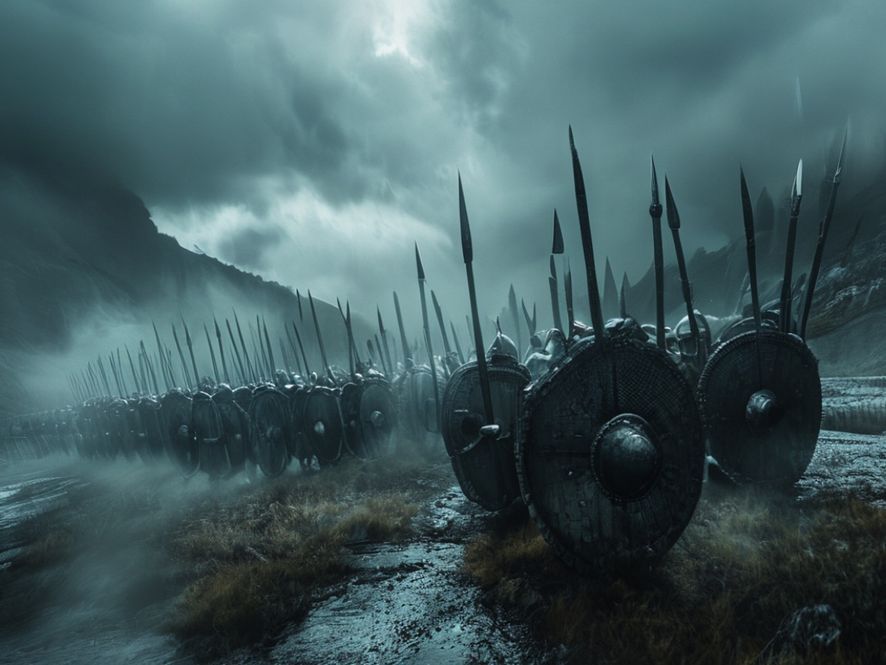
- Shield wall scenes are generally realistic in concept, but stylized for dramatic effect.
- Athelstan the monk is an entirely fictional character created by Michael Hirst.
The underlying issue: 118 years compressed
There is a simple way to measure the gap between Michael Hirst's series and history: put the dates on a timeline.
The Lindisfarne raid, which opens the first season, took place in 793. The Paris siege, which Ragnar leads in person, took place in 845. The Great Heathen Army of his sons landed in England in 865. Rollo obtained Normandy in 911. That is one hundred and eighteen years—four generations—covered by characters who only age about twenty years on screen.
This is not negligence; it is a creative decision. A series needs a through-line, and thus characters who span these events. Scandinavian history of the 9th century, however, offers only scattered names in annals written by their victims. To tell a story, it was necessary to bridge the gaps—and bridging implies bringing events closer together.
This process is nothing new. It is the hallmark of the chanson de geste, which aggregated exploits belonging to others around Charlemagne. It is the method of the sagas themselves, which gathered facts attributable to several chieftains under the name of Ragnar. The series, therefore, does not betray the Nordic tradition: it extends its functionality using the medium of television.
Nevertheless, the viewer deserves to know where the line is drawn. This article is not an attempt to put the series on trial—it has done more for public interest in medieval Scandinavia than thirty years of academic publications. It seeks to separate three categories: what is verified, what is legendary, and what is invented for the sake of the narrative.
Another, more subtle discrepancy is worth noting: geography. Kattegat, the port that serves as the home for the entire series, does not exist. The name actually refers to the strait separating Denmark from Sweden, not a settlement. The real centers of the time were called Ribe, Hedeby, Birka, or Kaupang—and the series merged them into a single location, just as it merged several chieftains into one Ragnar.
The process is the same in both cases, and in dramaturgy, it has a name: the unity of place and action. A story dispersed across four ports and twelve chieftains over a century would not work on screen. The question is therefore not whether the series simplifies—all historical fiction simplifies—but to identify where, so as not to mistake simplification for reality.
A methodological warning is necessary from the start. "Verified" does not mean "recounted in a saga." The Icelandic sagas date from the 13th and 14th centuries; they constitute literary sources, not historical reports. The documents contemporary to the events are the Frankish, Anglo-Saxon, and Irish annals, written by monks who suffered the raids. When the two contradict each other, the latter are the ones that carry authority.
Ragnar and Lagertha: two characters, two statuses
The two central characters of the series do not share the same documentary status, and this is important.
Ragnar occupies an intermediate position. A chieftain named Reginheri ravaged Paris in 845 and received a ransom from Charles the Bald: the Annals of Saint-Bertin confirm this. But the Ragnar Loðbrók of the sagas—the father of the sons, the man in the snake pit, the husband of several remarkable women—only appears four centuries later. Most historians view him as a composite figure, aggregating several chieftains under a name that had become prestigious. We dedicate an entire article to this topic.
Lagertha is in an even more fragile situation, and this must be stated clearly. She does not come from the Icelandic sagas. She appears in the work of only one author: Saxo Grammaticus, a Danish chronicler writing in Latin around 1200, who portrays her as a woman Ragnar met in Norway, who fought with her hair loose, and whom he married and later divorced.
However, Saxo is a unique author. He wrote to glorify Denmark, he compiled heterogeneous materials, and his Book IX blithely mixes history with the marvelous. Several specialists believe that his Lagertha might derive from a mythological figure—a connection has been proposed with Þorgerðr Hölgabrúðr, a protective Norwegian deity—rather than a person who actually lived.
This does not mean that Scandinavian women never fought. The question of "warrior women" is open, and archaeology reignited the debate in 2017 with the DNA analysis of grave Bj 581 in Birka, a richly armed burial whose occupant turned out to be a woman. The debate over the interpretation of this grave remains lively—is it symbolic grave goods or proof of actual warrior status?—but it has definitively dismissed the notion that the question was settled.
The difference between the two characters can be summed up in one sentence. For Ragnar, the doubt concerns his identity: several real men behind one name. For Lagertha, it concerns her very existence: a single, late, and suspect source of literature.
The sons, the Great Heathen Army, and the Siege of Paris
It is regarding the sons that the series comes closest to history, because they are documented by their adversaries.
The Anglo-Saxon Chronicle, written during the events, names Ívarr, Halfdan, and Ubba as the leaders of the "Great Heathen Army" that landed in 865. York fell in 866, King Edmund of East Anglia was killed in 869, and Northumbria was divided among Halfdan's men in 876. These facts are solid, dated, and the series faithfully reproduces their substance.
It takes considerable liberty, however, in making this campaign an act of filial revenge. In the sagas, the sons invade England to avenge their father, who was thrown into the snake pit by King Ælla. In the annals, we see a methodical operation of conquest: negotiation for horses, fortified winter camps, installation of puppet kings, and then the partition of the land. The emotional motive belongs to legend; the sources describe a planned operation.
The Siege of Paris illustrates another type of arrangement. It did happen, but the series composes a single version of it where history counts several: the 845 raid attributed to Reginheri, and the great siege of 885-886, forty years later, led by Sigfred and Rollo, where Paris resisted under the command of Count Odo. The series merges these episodes and places Ragnar there, though he was absent from the second for simple chronological reasons.
As for Rollo, presented as Ragnar's brother, he represents the most spectacular discrepancy. The historical man—Hrólfr, Rollo—obtained Normandy via the Treaty of Saint-Clair-sur-Epte in 911, two to three generations after the events in the series. He has no known blood relation to the characters of the Great Heathen Army.
The assessment is therefore mixed, and rather to the credit of the series on this specific point: military facts are largely respected, while the motivations and family ties are products of dramatic construction. This is exactly the opposite of what one would expect from fiction, and it is to the show's credit.
Floki, Athelstan, Ælla: where the supporting cast comes from
A few supporting characters deserve clarification of their origins, as they are often mistaken for historical figures.
Floki overlays two sources. There was a Hrafna-Flóki Vilgerðarson, a very real navigator who reached Iceland around the 860s and, according to the Landnámabók, gave it its current name after seeing a bay choked with ice. He did not build Ragnar's ships and was no mystic: he was an unlucky settler who lost his livestock during the first winter. The character's personality—the cunning, the unstable devotion, the jealousy toward the Christian—is borrowed from the god Loki, whose name resonates by design.
Athelstan is a pure invention. No English monk captured at Lindisfarne served as an advisor to a Scandinavian chieftain in the sources. The character serves a precise narrative function: giving the viewer an outsider's perspective on the Nordic world and embodying the encounter between two religious systems. The name itself is borrowed from a 10th-century English king, with no relation.
Ælla of Northumbria existed and did indeed die during the capture of York in 867. But his role in the series—as Ragnar's executioner and the victim of the blood eagle—comes from the sagas, not the annals. The torture itself is the subject of scholarly debate, which we detail elsewhere, and the current conclusion is: indecisive.
Harald Fairhair presents a familiar chronological problem. The historical figure unified Norway around the end of the 9th century and died around 930; the series makes him a contemporary of Ragnar, which is one generation too early.
A final word on what the series could not show, for lack of knowledge. Language is the best example: the characters speak English, with a few lines in reconstructed Old Norse. Yet the actual pronunciation escapes us for the most part, and the mutual intelligibility between Old Norse and Old English—probably partial, as these are related languages—remains a subject of discussion among linguists. The series chooses convenience where research leaves things open.
The same goes for ritual. The scenes of sacrifice at Uppsala are based on a single piece of testimony, that of Adam of Bremen writing around 1070—a German cleric who never set foot there and reported hearsay about practices he disapproved of. It is our best source on the subject, and it is frankly poor. Every depiction of a *blót* is therefore speculative reconstruction, including the most carefully crafted ones.
These choices have a logic. Each of these characters allows the series to show a theme without resorting to exposition: Floki embodies paganism, Athelstan the contact with Christianity, Harald the political unification of Norway. These are historical concepts turned into faces—a legitimate process, provided one does not confuse the face with the fact.
What the series gets right, and it's quite a bit
It would be unfair to dwell only on the discrepancies. On several points, the series is more accurate than anything cinema had produced before it—and sometimes more accurate than the public's own perception.
A primary accomplishment, and a major one: the Scandinavians are shown as farmers. Ragnar is a farmer before he is a chieftain; we see him plowing, worrying about his harvests, discussing land. This is historically accurate and directly contradicts the image of the professional raider. The vast majority of Scandinavians in the Viking Age never participated in a raid.
Second achievement, law. The series features the Thing, the assembly where disputes are settled, oaths are sworn, and a leader's power is debated. Nordic societies were legal societies, obsessed with procedure and compensation — the wergeld, the price paid for a death. No previous production had dared to show Vikings litigating.
Third achievement, the ship. The ships in the series are derived from the actual Gokstad and Oseberg wrecks, and the role of the shallow draft — navigating rivers, docking without a port — is correctly portrayed. That is where the true Scandinavian strategic superiority lay, not in some kind of ferocity.
Fourth achievement, religious syncretism. The series shows people wearing both a cross and a Thor's hammer, getting baptized for business interests while still performing sacrifices. This is exactly what archaeology documents: jewelry molds from Haithabu allowing for the casting of both crosses and hammers indiscriminately, mixed burials, and the long period of coexistence.
Fifth achievement, the status of women. Without settling the question of shield-maidens, the series shows women who own property, inherit, divorce, and speak at the Thing. This point is solidly established by Scandinavian legal codes, which granted women rights significantly superior to those of their Frankish or Anglo-Saxon contemporaries.
Sixth achievement, more subtle: the series shows Scandinavians trading. Kattegat is a merchant port before it is a raiding base; people negotiate there, weigh silver, and welcome foreigners. This is fundamental and almost always omitted elsewhere. The great agglomerations of the Viking Age — Ribe, Birka, Hedeby, Kaupang — were trading hubs connected to the Carolingian Empire, Byzantium, and the Islamic world, and the tens of thousands of silver dirhams found in Swedish hoards speak to the volume of this trade better than any tale of pillaging.
Seventh achievement, violence without moral complacency. The series does not turn its characters into misunderstood heroes: they kill unarmed monks, enslave people, and perform human sacrifices. The slave trade was one of the most lucrative activities in the Scandinavian world — the English word thrall comes from the Old Norse þræll — and many productions gloss over it. This one does not.
One might add a detail that few productions attend to: hairstyles and hygiene. English sources criticize the Scandinavians for combing their hair, bathing on Saturdays, and changing their clothes — to the point of seducing English women. Antler combs are the most frequent object found in urban excavations from the Viking Age. The series was right to show them clean.
How to watch the series without being misled
How, then, to watch Vikings without being misled? By keeping a simple distinction in mind between three registers.
The material framework is generally reliable: ships, longhouses, tools, clothing, social organization, religious practices. This is the area where the series relies on archaeology, and where it is better than its reputation.
The events are real but rearranged. Lindisfarne, Paris, the Great Army, the conquest of Northumbria all took place; their sequence and participants have been redistributed to fit into a single lifetime.
The people, finally, form a gradient: from those attested by contemporary sources (Ívarr, Halfdan, Ubba, Ælla, Rollo) to the late legendary (Ragnar, Lagertha), and up to completely invented ones (Athelstan). This is the register where caution is most necessary, because it is the one to which the viewer attaches themselves.
A final remark, which applies beyond this series: perfect reconstruction is impossible, and not just out of laziness — we are ignorant of a multitude of basic things. We do not know with certainty how Old Norse was pronounced, how a sacrifice was performed, or what people thought of their gods on a daily basis. Any visualization fills these gaps — the only question is whether it does so honestly.
From this point of view, Vikings does well. It has replaced a caricature — the hirsute barbarian in a horned helmet — with a complex, legalistic, commercial, and religiously plural society. It is a net gain, even if paid for at the price of a mangled chronology.
Our position, on this site, is to embrace both. We sell items inspired by an imaginary world, and we insist on stating where that imaginary comes from: what goes back to the Eddas and excavations, what comes from medieval sagas, and what was invented in the 19th century or on television. All three have their value. Confusing them has none.
Frequently Asked Questions about Vikings: Series vs. History
Is the Vikings series historically accurate?
The series blends historical facts and fiction. The major events (Lindisfarne raid, Siege of Paris) are real, but the chronology is compressed, characters from different eras coexist, and many relationships are invented for dramatic storytelling.
Were Ragnar and Rollo really brothers?
No. In reality, Rollo of Normandy (Göngu-Hrólfr) lived a century after the presumed time of Ragnar. The series presents them as brothers to create dramatic conflict, but there is no historical familial link between them.
Did the Lindisfarne raid really happen in 793?
Yes, the Lindisfarne raid in 793 is one of the best-documented events in Viking history. Anglo-Saxon chronicles describe the attack on the monastery. However, Ragnar Lothbrok was likely not there — the series places him there for narrative reasons.
Is the shield-wall technique in the series realistic?
The shield-wall scenes are generally realistic in their concept, but stylized for entertainment. The real shield wall was more static and disciplined. The series adds acrobatic movements and individual fights that would not have occurred in a real, tight formation.
Did Athelstan really exist?
No, Athelstan the monk is an entirely fictional character created by Michael Hirst. He serves as a narrative bridge between Viking and Christian cultures. However, monks captured during Viking raids are historically attested.
Was Paris really besieged by the Vikings?
Yes, Paris was besieged several times. The most famous siege dates to 845, where a Viking leader (possibly Ragnar) extorted 7,000 pounds of silver. A second major siege took place in 885-886, repelled this time by Count Odo. The series blends both events.
What are the delivery times and return conditions for the Freyja statue?
For the Freyja statue, as with any order, allow for 10 to 20 business days in total: 3 to 5 days for preparation, then 7 to 15 days for delivery within mainland France, and 10 to 20 days within the European Union. Delivery costs €4.90 in France and the EU, and is free on orders over €49. After receipt, you have 14 days to change your mind and return the item to us: return shipping costs are your responsibility. If the received item is defective or does not match your order, we will refund the return shipping costs upon presentation of proof of postage.
"Cattle die, kinsmen die, the self must also die; but glory never dies, for him who wins a good name."
— Hávamál, stanza 76, Poetic Edda
May the Aesir guide you on the path of honor.
👉 Explore our collections of Viking jewelry and Viking tankards to wear the Viking spirit every day.
Sources
- Anglo-Saxon Chronicle (865-878) and Annals of Saint-Bertin (845, 885-886) — contemporary sources of the raids, written by their victims.
- Saxo Grammaticus, Gesta Danorum, Book IX, circa 1200 — the only ancient source mentioning Lagertha.
- Landnámabók — Hrafna-Flóki Vilgerðarson and the naming of Iceland.
- Charlotte Hedenstierna-Jonson et al., “A female Viking warrior confirmed by genomics,” American Journal of Physical Anthropology, 2017 — genomic analysis of the Birka Bj 581 grave, and the subsequent debate on its interpretation.
📚 Read also
- How Tall Were the Vikings? The Answer from Skeletons, by the Numbers
- Vikings Valhalla Netflix: Sequel and New Heroes
- The 5 Legendary Battles of Ragnar in the Vikings Series
- Bjorn Ironside: The Viking King of Sweden
- The Sons of Ragnar: Ivar, Bjorn, Ubbe, and Sigurd
- Rollo in Vikings: The True Story of Rollo, Founder of Normandy

Leave a comment
All comments are moderated before being published.
This site is protected by hCaptcha and the hCaptcha Privacy Policy and Terms of Service apply.