
Filters
32 products
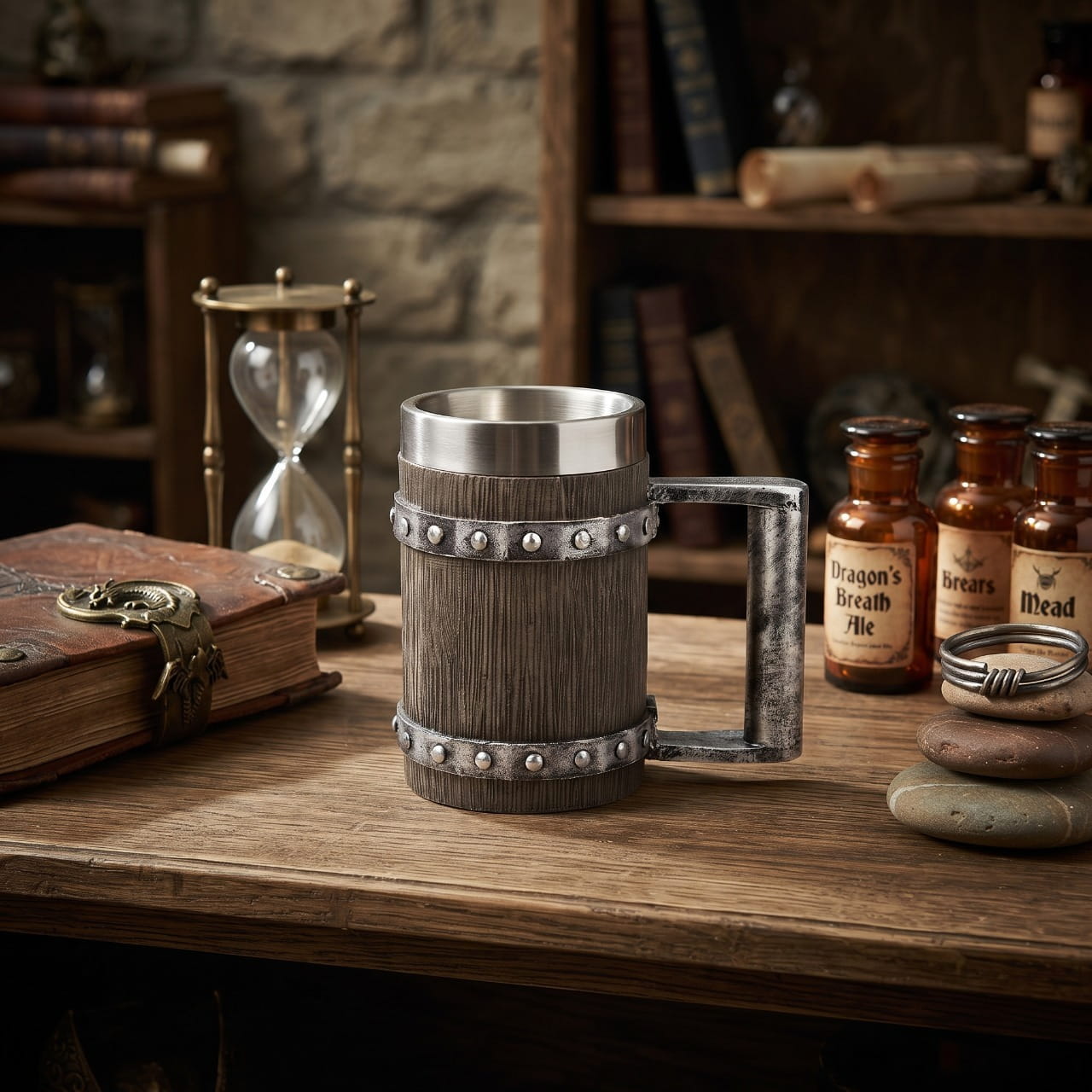
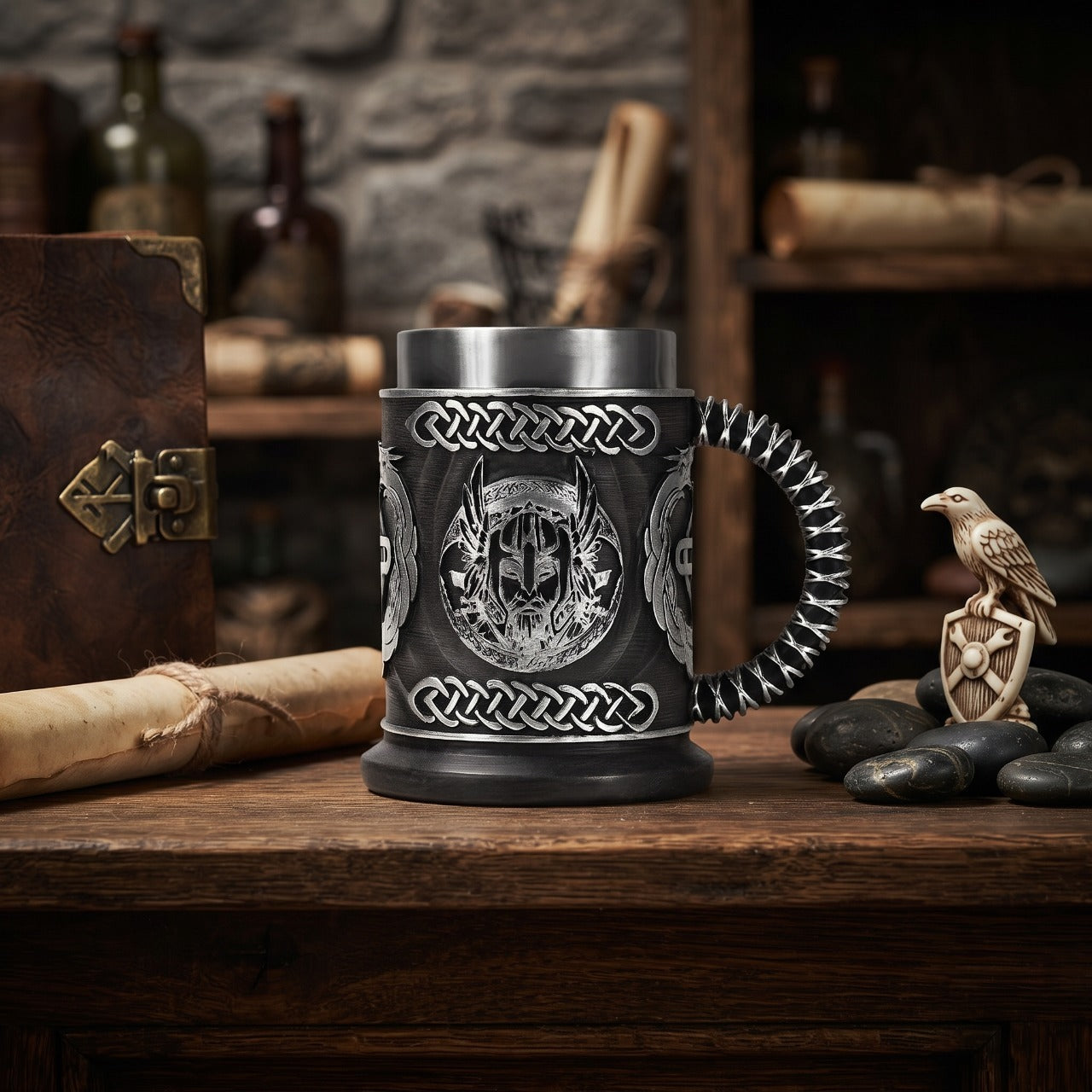
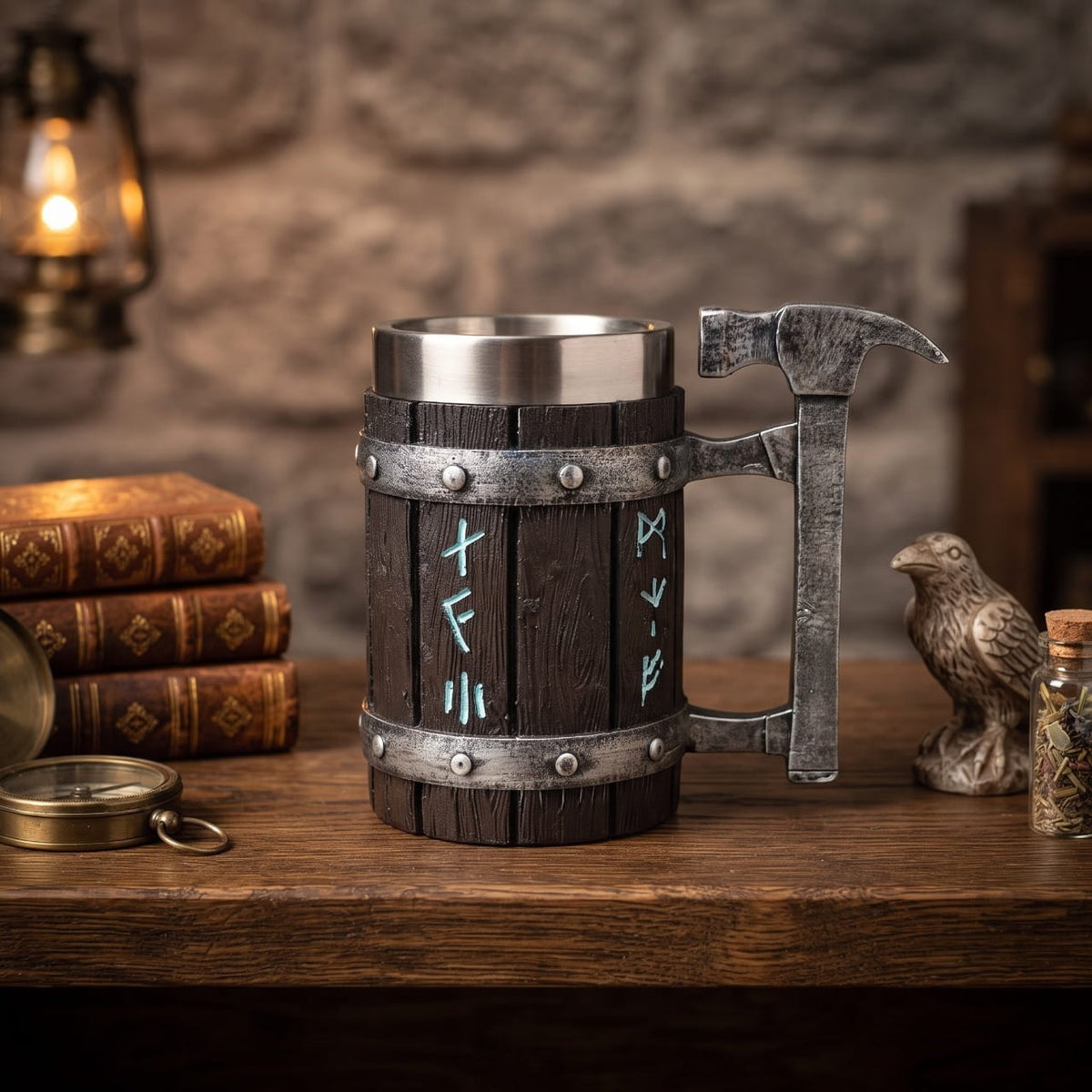
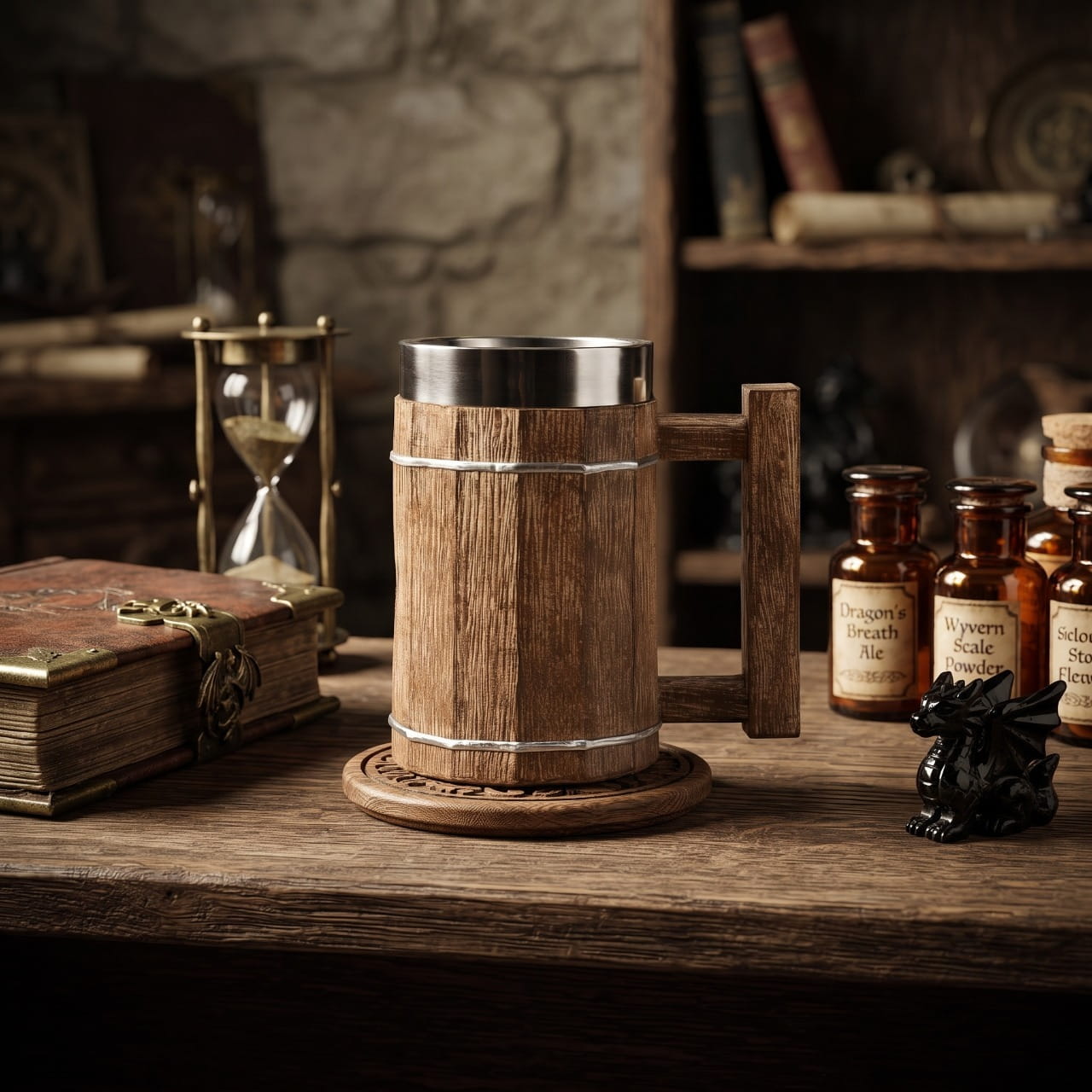
Collections similaires
You would also like

Frequently Asked Questions about our Viking Tankards
Can you really drink from your Viking tankards?
Absolutely! All of our viking tankards are equipped with a food-grade 304 stainless steel insert. It is hygienic, tasteless, and easy to clean. Beer, mead, wine, coffee — you can safely drink anything from them.
How to clean a wooden Viking mug?
Wash your wooden mug by hand with warm water and mild soap. Never put it in the dishwasher or microwave — heat and prolonged exposure to moisture can warp the wood. Dry it immediately after washing. Simple maintenance that will preserve your mug for years to come.
What is the capacity of your Viking tankards?
Our mugs come in a variety of capacities: 350 ml for daily mugs, 500 ml for standard steins, and up to 600-700 ml for large banquet steins. The exact capacity is indicated on each product page.
Do Viking tankards keep drinks cold?
Wood is a natural insulator, so your drinks stay cold longer than in a standard glass. The stainless steel insert reinforces this effect. For ice-cold beers, place your tankard in the refrigerator 30 minutes before serving.
How are your tankards made?
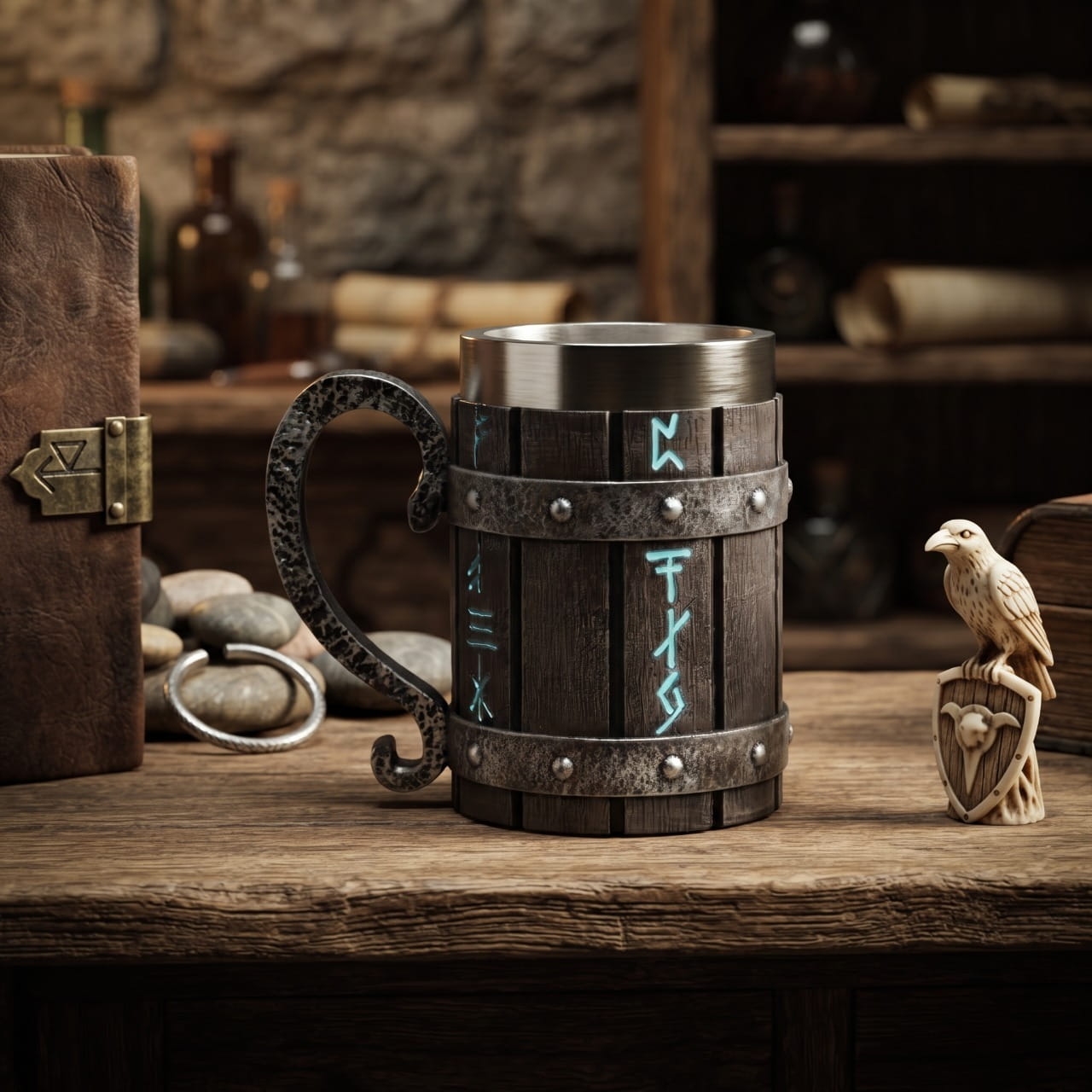
Our Viking tankards are carved from solid wood and assembled by hand. The metal bands and Norse engravings (Vegvisir, runes, knotwork) are applied piece by piece. Each piece is unique, with slight natural variations in the wood.
Viking Tankard — en savoir plus
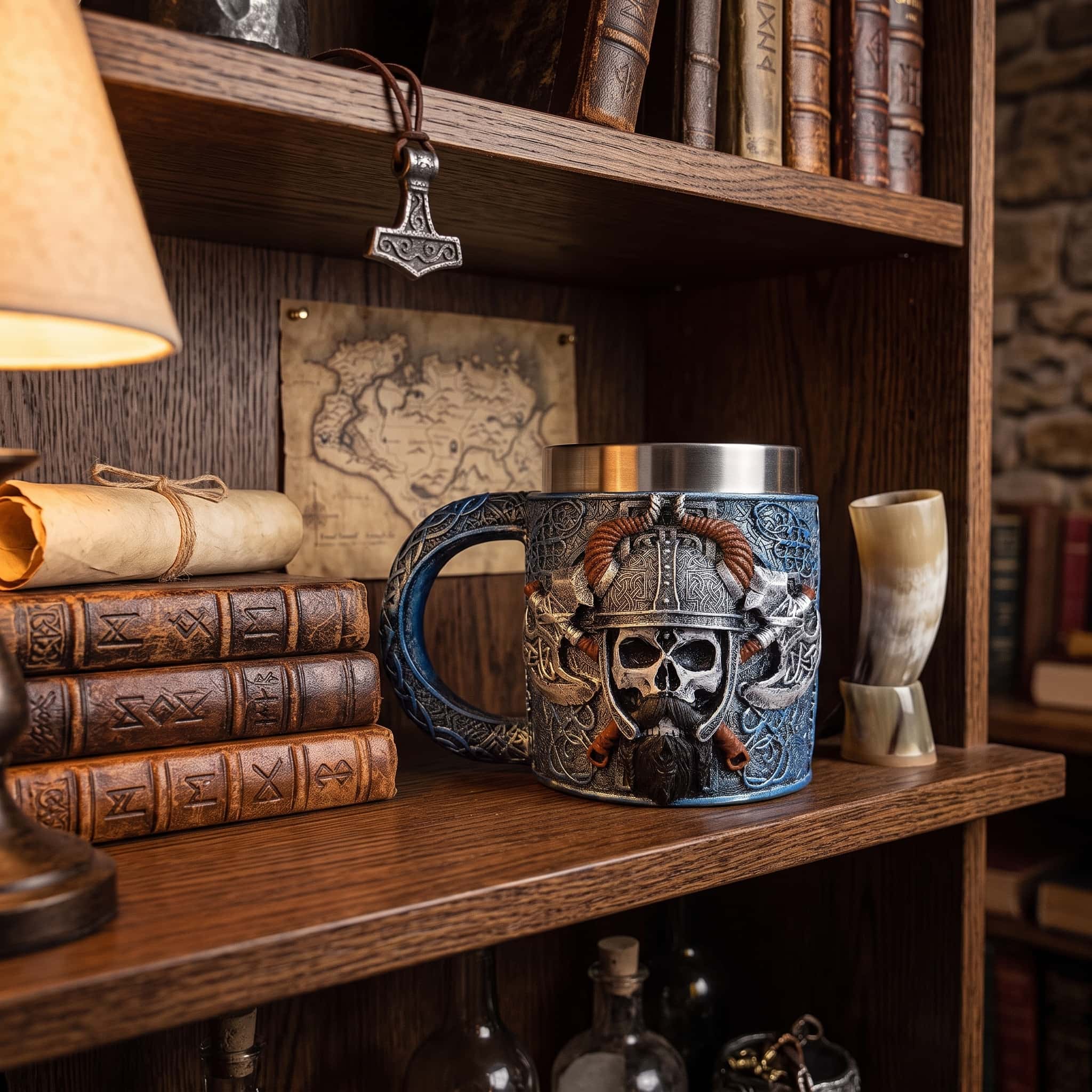
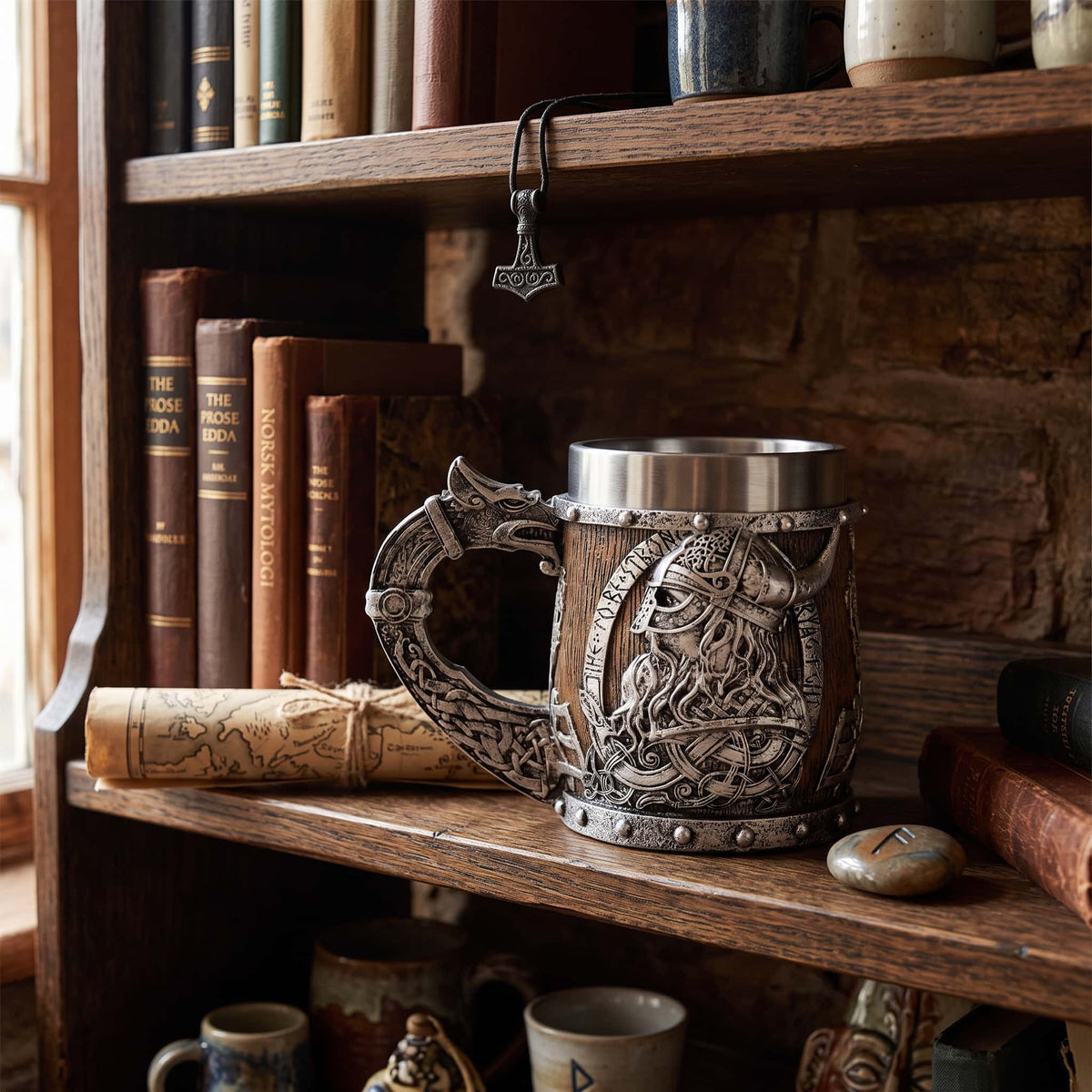
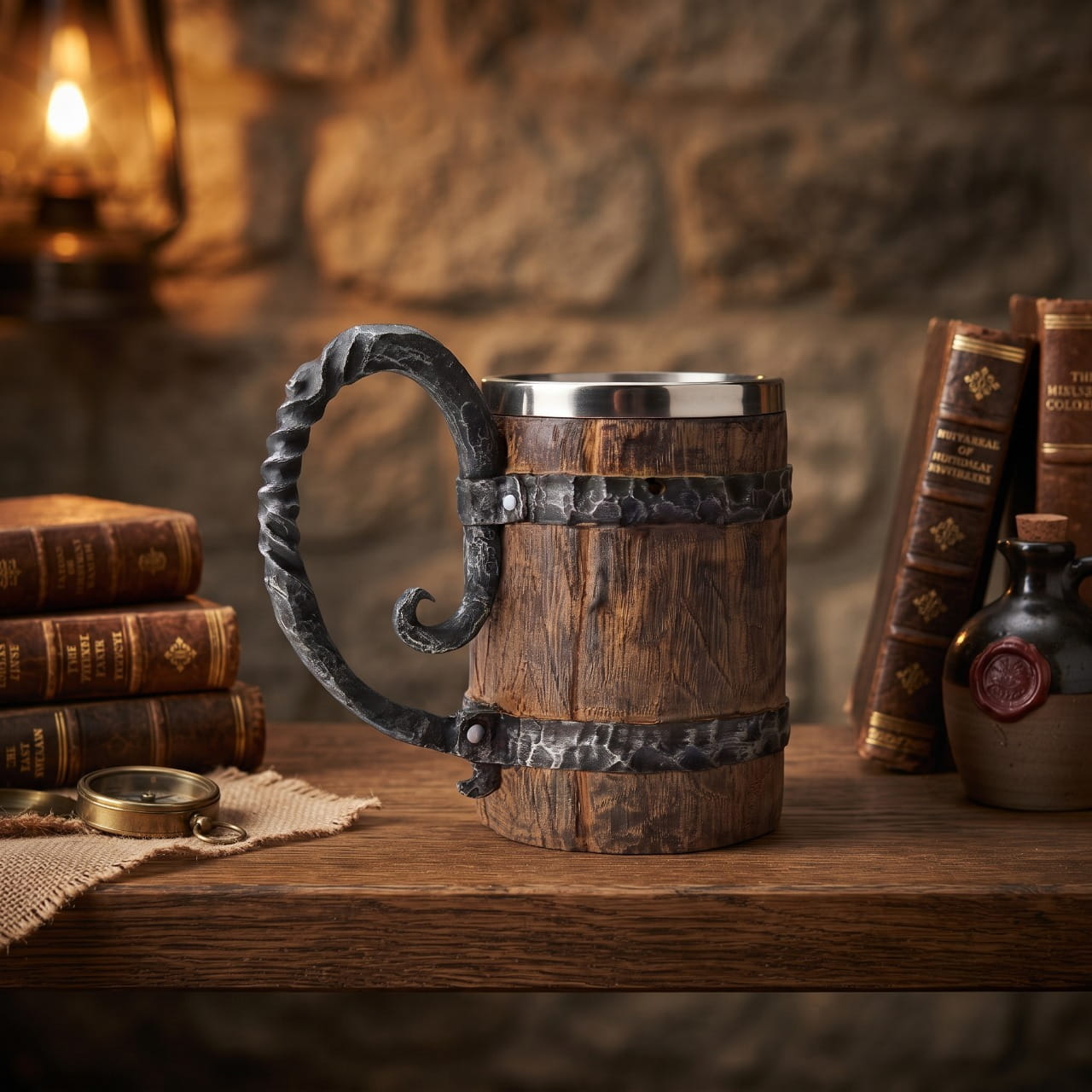
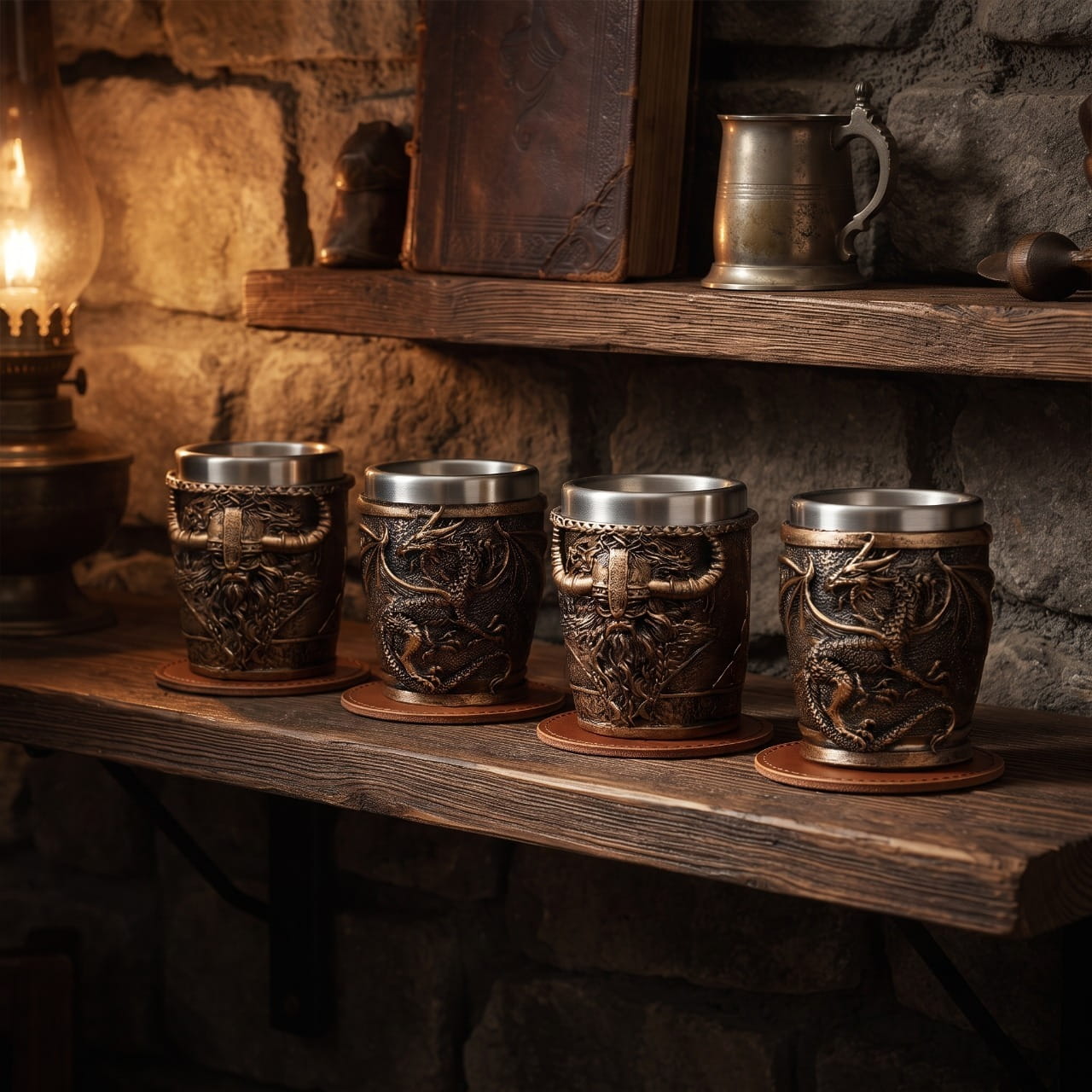
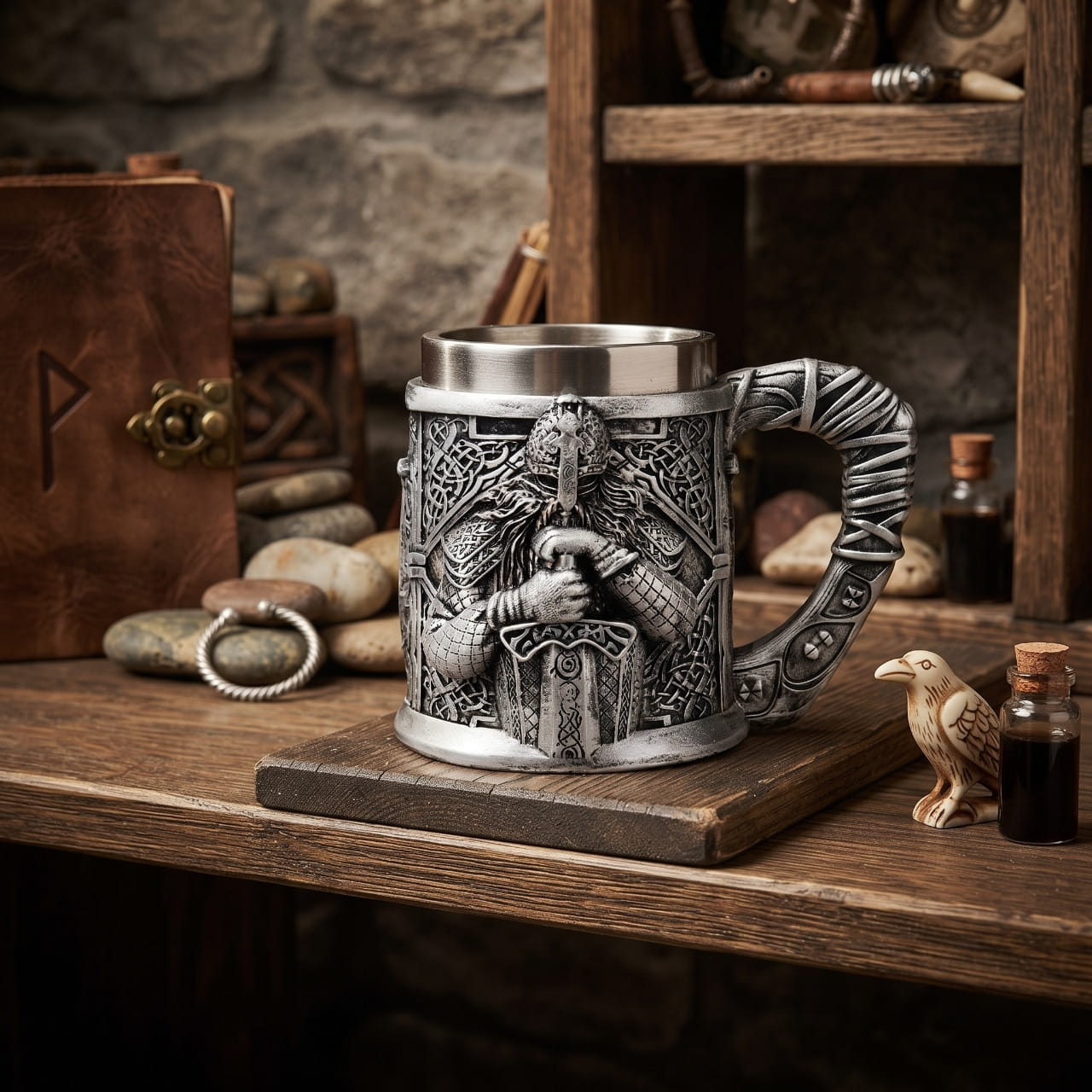
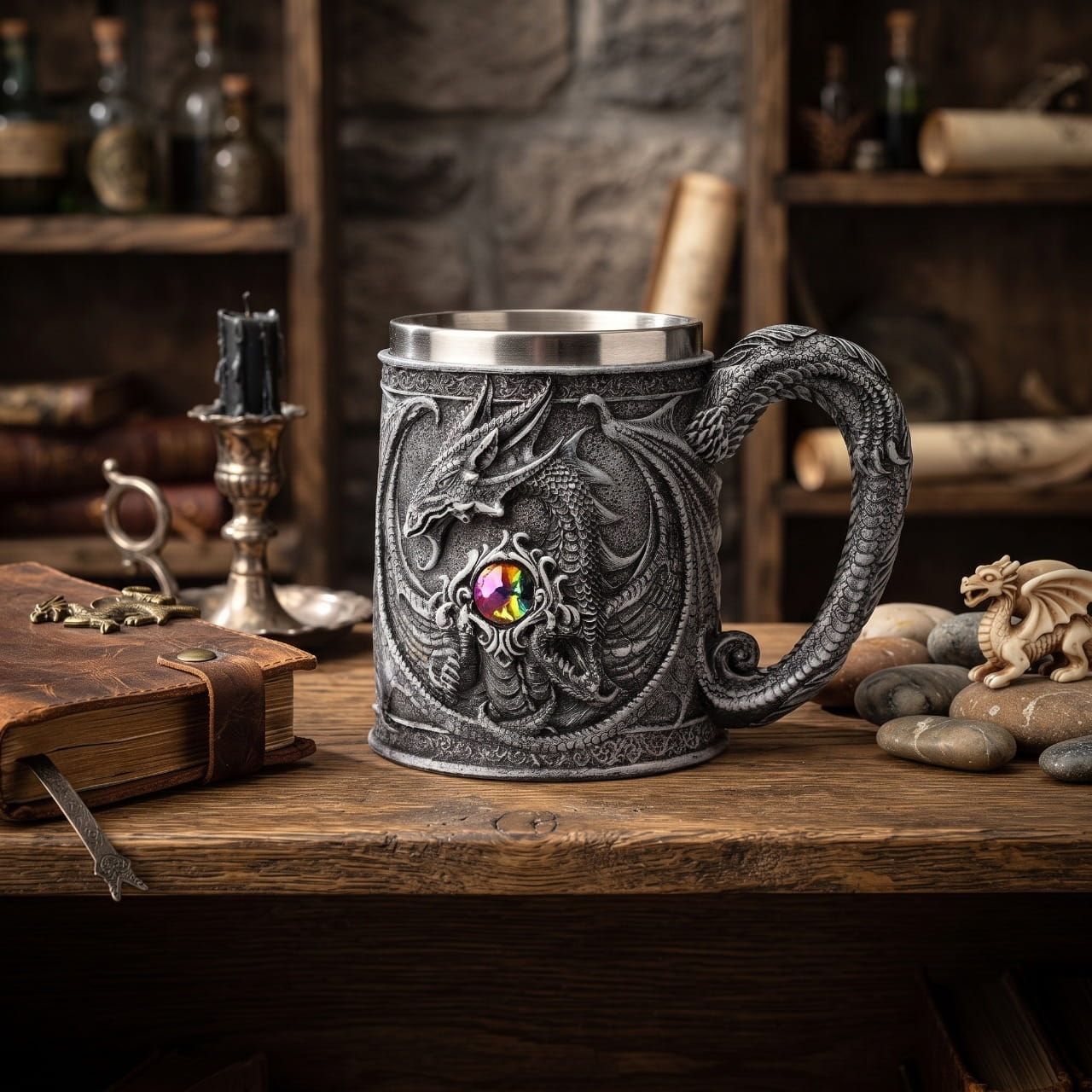
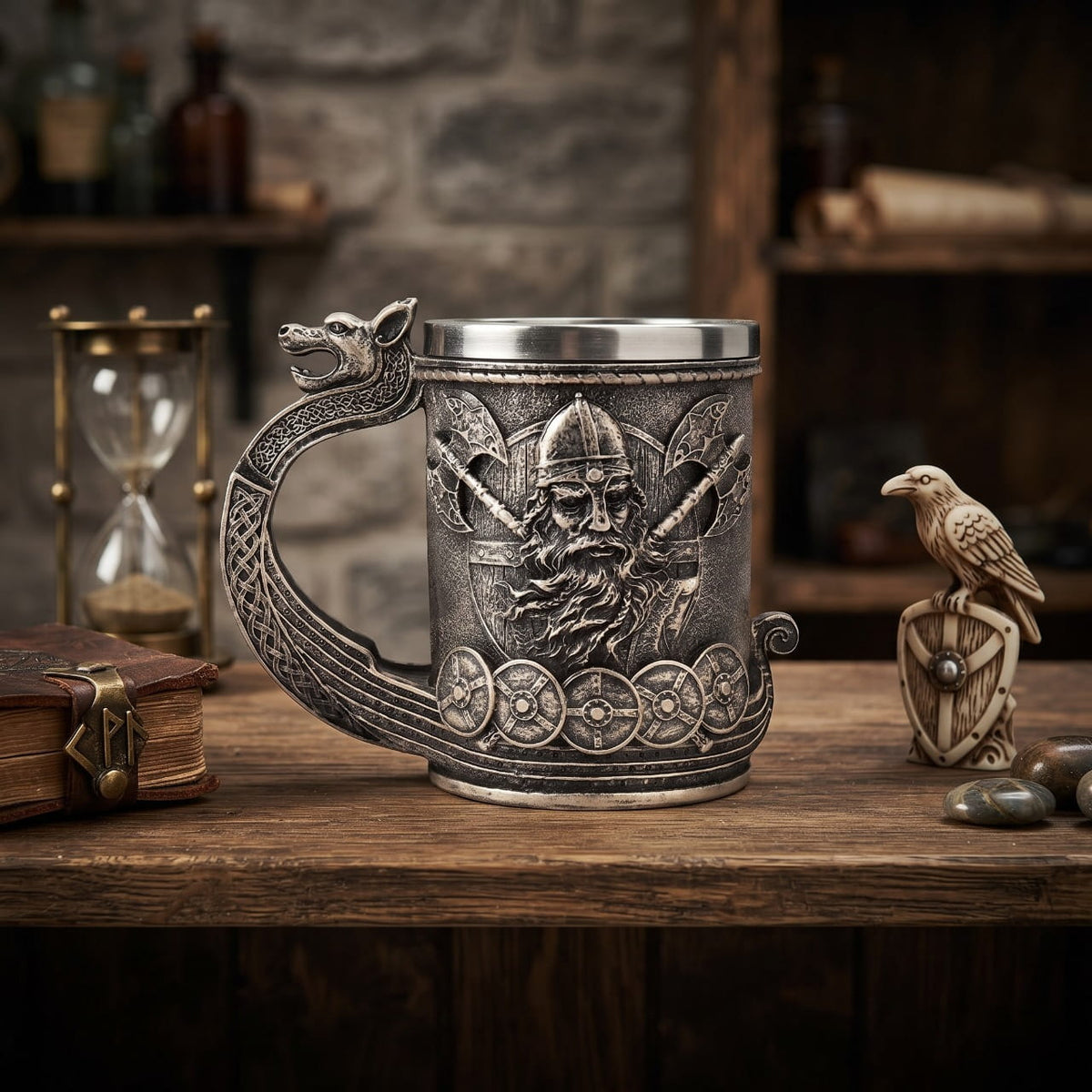
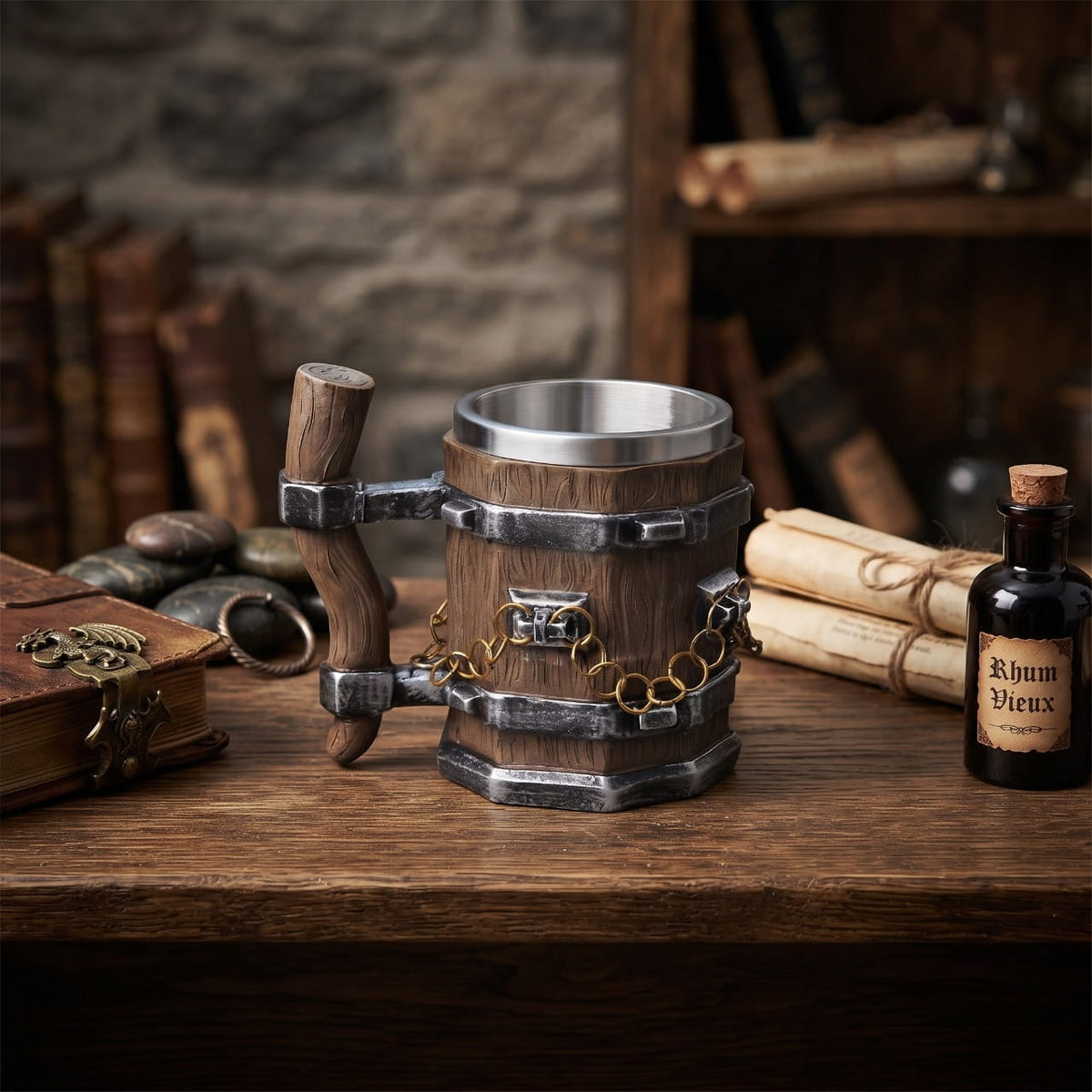
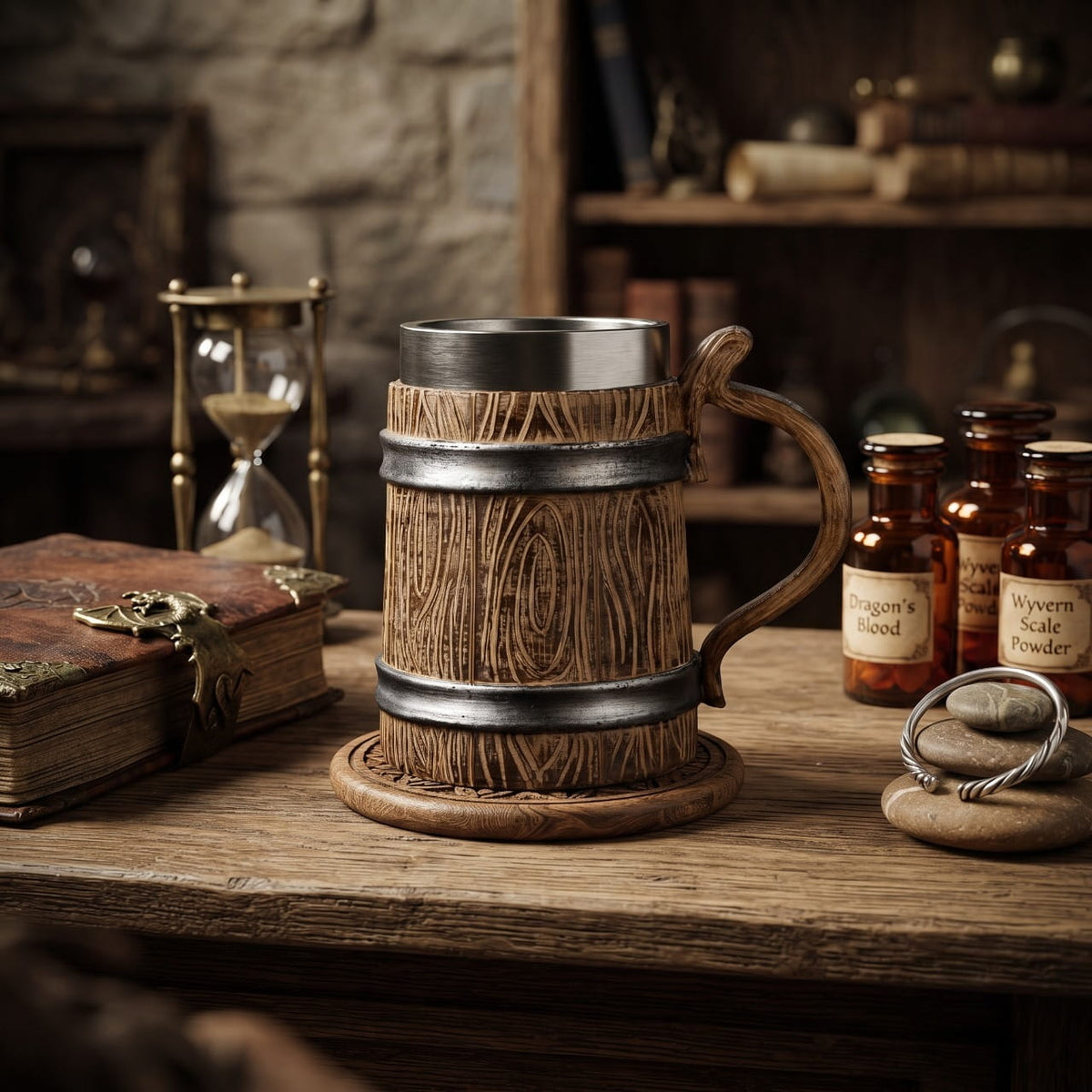
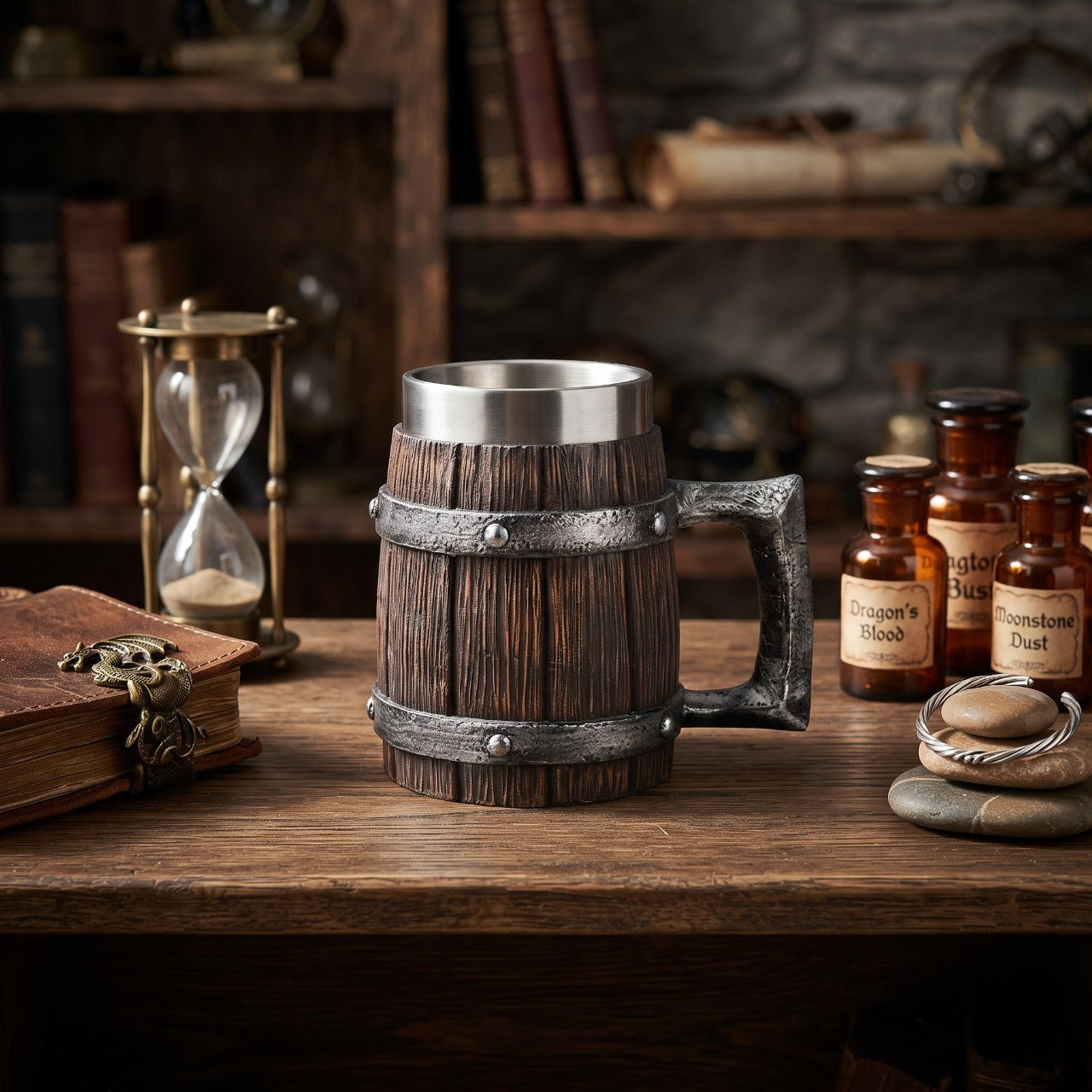
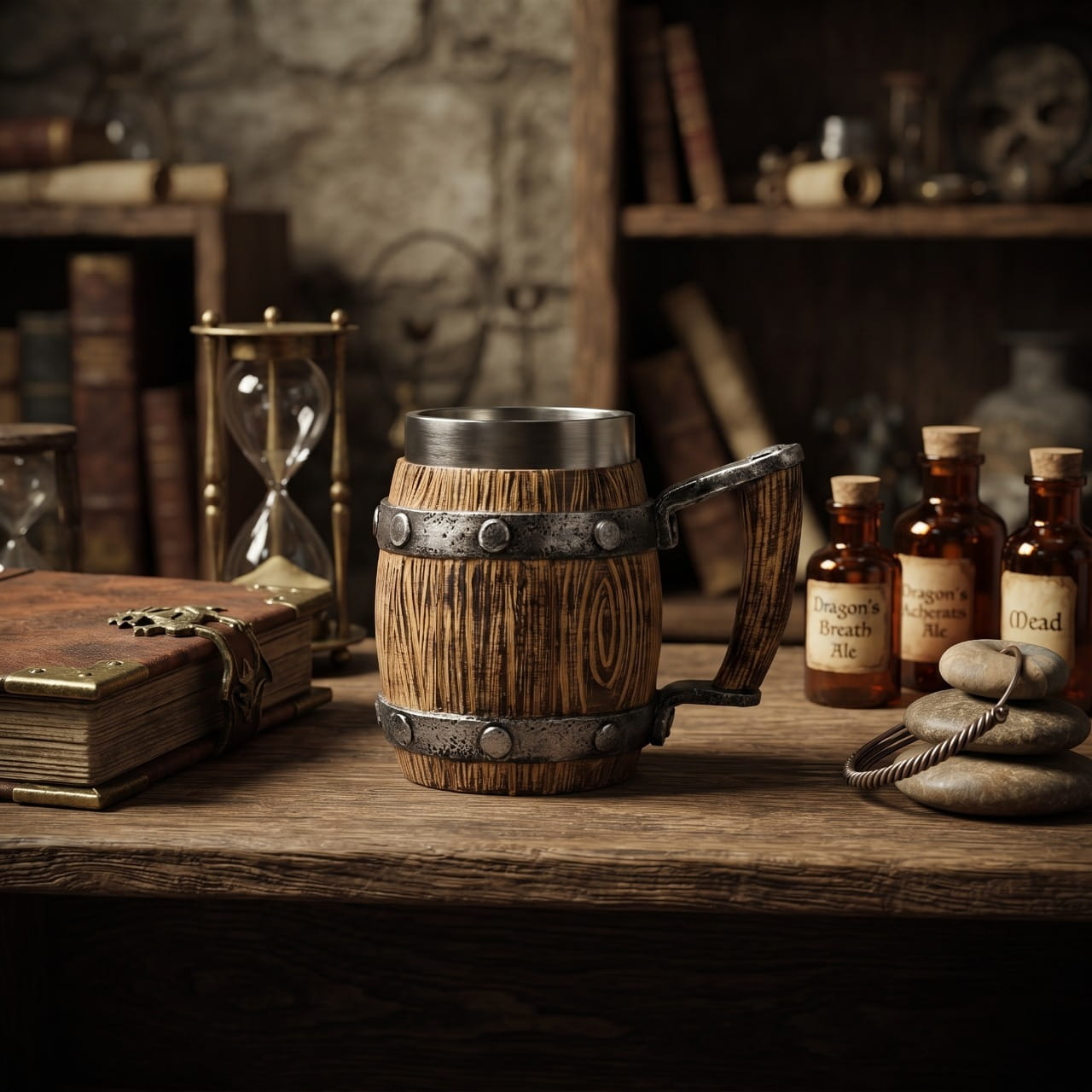
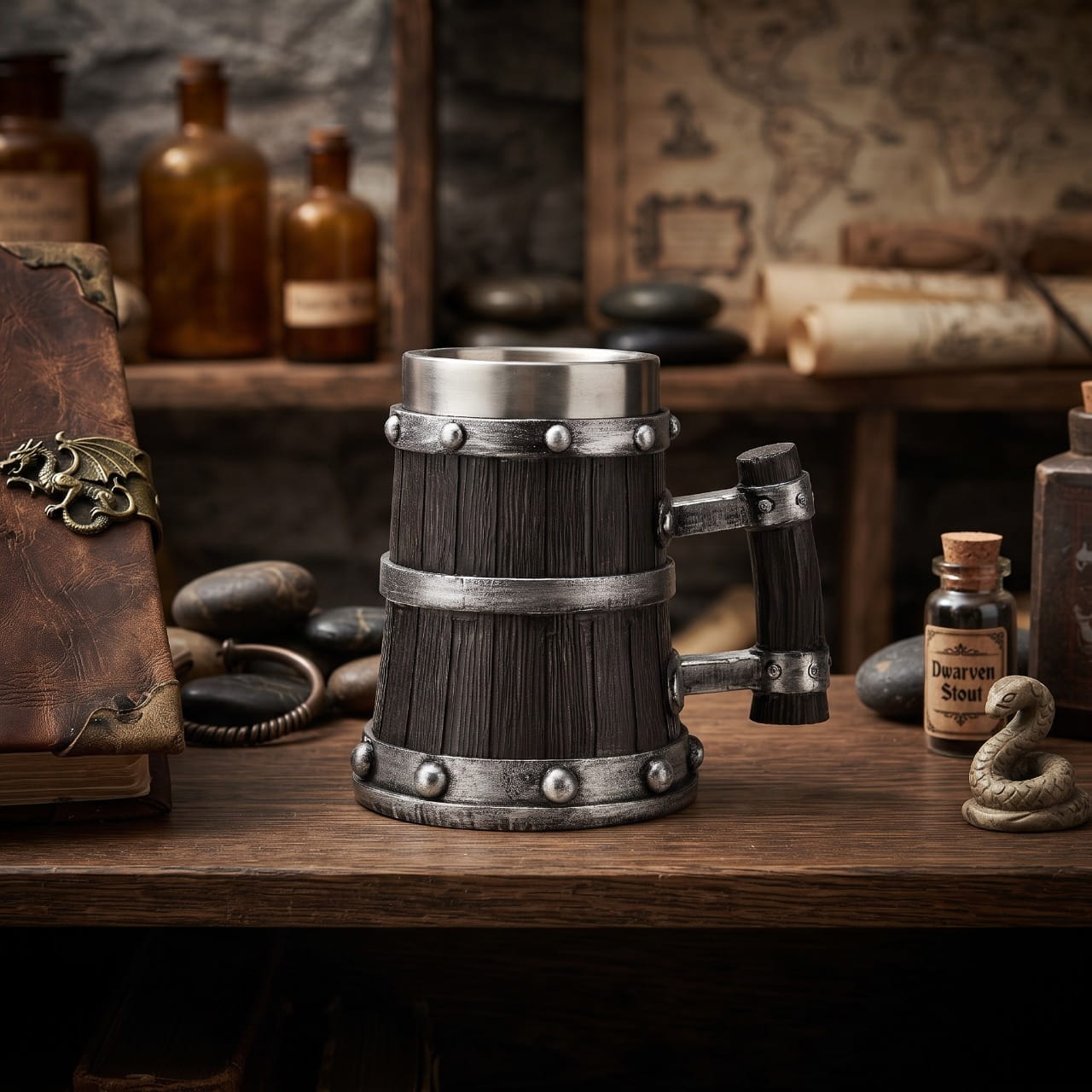
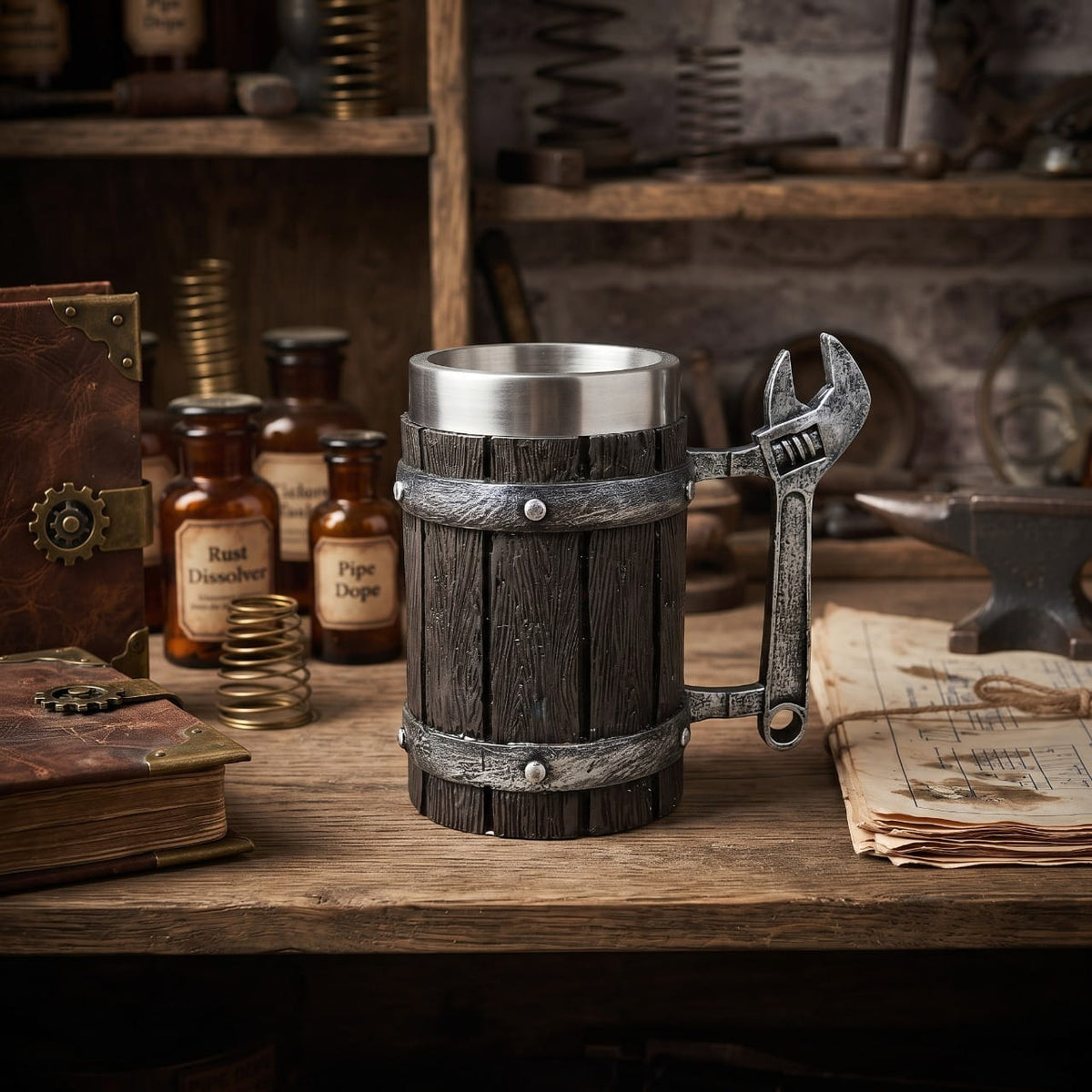
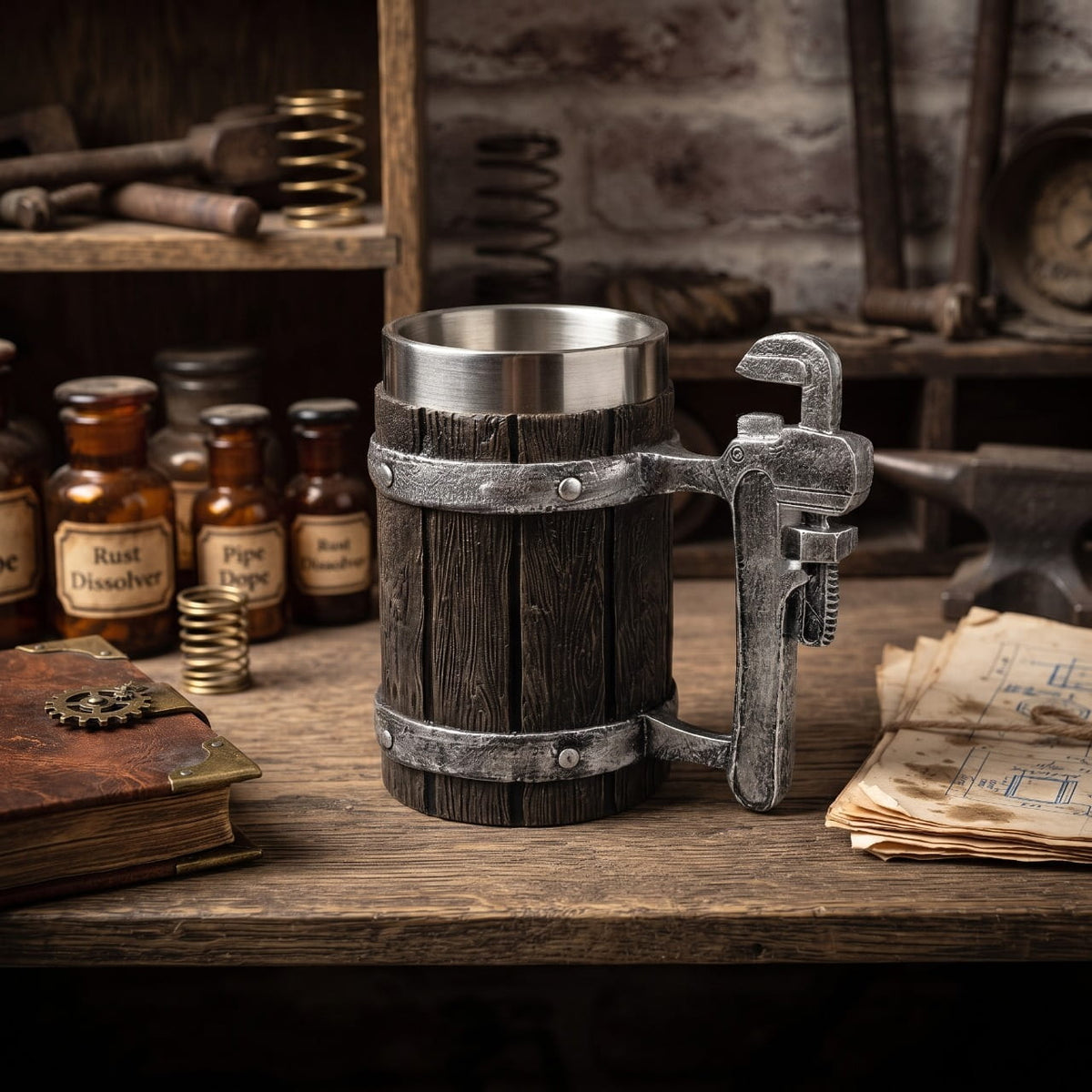
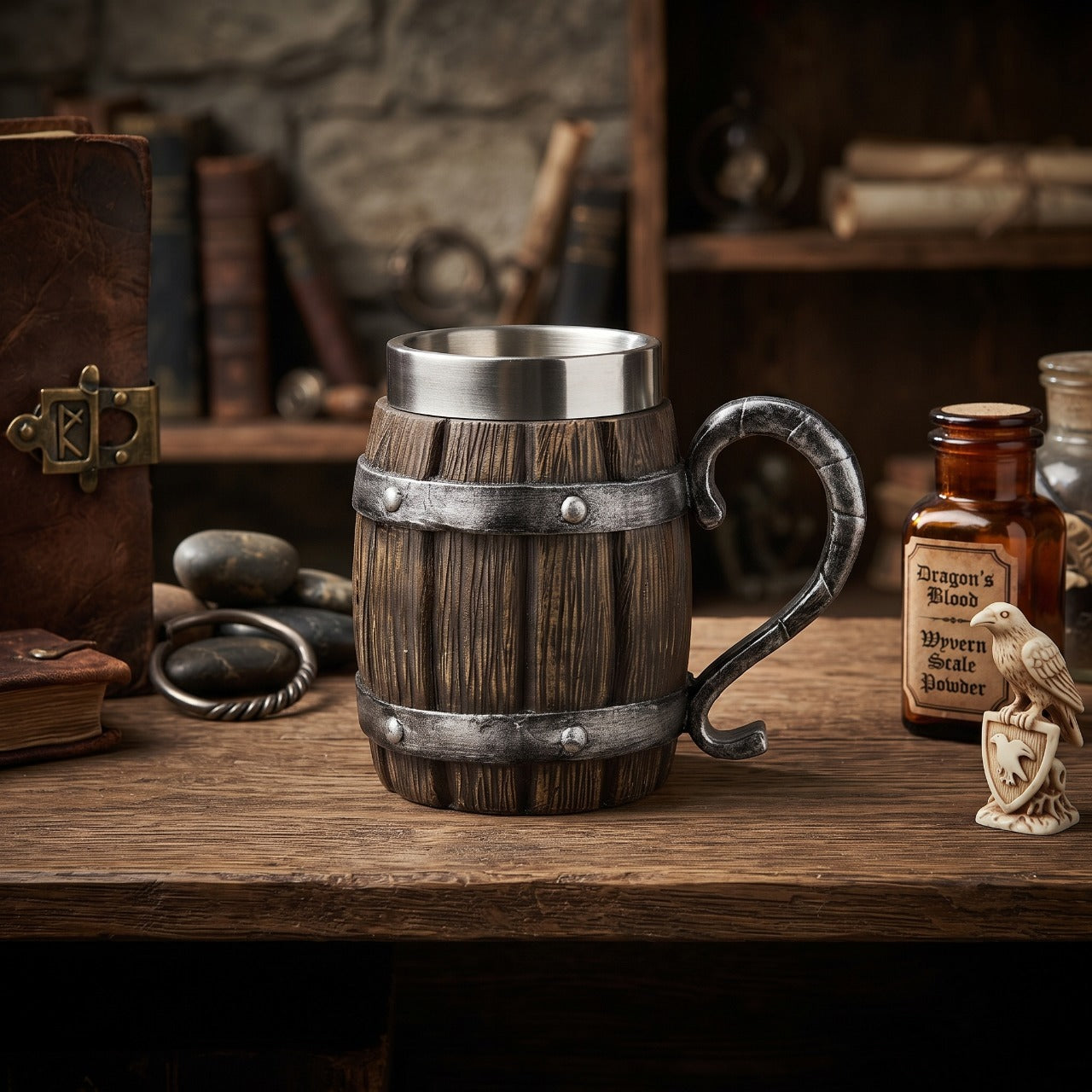
This collection gathers our Viking tankards, ranging from 450 to 600 ml. Iron-banded barrels, handles sculpted into hammers or axes, dragons coiled around the body, embossed skulls: every piece is a service tankard, not a display item—the interior is made of food-grade stainless steel and is meant for real drinking.
How a Viking tankard is built
This is the point that nobody explains, and it changes everything in terms of use. The vast majority of our tankards are pieces with a dual structure: an outer shell of sculpted resin, molded and then hand-painted to replicate the grain of the wood, rivets, scales, or interlacing patterns; and inside, a cup made of food-grade 304 stainless steel, the same kind found in insulated water bottles.
This shell and cup effectively form a double wall—as is the case with almost all our tankards—and it is this that provides insulation: the hand does not absorb the cold of the drink, and the drink does not absorb the heat of the hand. This construction also explains the durability of the decoration, which is impossible to achieve with solid metal, as well as the reasonable weight of a 600 ml tankard.
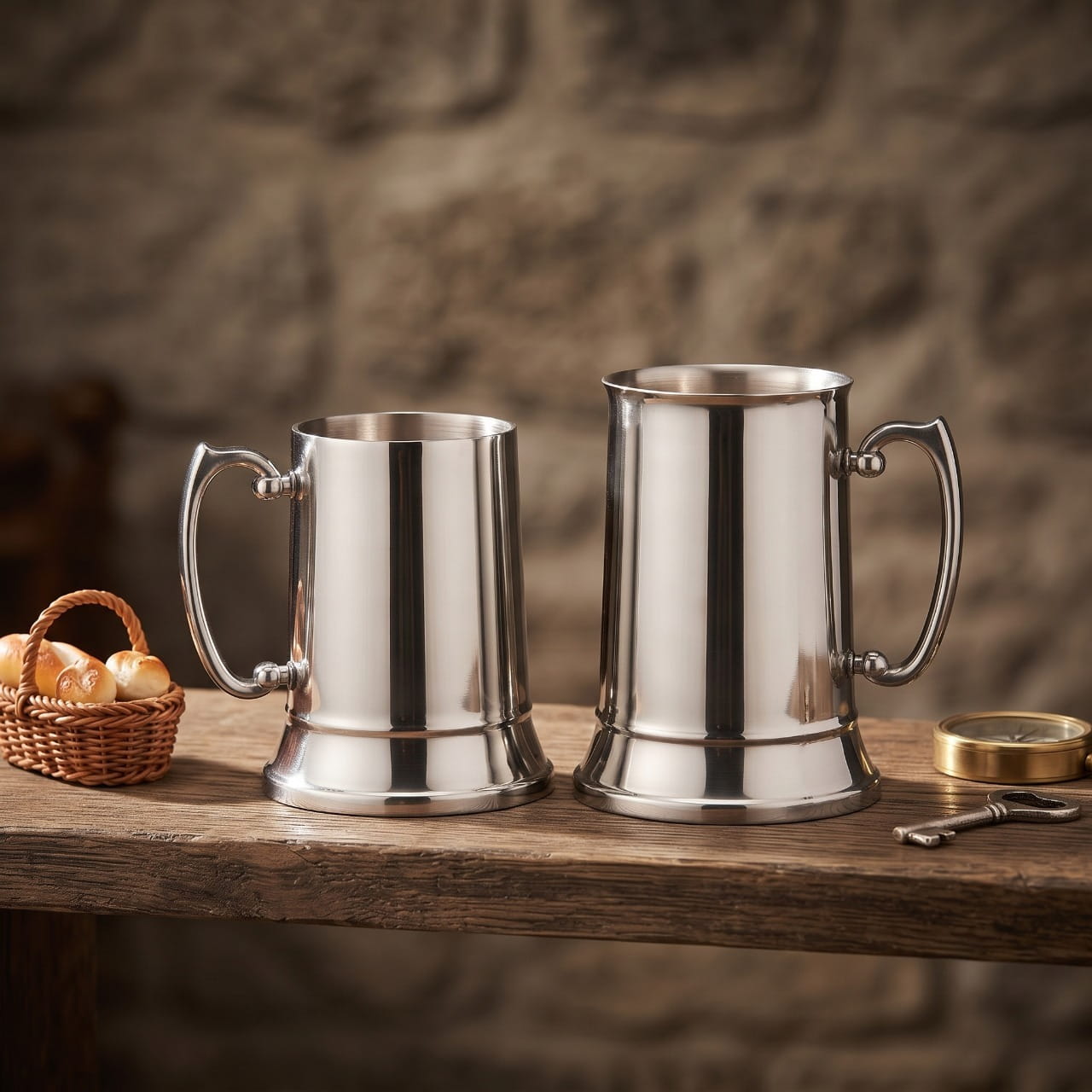
However, it does impose a constraint, and you must be aware of it before purchasing: no dishwasher, no microwave. Almost all our tankards bear the notice "hand wash only," and most include "not microwave safe." Heat and alkaline detergents attack the resin and the seal between the two materials. The all-steel models are the exception: the double-walled unadorned tankard and the polished tankard.
Which capacity to choose
The stated capacities are measured to the brim. Count on one to two centimeters less for foam if you are serving draft beer.
| Capacity | Equivalent | For whom |
|---|---|---|
| 50 ml | a shot glass | mead, aquavit, strong spirits |
| 450 ml | a generous half-liter | daily use, manageable tankard |
| 500 ml | exactly half a liter | a standard bottle, no leftovers |
| 600 ml | more than an Imperial pint | banquet capacity, the best-seller |
The 600 ml is by far the dominant format in the collection: it swallows a 50 cl bottle while leaving room for the foam, and it is the capacity that gives a barrel tankard its stocky silhouette. The 450 ml is better suited for those who want a tankard that can be held in one hand without effort, or for daily use rather than large banquets.
Four families of models
Four major aesthetic lines, and each has its origin—and for two of them, an origin much later and much more amusing than one might imagine.
Barrel tankards
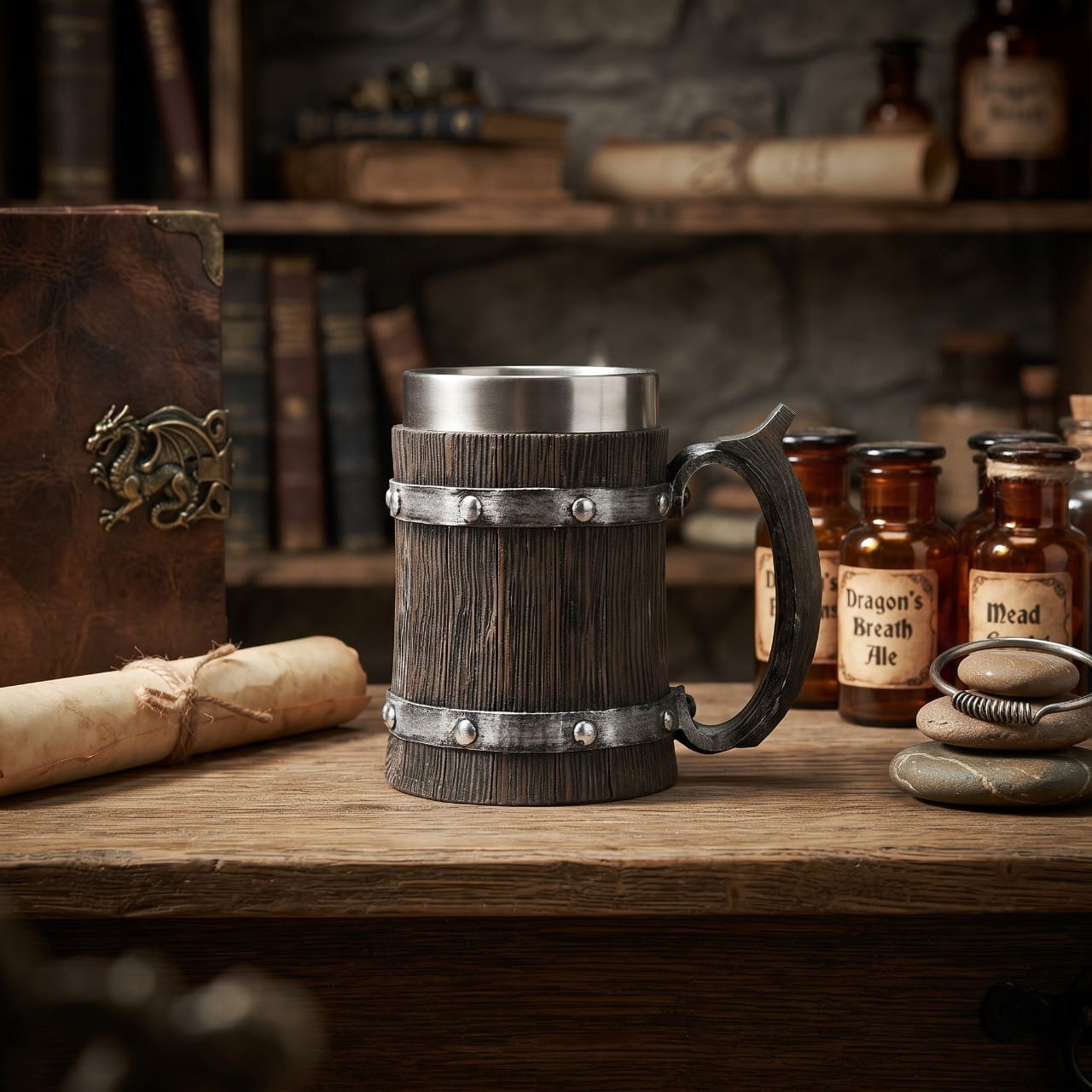
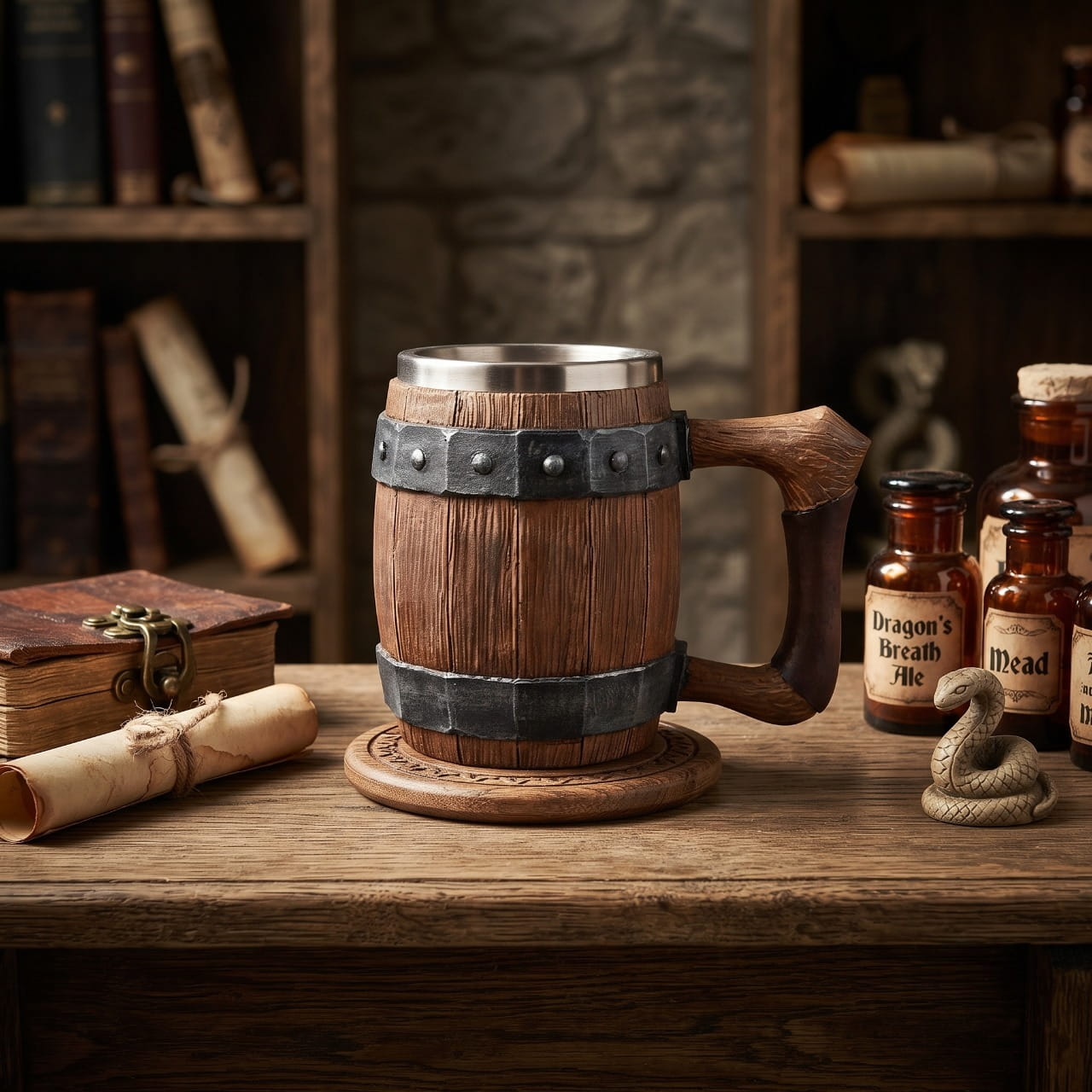
This is the most represented family. Staved barrel with visible slats, iron bands, forged handle: the same silhouette comes in light wood, dark wood, burnt wood, or steel, with handles that change everything—iron horn, carpenter's hammer, wrench, battle axe.
The stave construction is perfectly documented among the Scandinavians. The Oseberg ship burial in Norway yielded several buckets assembled in this way: wooden slats joined side by side and tightened by bands, exactly the principle of a barrel. One of them, the famous "Buddha bucket," bears a brass fitting depicting a figure sitting cross-legged—likely an Irish piece brought back from a voyage, and one of the most beautiful testimonies to the extent of Viking contacts.
A note of honesty, however: the tankard with a handle and lid as we imagine it in a tavern mainly dates back to the late Middle Ages and the modern era. In the 10th century, people drank from horns, turned wooden bowls, and goblets. The barrel shape is therefore a tavern silhouette, historically later than the Viking Age, mounted on an assembly technique that is truly Scandinavian.
Dragon tankards
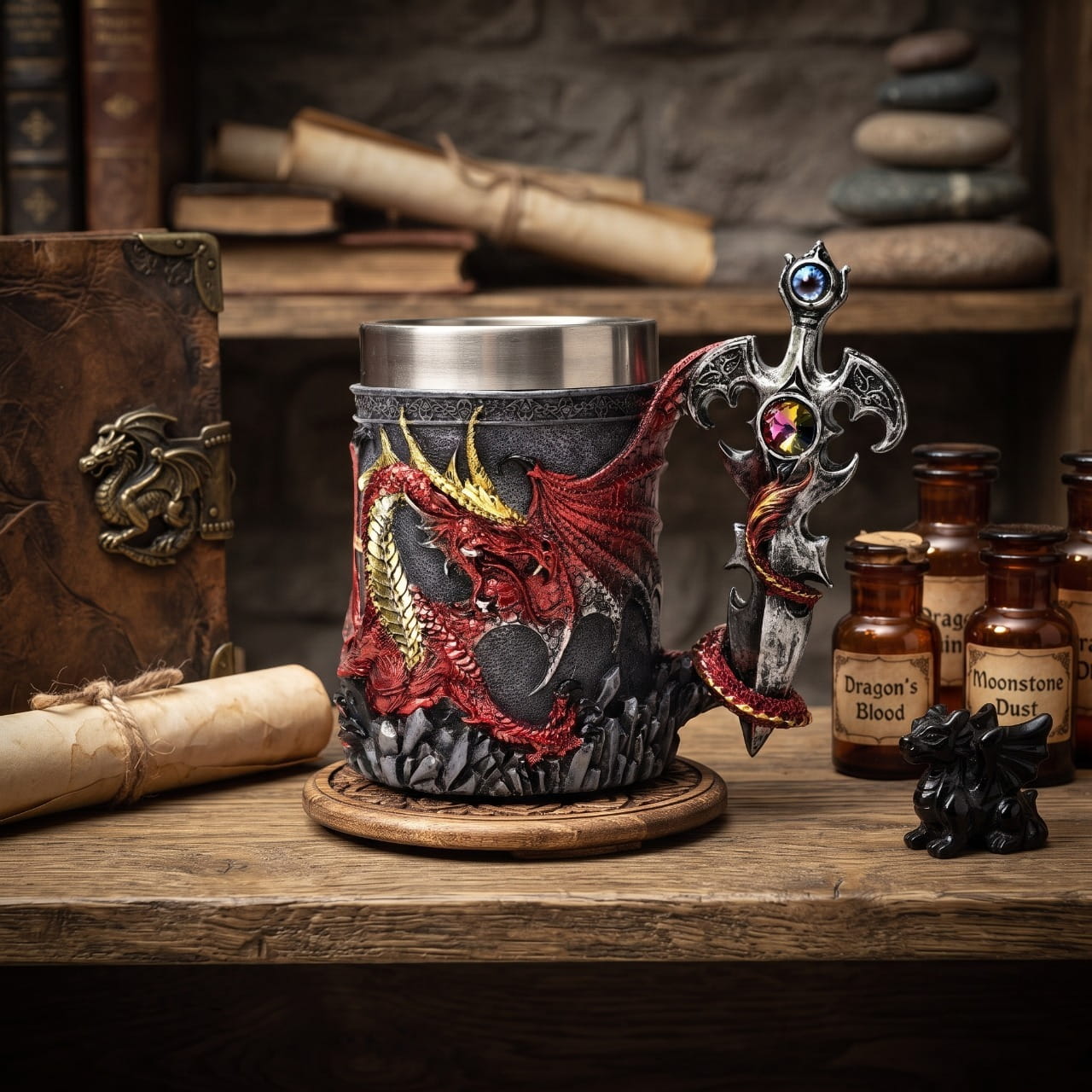
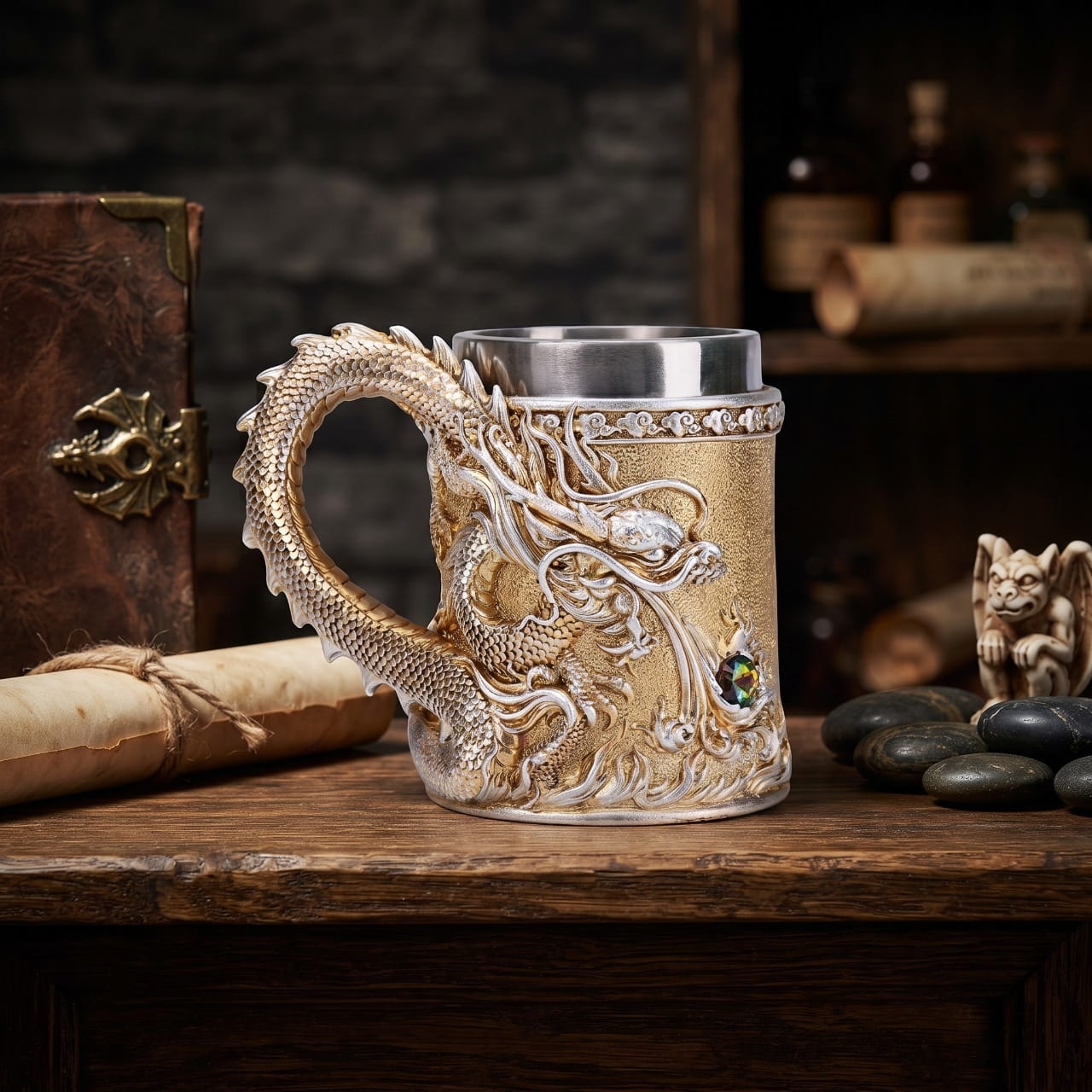
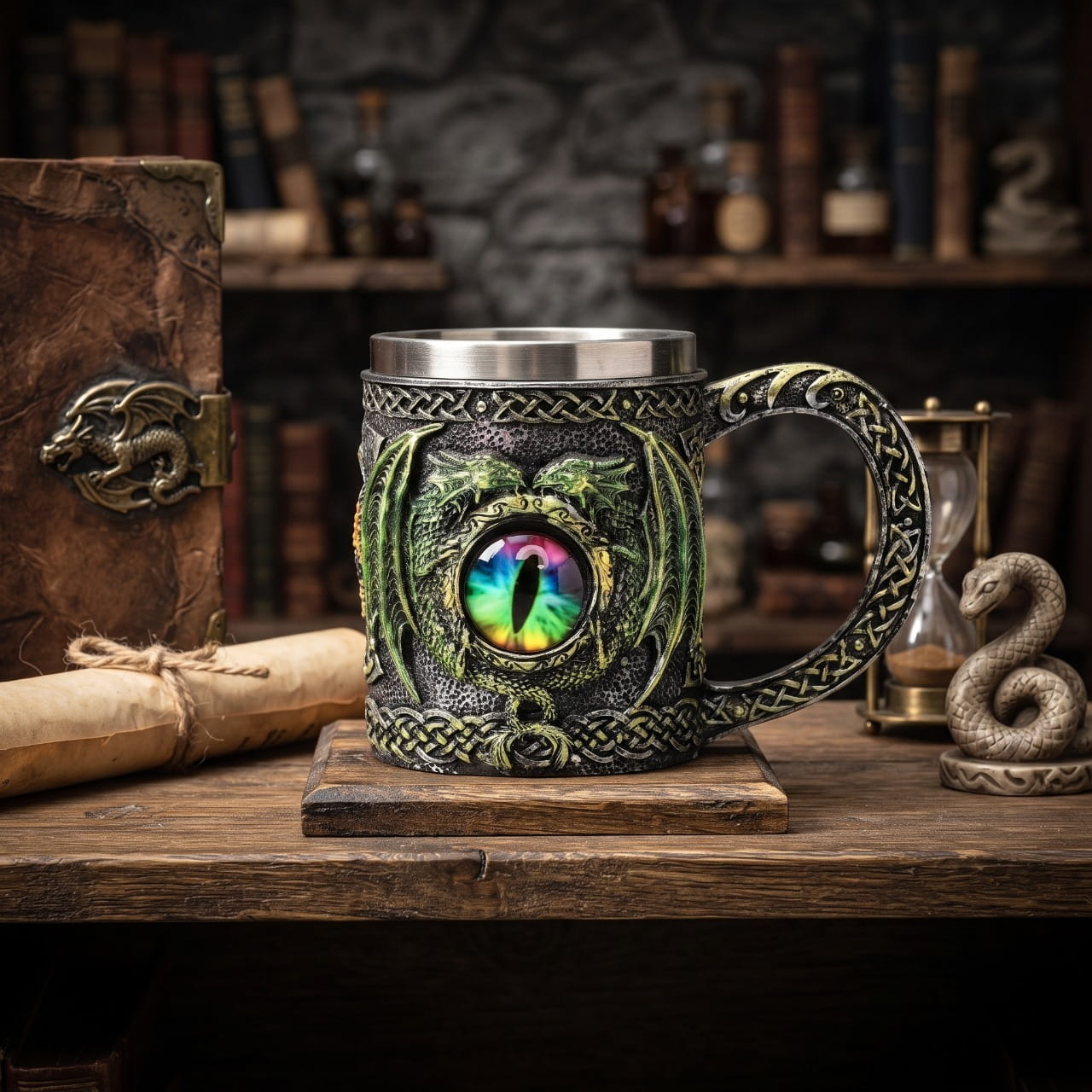
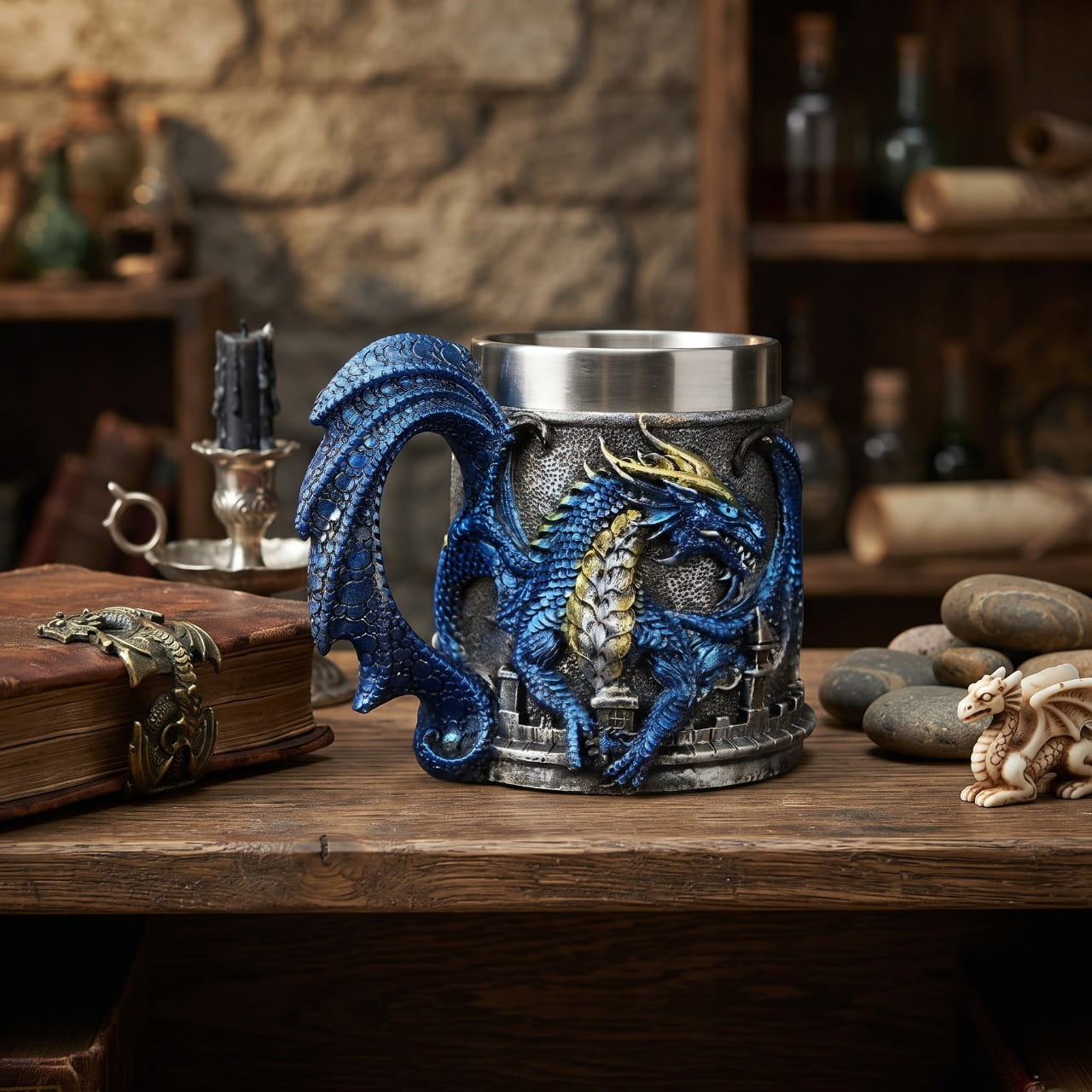
A sculpted beast coils around the body, mouth open on the handle or wing spread as a grip. The motif is this time fully Nordic: the dragon is everywhere in Scandinavian texts and art. Fáfnir, the dwarf turned into a dragon by his greed for gold, whom Sigurd kills by sliding into a pit beneath his belly. Níðhöggr, who gnaws at the roots of Yggdrasil. Jörmungandr, the serpent so long that it encircles the earth and bites its own tail. Our pieces with these motifs, well beyond tankards, are gathered in the Nordic dragons and serpents section.
Archaeology confirms the obsession: the Oseberg ship ends in a bow sculpted into a serpent spiral, and animal ornamentation dominates all Scandinavian styles from the 9th to the 12th century. One exception to note in the collection: the oriental dragon, long, wingless, with whiskers, belongs to the imagination of the Far East—a benevolent creature linked to water and rain, at the antipodes of the Nordic dreki. It is a beautiful model, but it is not the same beast.
Skull tankards
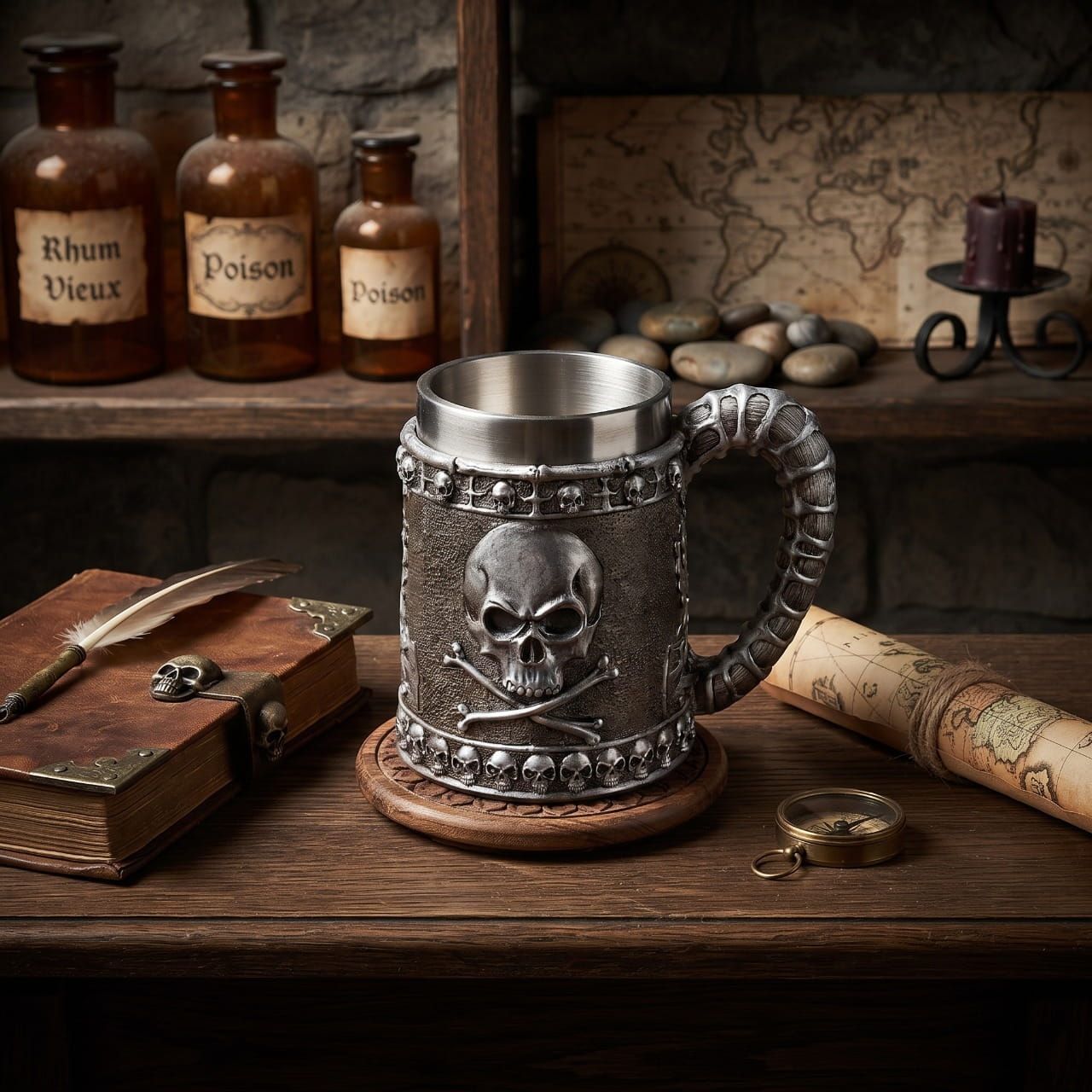
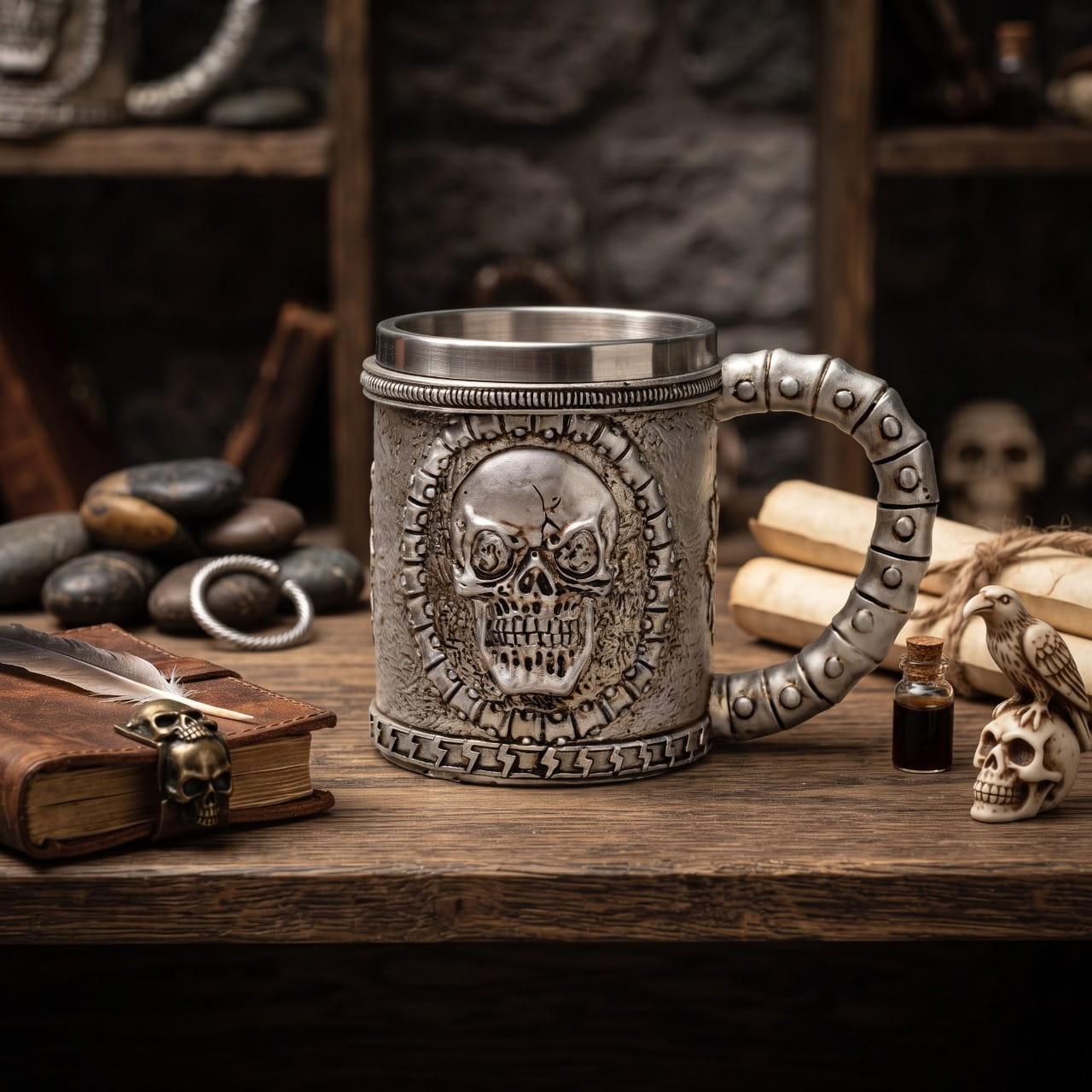
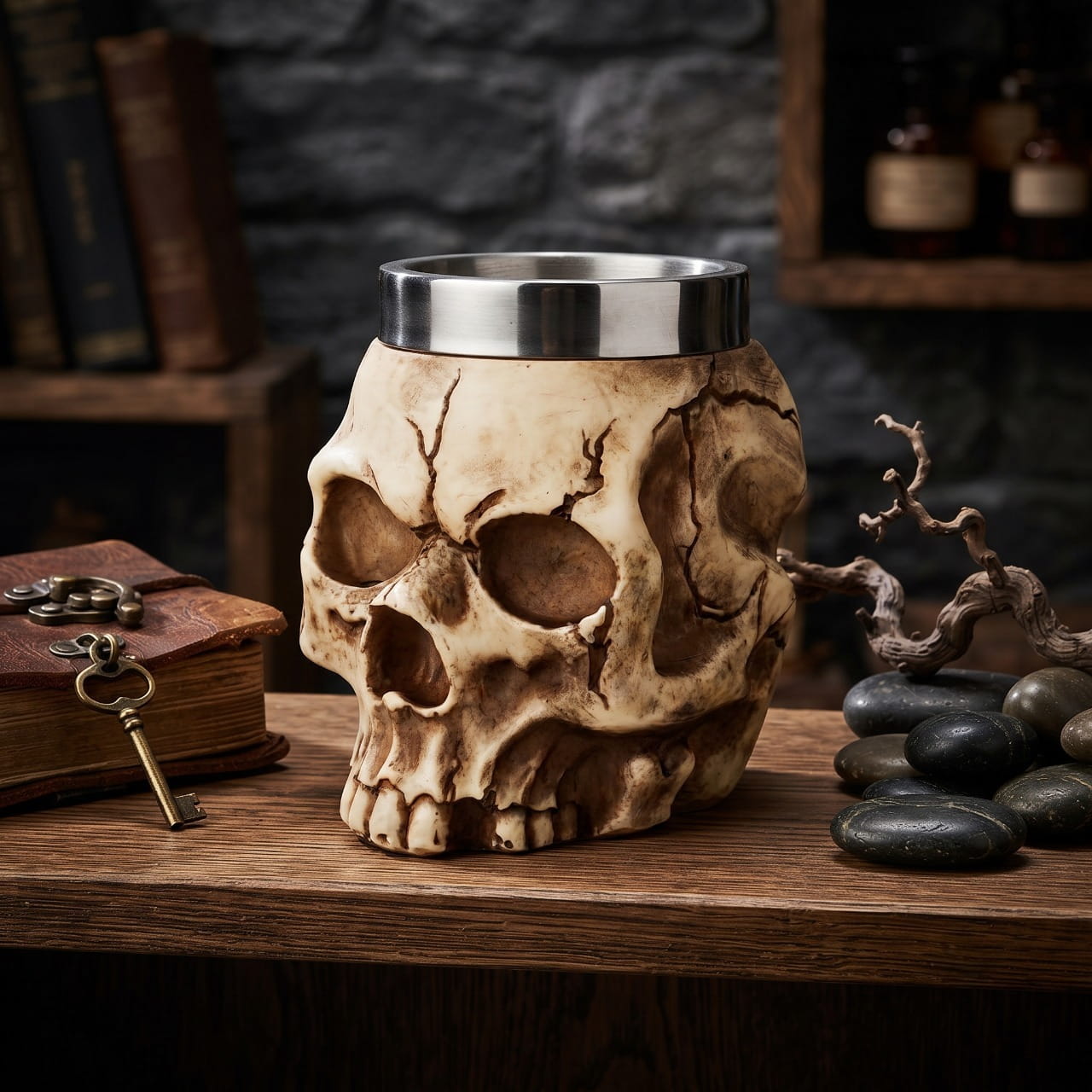
From silver skulls to mugs modeled after a realistic head, this family plays a darker note. It is an opportunity to correct the most persistent of Viking legends—that of the warrior drinking from the skulls of his enemies.
It comes from a single translation error in 1636. The Danish scholar Ole Worm published a Latin version of the Krákumál that year, the death song attributed to Ragnar Lodbrok. The poem promises warriors that they will drink in Valhalla ór bjúgviðum hausa—"from the curved branches of the skulls." It is a perfectly clear poetic periphrasis: the curved branches that grow on a skull are horns. The Latin translation suggested it referred to the skulls themselves; the image gained traction throughout learned Europe, and it has been with us for four centuries since.
The skulls in this collection are therefore deliberate decoration, not a historical reference. Moreover, the skull has its place in the Nordic imagination through another door: that of Mímir, whose severed head Odin preserved, embalmed with herbs, and made speak to deliver the secrets of the other worlds.
Warriors, Odin, and Baphomet
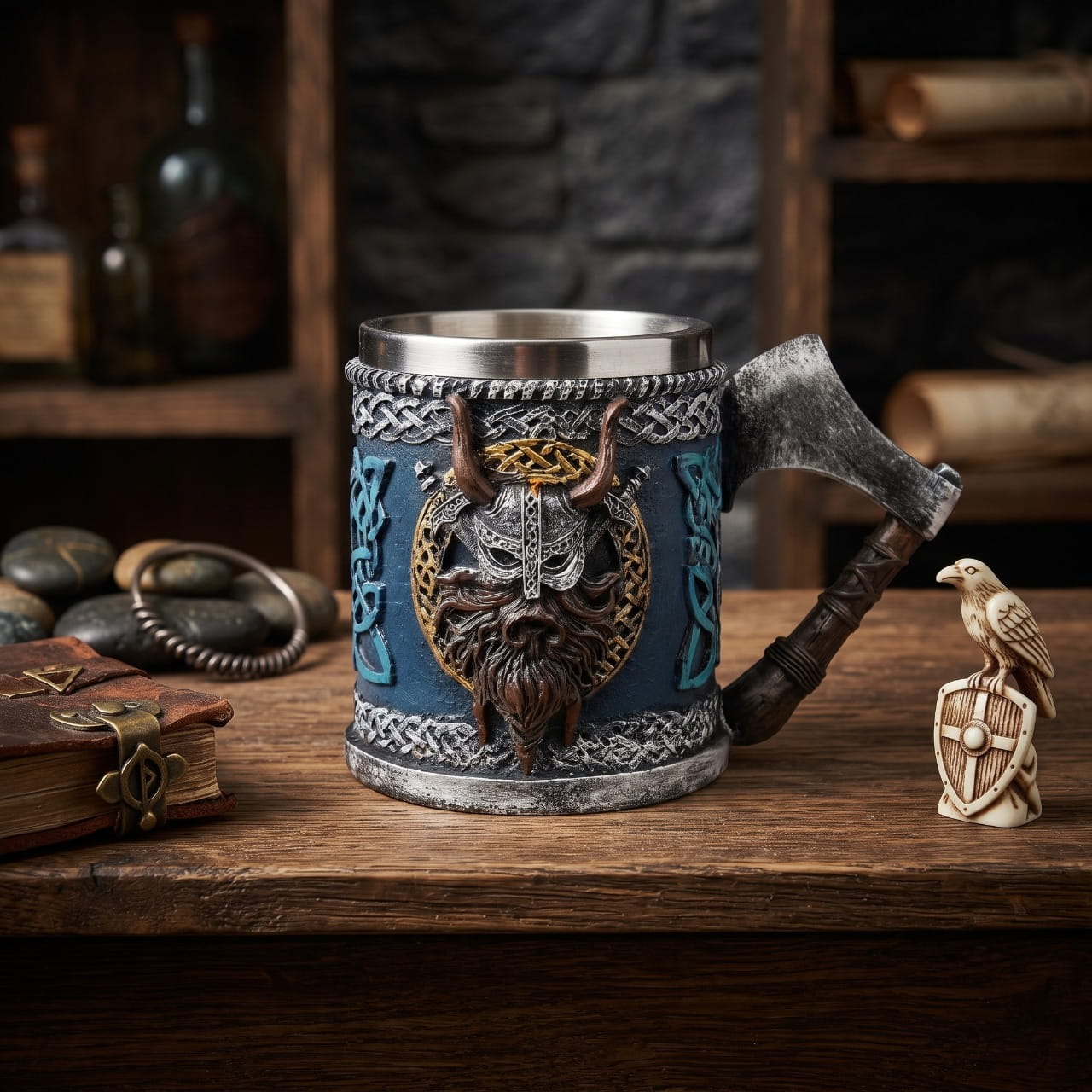
A few pieces round out the collection: a shield wall, an interlaced helmet, a sword, and a chalice of Odin, the All-Father. They use Scandinavian graphic codes—interlacing, shield boss, nasal helmet (the very one from the only complete Viking helmet found to date, at Gjermundbu in Norway, which obviously bears no horns).
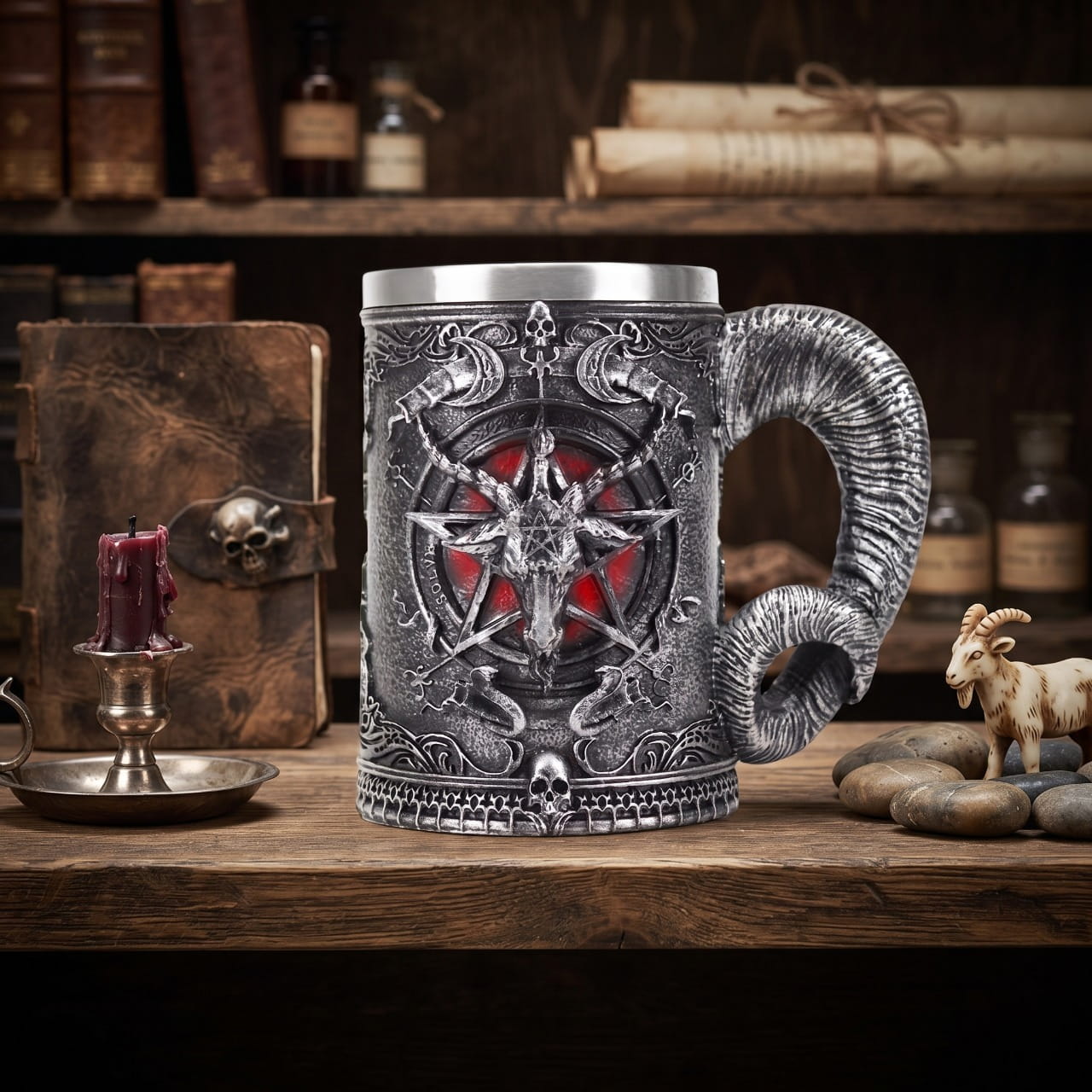
One model in the collection is completely outside the framework, and let's be frank: the Baphomet tankard with ram's horns has no link to the Nordic world. The name appears in the Templar trials at the very beginning of the 14th century, and the goat-headed figure that everyone knows is the drawing by the French occultist Éliphas Lévi, published in 1856. It is a piece of Gothic aesthetics, included because it is popular, not because it is Viking. We prefer to clarify this rather than let anyone believe otherwise.
Care: what not to do
A single rule, but a firm one: hand wash only. Lukewarm water, soft sponge, ordinary dish soap, rinse, dry. The dishwasher combines everything that resin hates—heat, steam, alkaline products—and will bleach the paint in just a few cycles.
No microwave either, and do not put it in the freezer to cool the tankard before serving: the two materials do not expand at the same rate, and the separation is irreversible. To serve cold, fill the tankard with ice water for a few minutes, empty it, then serve. Finally, do not leave a full tankard sitting overnight: the steel is fine, but the sugary residue of an amber beer is a nuisance to dislodge once dry.
Which tankard for which use
With capacity and style settled, three practical details distinguish the models.
Weight when full. A 600 ml tankard weighs nearly nine hundred grams when filled. Over a whole evening, the handle matters as much as the decor: a wide, closed handle that allows three fingers to pass through can be held without fatigue; a narrow, sculpted handle is superb on display but less comfortable to use. If the tankard is intended for real service, look at the handle first.
Hand washing. Almost all models require it, and it is the constraint to accept in advance. It takes thirty seconds—lukewarm water, soft sponge, drying—but it is a daily task. The all-steel models, the unadorned double-wall and the polished tankard, are the only ones exempt.
Display or table. The most sculpted pieces—coiled dragons, embossed skulls—are designed to be looked at and do not handle cupboard knocks well. The barrels, more compact and robust, are the true daily-use tankards. Many of our customers have both: one for service, one for display.
Giving a Viking tankard as a gift
It is the easiest gift in the shop—a useful, spectacular object, with no size concerns. Three benchmarks to aim true.
The 600 ml barrel is the safe bet. It is the best-selling format, the one that swallows a 50 cl bottle, and the one that corresponds to the image everyone has of a Viking tankard. In the absence of information on the recipient's tastes, this is the choice that disappoints the least.
The handle tells a story. Carpenter's hammer, wrench, battle axe, iron horn: these variants allow a nod to the profession or character of the recipient. It is the detail that turns a generic object into a personal gift, and it costs nothing extra.
Include a note about care. Just like with horns, a resin-shell tankard given without warning will one day end up in the dishwasher. A sentence on the card—hand wash, no microwave—is enough to ensure years of service. For use without any constraints, look toward an all-steel model.
Frequently Asked Questions
Is a Viking tankard dishwasher safe? No, except for the all-steel models. Resin-shell tankards must be washed exclusively by hand: the dishwasher damages the paint and the seal between the resin and the steel.
Can you really drink from it? Yes. The interior is a 304 food-grade stainless steel cup, with no contact between the drink and the resin. These are service tankards, not decorative replicas.
Which capacity for a 50 cl bottle? A 600 ml model. The 500 ml model fits the bottle exactly, with no room for foam.
Does the tankard keep the drink cold? Better than a glass, yes: the resin-steel double wall slows down temperature exchange and prevents condensation on the outside. However, it is not an insulated vacuum flask—count on coldness held for the duration of a serving, not an entire evening.
Can you serve a hot drink in it? Nothing prevents this in terms of food safety, but avoid boiling liquids: repeated expansion tires the assembly. For daily hot use, turn to our mugs.
Do the runic engravings mean anything? On most models, yes: they are runes from the Futhark, reproduced for their graphic appeal. They do not compose a sentence, unless otherwise stated on the product page.
What are the delivery times and costs? Tracked delivery is free on orders over €49, regardless of the delivery country.
Also to explore: discover our drinking horns and Nordic mugs, all of our Viking tableware, our best sellers, and our Viking decor. To choose knowledgeably, read our guide to Viking tankards and mugs.