
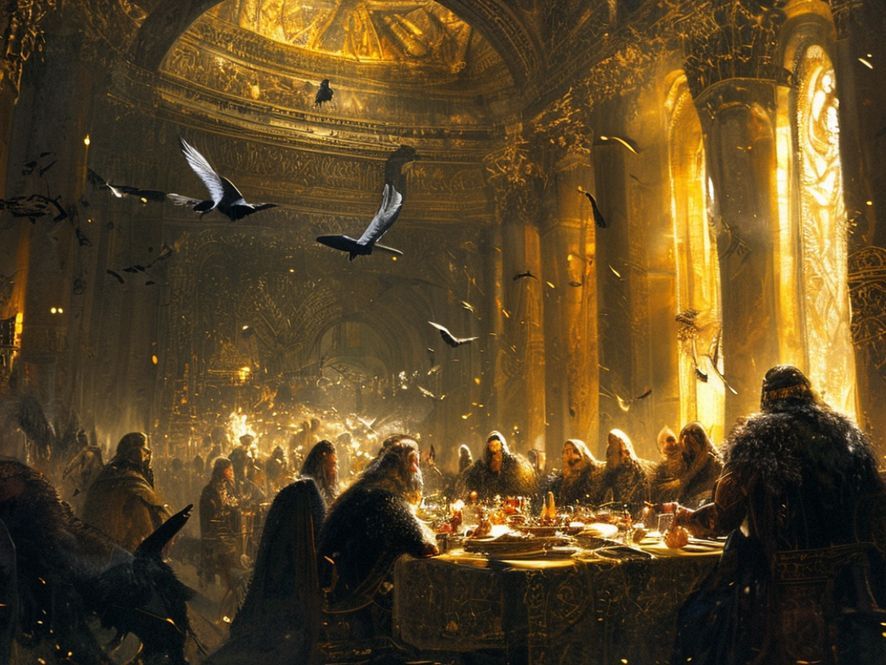
Vikings: Valhalla on Netflix: Sequel and New Heroes
📌 In Brief
- Vikings: Valhalla is the spiritual sequel to the Vikings series, produced by Netflix.
- The three protagonists are Leif Erikson, the explorer of Vinland; Harald Sigurdsson, the future King of Norway; and Freydis Eiríksdóttir.
- Vikings: Valhalla has 3 seasons aired on Netflix between 2022 and 2024.
- Vikings: Valhalla is designed as a standalone series.
- The series takes significant historical liberties.
Are you looking for the Valhalla of mythology, Odin's hall where warriors who die in battle go? Read our article on Valhalla. This one is about the series.
Vikings: Valhalla: The Long-Awaited Sequel to the Vikings Series on Netflix
When Michael Hirst's Vikings series drew the curtain after six intense seasons, millions of viewers around the world were left orphaned. Orphaned of Ragnar Lothbrok, orphaned of the raids on England, orphaned of that unique way of telling the story of the Age of the Northmen. Then, in February 2022, Netflix unveiled Vikings: Valhalla, an ambitious sequel that transports the narrative a century later, to the heart of an era where the Viking world is transforming irremediably. Created by Jeb Stuart, this new series does not seek to replace its predecessor. It extends it, expands it, and offers it a new resonance.
The series is set nearly 100 years after the events of the original work. The era of Ragnar Lothbrok and his sons now belongs to legend. The names of Bjorn Ironside, Ivar the Boneless, and Lagertha are sung in the halls but no longer lived in the flesh. The 11th century begins, and with it, a deep fracture runs through Scandinavian civilization: the progressive Christianization of the Nordic kingdoms now pits pagan Vikings, faithful to the old gods, against Vikings converted to Christianity. It is in this fundamental tension that the sequel draws all its narrative power.
Netflix entrusted Jeb Stuart, the screenwriter of Die Hard and The Fugitive, with the colossal task of continuing Michael Hirst's legacy. The bet was risky. How do you succeed a series that had redefined the historical drama genre on television? Stuart's answer was not to copy, but to reinvent: new heroes, a new central conflict, and a cinematic ambition that rivals the biggest streaming productions. This production is not a mere spin-off. It is a work in its own right that is part of the same saga, with the same requirement for historical truth and dramatic intensity.
Leif Erikson, Harald Sigurdsson, and Freydis: The Three Pillars of Vikings: Valhalla
The genius of the series lies in the choice of its protagonists. While the original series revolved around a single titanic hero, Ragnar, the Netflix sequel builds its narrative on a trio of historical characters whose destinies intertwine and complement each other. Each embodies a different facet of the changing Viking world.
Leif Erikson, played by Sam Corlett, is the first of them. Son of Erik the Red, Leif Erikson is famous for having discovered America long before Christopher Columbus, reaching the shores of Vinland around the year 1000. In the series, he arrives from Greenland with his sister Freydis, a man of land and sea, a born navigator whose gaze is always fixed on the horizon. Leif is not a warrior by nature. He is an explorer, a thinker, a man whom circumstances force to take up arms. His narrative arc across the three seasons is one of transformation: from naive Greenlander to feared warlord, from hesitant pagan to pragmatic Christian. Sam Corlett imbues the character with a quiet gravity, a magnetic presence that recalls, at times, the young Ragnar from the early seasons of the original series.
Harald Sigurdsson, played by Leo Suter, is the antithesis of Leif. Where the Greenlander is introverted, Harald is flamboyant. Prince of Norway, descendant of the legendary Harald Fairhair, he dreams of reclaiming the throne that is rightfully his. History knows Harald Sigurdsson by the name Harald Hardrada, "the Ruthless," the very same who would perish at the Battle of Stamford Bridge in 1066, in what is often considered the true end of the Viking Age. In the series, we follow his youth: a prince in exile, charming and ambitious, navigating between political alliances and bloody battles. Leo Suter brings to the role an incandescent charisma, blending political cunning with physical bravery.
Freydis Eriksdotter, played by Frida Gustavsson, is perhaps the most powerful character in the entire series. Sister of Leif, a fervent worshiper of the old gods, Freydis is a warrior whose faith never wavers. Her journey is marked by violence and redemption: a victim of assault at the beginning of the series, she rises with fierce determination, becoming the protector of the pagan faith and, eventually, the guardian of the great temple at Uppsala. Freydis carries the weight of a disappearing civilization on her shoulders, and Frida Gustavsson plays this burden with a raw intensity that places her among the greatest heroines of contemporary television. She is the spiritual heir to Lagertha, the legendary shieldmaiden of the original series.
“We are not defined by the gods we pray to, but by the courage with which we serve them.”
— Freydis Eriksdotter, Vikings: Valhalla
The Pagan vs. Christian Conflict: The Beating Heart of Vikings: Valhalla
While the original Vikings series explored the encounter between Scandinavians and the Christian world through raids and alliances, the Netflix sequel dives into the heart of the internal rift. The central conflict no longer pits Vikings against Anglo-Saxon or Frankish kingdoms. It pits Vikings against each other. On one side, the pagans, those who still worship Thor, Odin, and Freya, who believe in Valhalla and the power of runes. On the other, the converts, those who have embraced Christ and seek to eradicate the old beliefs to secure their political power.
This conflict is embodied from the first season by the massacre of Kattegat, where Jarl Olaf Haraldsson, a fervent Christian and future saint of the Church, orders the execution of pagan Vikings in a bloodbath that triggers guerrilla warfare between the two camps. The series never simplifies this conflict. Not all Christians are fanatics, and not all pagans are innocent victims. The series shows with subtlety how religion becomes an instrument of power, how faith can both inspire greatness and justify barbarism. This nuanced treatment is one of the great strengths of the Netflix production.
The importance of faith in this saga is also found in the symbols the characters wear. Pagans wear Vegvisir amulets, pendants of Thor's Hammer, bracelets engraved with runes — all identity markers in a world where believing in the old gods can cost you your life. Wearing a Vegvisir necklace today means perpetuating this legacy, asserting a connection with the Nordic traditions that the series' characters defend at the risk of their existence. The converts wear crosses and burn temples. Between these two worlds, figures like Leif Erikson seek a path of reconciliation, understanding that the future of the Scandinavians requires adaptation without forgetting.
The Three Seasons of Vikings: Valhalla: Narrative Arc and Evolution
The first season of Vikings: Valhalla, released on February 25, 2022, lays the foundations. The action focuses on the preparation and execution of the invasion of England by King Canute the Great. This is a major historical event: in 1013-1016, the Danes effectively conquered the English throne, and Canute established a North Sea Empire encompassing Denmark, Norway, and England. The series reconstructs the famous Battle of London, where the Vikings pulled down the bridge to force their way into the city, with a visual mastery that rivals the greatest battle scenes in cinema. Leif, Harald, and Freydis meet in Kattegat and forge bonds that will determine the rest of the series.
The second season, released in January 2023, considerably widens the geographical horizon. The characters are separated, each pursuing their own quest. Leif and Harald travel to Constantinople, the ancient Miklagard of the Norse sagas, to join the famous Varangian Guard, that elite corps of Scandinavian warriors serving the Byzantine Emperor. This historical detail is remarkably accurate: the Varangian Guard actually existed, and Harald Hardrada was one of its most illustrious members before returning to Scandinavia to claim the throne. Meanwhile, Freydis finds refuge in Jomsborg, a legendary fortress of pagan warriors, where she becomes the "Keeper" of the Nordic faith. This season considerably enriches the series' universe by showing the true extent of Viking influence, from Greenland to Byzantium.
The third and final season, unveiled in July 2024, concludes the narrative arcs with remarkable intensity. Harald continues his quest for the throne of Norway, Freydis faces the ultimate threat against the last pagans, and Leif discovers his vocation as an explorer, one that will historically lead him to the shores of North America. The final season does not betray its characters. It brings them to where history expected them, with dignity and emotion, while leaving the door open to the vastness of what remains to be discovered. The series ends as it began: with the North Wind in the sails and eyes fixed on the unknown.
“The ocean doesn't care about your prayers. It only respects the men who dare to cross it.”
— Leif Erikson, Vikings: Valhalla, Season 3
Vikings: Valhalla vs. The Original Vikings Series: Continuity and Differences
The question that haunts every viewer is inevitable: does this sequel live up to the original? The answer is neither a categorical yes nor a no, because the two works pursue different goals. Michael Hirst's series was an epic centered on an extraordinary man, Ragnar Lothbrok, whose death in season 4 fractured the narrative into two distinct halves. Vikings Valhalla, meanwhile, distributes its narrative weight among three equal protagonists, creating a more balanced structure but one less focused on an individual destiny.
Visually, the Netflix sequel benefits from larger budgets and more advanced production technologies. The battles are more spectacular, the sets more vast, the cinematography more ambitious. The naval combat scenes, the reconstructions of Kattegat and Constantinople, the geographic scope of the series—all testify to a production that spared no expense. Where the original series, produced for the History Channel, had to contend with budget constraints, the sequel on Netflix unfolds with a visual scale that places the series among the platform's major productions.
On the other hand, some purists regret a less developed psychological depth. Ragnar, masterfully played by Travis Fimmel, remains a character of a complexity rarely matched in the genre. His relationship with power, faith, and death, his silence laden with meaning—all bear the mark of a character matured over several seasons. The heroes of the sequel, constrained by a format of three seasons of eight episodes each, have less time to develop that same depth. Despite this, Frida Gustavsson (Freydis) and Sam Corlett (Leif) deliver performances that firmly anchor the series in dramatic excellence. The series deserves to be approached with the same mindset as a warrior putting on an Odin’s raven runic bracelet before battle: with respect for tradition and curiosity for what is to come.
The Historical Accuracy of Vikings Valhalla: Between Fiction and Reality
One of the major assets of Vikings Valhalla is its grounding in real historical events. Unlike the original series, where Ragnar Lothbrok is a semi-legendary figure whose very existence is debated, the protagonists of Valhalla are well-documented figures. Leif Erikson is attested to by the Icelandic sagas and archaeological discoveries, most notably the L'Anse aux Meadows site in Newfoundland. Harald Sigurdsson is one of the best-documented figures of the Viking Age, his journey detailed in Snorri Sturluson's Heimskringla. Freydis, for her part, is mentioned in the Saga of the Greenlanders and the Saga of Erik the Red as an explorer who traveled as far as Vinland.
Naturally, the series takes liberties. The timeline is compressed: events that unfolded over several decades are condensed into a few narrative years. Meetings between characters who likely never crossed paths are fabricated for the sake of drama. But that is the nature of all ambitious historical fiction: the series does not claim to be a documentary. It uses history as a living backdrop, a skeleton of reality upon which it weaves dramatic flesh. The details of daily life—clothing, weapons, ships, religious rituals, social structures—are treated with a care that testifies to in-depth research. And when the series deviates from history, it generally does so in service of deeper emotional truths.
The treatment of the Varangian Guard is a remarkable example of this creative fidelity. The idea that Scandinavian warriors served the Byzantine emperor might seem implausible, but it is a well-established historical fact. The Varangians protected the emperors of Constantinople for centuries, and runic graffiti carved by Vikings has been discovered in the Hagia Sophia basilica itself. The series brings this little-known reality to life with a sense of detail and wonder that enriches the viewer's understanding of the true extent of Viking civilization.
Vikings Valhalla Season by Season: What You Need to Remember
For those who have not yet discovered the series or wish to recall the main points, here are the key moments of each season of Vikings Valhalla. Season 1 opens with the gathering of Viking forces at Kattegat to invade England, under the leadership of King Canute. The massacre of the pagans by Jarl Olaf establishes the religious conflict. The Battle of London is the climax, with Leif revealing his talents as an improvised warrior. The season ends with the trio splintering: Freydis chooses faith, Harald chooses power, and Leif seeks his own path.
Season 2 is one of exile and transformation. Leif and Harald cross the Baltic Sea, then the Russian rivers, to reach Constantinople. Their journey is an odyssey that recalls the great historical Viking voyages, from the Dnieper to the gates of Miklagard. Freydis, in Jomsborg, builds a pagan community and gives birth to a child. But the Christian threat looms closer, and the fortress is not as impenetrable as it seems. This season considerably deepens the characters, offering each scenes of vulnerability that contrast with the brutality of the world around them.
Season 3, the final chapter, pushes every arc toward its conclusion. Harald embarks on the conquest of Norway, facing formidable opponents in a race for the throne that is as political as it is military. Freydis leads the final fight for the survival of the pagan faith, accepting that absolute victory is impossible but that memory can be preserved. And Leif, true to his historical destiny, turns his gaze West, toward the unknown lands that the sagas call Vinland. The series closes on a note that is both melancholic and triumphant: a civilization is transforming, traditions are fading, but the spirit of exploration and resilience of the Vikings endures forever.
The Legacy of Vikings Valhalla and the Future of Viking Series on Netflix
With the conclusion of Vikings Valhalla in three seasons, Netflix has demonstrated that it is possible to continue an iconic television franchise without distorting it. The series has attracted millions of viewers worldwide, generated a massive resurgence of interest in Viking history, and helped popularize historical figures like Leif Erikson and Harald Hardrada among a public that knew little of them. The question now is one of the future: will there be other Viking series on Netflix or elsewhere?
While no direct sequel has been announced, the public's appetite for Nordic narratives has never been stronger. Series, films, video games, and literature dedicated to the Vikings are multiplying, testifying to a cultural fascination that shows no sign of waning. The Viking Age, with its explorers, warriors, poets, and gods, offers an inexhaustible reservoir of stories. Characters like Rollo, the founder of Normandy (already present in the original series), the sea kings who raided Paris, or the colonizers of Iceland could easily fuel new productions.
What is certain is that Vikings Valhalla has left a lasting mark. It reminded the world that the Vikings were not merely marauding barbarians, but a civilization of extraordinary richness, capable of traveling from Greenland to Constantinople, founding kingdoms in England and Russia, discovering America five centuries before Columbus, and producing literature, mythology, and art that continue to inspire the entire world. Wearing a Nordic axe necklace around your neck is to claim that legacy, to affirm that the spirit of the North still lives in those who refuse to succumb to oblivion.
Vikings Valhalla will remain in the history of television series as a sequel worthy of its predecessor, a work that knew how to honor the past while carving its own wake. From Kattegat to Constantinople, from Greenland to Vinland, it carried the Viking breath to the ends of the known world—and beyond. For all those whom the saga of the Northmen continues to haunt, this series is not just entertainment. It is a reminder that the Vikings, a thousand years ago, changed the face of the world. And that their legacy is far from over.
“Our ancestors did not cross the seas so that we might remain at anchor. The true Valhalla is the journey itself.”
— Le Comptoir Viking
May the North wind guide your path, from Kattegat to Vinland and beyond.
Frequently Asked Questions about Vikings Valhalla
Is Vikings Valhalla a sequel to Vikings?
Yes, Vikings: Valhalla is the spiritual sequel to the Vikings series, produced by Netflix. It takes place 100 years after the events of the original series, at the beginning of the 11th century, with new historical characters.
Who are the main characters of Vikings Valhalla?
The three protagonists are Leif Erikson (the explorer who discovered America), Harald Sigurdsson (the future king of Norway), and Freydis Eriksdotter (a warrior and guardian of the Nordic faith). All are real historical figures.
How many seasons are in Vikings Valhalla?
Vikings: Valhalla has 3 seasons that aired on Netflix between 2022 and 2024. The series covers a period ranging from the fall of the English Danelaw to Leif Erikson's explorations toward the New World.
Do you need to have seen Vikings to understand Valhalla?
No, Vikings: Valhalla is designed as a standalone series. Taking place 100 years later with different characters, it is understandable without having watched the original series. However, watching Vikings enriches your understanding of the historical and cultural context.
Is Leif Erikson in Valhalla historically accurate?
The series takes significant historical liberties. The real Leif Erikson explored Vinland (North America) around the year 1000, which is accurate. However, his presence in England and his interactions with the other characters are largely fictionalized for the needs of the narrative.
Will there be a season 4 of Vikings Valhalla?
No, season 3 is the final season. Creator Jeb Stuart confirmed that the story concludes with the third season. The narrative arcs of Leif, Harald, and Freydis find their resolution, bringing the Valhalla saga to an end.
What are the shipping times and return policies for the Vegvisir Compass necklace?
For the Vegvisir Compass necklace, as with any order, allow for 10 to 20 business days in total: 3 to 5 days for processing, then 7 to 15 days for delivery in mainland France, and 10 to 20 days within the European Union. Shipping costs €4.90 in France and the EU, and is free for orders over €49. After receipt, you have 14 days to change your mind and return the item: return shipping costs are your responsibility. If the received item is defective or does not match your order, we will refund the return shipping costs upon receipt of proof of postage.
👉 Discover our collection of viking jewelry and wear the legacy of the Vikings every day.

Leave a comment
All comments are moderated before being published.
This site is protected by hCaptcha and the hCaptcha Privacy Policy and Terms of Service apply.