
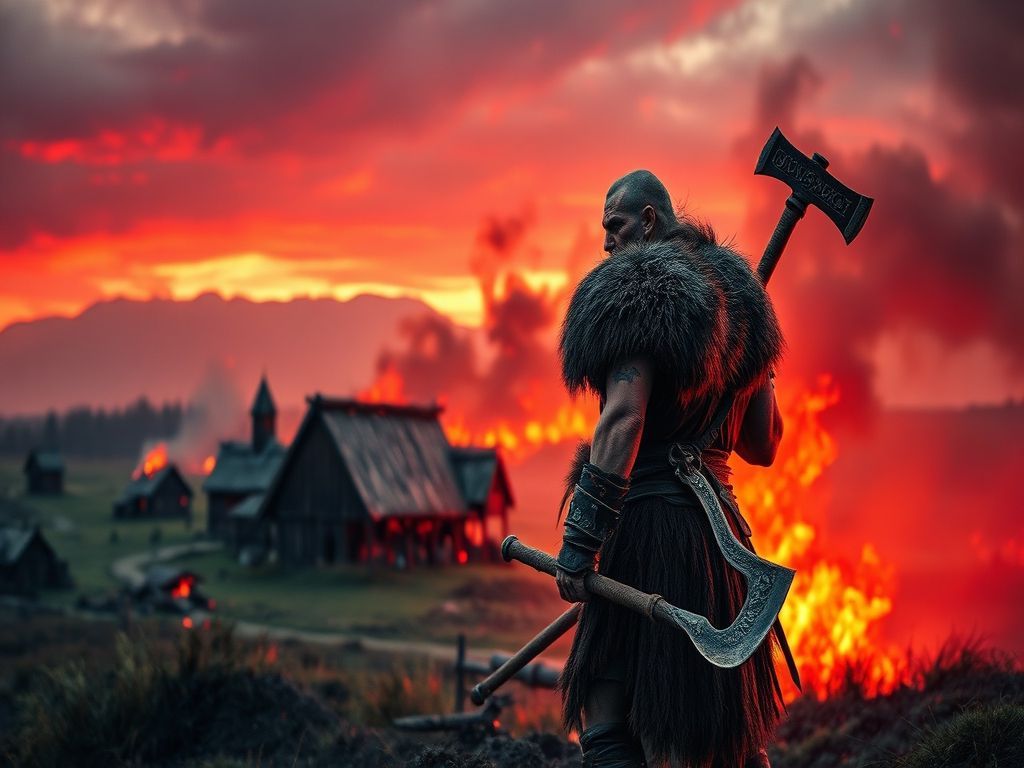
Vikings: The Impact of the Series on Popular Culture
📌 In Brief
- The series revived interest in Nordic culture: tattoos, Mjölnir jewelry, Scandinavian decor, and visits to Viking museums.
- Major games include Assassin's Creed Valhalla, God of War (2018 and Ragnarök), Valheim, Hellblade: Senua's Sacrifice, and The Banner Saga.
- Modern interest began with Wagner's operas (19th century), then the films of the 1950s-60s.
- Representation is often romanticized.
- Vikings embody universal values: courage in the face of adversity, exploration of the unknown, individual freedom, and the connection with nature.
Ragnar's braided crest is actually a creation of the costume designers, not the historical sources — the attested Scandinavian cut is almost the opposite. Our Viking hairstyle guide untangles what the series invented from what the texts describe.
The Night Everything Changed
On March 3, 2013, something unprecedented happened on screens in the English-speaking world. The History Channel, previously known for its documentaries on World War II and theories about lost civilizations, aired the first episode of a historical drama created by British screenwriter Michael Hirst. Its title was just one word — Vikings — and its ambition was staggering: to resurrect the era of the Scandinavian raids, not through the distorted lens of Hollywood clichés, but with a narrative and visual depth never before attempted for this period. A simple farmer from Kattegat, named Ragnar Lothbrok, looked at the horizon and dreamed of sailing West. No one suspected that this gaze would trigger a cultural tidal wave whose ripples are still being felt more than a decade later.
Because the Vikings series did not just tell a story. It transformed the way tens of millions of people perceive the Scandinavian Middle Ages, Norse mythology, and even the objects they wear on a daily basis. It spawned a global cultural phenomenon that touches fashion, tattooing, jewelry, music, tourism, video games, and literature. This article offers an in-depth analysis of this shockwave, chapter by chapter, to understand how a television fiction succeeded in reinventing an entire civilization in the contemporary imagination.
From Lindisfarne to Netflix: The Conquest of the World Through Fiction
To measure the impact of the Vikings series on popular culture, one must first understand the void it came to fill. Before 2013, the Viking in the Western collective imagination was a caricature: a hairy barbarian wearing a horned helmet, pillaging monasteries between drinking bouts. The rare cinematic productions dedicated to the medieval Scandinavians — Richard Fleischer's The Vikings in 1958, The 13th Warrior in 1999 — had certainly contributed to fueling a certain fascination, but never offered a long-form, psychologically complex story grounded in ambitious historical reconstruction.
Michael Hirst, already the author of The Tudors, gambled on an epic serialized narrative. Six seasons, 89 episodes, from 2013 to 2020. The series covers nearly one hundred years of history, from the first raids in England to the exploration of Iceland and the Mediterranean. It attracted up to 5.5 million viewers per episode in the United States and was distributed in over 160 countries. The arrival of the seasons on Amazon Prime Video, then the launch of the sequel Vikings: Valhalla on Netflix in 2022, extended and amplified the audience far beyond the original fans. The Vikings series became a global phenomenon of remarkable longevity.
This success rests on several pillars. First, the quality of the characters: Ragnar Lothbrok (Travis Fimmel), Lagertha (Katheryn Winnick), Floki (Gustaf Skarsgård), Rollo, Bjorn, Ivar the Boneless — all figures whose psychological depth stands in sharp contrast to the one-dimensional Vikings of previous cinema. Then, the artistic direction: Irish landscapes transformed into Norwegian fjords, meticulously documented costumes, and sets whose realism was praised by historians. Finally, the respect — imperfect but sincere — for Norse mythology and customs, which gave the public a gateway into a little-known cultural universe.
"I didn't want to make a documentary. I wanted the audience to feel what it meant to be a Viking — the spirituality, the ambition, the relationship with death, the smell of salt and blood." — Michael Hirst, creator of the Vikings series
Viking Fashion: When Kattegat Inspires the Runways
The most visible and immediate impact of the Vikings series on popular culture manifested in the field of fashion. As soon as the first season aired, the characters' aesthetic codes began to infiltrate fashion trends well beyond the circles of historical reenactment. Worn leather, raw textures, earthy and dark tones, layering, metallic accessories adorned with intertwined patterns — a whole visual vocabulary emerged, directly derived from the Kattegat wardrobe.
The phenomenon affected several segments of fashion. In street-style Viking fashion, t-shirts printed with runes, hoodies adorned with the Valknut or Vegvisir, and leather jackets with laces inspired by Ragnar's costumes multiplied on e-commerce platforms. Specialized brands like Grimfrost (founded in Sweden) built business empires entirely anchored in this renewed Nordic aesthetic. On the haute couture side, houses like Alexander McQueen and Rick Owens integrated elements of medieval Scandinavian inspiration into their collections — deconstructed armor, faux fur coats, massive oxidized silver jewelry.
Between these two registers, it is street style that is worn daily: our Viking hoodies with Nordic patterns fall into this category, with the Vegvísir, Odin's ravens, Yggdrasil, or interlacing patterns printed in large format — the Nordic motif without the reenactment costume.
Hairstyling constitutes a chapter all on its own. The "Ragnar undercut" — shaved sides, long braided hair on top — became one of the most requested men's haircuts in Western salons between 2014 and 2018, according to Google Trends data. Lagertha's style, with its complex side braids, generated thousands of YouTube tutorials and influenced women's hair styling all the way to Hollywood red carpets. Long, braided beards or those adorned with metal beads moved from the status of subcultural marker to mainstream trend, fueled by the aesthetics of characters like Rollo and King Ecbert.
These beads slipped into a beard or a braid form a separate category of accessories, halfway between jewelry and hair accessories. Our Viking hair clips and hair jewelry cover this register, from hair pins to rune-engraved beads.
Tattoos and Jewelry: Ink and Metal as Identity
If clothing fashion constitutes the most superficial layer of cultural influence, tattooing represents the deepest commitment — literally etched into the skin. The Vikings series caused an unprecedented explosion in the demand for Nordic-inspired tattoos. Ragnar's tattooed scalp, Floki's ritualistic patterns, the interlacing and runes that adorn the characters' bodies transformed tattoo parlors around the world.
The most requested motifs reveal the scale of the phenomenon. The Yggdrasil tree, the World Tree of Norse cosmology, became one of the most popular designs in Western studios, often tattooed in large format on the back or forearm. The Vegvisir — the Icelandic magical compass, worn by Björk before being popularized by the series — now adorns millions of skins. The Valknut, the Helm of Awe (Aegishjalmur), the Elder Futhark runes, the Mjölnir hammer: demand for each of these symbols as tattoos grew exponentially in the years following the start of the series.
The same phenomenon is observed in the world of jewelry. Before the Vikings series, Nordic-inspired jewelry was confined to niche markets — medieval reenactors, heavy metal fans, mythology enthusiasts. After 2013, the market literally exploded. Axe-shaped pendants adorned with Celtic knotwork, wolf or raven-headed rings, rune-engraved bracelets, steel and silver torcs — these pieces became identity markers for a global community of enthusiasts. Viking jewelry is not a simple decorative accessory: it functions as a talisman, a sign of recognition between initiates, a tangible link to an aesthetic and philosophy of life that the series made desirable.
"Since the series started, requests for Viking tattoos have increased tenfold in our studio. These aren't just motifs — clients want to understand the meaning behind every rune, every symbol. The series has created a real quest for meaning." — Testimonial from a Berlin tattoo artist, collected in 2019
Wardruna and the Nordic Musical Renaissance
One of the most powerful — and most underestimated — vectors of the Vikings series' impact on popular culture lies in its soundtrack. From the very first season, Michael Hirst called upon the Norwegian band Wardruna to compose part of the show's music. Founded in 2003 by Einar Selvik — a former member of the black metal band Gorgoroth —, Wardruna creates haunting music built around ancient instruments: the lyre, langspil, bukkehorn, goat-skin drums, and above all, the human voice used as a ritual instrument, somewhere between singing and incantation.
The collaboration with the Vikings series propelled Wardruna from obscurity to a global audience. Their album Ragnarok (2016) reached the top of the Norwegian charts, and the band now sells out concert halls across Europe and North America. The tracks Helvegen and VöluspA, used in key scenes of the series, have accumulated hundreds of millions of streams on Spotify. The performer Fever Ray (Karin Dreijer), author of the iconic theme song If I Had a Heart, also saw her popularity skyrocket.
But the effect goes well beyond Wardruna. The series has given birth to a true musical genre: Nordic folk, or Viking folk, which blends traditional Scandinavian instruments, Old Norse lyrics, and ritualistic atmospheres. Artists like Heilung, Danheim, Forndom, Skald, and Nytt Land have emerged in the wake of this movement, filling specialized festivals around the world (Midgardsblot in Norway, Castlefest in the Netherlands). "Viking" music has gone from a niche micro-genre to a recognized musical movement with its own codes, streaming platforms, and dedicated audience.
Viking Tourism: When Fiction Moves Crowds
The most measurable economic impact of the Vikings series is perhaps in the tourism sector. Ireland, where the series was primarily filmed (Ashford Studios, County Wicklow), saw an influx of thousands of visitors eager to tread the landscapes of Kattegat. Tourism Ireland quickly capitalized on the phenomenon by integrating the series into its promotional campaigns, much like Northern Ireland did with Game of Thrones.
But it is Scandinavia itself that has benefited most from this "Vikings effect." Cultural tourism in Norway, Sweden, and Denmark saw spectacular growth between 2014 and 2020. The Viking Ship Museum in Oslo (Vikingskipshuset) recorded attendance records. The Viking village of Borg, in the Lofoten Islands, saw its visitors triple. The Fotevikens Museum park in Sweden, a full-scale reconstruction of a medieval Scandinavian village, has become an international destination. In Iceland, a country associated with the sagas and now with Vikings: Valhalla (part of the plot of which takes place in Reykjavik), Nordic cultural tourism has exploded.
Viking festivals have also proliferated. The Lofotr Viking Festival in Norway, the Viking Market in Gudvangen, the Jorvik Viking Festival in York (England), the Wolin festival in Poland — all have seen attendance jump in the wake of the series. These events, which blend historical reenactment, craftsmanship, music, and combat demonstrations, now attract tens of thousands of participants, including an increasing proportion of young adults whose entry point into Nordic culture was the Vikings series.
Video Games: From Skyrim to Assassin's Creed Valhalla
The video game industry, always quick to capitalize on cultural trends, has massively ridden the Viking wave triggered by the series. While The Elder Scrolls V: Skyrim (2011) had already set the scene by offering a world of Nordic inspiration, it was in the post-Vikings years that the medieval Scandinavian theme became a major selling point.
The most spectacular case is that of Assassin's Creed Valhalla (Ubisoft, 2020), which puts the player in the shoes of Eivor, a Viking warrior navigating between 9th-century Norway and England. The game sold over ten million copies in a few months, becoming the most successful launch in the franchise's history. The influence of the Vikings series is omnipresent in its aesthetics, its characters, and even its soundtrack (Einar Selvik of Wardruna collaborated with Jesper Kyd on the game's music). The success of God of War (2018) and God of War Ragnarök (2022), which transport Kratos into the world of Norse mythology, also testifies to the public's appetite for this theme.
Independent titles like Valheim (2021), a Viking-inspired open-world cooperative survival game, have seen staggering success: more than ten million copies sold in early access. Northgard, Tribes of Midgard, Jotun, Niffelheim — the list of games exploiting the Nordic universe is endless. The Viking has become, alongside the samurai and the knight, one of the three most popular warrior archetypes in contemporary video games, and this status owes a great deal to Michael Hirst's Vikings series.
Literature, Podcasts, and Education: Knowledge as a Legacy
The effect of the Vikings series is not limited to aesthetic consumption. It has generated an authentic thirst for knowledge. Sales of books on the Viking Age jumped dramatically in the years 2013-2020. Reference works like The Age of the Vikings by Anders Winroth, The Children of Ash and Elm by Neil Price, or Les Vikings by Régis Boyer (in French) have reached audiences they would never have known without the leverage effect of the television drama.
In the world of podcasts, the saga of Ragnar and the universe of the series have inspired dozens of dedicated programs. The Viking Age Podcast, Saga Thing, and even episodes devoted to the Vikings in mega-podcasts like Dan Carlin's Hardcore History, have attracted millions of listeners. On YouTube, channels like Jackson Crawford (specialist in Old Norse at the University of Colorado) or Survive the Jive have seen their audiences explode, driven by the curiosity of an audience educated by the series.
In the academic world, the "Vikings effect" has resulted in a notable increase in enrollments in departments of Scandinavian studies, medieval studies, and Nordic archaeology. The University of Oslo, Uppsala University, and the University of Cambridge have reported a growing interest in courses on Old Norse and Viking history. The Vikings series has functioned as a formidable tool for popularization, making thousands of people want to go beyond fiction to discover the historical reality.
The Limits: What the Series Distorted
No honest analysis of the impact of the Vikings series would be complete without addressing its historical distortions. Michael Hirst has always claimed creative liberties, and the series certainly takes considerable ones. Timelines are compressed or rearranged: Ragnar Lothbrok, a semi-legendary figure of the 9th century, interacts with historical characters who lived decades apart. Some events are merged, others invented from scratch.
More problematic, the series has contributed to certain persistent myths. The omnipresence of tattoos on characters, for example, rests on fragile historical foundations: sources attesting to tattoos among the Vikings are rare and contested (mainly the account of Ahmad ibn Fadlan, a 10th-century Arab traveler). Similarly, the military role of shieldmaidens, although supported by recent archaeological discoveries (grave Bj 581 at Birka), remains debated among historians.
But these limits, paradoxically, do not diminish the cultural impact of the series — they make it more complex. Fiction opened the door; it is up to the curious viewer to step through it to discover the historical reality, which is often even more fascinating than the fiction. Passionate discussions among fans on forums, debating the accuracy of this or that episode, testify to an intellectual engagement that few television series have managed to spark.
"The show is not a history lesson. But it has made more people interested in the Viking Age than all the school textbooks combined. That is its true legacy." — Neil Price, professor of archaeology at Uppsala University
A Living Legacy: Viking Culture in 2026
More than three years after the end of the original series, and as Vikings: Valhalla concluded its third and final season on Netflix in 2024, the cultural legacy of Michael Hirst's saga remains massively present. Google searches for "Viking tattoo," "Viking jewelry," and "Norse mythology" remain at historically high levels. Reenactment festivals continue to grow. Nordic folk is an established musical genre. Video games with Nordic themes are multiplying.
What has changed is the maturity of the phenomenon. For many, the first fans of 2013, attracted by the raw aesthetic and spectacular combat, have become informed connoisseurs of Nordic culture. They read the sagas in translation, study runes, visit archaeological sites, and wear jewelry inspired by Nordic craftsmanship not as simple fashion accessories, but as meaningful symbols — strength, resilience, connection with the ancient world. The Vikings series sowed a seed that has sprouted far beyond what its creators imagined.
In this sense, Michael Hirst has accomplished something rare. Like the skalds of old, who passed on the memory of heroes by word of mouth through the centuries, he has found a way to keep the Viking world alive in the minds of millions of people — not as a past frozen in museum display cases, but as a living, pulsating force that continues to inspire how we dress, decorate our skin, compose our music, and dream our adventures. Kattegat is everywhere. The drakkars have never stopped sailing.
"Do not fear death. If it comes, may it find us alive."
— Le Comptoir Viking
May the Aesir guide you on the path of honor.
Frequently Asked Questions about Vikings and Popular Culture
How did the Vikings series influence popular culture?
The Vikings series triggered a massive revival of interest in Nordic culture: an explosion of Viking tattoos, Mjolnir jewelry, Scandinavian decor, tourism in Scandinavia, and the multiplication of Viking brands. It brought Norse mythology into the mainstream.
Which video games were inspired by the Vikings?
Major games include Assassin's Creed Valhalla, God of War (2018 and Ragnarök), Valheim, Hellblade: Senua's Sacrifice, The Banner Saga, For Honor, and Tribes of Midgard. Viking aesthetics and mythology dominate modern gaming.
Is Viking fashion a recent phenomenon?
Modern interest began with Wagner's operas (19th century), then the films of the 50s-60s. But the real boom dates from 2013 with the Vikings series, followed by Marvel's Thor and God of War. Social media has amplified this trend.
Are Vikings well-represented in the media?
Representation is often romanticized. Media shows heroic warriors, but often forgets the Vikings as farmers, merchants, and artisans. The myth of horned helmets persists despite historical corrections. The Vikings series, however, improved the nuance of the representation.
Why are Vikings so fascinating?
Vikings embody universal values: courage in the face of adversity, exploration of the unknown, individual freedom, and connection with nature. Their rich mythology and powerful aesthetics offer a counterpoint to modernity that appeals to a wide audience.
Has music been influenced by the Vikings?
Yes, Viking metal is a subgenre of music (Amon Amarth, Wardruna, Heilung, Danheim). Wardruna, whose founder Einar Selvik composed for the Vikings series, uses traditional Nordic instruments. Viking music has become a genre in its own right on streaming platforms.
What are the delivery times and return conditions for the Celtic Interlacing Axe necklace?
For the Celtic Interlacing Axe necklace, as with any order, allow for 10 to 20 business days in total: 3 to 5 days for preparation, then 7 to 15 days for delivery in mainland France, 10 to 20 days in the European Union. Delivery costs €4.90 in France and the European Union, and is free for orders over €49. After receipt, you have 14 days to change your mind and return the item: return shipping costs are then your responsibility. If the item received is defective or does not match your order, we will refund the return costs upon proof of shipping.
👉 Explore our collections of Viking jewelry and Viking decorations to wear the Viking spirit every day.

Leave a comment
All comments are moderated before being published.
This site is protected by hCaptcha and the hCaptcha Privacy Policy and Terms of Service apply.