
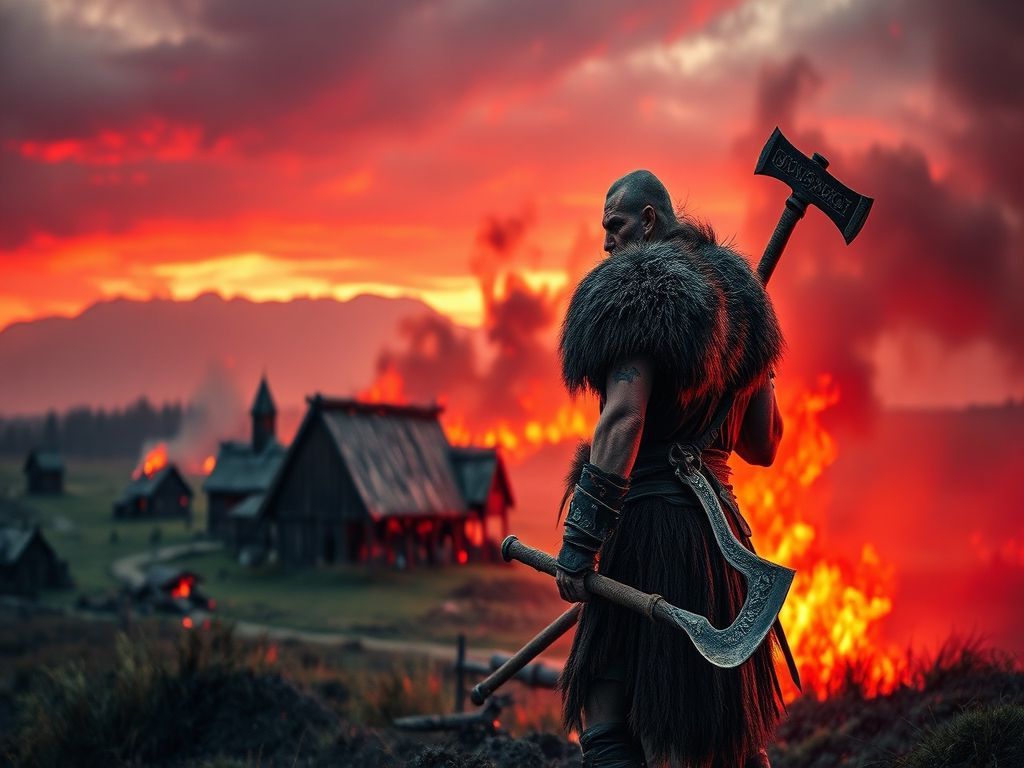
Lagertha in Vikings: Warrior, Queen, and Legend
📌 In Brief
- Lagertha is mentioned in the Gesta Danorum by Saxo Grammaticus (12th century) as a warrior and shieldmaiden who reportedly fought alongside Ragnar.
- Lagertha is played by Canadian actress Katheryn Winnick, who is a 3rd-degree black belt in Taekwondo in real life.
- Archaeology confirms the existence of Viking warrior women.
- Lagertha dies in Season 6, stabbed by a delirious Hvitserk (Ragnar's son).
- In the series, Lagertha becomes Queen of Kattegat after overthrowing Aslaug's rule.
A Single Ancient Source: Saxo Grammaticus
Let’s start with the fact that dictates everything else, and which most French articles overlook: Lagertha appears in only one ancient text.
That text is the Gesta Danorum, or "Deeds of the Danes," by Saxo Grammaticus, completed around 1200. She appears there in the Latinized form Lathgertha, in Book IX, within the section dedicated to Ragnar Loðbrók. That is it. No other medieval source mentions her.
This absence is all the more striking given that she is missing from the very corpus that should have known her. The Saga of Ragnar Lodbrok, which details the hero's life, does not name her. Neither does the Þáttr af Ragnars sonum. Nor Snorri's Heimskringla, the Landnámabók, or any of the great Icelandic sagas. The wives traditionally attributed to Ragnar in Norse tradition are Þóra Borgarhjǫrtr and Áslaug, daughter of Sigurðr and Brynhildr—two women whose place Lagertha never takes.
We are left with a figure attested by a unique source, written in Latin, in Denmark, approximately three hundred and fifty years after the alleged events, by an author writing a commissioned national history.
This is not enough to declare her a fabrication—medieval history often relies on isolated accounts. But it does require a methodology: before recounting what Lagertha supposedly did, one must examine who told her story, and why. That is what we will do, in that order.
What Saxo Actually Says
Saxo's account consists of a few episodes, and it is worth reporting them faithfully, as the series departs from them significantly.
It all begins with revenge. The Swedish king Frø kills Siward, King of Norway and Ragnar's grandfather, then imprisons the women of his family in a brothel to humiliate them. Ragnar comes to avenge his ancestor. The captive women escape, don men's clothing, and join his army.
One of them distinguishes herself in battle. Saxo writes that she fought with her "hair loose over her shoulders," with a courage no one expected of a woman, and that her valor decided the outcome. Ragnar, having learned who she was, wanted her as his wife.
There follows a folkloric episode: Lagertha places a bear and a dog outside her home to test her suitor. Ragnar kills the bear with a spear, strangles the dog, and wins her hand. They have a son, Fridleif, and two unnamed daughters.
The marriage is short-lived. Ragnar repudiates her to marry Þóra, citing the very beasts she had set against him—a grievance Saxo reports without comment.
Then comes the most remarkable scene. Much later, when Ragnar is struggling in a Danish civil war, he receives reinforcements from his former wife: Lagertha arrives with one hundred and twenty ships and wins the battle by attacking the enemy from the rear. She was under no obligation to do so; Saxo emphasizes that she retained affection for him despite the repudiation.
The final episode is the darkest. Returning home, Lagertha kills her second husband with a spear point hidden in her dress, and rules alone—because, Saxo writes, "this most arrogant woman thought it more pleasant to rule without her husband than with him."
This last comment is revealing. Saxo admires the character's courage but disapproves of her ambition. We are therefore not reading a report, but a moral portrait, written by a 12th-century cleric for an audience he intended to edify.
Who Was Saxo, and Why Be Skeptical?
Saxo Grammaticus was a Danish cleric and secretary to Archbishop Absalon of Lund, and his Gesta Danorum was a commissioned work. He worked on it between approximately 1180 and 1208.
The project was explicit: to give Denmark a national history capable of competing with that of Rome. Sixteen books in Latin, modeled on the style of classical historians, tracing the Danish past from its mythical origins. It was as much a political act as it was a scholarly endeavor.
However, the first nine books—including the one containing Lagertha—explicitly belong to the legendary realm. Saxo compiled oral traditions, poems, and information gathered from Icelanders, organizing them according to the literary models he knew: Virgil, Valerius Maximus, and Latin historians. The strictly historical part of his work begins much later.
Two aspects of his methodology invite caution.
First, he constantly moralizes. Each figure illustrates a virtue or a vice, and the narrative is constructed to deliver a lesson. The final comment on Lagertha—that she was arrogant for wanting to rule alone—is a direct example.
Second, and more decisively, warrior women abound in his work. Saxo devotes several passages to these women who "refused a soft life," adopted male attire, and led troops. He mentions several by name in different books. Such recurrence, in an author steeped in ancient literature where Amazons are a classic motif, looks very much like a topos—an inherited figure of speech, projected onto a Norse past that needed to be rendered glorious.
This is not to say that Saxo invented everything. He certainly transmits authentic material, and his testimony on several points is corroborated elsewhere. It is simply a reminder that between the events of the 9th century and his page, there were three and a half centuries of oral transmission, a foreign language, a political agenda, and a Latin library. That is a lot of filters.
The Mythological Hypothesis: Lagertha and Þorgerðr
A tempting hypothesis circulates among specialists of Saxo, and it deserves to be presented—as what it is: a possibility, not a conclusion.
It suggests that Lagertha was not a woman who actually lived, but rather a distorted memory of a deity: Þorgerðr Hölgabrúðr, a tutelary power venerated in the Norwegian Trøndelag.
This Þorgerðr is not an obscure figure. The Jómsvíkinga saga recounts that during the naval battle of Hjörungavágr, around 986, Jarl Hákon, in difficulty, sacrificed to her and invoked her. She then appeared above the fleet and triggered a hail storm, with arrows flying from each of her fingers. The battle turned. The parallel to a female figure appearing to turn the tide of a battle is immediate.
The strongest argument, however, is linguistic. The reconstructed Old Norse form of the name Lagertha would be Hlaðgerðr, whose first element, Hlað-, refers to Hlaðir—Lade, near the present-day Trondheim. Hlaðir was precisely the seat of the Jarls of Lade, the dynasty for which Þorgerðr was the patron goddess. The name, therefore, would carry the address of the goddess.
The proposed scenario is thus: a Norwegian tradition concerning a protective power associated with Lade was transmitted orally, then collected by Saxo who, lacking the religious key, historicized it as a warrior princess—a process he practices elsewhere, and which Northern Christian authors systematically applied to pagan gods.
This reading is not proven, and it has its detractors. It has the merit of explaining several anomalies at once: the total absence of Lagertha in the Icelandic corpus, the marvelous character of the bear and dog episode, and her decisive, quasi-supernatural intervention in a losing battle.
What can be stated safely, however, is this: there is no evidence to suggest that Lagertha existed, and several serious indications suggest that she comes from somewhere other than history.
Armed Women: What Archaeology Really Says
Saying that Lagertha likely did not exist does not imply that no Scandinavian woman ever bore arms. These are two distinct questions, and the latter is open.
The most discussed case is grave Bj 581 in Birka, Sweden. Excavated in 1878, it contained full warrior equipment—sword, axe, spear, arrows, two shields, two horses—and, a rare detail, a board game with pieces, usually interpreted as a sign of leadership. For over a century, it was assumed to be male without ever examining the bones.
An osteological re-evaluation in 2016, followed by a genomic analysis published in 2017, established that the individual carried two X chromosomes. The news went around the world.
The debate that followed is instructive and is not settled. The objections do not concern the individual's sex, which is now established, but the interpretation: funerary furniture expresses what the living want to say about the dead, which does not necessarily equate to a profession. A woman could be buried with weapons as an heir, as a representative of a lineage, or for other symbolic reasons. The original team responded that the cluster of clues—full armament, horses, strategy game—makes the warrior hypothesis the most plausible.
Other cases exist, though they are less publicized. The grave at Nordre Kjølen, in Norway, contained a woman accompanied by weapons. The one in Gerdrup, Denmark, contained a woman buried with a spear, in an unusual layout.
Finally, one external testimony deserves to be cited, as it comes from neither the sagas nor Scandinavia. The Byzantine chronicler John Skylitzes, describing the aftermath of the battle of Dorostolon against the Rus' in 971, reports that the victors, while stripping the dead, discovered with amazement women in arms among them. The text was written a century after the event, but it is independent of any Norse tradition.
It must also be remembered that "bearing arms" was not necessarily a profession. In a society where farms were isolated, where neighborhood disputes escalated, and where men would leave for several months on expeditions, the defense of a farmstead fell to those who remained. The sagas show women who command a household, arm their people, and pursue family vendettas—without ever stepping onto a warship.
The reasonable conclusion is nuanced. The existence of some female combatants is plausible and partially supported. On the other hand, the idea of an institution of "shield-maidens," of an organized corps of skjaldmeyjar, rests on nothing solid: this word belongs to the literary vocabulary of the sagas, not to administrative or legal documents.
From Saxo to the series: crafting an icon
How did a character attested to by a single Latin page become one of the most recognizable figures in popular culture? In stages, and each one adds a layer.
The first is the Nordic romanticism of the 19th century. Saxo, rediscovered and translated, provided Scandinavian nations in search of identity with a gallery of heroic ancestors. Lagertha finds her place there, alongside Wagner's valkyries and Doepler's horned helmets—the same factory, the same era.
The second is Michael Hirst's series, starting in 2013. It does not just pick up the character: it gives her a complete arc that Saxo never outlines—countess, queen, leader of men, over six seasons. The Lagertha known by millions of viewers is overwhelmingly a contemporary creation.
The third layer is currently in progress, and it is our own: that of articles, games, objects, and tattoos that use the series' character while believing her to be historical. It is precisely to interrupt this chain that we are writing these pages.
Should we conclude that Lagertha is worth nothing? Certainly not—but she is worth something other than what we think. She is a document about those who told her story: about a 12th-century Danish clerk who admired a woman's courage while disapproving of her ambition; about a 19th-century Europe that sought glorious origins; about a 21st-century television production that wanted a heroine to match its hero.
Three eras, three Lagerthas, and none of them really tell us about the 9th century. It is a bit disappointing if one was looking for a biography; it is fascinating if one accepts looking at what each century projects onto the previous one.
And as for the question that always comes last—did Scandinavian women have power?—the answer does not depend on Lagertha. It is read in legal codes, which recognized their right to own, inherit, divorce, and testify; in the richly equipped graves of women; in runic inscriptions commissioned by widows. That power is documented, and it does not need a legendary warrior to be established.
Frequently Asked Questions about Lagertha
Did Lagertha really exist?
Lagertha is mentioned in Saxo Grammaticus's Gesta Danorum (12th century) as a warrior and shield-maiden who allegedly fought alongside Ragnar. Her historical existence remains uncertain, but the concept of Nordic female warriors is attested by archaeology.
Who plays Lagertha in the Vikings series?
Lagertha is played by Canadian actress Katheryn Winnick, who practices taekwondo (3rd-degree black belt) in real life. She performed many of her own fight scenes, bringing physical authenticity to the character.
Did Viking women really fight?
Archaeology confirms the existence of female Viking warriors. In 2017, DNA analysis of a high-ranking warrior buried in Birka (Sweden) revealed that it was a woman, buried with weapons and horses—a discovery that shook the traditional view.
How does Lagertha die in the series?
Lagertha dies in season 6, stabbed by Hvitserk (Ragnar's son) in a state of delirium. A prophecy had foretold that she would die at the hand of one of Ragnar's sons. She receives a funeral worthy of a Viking queen and warrior.
Was Lagertha a queen?
In the series, Lagertha becomes Queen of Kattegat after overthrowing Aslaug's reign. In the historical sources of Saxo Grammaticus, she is described as a noble warrior and a leader, but the title of queen is a dramatic liberty taken by the series.
What is Lagertha's symbol?
Lagertha is often associated with the shield and the sword, symbols of the shield-maidens. In the series, her distinctive side-shave hairstyle and warrior braids have become iconic elements. She embodies feminine strength in Viking culture.
What are the delivery times and return conditions for the Thor's Hammer mug?
For the Thor's Hammer mug, as for any order, allow for 10 to 20 business days in total: 3 to 5 days for preparation, then 7 to 15 days for delivery in mainland France, 10 to 20 days in the European Union. Delivery costs €4.90 in France and the European Union, and is free on orders over €49. After receipt, you have 14 days to change your mind and return the item to us: return shipping costs are your responsibility. If the received item is defective or does not match your order, we will refund the return costs upon presentation of proof of postage.
"This very arrogant woman judged it more pleasant to rule without her husband than with him."
— Saxo Grammaticus, Gesta Danorum, book IX
May the Aesir guide you on the path of honor.
👉 Discover our collection of viking jewelry and carry the legacy of the Vikings daily.
Sources
- Saxo Grammaticus, Gesta Danorum, book IX, circa 1200 — the only ancient source mentioning Lathgertha; Lagertha is absent from the Ragnars saga loðbrókar and the entire Icelandic corpus.
- Jómsvíkinga saga — Þorgerðr Hölgabrúðr invoked by Jarl Hákon at the Battle of Hjörungavágr, the basis for the mythological hypothesis.
- Charlotte Hedenstierna-Jonson et al., "A female Viking warrior confirmed by genomics," American Journal of Physical Anthropology, 2017 — grave Bj 581 in Birka, and the ensuing debate of interpretation.
- John Skylitzes, Synopsis historiarum — armed women discovered among the dead Rus' after the Battle of Dorostolon (971), an independent Byzantine testimony to Nordic traditions.
📚 Read also
- How Tall Were the Vikings? The Answer from Skeletons, Figures in Support
- Viking Names: Over 130 Authentic Nordic Names, Meaning and Pronunciation
- Ragnar Lothbrok: True History vs. Vikings Series
- Vikings: The Impact of the Series on Popular Culture
- Vikings TV Series: Full Season-by-Season Summary (1 to 6)
- Vikings Series vs. True History: The Differences

Leave a comment
All comments are moderated before being published.
This site is protected by hCaptcha and the hCaptcha Privacy Policy and Terms of Service apply.