
Viking Arm Tattoos for Men: 50 Ideas and Symbols
A clarification is necessary right from the start, as it is missing from most pages dedicated to the subject: we have no direct evidence that the Scandinavians of the Viking Age tattooed themselves. The only testimony regularly cited is that of Ibn Fadlan, an Arab diplomat who encountered the Rus' on the Volga in 922 and described men covered "from fingernails to neck" in dark green patterns representing trees and figures. However, the Arabic term used could refer to either tattoos or body paint, and the Rus' of the Volga are not the same as the Scandinavians of Norway. It's a thin thread. The Viking arm tattoo for men is therefore a contemporary art form that draws from an authentic Nordic repertoire—and that is how it should be approached, without inventing a genealogy that it does not have.
If you are looking for inspiration for a Viking arm tattoo for men that has meaning, you are in the right place. This guide gathers 50 Nordic ideas and symbols organized by arm area—full sleeve, forearm, bicep—along with their meanings, the most suitable graphic styles, and concrete advice on how to compose a coherent piece that you will wear with pride, just as the warriors of old wore their shields.
📌 In Brief
- The most popular designs for the arm are the full Nordic sleeve, the Vegvisir on the forearm, and the wolf or raven head.
- Ibn Fadlan, in the 10th century, described the Volga Rus as covered in patterns from neck to fingertips: this is the only written source on the subject, and it is inconclusive.
- A full Viking sleeve (whole arm) generally costs between 2,000 and 5,000 euros in France, spread over 4 to 8 sessions of several hours.
- The most requested symbols are the Vegvisir, the Valknut, the ravens Huginn and Muninn, and the Mjölnir hammer.
- A forearm is sufficient for a single symbol (Vegvisir, Valknut, rune).
The arm is only one possible placement among a dozen. Our Viking tattoo guide compares them all and explains what each zone imposes on the motif.
The Viking full sleeve: an epic etched on the skin
The full sleeve is the most committed choice for a Viking arm tattoo for men. It transforms the entire limb into a continuous fresco, from shoulder to wrist, and is conceived as a narrative: each section carries its own episode, and the transitions count just as much as the motifs themselves. Expect several sessions spread over six months to two years depending on the density of the project.
Here are the fundamental elements for composing an impressive Viking sleeve:
1-5. The great trees and roots of Yggdrasil. The World Tree forms the ideal spine for a sleeve. Its roots start from the wrist, its trunk wraps around the forearm, and its canopy extends over the shoulder. Three roots for three worlds: Asgard, Midgard, and Helheim. To delve deeper into the symbolism of this sacred tree, see our article dedicated to the Yggdrasil tattoo and its meaning.
6-8. The ravens Huginn and Muninn. Odin's two emissaries flying around the tree bring movement and dynamism. One symbolizes thought, the other memory. Placed on the inside of the arm, they create a striking contrast with the exterior geometric motifs.
9-12. Celtic knots and interlace. These patterns of infinite chaining serve as connective tissue between the large pieces. They fill the spaces and create visual unity. Braided bands, quaternary knots, triquetra spirals—they are the mortar of any successful Nordic sleeve.
13-15. Jörmungandr, the Midgard serpent. The world-serpent biting its own tail is perfect for spiraling around the arm. It creates a natural continuity between different sections and symbolizes the eternal cycle of life, death, and rebirth. This motif also exists as jewelry in our Nordic dragons and serpents section.
16-18. Scenes of Ragnarök. For the most daring, an entire sleeve can tell the final battle of the gods. Thor confronting Jörmungandr on the shoulder, Fenrir breaking his chains on the bicep, the flames of Surtr licking the forearm. It is a statement of absolute power.
"Cattle die, kinsmen die, the self must also die; but glory never dies for the one who achieves it."— Hávamál, stanza 76, Poetic Edda
Forearm tattoos: sacred symbols within reach
The forearm is the most requested area for a Viking arm tattoo for men, and for good reasons: visible without being intrusive, it offers a flat and long surface, ideal for detailed symbols—a Vegvísir, an isolated rune, a frieze of interlace. It is also the easiest area to cover with a long sleeve, an argument that still carries weight in many professions.
19-21. The Vegvisir (runic compass). This eight-armed Nordic compass is probably the most requested Viking motif for a forearm tattoo. Placed in the center, it radiates power. It means that the wearer will never get lost, even in a storm. It is a perfect choice for those going through life's trials. Discover all the variations in our guide on the Vegvisir tattoo and its meaning.
22-24. The Elder Futhark runes. The 24 runes of the sacred Scandinavian alphabet each carry a deep meaning. Algiz for protection, Tiwaz for warrior courage, Thurisaz for defensive strength, Ansuz for Odin's wisdom. Aligned vertically on the forearm, they form a secret text that only the initiated can decipher. You can also frame a central symbol with runic bands.
25-27. The Valknut, Odin's triple triangle. The three intertwined triangles represent the link between life, death, and destiny. It is the symbol of warriors who do not fear falling in battle, those whom Odin chooses for Valhalla. On the forearm, it unfolds beautifully in geometric or dotwork versions. Explore its deep meanings in our article on the Valknut tattoo and Odin's symbol.
28-30. Nordic protection knots. The Dara knot symbolizes the roots of the sacred oak and inner strength. The shield knot offers protection in four directions. The Trinity knot (triquetra) represents the three cosmic realms. These more compact patterns work perfectly on their own on the inside of the forearm.
31-33. Interlace bands and ornamental cuffs. An interlace band that circles the forearm like a warrior's bracelet is a choice that is both subtle and striking. You can integrate runes, dragon heads, or geometric patterns. To complement the style for everyday wear, nothing beats a genuine steel Viking bracelet worn just below the tattoo.
Bicep tattoos: patterns of strength and power
The bicep offers a curved and voluminous surface, perfect for imposing motifs that play with anatomy. The muscular relief becomes part of the design: a well-placed pattern distorts with movement, which can be an asset or a trap. An experienced tattoo artist will consider your physique before fixing the composition.
34-36. Mjölnir, Thor's hammer. The hammer of the god of thunder is the ultimate emblem of masculine strength in Norse mythology. On the bicep, it strikes with unparalleled presence. It is depicted alone in a realistic style, surrounded by lightning, or integrated into a Nordic mandala with circular runes. To learn more about this symbol, read our complete guide to the Mjölnir tattoo.
37-39. Crossed axes. Two crossed war axes on the bicep: that is a classic motif that has never lost its impact. They are enriched with runic engravings on the blades, handles wrapped in braided leather, or wolf heads on the shafts. Some add a round shield behind for a warrior-blazon effect.
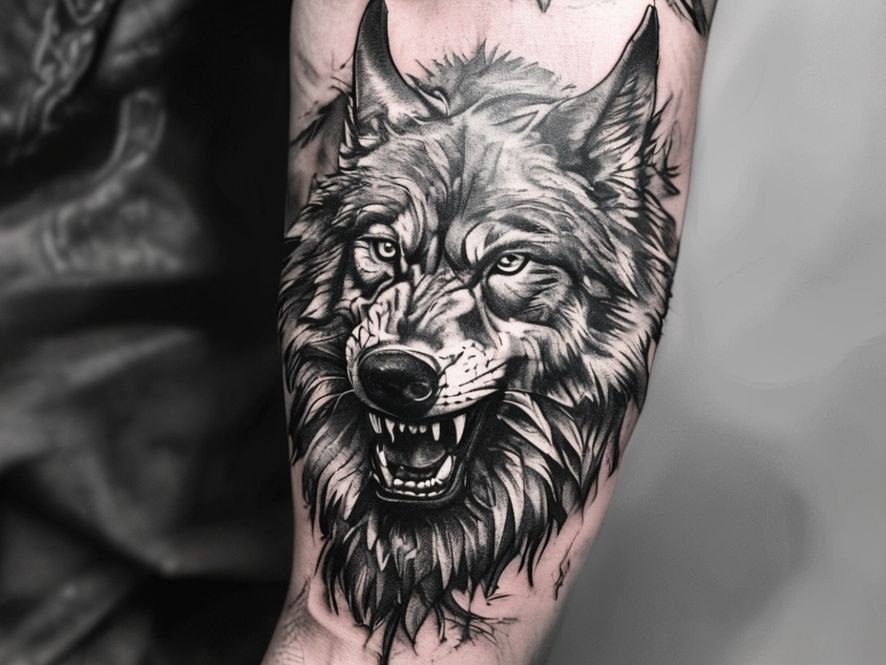
40-42. The wolves Fenrir, Sköll, and Hati. The wolf holds a central place in Norse mythology. Fenrir, the giant wolf who will swallow Odin at Ragnarök, in a realistic version on the bicep, creates a striking effect. Sköll and Hati, the wolves chasing the sun and moon, work in a pair on both biceps. A howling wolf head in blackwork is among the most requested Nordic tattoos.
43-45. Nordic helmets. The Aegishjalmur (Helm of Awe) is both a symbol and a fascinating graphic motif. Its eight-armed star structure radiates from the center of the bicep. Around it, you can place protective runes. The classic warrior helmet, with its cheek guards and nasal bar, also works remarkably well as a realistic portrait.
46-47. Drakkar ships. A drakkar with sails billowing in the wind, navigating stylized waves, is a spectacular choice for the outer bicep. The carved dragon-head prow can extend toward the shoulder, while the oars dip toward the elbow.
"A man without marks is a man without a story. The warrior wears on his flesh the battles he has fought and the gods he honors."— Le Comptoir Viking
How to compose a coherent Viking sleeve
A good Nordic tattoo is never improvised on the skin. The drawing is prepared in advance, transferred to a stencil, and adjusted on the body before the first needle touches the skin. Every element has its place, its rhythm, its reason for being. If you are considering an ambitious Viking arm tattoo for men, here are the principles of composition that the best specialists in the genre apply.
Choose a narrative thread. A successful Viking sleeve tells a story. It could be your personal journey (the Vegvisir as a starting point, Yggdrasil as the path, Valhalla as the destination), a specific myth (Thor fishing for Jörmungandr), or an abstract theme (the duality between chaos and order, represented by wolves and knots). Without a narrative, the symbols pile up soullessly.
Respect visual hierarchy. Masterpieces — Mjölnir, Vegvisir, Yggdrasil, a wolf's head — occupy the most visible areas: the outer bicep, the center of the forearm. Secondary motifs (runes, interlacing, textures) fill the spaces and create transitions. The background (smoke, clouds, filigree geometric patterns) unifies the whole.
48-49. Alternate scales. Large pieces sit alongside small details. A realistic portrait of one-eyed Odin on the shoulder contrasts with a fine line of runes on the wrist. A massive drakkar on the bicep is balanced by delicate interlacing in the crook of the elbow. This alternation creates rhythm and prevents the sleeve from appearing overloaded or monotonous.
50. Integrate Nordic natural elements. Pine branches, background mountains, North Atlantic waves, gradient northern lights — these elements fill the backgrounds and anchor mythological symbols in the real landscape of Scandinavia. They bring depth and dimension to your Nordic arm tattoo project.
Consider anatomical symmetry. The arm is a cylinder. The best Viking tattoo artists work in rotation: the main motif on the outer side (the most visible), a complementary motif on the inner side (more intimate), and fluid transitions on the sides. Test how it looks in motion before finalizing: a stunning design along the arm can end up cut in half as soon as you bend your elbow.
To accompany your sleeve daily and extend the Nordic aesthetic, a black steel Vegvisir Viking ring will perfectly complete the ensemble. Metal and ink share the same language of power.
Recommended tattoo styles for the Viking arm
Today's tattoo artists have an arsenal the Viking age never knew: calibrated needles, stable inks, rotary machines, not to mention asepsis. The style you choose for your men's Viking arm tattoo will radically change the atmosphere of the piece. Here are the five approaches best suited to the Nordic aesthetic.
Blackwork. Massive fills of pure black, violent contrasts between ink and bare skin. This is the most brutal and stripped-back style, the one that best evokes the idea of a mark made with very few tools. Viking symbols are reduced to their geometric essence. The Vegvisir in blackwork has absolute visual power. This style ages remarkably well and keeps its impact for decades.
Dotwork (pointillism). Thousands of dots create subtle gradients, organic textures, and almost hypnotic depth. The Valknut in dotwork takes on a mystical dimension. Nordic mandalas, Helms of Awe, and sacred geometric patterns express themselves beautifully in this technique. The result is softer than blackwork, more contemplative, but just as impressive.
Neo-Nordic. This contemporary style blends traditional Viking aesthetics with modern techniques: fine geometric lines, minimalist ornamental strokes, symmetrical compositions reminiscent of stone carvings. Neo-Nordic is perfect for a men's Viking arm tattoo that is both faithful to historical sources and resolutely modern. It is the style gaining momentum in Scandinavian studios.
Nordic Realism. Photorealistic portraits of Odin, Thor, Freya. Fjord landscapes with photographic precision. Drakkars cutting through textured waves. Realism requires an exceptionally gifted tattoo artist, but the result is breathtaking. On a full arm, a realistic Viking warrior portrait combined with graphic elements creates a striking contrast.
Nordic Trash Polka. For rebellious spirits, this explosive style mixes realistic elements with ink splashes, aggressive brushstrokes, and sometimes touches of blood red. Applying trash polka to Viking themes yields results of rare intensity: a warrior's helmet splashed with deconstructed runes, a Fenrir wolf emerging from graphic chaos.
"Iron is forged in fire, man in trial. Let your marks be the story of your inner forge."— Le Comptoir Viking
Practical tips before getting started
The waiting period is not a commercial courtesy: it is the best protection against regret. Serious tattoo artists often require several weeks between the initial consultation and the first session, and they are right to do so. Apply the same requirement to your own men's Viking arm tattoo project.
Find a specialized tattoo artist. Not all tattooists master Nordic interlacing or sacred dotwork. Look for an artist whose portfolio shows true expertise in Viking tattooing. Check the precision of the knots, the fluidity of the interlacing, the depth of the symbols. A poorly executed Vegvisir loses all its power.
Prepare an inspiration board. Gather symbols that speak to you, styles that attract you, and placements that interest you. Discuss at length with your tattoo artist so they can compose a unique piece that tells your story. The best projects of this type are never copies: they are original creations nourished by tradition.
Think about evolution. If you start with a single symbol on the forearm, plan from the start for the possibility of extending it into a full sleeve. Ask your tattoo artist to position the first motif with future additions in mind. A men's Viking arm tattoo that grows over the years is a saga written chapter after chapter.
Pain is a rite of passage. The arm is a relatively bearable area — the outer bicep and outer forearm are among the least painful zones. Conversely, the inside of the elbow and the hollow of the armpit are much more sensitive. Plan to eat before the session and don't hesitate to announce your breaks: no one gains anything by gritting their teeth in silence for four hours.
To carry the Nordic spirit beyond your ink, discover our Viking bracelet with Odin's ravens: its stainless steel engraved with runes perfectly complements a tattooed forearm.
The same repertoire of symbols is available in metal: Mjölnir, Valknut, wolf heads, and runic friezes can be engraved just as well on a ring as on a pendant. Our Viking Jewelry department gathers the rings, necklaces, bracelets, and earrings that draw from this same Nordic vocabulary, perfect for extending the motifs chosen for your skin into everyday life.
Conclusion: your arm, your saga
What remains is essential, and it is not technical. A successful Nordic tattoo is not a collection of stacked symbols: it is a composition that stands on its own. An Yggdrasil with roots reaching down toward the wrist, ravens taking flight from the elbow, Mjölnir on the bicep, a runic frieze as a border — every element must have a reason to be there rather than elsewhere. It is this coherence, much more than the amount of ink, that separates a beautiful arm from one that is simply crowded.
Your men's Viking arm tattoo can be as grand as a full sleeve telling the story of Ragnarök, or as intimate as a single rune on the inner wrist. What matters is that every line has meaning, that every symbol belongs to you, and that the whole tells the story of who you are. The 50 ideas presented in this guide are only a starting point. You will write the true saga — ink by ink, symbol by symbol, on the eternal canvas of your skin.
May the Norns weave for you a destiny of glory. Skål!
Frequently Asked Questions about Men's Viking Tattoos
Which Viking tattoo should I choose for my arm?
The most popular designs for the arm are the full Nordic sleeve (Yggdrasil + runes + interlacing), the Vegvisir on the forearm, the Fenrir wolf head, or a drakkar as an arm piece. The choice depends on the symbolism that speaks to you.
Did the Vikings really have tattoos?
The Arab historian Ahmad Ibn Fadlan (10th century) described the Volga Rus as having bodies covered with patterns from neck to fingertips, representing trees and symbols. This is the only written source that mentions it, and it is not enough to conclude: the Arabic term used could designate a tattoo or body paint, and these Volga Rus should not be confused with the Scandinavians of Scandinavia.
How much does a full Viking sleeve cost?
A full Viking sleeve (entire arm) generally costs between 2,000 and 5,000 euros in France, spread over 4 to 8 sessions of several hours. The price depends on the tattoo artist, the level of detail, and the complexity of the chosen interlacing and symbols.
Which Viking symbols are tattooed the most?
The most popular symbols are: the Vegvisir (Viking compass), the Valknut (Odin's knot), Huginn and Muninn (Odin's ravens), the Mjölnir (Thor's hammer), runes, and Yggdrasil (World Tree).
Do I need a forearm or a full arm for a Viking tattoo?
A forearm is sufficient for a single symbol (Vegvisir, Valknut, rune). For a narrative composition with several elements (Yggdrasil + runes + interlacing + animals), a full arm (sleeve) offers the necessary space for a detailed and coherent rendering.
Is a Viking tattoo suitable for a first tattoo?
Yes, if you start with a medium design (10-15 cm) like a Vegvisir or a Valknut on the forearm. Avoid starting directly with a full sleeve. You can always enlarge the composition later by adding elements around the initial design.
👉 Explore our collections of Viking bracelets and Viking rings to carry the Viking spirit everyday.

Leave a comment
All comments are moderated before being published.
This site is protected by hCaptcha and the hCaptcha Privacy Policy and Terms of Service apply.