
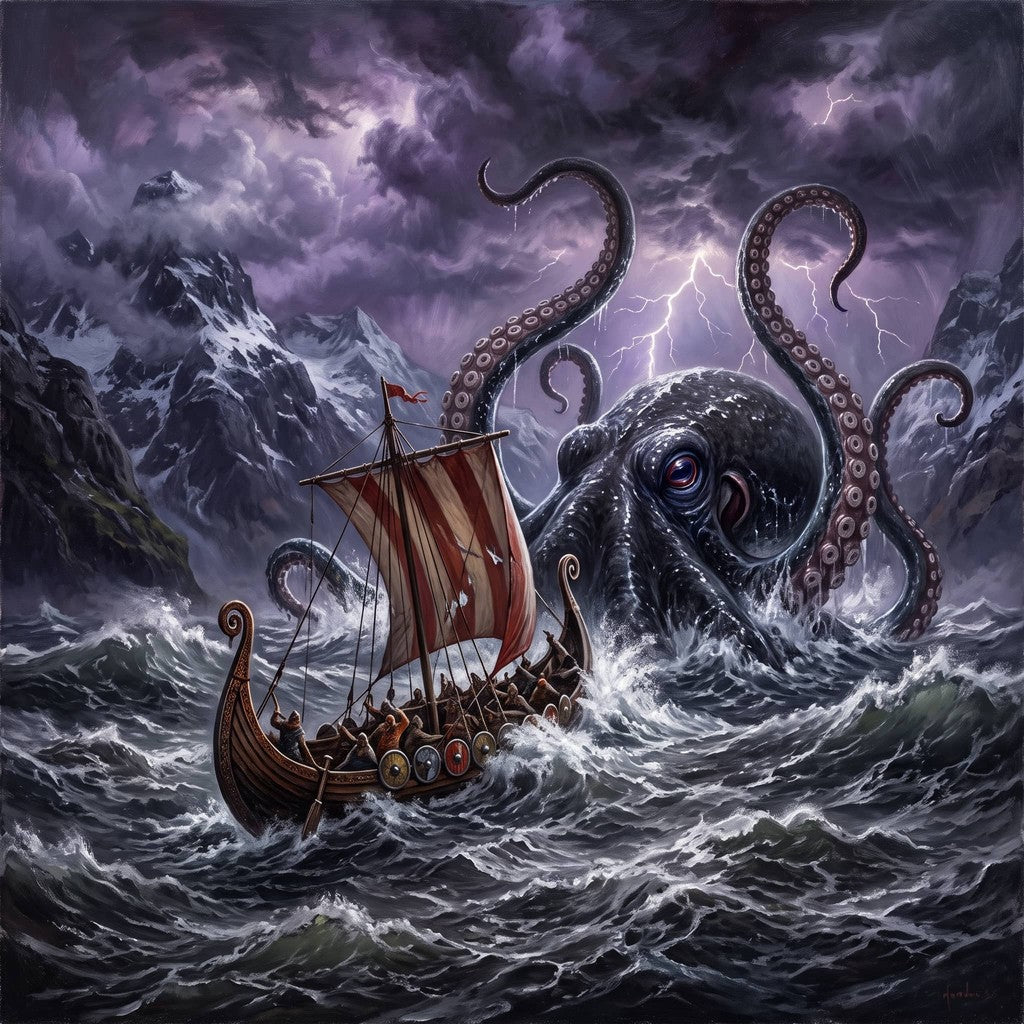
The Kraken: The Sea Monster of Nordic Legends, from Myth to Giant Squid
The Kraken is the sea monster of Norwegian legends: a beast as large as an island, which seizes ships with its arms and drags them into its whirlpool. The word does not appear in any saga, but its ancestor, the Hafgufa, was already haunting the Greenland Sea around 1250. Here is where it comes from, what Bishop Pontoppidan said about it in 1752, how a French naturalist burned his wings on it, and what science has found in the depths: the giant squid.
📌 In brief
- The Kraken is a sea monster from Norwegian legends, so large it is mistaken for an island, which seizes ships with its arms or swallows them in the whirlpool it creates while diving.
- The Kraken of legend does not exist, but the animal that inspired it does: the giant squid, *Architeuthis dux*, which can reach thirteen meters including tentacles, photographed alive in 2004 and filmed in 2012.
- The word "Kraken" does not appear in any saga or Edda: it dates from the 18th century.
- Pontoppidan gave it a circumference of a mile and a half; Wallenberg, in 1781, scaled it back to "no larger than the island of Öland."
- Jörmungandr is the world-serpent of the Eddas, son of Loki, who encircles Midgard and kills Thor at Ragnarök.
Sources: Kraken, Wikipedia · Hafgufa · Giant squid · Konungs skuggsjá · Pierre Denys de Montfort. Extracts translated or paraphrased by us.
What is the Kraken? A Norwegian monster, not a beast of the Eddas
The Kraken is a sea monster from Scandinavian legends: a creature so vast it is mistaken for an island, rising from the depths to seize ships with its arms and drag them to the bottom, or swallowing them into the whirlpool it creates while diving. According to tales, it lives in the cold waters of Norway, off the coast of the Lofoten Islands and the North Sea.
First clarification, because it changes everything: the word Kraken does not appear in any saga or Edda. The Vikings never spoke the word. The name is first attested in 1700, and its detailed description dates from 1752. What Scandinavians of the Middle Ages knew was a different monster, the Hafgufa ("sea vapor"), of which the Kraken is the heir. We will return to this below, as that is where the true connection to the Viking world lies.
Second clarification, more grounded: if you searched "Kraken" on Google, you may have encountered a cryptocurrency exchange, a spiced rum, or a Seattle hockey team. All have borrowed the monster's name. This article only discusses the beast, its origins, and what science has made of it.
Where does the word "Kraken" come from?
In Norwegian, krake refers to something twisted, stunted, or malformed: a misshapen tree, a scrawny animal, or an uprooted post. Kraken is the definite form, "the krake." The name therefore primarily denotes a silhouette, that of something with twisted limbs sticking out of the water, rather than a proper noun. In Swedish, the word took on the meaning of "octopus," which shows that the image of the many-armed monster eventually took hold.
The first written trace is Italian: in 1700, the traveler Francesco Negri reported a monstrous fish from the Lofoten Islands that the fishermen called sciu-crak. In 1741, the missionary Hans Egede, who was well-acquainted with Greenland and Norway, described a sea monster with "arms" capable of sinking a boat. And in 1752, the Bishop of Bergen gave it its definitive form. The Kraken is thus a creature of the 18th century, born of Norwegian fishermen's tales organized by scholars. It is sometimes read that Carl Linnaeus included it in the first edition of his Systema Naturae in 1735 under the name Microcosmus, before removing it; this attribution is debated, but it speaks volumes about how credible the beast seemed at the time.
The milestones of this history, from the Middle Ages to modern science, can be summarized in a timeline:
The Viking ancestors of the Kraken: Hafgufa and Lyngbakr
The true connection between the Kraken and the Nordic world is found in two Norwegian and Icelandic texts from the Middle Ages. The first is the Konungs skuggsjá, the "King's Mirror," a manual for princely education written around 1250 in Norway. In its description of the Greenland Sea, the author—a father instructing his son—lists whales, the margýgr (a fish-woman who heralds storms), and then the greatest of all creatures, the Hafgufa, the "sea vapor." It resembles an island more than a beast; it is almost never seen; and only two are said to exist, as they cannot reproduce; otherwise, the sea would be full of them. To feed, it belches up a mass of food and then opens a mouth so vast that fish, attracted by the smell, swim into it in entire schools until it closes its jaws upon them.
The second text is the Örvar-Odds saga, a legendary Icelandic saga. The hero Oddr crosses the Greenland Sea and encounters two monsters: the Lyngbakr, "heather-back," a whale so vast that vegetation grows on its back and sailors land on it before it dives, and the Hafgufa, which swallows men, ships, and whales. A companion of Oddr explains that it only surfaces at high tide with its mouth open, and that what they mistook for two rocks are its upper and lower jaws. These two images—the island that dives and the jaw mistaken for a rock—are exactly what Pontoppidan would repeat five centuries later for his Kraken.
"It is said that it does not show itself more than twice a year. It stays under water with its mouth open, and fish enter it of their own accord; then it closes it."
— From the Konungs skuggsjá, Norwegian "King's Mirror" (c. 1250)
One thing must be stated clearly: the Kraken is not the Midgard Serpent. Jörmungandr is a serpent that encircles the world and which Thor confronts; the Hafgufa and the Kraken are masses that swallow. The Scandinavians themselves never confused them, and our guide to creatures of Norse mythology presents them separately.

The hafgufa of the King's Mirror (c. 1250): two "rocks" that are an open mouth, the ancestor of the kraken.
1752: The Bishop of Bergen invents the modern kraken
Erik Pontoppidan was a serious man: Lutheran Bishop of Bergen, historian, and author of a two-volume Natural History of Norway (1752-1753) which cataloged the kingdom's fauna, flora, and curiosities. In the final pages, he discusses the kraken, based on accounts from fishermen. Its back, he claims, measures about a mile and a half in circumference; when it emerges, one thinks they see an island bristling with spikes resembling masts; then it dives back down, and the whirlpool it creates is more dangerous than its arms. Pontoppidan adds a practical detail: fishermen know they are above the kraken when the lead line indicates twenty fathoms where the map promises eighty, and the fishing is excellent, because the beast attracts the fish. They haul in their lines as soon as the bottom "rises" beneath them.
Thirty years later, the Swede Jacob Wallenberg corrected the scale with a smile: according to Norwegian pilots, the kraken is not that enormous, "no larger than our Öland," an island of less than sixteen kilometers. It is this version, the living island circled by whirlpools, that Jorge Luis Borges would summarize as a rule in his Book of Imaginary Beings: "floating islands are always krakens." Pontoppidan also reports that a young specimen supposedly washed ashore and rotted on the beach of Alstahaug, north of Trondheim. No bones of it were ever found.
"The kraken, which is also called crab-fish, is not, according to the Norwegian pilots, as enormous as is said, head and tail included: it is no larger than our Öland."
— Jacob Wallenberg, Min son på galejan (1781)

Pontoppidan's kraken (1752): a back mistaken for an island, spikes like masts, and the most abundant fishing on the coast.
A composite monster: whale, crab, octopus, and maelstrom
What Pontoppidan describes is not yet an octopus. His initial lines evoke a crab or a whale instead: a back, spikes, a breathing mass. The arms appear later, when naturalists associate the kraken with cephalopods. Today, historians view it as a composite monster, made of several real things: the backs of large whales, mistaken for reefs; beached giant squids; and the very real whirlpools of the Norwegian coast, the most famous of which, the Moskstraumen, south of the Lofoten, gave its name to the maelstrom and inspired Edgar Allan Poe in 1841. A fisherman who has seen all this does not need to invent things to believe in the kraken.
The Frenchman who believed in the colossal octopus
France has its chapter in this story, and it is a cruel one. In 1801–1802, the naturalist Pierre Denys de Montfort published a General and Particular Natural History of Mollusks in which he distinguished two giant octopuses: the "kraken octopus" of Norwegian sailors, and an even larger "colossal octopus," for which he claimed proof from a votive painting kept in a chapel in Saint-Malo, showing a ship from Saint-Malo, off the coast of Angola, seized by a beast with disproportionate arms. He also cited Pliny the Elder, who in the 1st century recounted the story of an enormous octopus that came to plunder salt stores in a town in Spain.
Then Montfort went too far. He claimed that ten British warships, which disappeared on the same night in 1782, had been sunk by a colossal octopus. The British Admiralty knew perfectly well the fate of its ships: they had gone down in a hurricane off the coast of Newfoundland in September 1782. The naturalist became the laughingstock of the learned world, his career never recovered, and he died in poverty in Paris around 1820. The irony is that he was partly right: the "octopuses" his witnesses were describing were giant squids, and science would give them a name fifty years later.
From myth to science: the giant squid
1857–1861: The monster receives a name, then a French adversary
In 1857, the Danish zoologist Japetus Steenstrup described, based on a beak and remains washed up on the coasts of Jutland, an animal he christened Architeuthis, "the supreme squid." The kraken entered nomenclature. Four years later, on November 30, 1861, the French steam corvette Alecton, commanded by Lieutenant Bouyer, encountered a six-to-seven-meter squid floating on the surface off the coast of Tenerife. The crew fired cannons at it, harpooned it, and attempted to haul it aboard; the rope cut through the flesh, and the beast fell back into the sea, leaving only a piece of its tail. Bouyer's report was read at the Academy of Sciences, where it was met with polite skepticism. This is the scene that Jules Verne reused almost word-for-word in Twenty Thousand Leagues Under the Seas (1870), when the Nautilus is attacked by giant octopuses; the novelist even cites Pontoppidan and the Alecton in the text.

November 30, 1861: The crew of the Alecton faces a giant squid off the coast of Tenerife, the scene that Jules Verne would later adopt.
What we know about the giant squid today
The 1870s brought a series of beachings in Newfoundland, and the giant squid ceased to be a hypothesis. But it was not until 2004 that a Japanese team, led by Tsunemi Kubodera, photographed one alive nearly 900 meters deep, and 2012 until it was filmed in its environment. We now know that a female can reach thirteen meters, including tentacles, that its eyes, at twenty-five centimeters, are the largest in the animal kingdom, and that its only predator is the sperm whale, whose skin often bears the round scars of its suckers. A more massive cousin, the colossal squid of the Antarctic, was recovered whole in 2007: four hundred and ninety-five kilograms, with rotating hooks at the ends of its tentacles. Neither has ever sunk a ship.

The giant squid, Architeuthis dux: up to thirteen meters, eyes of twenty-five centimeters, filmed alive for the first time in 2012.
Does the kraken exist?
Let us answer directly: The kraken as described by Pontoppidan does not exist: no marine animal measures a kilometer long, is mistaken for an island, or creates a whirlpool when it dives. But the beast that fueled the legend does exist—it is the giant squid, and it lives up to its reputation: longer than a bus, eyes like dinner plates, a whole life spent in the darkness of the depths, and an adversary, the sperm whale, whose battles leave behind marks. The Norwegian sailors of the 18th century were not lying; they were assembling what they had seen.
There remains a share of the unknown, and that is what makes the myth endure. The giant squid has been seen alive only a handful of times; the deep ocean is less explored than the surface of Mars; and each new carcass hauled up by a trawl renews the question of the animal's maximum size. Accounts of twenty-meter specimens are not documented, but no one can swear they are false.
The kraken in culture: from Tennyson to "Release the Kraken"
The kraken owes its global career to a sonnet. In 1830, the English poet Alfred Tennyson published The Kraken: the beast has been sleeping for centuries in the abyss and will only rise at the end of time, to die at the surface. The poem transmitted the Norwegian monster to English literature, and from there to the world. Herman Melville devoted a chapter to it in Moby Dick (1851), when the Pequod encounters a giant squid. Victor Hugo, in Toilers of the Sea (1866), wrote the sentence that sums it all up: this monster is "that which sailors call octopus, which science calls cephalopod, and which legend calls kraken." And Jules Verne, as we have seen, makes it the adversary of the Nautilus.
Cinema then took it very far from Norway. In Clash of the Titans (1981, then 2010), the kraken is a Greek monster unleashed against Andromeda: the command "Release the Kraken!" has become a cult line, even though Greek mythology never knew a kraken, but rather a ketos, a nameless sea monster. Pirates of the Caribbean (2006) made it Davy Jones's creature; Game of Thrones placed it on the banners of the Greyjoys. Since then, the name has been used as a brand for rum, a cryptocurrency platform, and a hockey team, a sign that it now evokes an idea more than a beast: the force that surges from the depths.
The kraken in tattoos and jewelry
Along with the dragon and the wolf, the kraken is one of the most requested creatures in Norse tattooing, and for a simple reason: its tentacles adapt to any shape—an arm, a shoulder, a calf—and lend themselves to interlacing. The motif speaks of the sea, depth, and hidden strength; it has no religious significance, which makes it freer than the Valknut or Mjöllnir. Our guide to Viking tattoos details how to compose it.
In jewelry, it is the tentacle that we focus on: wrapped around a finger, an earlobe, or the outer ear. Our kraken tentacle hoop earrings, ear cuff, and tentacle rings feature this motif in stainless steel, found in the earrings and Viking rings collections.
Frequently Asked Questions about the Kraken
What is the kraken?
The kraken is a sea monster from Norwegian legends, so large that it is mistaken for an island, which grabs ships with its arms or engulfs them in the whirlpool it creates when diving. It was described in 1752 by Erik Pontoppidan, Bishop of Bergen, based on fishermen's accounts.
Does the kraken really exist?
The kraken of legend does not exist, but the animal that inspired it does: the giant squid, Architeuthis dux, reaching up to thirteen meters including its tentacles, photographed alive in 2004 and filmed in 2012. No squid has ever sunk a ship.
Is the kraken a Viking monster?
The word kraken appears in no saga or Edda: it dates back to the 18th century. However, its ancestor, the hafgufa, or "sea mist," is described around 1250 in the Norwegian King's Mirror and the Örvar-Odds saga, in the Greenland Sea. The kraken is therefore the heir to a medieval Scandinavian monster.
How big is the kraken?
Pontoppidan gives it a back with a circumference of a mile and a half; Wallenberg, in 1781, scaled it down to "no larger than the island of Öland." The real giant squid reaches thirteen meters for a female, and its body alone rarely exceeds two meters.
What is the difference between the kraken and Jörmungandr?
Jörmungandr is the World Serpent of the Eddas, son of Loki, who encircles Midgard and kills Thor at Ragnarök. The kraken is a mass of arms that swallows ships, inheriting traits from the hafgufa. The Scandinavians never confused the two.
Where does the word kraken come from?
From the Norwegian krake, which refers to something twisted, stunted, or uprooted; kraken is its definite form. The word is attested in 1700 as sciu-crak by the traveler Francesco Negri, then by Hans Egede in 1741 and Pontoppidan in 1752.
Is the kraken an octopus or a squid?
Early descriptions refer more to a crab or a whale. It was 19th-century naturalists, including the Frenchman Denys de Montfort, who turned it into an octopus. Science has settled on the giant squid, whose strandings fueled the legend.
Who was Pontoppidan?
Erik Pontoppidan (1698-1764) was the Lutheran Bishop of Bergen and author of a Natural History of Norway published in 1752-1753. He is the one who gave the kraken its classic description: the living island, the whirlpool, and the good fishing spots above the beast.
Why do people say "Release the Kraken"?
It is a line from the film Clash of the Titans (1981, remade in 2010), where Zeus unleashes the kraken against Andromeda. The film transposes a Norwegian monster into Greek mythology, which never knew it; the Greek sea monster in the legend of Andromeda is simply called ketos.
Where does the kraken live?
Legend places it in the fjords of Norway, off the coast of Lofoten, and in the Greenland Sea for its ancestor the hafgufa. The giant squid, meanwhile, lives in the depths of all the world's oceans, between three hundred and one thousand meters, and is only seen when stranded or brought up by trawlers.
“This monster is the one that sailors call an octopus, that science calls a cephalopod, and that legend calls a kraken.”
— Victor Hugo, The Toilers of the Sea (1866)
May the Aesir guide you on the path of honor.
👉 The tentacle on your finger or ear: find the kraken in our earrings and our Viking rings.

Leave a comment
All comments are moderated before being published.
This site is protected by hCaptcha and the hCaptcha Privacy Policy and Terms of Service apply.