
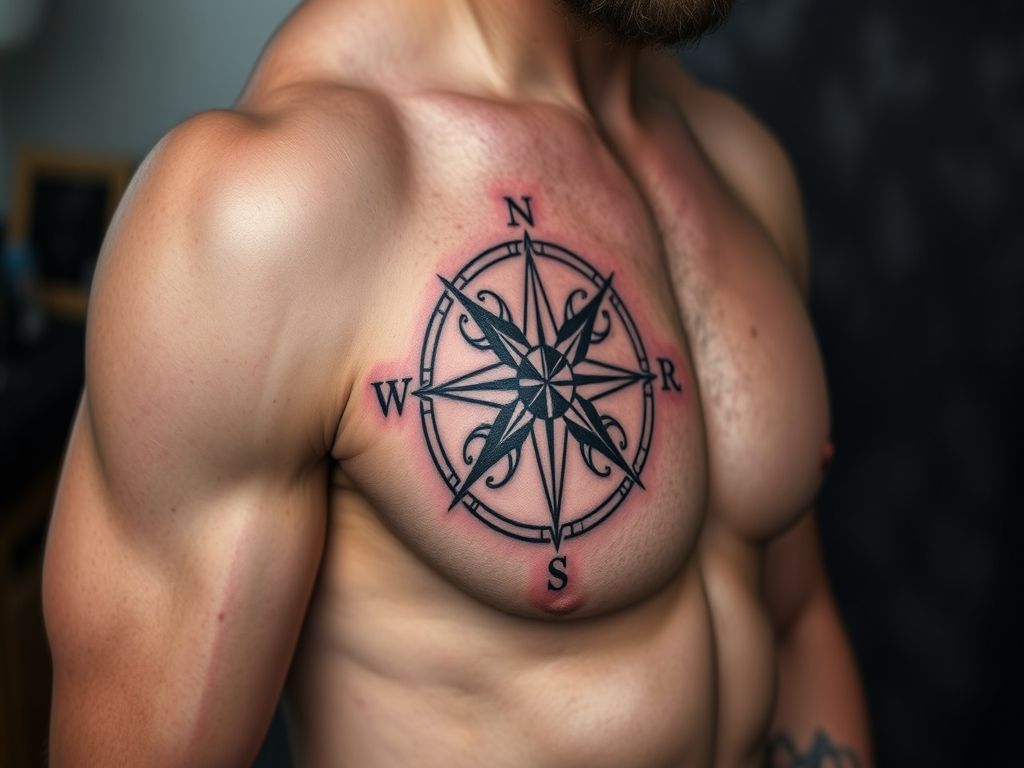
Valknut Tattoo: The Symbol of Odin and Death
Night was falling on the coasts of Gotland. Under a sky streaked with ash-colored clouds, an old man with soot-blackened fingers carved stone with a precision that only decades of practice could provide. Each chisel blow created an angle, and each angle interlocked with another, until they formed three perfectly intertwined triangles. He had known this sign since childhood. His father wore it engraved on his arm, as did his grandfather before him. It was the Valknut — the knot of the slain warriors, the mark of Odin, the seal of passage between the world of the living and that of the chosen of Valhalla.
Today, this symbol transcends the centuries to anchor itself on the skin of those who seek to carry a thousand-year-old legacy. The Valknut tattoo is not merely a geometric pattern. It is a declaration: one of a bond with death, with courage, and with the one-eyed god who chooses his warriors on the battlefield. But before you engrave this symbol on your body, you must understand what it truly means — and why it has traversed over a thousand years of history without losing an ounce of its power.
📌 In Brief
- The Valknut is a symbol formed of three intertwined triangles. Its name is a modern construction, coined in the 19th century from the Old Norse valr, slain warriors, and knut, knot.
- Not exactly. The Valknut is more of a symbol of transition and courage in the face of death.
- In certain neo-pagan beliefs, the Valknut is considered a powerful symbol linked to Odin and death, and some believe it attracts trials.
- Common placements are the wrist for a discreet look, the forearm, the nape, the chest, or the shoulder blade.
- The Valknut exists in two versions: the Borromean (three separate but linked triangles) and the unicursal (a single continuous line forming the three triangles).
The Valknut is one of the few Nordic symbols truly attested by archaeology. Our Viking tattoo guide applies the same criterion to all the others.
The symbol can also be worn as jewelry: Valknut necklaces, rings, and watches are collected in our Valknut section.
The Origin of the Valknut: From the Gotland Stones to the Oseberg Ship
To understand the Valknut tattoo, one must go back to the sources. The word itself is a modern construction, coined from Old Norse: valr, which means "slain warriors," and knut, which means "knot." The knot of the slain, then. A name that, in itself, sets the tone.
The first depictions of the Valknut appear on the Gotland picture stones, the Swedish island that served as a commercial and spiritual crossroads for Nordic peoples between the 5th and 11th centuries. On these massive funerary steles, one finds scenes of battles, sea voyages, and religious rituals. And there, in the middle of these narratives carved into stone, stand the three intertwined triangles — always associated with scenes of death or transition to the afterlife.
The most famous of these stones is the Stora Hammars I stone. On one of its faces, a warrior can be seen hanging from a tree — a direct reference to Odin's sacrifice on Yggdrasil — and right next to it, the Valknut. On another face, a rider arrives at Valhalla, welcomed by a Valkyrie holding a drinking horn of mead. The Valknut is there, once again, marking the boundary between life and death.
"I know that I was hanging on a windy tree nine whole nights, wounded with a spear, dedicated to Odin, myself to myself, on that tree of which no man knows from where the roots run."— Hávamál, stanza 138, Poetic Edda
The other major discovery is the Oseberg ship, unearthed in 1904 in southern Norway. This incredibly rich 9th-century funerary ship contained the bodies of two high-ranking women — likely a priestess and her servant. Among the objects found, a ceremonial bed featured a Valknut carved into one of its posts. The symbol was where death was, where the passage to the other world took place.
What is striking is the consistency of this association. The Valknut never appears in a mundane context. It does not adorn kitchen utensils or farm tools. It is found exclusively in funerary or sacrificial contexts, or in relation to the cult of Odin. If you choose to wear a Valknut tattoo, you are wearing a symbol that the ancient Scandinavians reserved for the most sacred moments of existence.
Meaning of the Valknut: The Knot of the Slain Warriors
The meaning of the Valknut is intimately linked to Odin, the All-Father, the god of war, wisdom, magic, and death. In Norse mythology, Odin is not a god of victory — he is the god of those who fall. He does not protect warriors from death: he chooses them for it.
According to the Eddas, when a warrior dies in battle, Odin sends his Valkyries — those divine female warriors mounted on winged steeds — to select the most valiant among the dead. These chosen ones are then brought to Valhalla, Odin's great hall in Asgard, where they feast each night and train each day, awaiting Ragnarök, the final battle.
The Valknut tattoo symbolizes this pact between the warrior and death. The three triangles represent, according to the most widespread interpretations, the connection between three realms: Asgard (the world of the gods), Midgard (the world of humans), and Helheim (the world of the dead). Other specialists see in them the three phases of existence: birth, life, and death. Still others consider that the nine points of the three triangles represent the nine worlds of Norse cosmology, all linked by the sacred tree Yggdrasil, the World Tree.
"Freyja chooses every day the half of the slain in battle. The other half goes to Odin."— Grímnismál, stanza 14, Poetic Edda
But there is one dimension that many forget: the Valknut is also a symbol of voluntary sacrifice. Odin himself hung from Yggdrasil for nine days and nine nights, pierced by his own spear Gungnir, to obtain the knowledge of the runes. The Valknut, in this context, does not only represent death — it represents the acceptance of death as the price to be paid for something greater. Wearing a Valknut tattoo is affirming that one is ready to go through the trial, whatever it may be, to access a profound transformation.
It is, moreover, fascinating to note that the Valknut is often depicted alongside Odin's ravens, Huginn (Thought) and Muninn (Memory), as well as his two wolves, Geri and Freki. These divine companions reinforce the link between the symbol and the All-Father. If you already wear a symbol of Nordic protection such as the Aegishjalmur, the Helm of Awe, the Valknut is its natural complement — one protects, the other accepts fate.
The Valknut and the Sacred Bond with Valhalla
Imagine the scene. A longship cuts through the gray waves of the North Sea. On board are thirty warriors, their faces marked by salt and fatigue. One of them, a young man barely out of adolescence, wears on his left shoulder a Valknut tattoo drawn in soot ink. His father had it engraved on him the day before his first raid, whispering these words: "If you fall, Odin will know you are his."
This scene, though imagined, reflects a probable historical reality. For Viking warriors, the Valknut was not an ornament — it was a safe-conduct to Valhalla. Wearing it was equivalent to saying: "I am not afraid of death, for death is but a door." The sagas tell us that the bravest warriors would rush into battle screaming Odin's name, certain that their bravery would earn them a place in the great hall.
The Valknut also represents the concept of Wyrd — destiny — as the Norse understood it. Unlike the Christian view of destiny as an immutable divine will, the Norse Wyrd is a complex fabric, an intertwining of causes and consequences. The three triangles of the Valknut, with their lines crossing and interlocking, perfectly illustrate this vision of a woven destiny, where each action has repercussions in the nine worlds. For the Vikings, sporting this symbol meant recognizing that death was an integral part of the fabric of existence — and accepting it with honor.
If this connection between symbols and Nordic destiny speaks to you, you will also appreciate the meaning of the Vegvisir, the Viking compass, which guides the wearer through storms — both literal and metaphorical.
The Valknut Controversy: Appropriation and Misuse
Let us now address a subject it would be irresponsible to ignore. Since the 1990s, the Valknut — like other Nordic symbols — has been co-opted by certain extremist groups, notably white supremacist and neo-Nazi movements that seek to associate the Scandinavian heritage with hateful ideologies.
It is essential to recall a historical truth: the Vikings were not supremacists. Archaeological and genetic research from recent decades shows that Nordic societies were remarkably cosmopolitan. Excavations in Birka, Sweden, have revealed objects originating from Baghdad, Constantinople, and North Africa. DNA analysis of Viking burials shows genetic diversity that contradicts any notion of "racial purity." The Vikings traded, married, and lived with peoples of all origins.
The Valknut itself is a symbol of death and spiritual passage, not ethnic identity. Its hijacking by hateful ideologies is a betrayal of its original meaning. If you choose to wear this sacred symbol, you can do so with the clear conscience that this symbol belongs to a rich and universal cultural heritage — and not to any political movement.
That said, it is important to be aware of this appropriation. Some people might associate your tattoo with these movements, especially if the Valknut is combined with other misappropriated symbols. This is why many wearers choose to incorporate the Valknut into a larger design — with runes, interlace, ravens, or elements of Norse mythology — to clearly anchor the tattoo in its original cultural context. The visual context and the wearer's intention make all the difference.
Valknut Tattoo Styles: From Minimalist to Realistic
This tattooed symbol offers remarkable versatility in terms of design. Its perfect geometry — three triangles intertwined into a single continuous motif — makes it adaptable to almost any tattoo style.
The minimalist Valknut is the most popular choice for a first Norse tattoo. Three black triangles, fine lines, no frills. This style works particularly well in small format — on the wrist, behind the ear, or on the ankle. The geometric purity of the symbol speaks for itself. Some tattoo artists use lines of varying thickness to give the motif a three-dimensional depth effect.
The dotwork Valknut is another highly prized style. Each triangle is filled with thousands of ink dots, creating an organic texture effect that contrasts beautifully with the symbol's geometric rigor. This style recalls rock carvings and gives the tattoo an ancient look, as if it had been etched into stone rather than skin.
The Valknut with interlace and runes is the most complete design. The central symbol is surrounded by Celtic knots or Scandinavian interlace patterns, with Elder Futhark runes arranged in a circle. This style requires more space — a forearm or a shoulder — but the result is spectacular. If you wish to wear this type of motif daily before engraving it into your skin, a Valknut signet ring with interlace is an excellent way to test out the symbol.
The blackwork Valknut leverages the maximum contrast between dense black ink and the skin. The triangles are filled with a deep, solid black, sometimes using negative (blank) lines to mark the interlacings. This style produces a powerful and immediately legible tattoo, even from a distance.
The Valknut integrated into a mythological composition is the choice of enthusiasts who want to tell a complete story on their skin. The Valknut is then placed at the center of a larger scene: Odin’s ravens flying on either side, Yggdrasil in the background, fallen warriors at his feet, and a valkyrie reaching toward the sky. This type of tattoo generally covers an entire arm (sleeve) or the full back.
Recommended Placements for a Valknut Tattoo
The placement of a Valknut tattoo depends as much on the chosen style as on the wearer's personal intention. Here are the most popular placements and their implied meanings.
The inner forearm is the most common placement. Visible to the wearer on a daily basis, it serves as a constant reminder of the symbol and its values. A medium-sized Valknut (6 to 8 cm) works perfectly in this area, alone or accompanied by runes. It is a placement that allows the tattoo to be shown or hidden depending on the clothing worn.
The shoulder and deltoid recall the traditional placement of warrior marks. On the Gotland stones, the depicted warriors often wear their symbols on their upper body. A Valknut on the shoulder, combined with interlace that descends toward the bicep, creates an effect of protection and power that directly evokes the Viking heritage.
The center of the chest is a bold and deeply symbolic choice. Placing the knot of the dead directly over the heart means asserting that you carry your destiny within you. This placement is often chosen by those who have overcome a difficult ordeal — an illness, a bereavement, a life transformation — and who see in the Valknut a symbol of rebirth through symbolic death.
The back, between the shoulder blades, is ideal for a large-scale design. This placement recalls Viking shields, which often bore symbols of protection and identity. A Valknut surrounded by a complete runic circle, placed between the shoulder blades, evokes a spiritual shield that is carried at all times.
The wrist is suitable for minimalist designs. A small 3 to 4 cm Valknut, in fine lines, offers elegant discretion while maintaining the power of the symbol. It is the choice of those who want a subtle reminder rather than a visible declaration.
Whatever the chosen placement, the Valknut tattoo acts as a personal talisman. And if you are looking to complete your Norse look beyond the tattoo, a Valknut and Ouroboros dragon necklace carries the same symbolic charge around your neck — the knot of the dead combined with the serpent of eternity.
Combining the Valknut with Other Norse Symbols
The Valknut tattoo gains depth when combined with other elements of Norse symbolism. Here are the most consistent and aesthetically successful associations.
Valknut and Huginn/Muninn: Odin's two ravens, placed on either side of the Valknut, create a composition that tells the complete story of the All-Father. Thought and Memory frame the knot of the dead — a visual metaphor for consciousness facing destiny.
Valknut and Yggdrasil: the World Tree whose roots plunge into the nine realms is the natural complement to the Valknut. The tree represents the structure of the universe, and the Valknut the passage between its different levels. Together, they form a complete cosmological narrative.
Valknut and Futhark runes: surrounding the Valknut with a circle of runes is one of the most requested compositions. The chosen runes can personalize the message — Algiz for protection, Tiwaz for courage, Ansuz for Odin’s wisdom. Each added rune enriches the tattoo’s narrative.
Valknut and Ouroboros: the serpent biting its own tail, symbol of the eternal cycle of destruction and rebirth, forms a perfect circle around the Valknut. This combination unites death (the Valknut) and eternity (the Ouroboros) into a single motif. For those who appreciate this association, the Viking Valknut & Ouroboros Dragon necklace offers a tangible glimpse of this aesthetic.
"The coward believes he will live forever if he avoids the fight; but old age will grant him no truce, even if the spears spare him."— Hávamál, stanza 16, Poetic Edda
What the Valknut Tattoo Says About the Wearer
Choosing a Valknut tattoo means making a statement that goes far beyond aesthetics. It is an assertion that one understands — and accepts — the cyclical nature of existence. That death is not an end, but a passage. That courage does not consist of avoiding the ordeal, but of going through it with eyes wide open.
People who wear this symbol often share a common trait: they have faced a turning point in their lives. A loss, a transformation, an inner struggle. The Valknut did not save them — it crystallized what they already knew. That one does not emerge from great ordeals unscathed, but one does emerge transformed. Like Odin, having descended into the darkness and returned with the knowledge of the runes.
In tattoo parlors around the world, the Valknut inked into the skin attracts a specific clientele: men and women who are not looking for a pretty design, but a symbol that carries meaning. An ancient meaning, engraved in stone over a thousand years ago, and which still resonates today in the flesh of those who choose to wear it.
The old engraver from Gotland could not have imagined that, more than a millennium later, millions of people around the world would contemplate the same three intertwined triangles he carved into the gray stone of his island. And yet, that is exactly what happened. The Valknut survived the Viking Age, Christian conversions, the oblivion of the centuries, and political appropriation. It survived because it touches on something universal: the relationship between the human and their own mortality.
If you wear — or if you are considering wearing — a Valknut tattoo, know that you are not simply wearing a geometric pattern. You are wearing the sign of Odin, the knot of fallen warriors, the promise of Valhalla, and the acceptance of destiny. Three triangles. Nine points. One message: death is only a passage, and only the brave cross it standing.
Frequently Asked Questions About the Valknut Tattoo
What does the Valknut mean?
The Valknut is a symbol formed by three intertwined triangles. Its name is a modern construction, coined in the 19th century from the Old Norse valr, warriors fallen in battle, and knut, knot. It is associated with Odin and the passage between life and death. It symbolizes the link between the world of the living, the dead, and the gods.
Is the Valknut a symbol of death?
Not exactly. The Valknut is more of a symbol of transition and courage in the face of death. In the Viking context, it represents the acceptance of destiny (wyrd) and the connection with Odin who guides fallen warriors to Valhalla. It is a symbol of bravery, not morbidity.
Is it dangerous to get a Valknut tattoo?
In some neo-pagan beliefs, the Valknut is considered a powerful symbol linked to Odin and death, and some believe it attracts ordeals. In reality, it is a personal and symbolic choice. The vast majority of wearers choose it for its aesthetics and its meaning of courage.
Where should you place a Valknut tattoo?
Popular placements are the wrist (discreet and symbolic), the forearm, the nape of the neck, the chest, or the shoulder. The Valknut works well in small format thanks to its sharp and recognizable geometric shape.
What is the difference between the two Valknut forms?
The Valknut exists in two versions: the Borromean (three separate but linked triangles) and the unicursal (a single continuous line forming the three triangles). Both are attested on runestones and Viking artifacts, with the same meaning.
Where has the Valknut been found?
The Valknut appears on the Stora Hammars stone in Gotland (Sweden), on rings, funerary stones, and the Oseberg ship bed (Norway). It is consistently associated with funerary or sacrificial scenes, confirming its link to Odin and death.
👉 Explore our collections of Viking rings and Viking necklaces to carry the Viking spirit daily.
If the symbol speaks to you enough to ink it, it also exists as jewelry: our Valknut collection brings together pendants, rings, and bracelets bearing the knot of Odin.

Leave a comment
All comments are moderated before being published.
This site is protected by hCaptcha and the hCaptcha Privacy Policy and Terms of Service apply.