
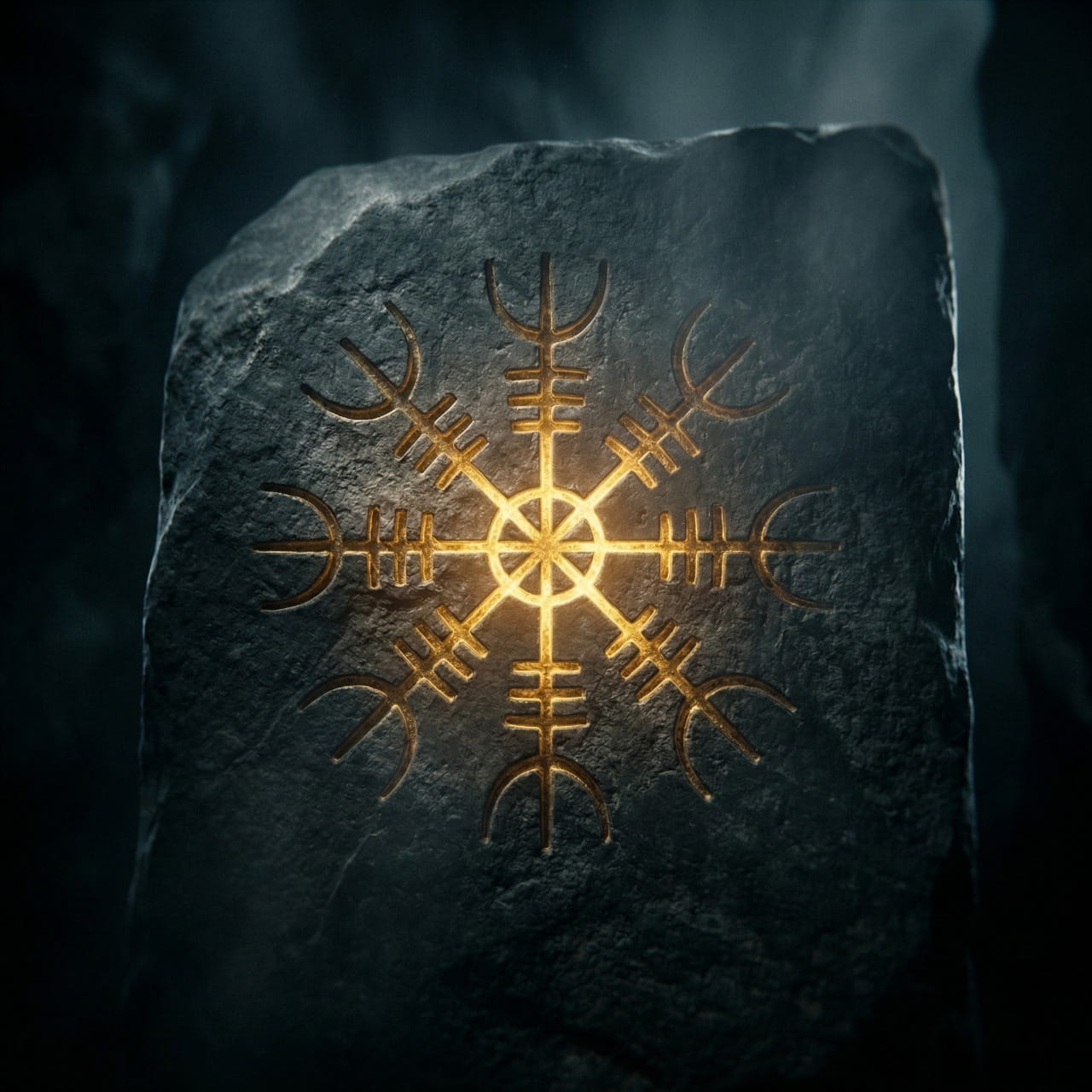
Aegishjalmur Tattoo: The Viking Helm of Awe
The Aegishjalmur tattoo, also known as the Helm of Awe, is one of the most feared and powerful symbols in the Nordic magical tradition. This magical stave with eight branches radiating from a central point was no mere ornament: it was a psychological weapon, a mystical shield that Viking warriors would carve between their eyes before heading into battle. Today, the Aegishjalmur tattoo embodies protection, invincibility, and the will to overcome any adversity.
In this article, we trace the origins of the Aegishjalmur back to the Icelandic sagas, dissect the meaning of its eight branches, clarify the common confusion with the Vegvisir, and guide you in choosing the ideal style and placement for your future tattoo.
📌 In Brief
- The Aegishjalmur, or "Helm of Awe," is a symbol with eight branches radiating from a center.
- Its name appears in the Volsunga Saga, where it belongs to the dragon Fáfnir.
- The eight-branched design itself is only attested in late Icelandic grimoires, from the 17th to the 19th centuries.
- As a tattoo, it is most often placed on the chest, back, or forearm; symmetry is the main technical challenge.
- Not to be confused with the Vegvísir: one protects, the other guides.
This page covers the Ægishjálmur alone. If you are still choosing your motif, start with our Viking tattoo guide: it ranks each symbol by its degree of historical attestation and compares placements.
The History of the Aegishjalmur in the Sagas
The Aegishjalmur first appears in Nordic literature within the Fáfnismál, one of the heroic poems of the Poetic Edda. In this foundational narrative, it is the dragon Fáfnir himself who reveals the power of this symbol. Fáfnir, once a dwarf transformed into a dragon by his greed, guards an immense treasure in his lair. Among his most precious possessions is the Aegishjalmur, the Helm of Awe, which he declares rendered him invincible against all living beings.
When the hero Sigurd (Siegfried in Germanic tradition) slays the dragon, he claims the Aegishjalmur as the centerpiece of the loot. It is not a physical helmet as its name might suggest, but rather a magical symbol that projects awe and terror into the hearts of enemies. The Old Norse word ægir denotes terror or fear, while hjalmr means helmet or covering. The Aegishjalmur is therefore literally the "Helm of Awe"—an invisible shield that strikes fear into anyone who dares to face its wearer.
Beyond the Fáfnismál, the Aegishjalmur reappears in Icelandic magical grimoires (gáldrabókur) of later centuries, notably the Huld manuscript, compiled by Geir Vigfússon in 1860, where it is cataloged among the most important magical staves. These grimoires describe specific rituals to activate the symbol: it had to be drawn with lead, pressed between the eyebrows, and accompanied by specific incantations. The persistence of this practice over several centuries testifies to the power attributed to this symbol in Nordic culture.
"I wore the Helm of Awe before the sons of men, since I rested upon my inheritance's hoard. I believed myself stronger than all, for I found no power equal to my own."— Fáfnir in the Fáfnismál, stanza 16, Poetic Edda
The 8 Branches: Symbolism of Protection and Awe
The visual form of the Aegishjalmur is striking in its geometry: eight identical branches radiate from a central point, creating a pattern of perfect symmetry. Each branch ends in a trident-like or fork shape, sometimes adorned with geometric shapes reminiscent of runes. This structure is no accident—each element carries a precise meaning.
The center: the point of power
The center of the Aegishjalmur represents the wearer themselves, the warrior who invokes the symbol's protection. It is the convergence point of all magical energy, the heart from which the awe radiates in all directions. Placed between the warrior's eyes, this center was identified with the third eye, the seat of will and supernatural perception.
The eight directions
The eight branches cover the eight cardinal and intercardinal directions, forming a 360-degree total shield around the wearer. No blind spots, no flaws—the protection is complete and absolute. This radiation in all directions means that the warrior is protected against physical as well as spiritual attacks, whether they come from the front, behind, or any side.
Some specialists in runic magic, such as Stephen Flowers in his work Galdrabók, suggest that the eight branches also correspond to the eight worlds that surround Midgard (the world of humans) in Nordic cosmology. The Aegishjalmur would thus be a microcosmic representation of the entire Nordic universe, with the wearer at the center.
The terminal tridents
The trident-like (or three-pronged fork) ends found at the tip of each branch are interpreted as elements of offensive projection. If the center protects, the extremities attack. They represent the awe that is projected outward, repelling enemies and paralyzing their will to fight. Visually, these tridents resemble the Algiz rune (ᛉ), the rune of protection in the Elder Futhark, which reinforces the symbol's protective dimension.
The duality of the Aegishjalmur is therefore fundamental: it protects the one who wears it while terrifying those who face them. It is this dual defensive-offensive function that makes it such a powerful tattoo motif, carrying an energy that is both protective and dominant.
Aegishjalmur vs Vegvisir: Clarifying the Confusion
One of the most common errors in the world of Nordic tattooing is the confusion between the Aegishjalmur and the Vegvisir. These two Icelandic symbols share a similar radial structure and are often presented side-by-side in works on magical staves. However, they are fundamentally different in their meaning, origin, and use.
Visual differences
The Aegishjalmur is characterized by eight identical and perfectly symmetrical branches. Each branch is the exact mirror of the other seven. The result is a pattern of absolute geometric regularity, evoking a snowflake or an eight-pointed star.
The Vegvisir, on the other hand, also has eight branches, but these are all different from one another. Each branch bears distinct ornaments, terminals, and angles. The Vegvisir is therefore visually asymmetrical and more complex in its details.
Differences in meaning
- Aegishjalmur: protection in battle, invincibility, terror inflicted on enemies. It is a symbol of warrior dominance.
- Vegvisir: magical compass, guide through the storm, ability to find one's way. It is a symbol of guidance and orientation.
Differences in origin
The Aegishjalmur dates back to the Fáfnismál and the ancient Nordic mythological tradition (Viking Age, 9th-11th centuries). The Vegvisir, meanwhile, only appears in late Icelandic manuscripts, mainly the Huld manuscript (1860). Some researchers consider the Vegvisir to be more a product of the medieval Icelandic magical tradition than the Viking Age itself.
In summary: if you are looking for a symbol of warrior protection and intimidating power, the Aegishjalmur is your choice. If you are looking for a spiritual guide to navigate the storms of life, the Vegvisir will be more suitable. And nothing stops you from wearing both: they complement each other perfectly—one for offensive protection, the other for inner guidance. Our Viking Vegvisir Protection Ring allows you to wear this symbol of guidance every day.
"The Aegishjalmur repels enemies. The Vegvisir guides the traveler. One is the shield, the other the compass. The wise warrior carries both."— Le Comptoir Viking
Historical Uses: The Warrior's Ritual
The use of the Aegishjalmur by Nordic warriors was much more than simple superstition: it was a codified ritual, passed down from generation to generation, which was an integral part of battle preparation.
Carved between the eyes
The primary method of use consisted of tracing the Aegishjalmur between the eyes, on the warrior's forehead, just before battle. This position was not arbitrary: the forehead was considered the seat of will and intention in the Nordic tradition. By placing the symbol there, the warrior aligned their personal will with the magical power of the Helm of Awe.
Icelandic grimoires specify that the symbol had to be traced with lead, a metal associated with the planet Saturn and forces of constraint and dominance in the European magical tradition. The warrior would then press their thumb against the symbol while saying the words: Ægishjalm ber ek mér með milli bruna—"I wear the Helm of Awe between my brows."
Berserkers and the Aegishjalmur
Although texts do not make an explicit link between Berserkers and the Aegishjalmur, many historians and specialists in Nordic magic establish a logical connection between the two. The Berserkers, those frenzied warriors who fought in an animalistic rage, were renowned for their ability to terrify their enemies by their presence alone. The Aegishjalmur, with its awe-projecting function, would have perfectly complemented the psychological arsenal of these fierce fighters.
Beyond the battlefield
The use of the Aegishjalmur was not limited to combat. Icelandic grimoires also mention its use in civilian contexts: to win a legal dispute at the Thing (the Viking legislative assembly), to impress an opponent during a negotiation, or to protect oneself from the evil eye. The Helm of Awe was a versatile tool of psychological domination, applicable to any situation where one needed to project power and inspire respect.
To deepen your knowledge of protection symbols in the Nordic tradition, our article on Viking magic runes and protection rituals offers a complete overview of these ancestral practices.
Recommended Tattoo Styles for the Aegishjalmur
The Aegishjalmur possesses a natural geometry that lends itself remarkably well to tattooing. Its radial symmetry, precise lines, and repetitive structure make it a technically demanding but visually spectacular motif. Here are the most suitable styles for this symbol of terror.
Pure geometric style
This is the most natural style for the Aegishjalmur. The symbol's geometry, with its straight lines and perfect symmetry, calls for a precise and clean rendering. In a geometric style, each line must be impeccably consistent, each angle perfectly measured. The result is a tattoo of visual purity that reflects the purity of the magical protection it represents.
Strong points: fidelity to the original design, immediate readability, excellent aging. This style works just as well in a small format (wrist, nape of the neck) as in a large size (chest, back). The geometric Aegishjalmur is the ideal choice for purists who want to respect the symbol's authenticity.
Blackwork and dotwork style
Blackwork brings considerable visual intensity to the Aegishjalmur. Solid blocks of black around the symbol or in the negative spaces create a striking contrast that reinforces the intimidating aspect of the Helm of Awe. Combined with dotwork, where transition areas are filled with meticulous pointillism, the result is a hypnotic tattoo that draws the eye in the same way the original symbol was meant to capture the attention of enemies.
Strong points: maximum visual impact, mystical aura, possibility of creating radiating effects around the central symbol thanks to point shading.
Realistic and organic style
For a more creative interpretation, the realistic style allows for integrating the Aegishjalmur into a rich visual environment: engraved on a runestone, burned into wood, forged in metal, or traced into the warrior's own skin with a scarification effect. This treatment gives the symbol a material and tactile dimension that strengthens its grounding in reality.
Strong points: uniqueness of the design, possibility of telling a visual story, texture and depth. Particularly effective for large pieces where the Aegishjalmur is the central motif of a wider composition incorporating Nordic elements.
Nordic tribal style
By drawing inspiration from the interlace and knots of Viking art (Urnes style, Mammen style, Ringerike style), one can create an Aegishjalmur whose branches are composed of intertwined motifs rather than simple straight lines. This style creates a bridge between the magical symbol and the decorative aesthetic of the Viking Age, producing a tattoo that is both authentically Nordic in its form and powerful in its meaning.
Ideal Placements for the Aegishjalmur Tattoo
The placement of the Aegishjalmur tattoo amounts to choosing where your shield of terror will be anchored. Each placement carries its own symbolism and offers different technical advantages.
The forehead: the original placement
Although this is a bold choice, the forehead is the historically authentic placement for the Aegishjalmur. Warriors placed it between the eyebrows, where the third eye resides. Getting the Aegishjalmur tattooed on the forehead is replicating the ancestral gesture of the warrior preparing for battle. This placement is obviously not for everyone, but for those who take it on, it carries an unmatched symbolic weight.
The chest: the inner shield
The chest, at the center of the sternum, is the most popular placement for the Aegishjalmur as a tattoo. Placed over the heart, the symbol acts as a shield protecting the very essence of the warrior. The flat and wide surface of the torso allows for a perfect geometric rendering, with enough space for the symbol's symmetry to be fully appreciated.
Advice: an Aegishjalmur of 15 to 20 cm in diameter at the center of the chest, in a geometric or blackwork style, creates an impressive focal point. You can integrate it into a larger composition with runic elements or interlace that extends towards the pectorals and shoulders.
The shoulder and deltoid
The shoulder is a strategic placement for a symbol of warrior protection. In the Nordic tradition, the shoulder was one of the parts of the body most exposed in combat, protected by the shield. Placing the Aegishjalmur on the deltoid or the top of the shoulder is positioning the Helm of Awe where the physical shield offered its protection.
This placement offers a slightly curved surface that gives volume to the design, and visibility (short sleeves) or discretion (long sleeves) depending on the situation. It is an excellent choice for a first large Nordic tattoo.
Other recommended placements
- The upper back / between the shoulder blades: symbolic rear protection, large surface for a detailed design, easily concealable.
- The forearm: excellent for a medium-sized Aegishjalmur, visible and appreciable on a daily basis. Recalls the warrior's gesture of raising their arm.
- The calf: discreet but impactful placement, ideal surface for the symbol's radial symmetry.
- The hand / the wrist: for a small minimalist Aegishjalmur, reminiscent of the practice of tracing protective staves on the hands before an important task.
Compositions and Associations: Enriching your Aegishjalmur
The Aegishjalmur is sufficient unto itself as a tattoo, but it can also become the heart of a larger composition that enriches its meaning and creates a truly unique piece.
Aegishjalmur and runic circle
Surrounding the Aegishjalmur with a circle of Elder Futhark runes is one of the most elegant compositions. The runic circle acts as a sacred frame that amplifies the power of the central symbol. You can choose the 24 runes of the Elder Futhark for a complete circle, or select specific protection runes (Algiz, Thurisaz, Tiwaz) to strengthen the protective dimension of the design.
Aegishjalmur and dragons
Since the Aegishjalmur is originally the treasure of the dragon Fáfnir, integrating a Nordic dragon into the composition creates a direct narrative link with the mythological source of the symbol. The dragon can coil around the Aegishjalmur, guarding it as Fáfnir guarded his treasure, or be represented in an interlaced style (like Jörmungandr) encircling the magical stave.
Aegishjalmur and war motifs
Being a symbol of combat, the Aegishjalmur naturally pairs with other Nordic warrior elements: crossed axes, a round shield, a spectacular helmet, or Thor's Mjölnir hammer. These combinations reinforce the warrior theme and create a composition that tells a story of power and resilience in battle.
To carry this protective energy on a daily basis, our Viking Aegishjalmur Pendant Necklace faithfully reproduces the symbol of the Helm of Awe in a steel pendant. And to complete your collection with a piece that combines Nordic style and functionality, discover our Dark Wood Viking Watch, The Golden Vegvísir, engraved with another Icelandic stave: the runic compass.
Practical Tips Before Getting Tattooed
The Aegishjalmur tattoo requires impeccable technical execution. The slightest irregularity in symmetry will be immediately visible and will compromise the design's aesthetic. Here are our tips for ensuring a perfect result.
Choosing the right tattoo artist
Look for an artist specializing in geometry and symmetry. Check their portfolio to ensure their circles are perfectly round, their lines are consistently steady, and their symmetrical patterns show no deviation. The Aegishjalmur does not forgive approximation: eight identical branches mean that the slightest difference will be a visible flaw.
Minimum size
Due to the complexity of its details (terminal tridents, perpendicular lines), the Aegishjalmur requires a minimum size of about 8 cm in diameter so that all elements remain legible after healing. Below this size, the fine details risk merging over time, compromising the symbol's legibility.
Skin preparation
For an optimal geometric rendering, the skin must be in excellent condition on the day of the session. Moisturize the chosen area well in the weeks preceding the tattoo, avoid sun exposure, and arrive rested and hydrated. Supple and well-hydrated skin absorbs ink better and allows the tattoo artist to work with maximum precision.
Conclusion: The Shield of Terror on Your Skin
The Aegishjalmur tattoo is not a simple decorative motif. It is a direct legacy of the Nordic magical tradition, a symbol that has crossed the centuries from the Icelandic sagas to the present day. Carried by the dragon Fáfnir, invoked by Viking warriors before battle, cataloged in Icelandic magical grimoires, the Helm of Awe remains one of the most powerful and recognizable staves in Nordic culture.
Its eight symmetrical branches project terror in all directions while protecting the wearer at their center. Unlike the Vegvisir which guides, the Aegishjalmur dominates. It does not show the way — it forces the way to open before you.
Whether you choose to wear it on your forehead like the warriors of old, in the center of your chest like an invisible shield, or on your shoulder like a seal of power, your Aegishjalmur tattoo will be much more than a drawing: it will be a declaration of strength, an invocation of protection, and a direct link to the warriors who wore this same symbol over a millennium ago.
The Helm of Awe is waiting to be engraved on your skin.
Frequently Asked Questions about the Aegishjalmur Tattoo
What does the Aegishjalmur mean?
The Aegishjalmur, or Helm of Awe, is a Nordic magical symbol composed of eight identical branches radiating from a center. It was believed to inspire fear in enemies and protect its wearer in battle, conferring invincibility and inner strength.
What is the difference between the Aegishjalmur and the Vegvisir?
The Aegishjalmur has eight identical branches and serves as warrior protection and intimidation. The Vegvisir has eight all different branches and serves as a navigation compass. Visually similar, their magical functions are distinct.
Is the Aegishjalmur a real Viking symbol?
Like the Vegvisir, the Aegishjalmur appears in post-Viking Icelandic manuscripts (16th-19th century), but it is mentioned in older texts like the Poetic Edda. The concept of the Helm of Awe exists in the Nordic tradition, but its precise graphic form is later.
Where to place an Aegishjalmur tattoo?
The traditional placement is the forehead (between the eyes), as described in the sagas to terrify enemies. In modern tattooing, popular placements are the forearm, the chest, the shoulder, or the upper back.
Can the Aegishjalmur be combined with other symbols?
Yes, the Aegishjalmur is often combined with a circle of runes to reinforce its power, Nordic interlace around it, or in a larger design with the Valknut or Yggdrasil. Placed at the center of a composition, it becomes the focal point of protection.
What does the legend say about the Aegishjalmur?
According to the Poetic Edda, the dragon Fáfnir wore the Helm of Awe between his eyes, making him invincible. When Sigurd killed Fáfnir, he seized the symbol. Viking warriors traced it on their foreheads with charcoal or blood before battle to inspire terror.
👉 Explore our collections of Viking jewelry and Viking rings to carry the Viking spirit every day.

Leave a comment
All comments are moderated before being published.
This site is protected by hCaptcha and the hCaptcha Privacy Policy and Terms of Service apply.