
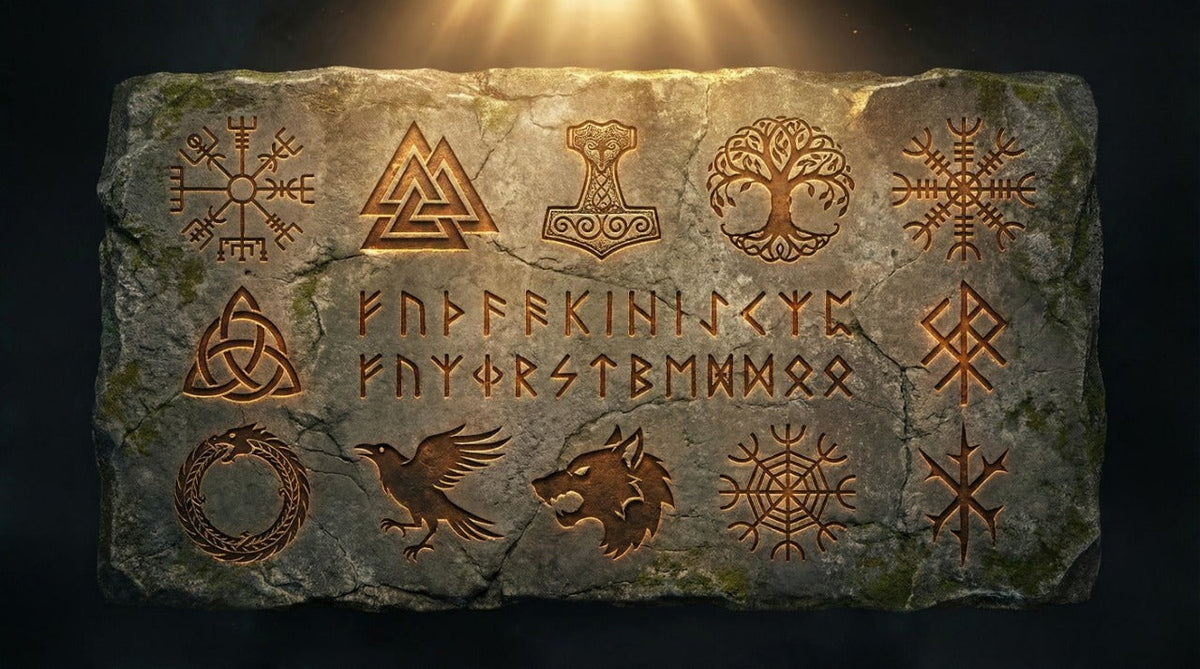
Magic Runes: Viking Protection and Rituals
Scandinavians of the Viking Age never considered runes to be a mere alphabet. Carved into an amulet, the hilt of a sword, or the lintel of a door, they were intended to take action: to ward off evil, bind a promise, or break a fever. This runic magic reaches us through three distinct channels—objects unearthed by archaeology, the Eddic poems, and the Icelandic sagas—and it is by cross-referencing these that we can distinguish what the Vikings actually practiced from what three centuries of esotericism have attributed to them since.
Summary
📌 In Brief
- Magic runes are runic symbols used for ritual and protective purposes, beyond simple writing.
- A bindrune is the combination of two or more superimposed runes to create a unique symbol with cumulative powers.
- Choose runes whose meanings align with your intention: Algiz (protection), Thurisaz (defense), Eihwaz (endurance).
- A galdrastafur (plural: galdrastafir) is an Icelandic magic symbol more complex than simple runes, such as the Vegvisir or the Aegishjalmur.
- It is a matter of personal belief.
Galdr: When the Voice Awakens the Runes
The word galdr comes from the verb gala, "to sing"—the same word used to describe the cry of a rooster or a bird. Sources describe a high-pitched, sustained, repetitive chanting performed aloud while the runes were being traced, or just after. Without it, the sign remained a drawing in the wood; with it, it was believed to become active. This was galdr, the vocal art of runic magic that the ancient Scandinavians practiced to infuse runes with their true power.
Galdr was not just any song. It was a codified incantation in which each rune possessed its own sound vibration, its own sacred frequency. The word comes from Old Norse gala, meaning "to sing" or "to cry," and it designated a practice reserved for those who had received instruction in magic runes. The runic poems—the Norwegian, Icelandic, and Anglo-Saxon runic poems—preserve traces of these invocations, with each stanza associating a sound, a meaning, and a force with each of the twenty-four runes of the Elder Futhark.
The principle made explicit by the texts is this: to invoke a rune, one must first name it. Each sign of the Futhark bears a name that is also a word in the common language. Algiz — ᛉ — is traditionally linked to the elk and to protection; the Anglo-Saxon runic poem associates the neighboring sign with the sedge, a marsh grass whose sharp edges wound the hand that grasps it. The image clearly explains the function attributed to it: not a passive wall, but a defense that wounds the aggressor. It is the best-anchored protection rune in practice, both ancient and modern.
According to archaeological sources and Eddic texts, galdr practitioners entered altered states of consciousness through the rhythmic repetition of runic names. This practice was akin to seiðr, the Norse shamanic magic, though galdr was considered more "masculine" and more directly linked to the power of Odin. It was Odin himself who, according to the Hávamál (stanzas 138-141), hung for nine nights from the Yggdrasil tree to acquire knowledge of the magic runes—a sacrifice that illustrates the price of this wisdom.
Galdr served several functions: protecting a place, blessing a weapon, cursing an enemy, healing an illness. The voice was the catalyst that transformed the inert symbol into an active force. Without galdr, the runes remained silent. With it, they became a bulwark against chaos.
Bindrunes: Merging Powers
The second documented technique involves melting several runes into a single sign. It is found on modest media—bone plaques, pieces of wood, spindle whorls—but also on monuments: several Swedish runestones feature ligatures where two signs share the same vertical stem. This is what we call a bindrune.
Bindrunes, or bandrúnir in Old Norse, are combinations of two or more runes superimposed into a single symbol. This runic magic technique allowed for concentrating several powers within a small space, creating a talisman whose power, it was thought, exceeded the sum of its components. The most common association in contemporary practice unites three runes into one figure:
- Algiz (ᛉ) — protection, divine shield, connection with the gods
- Thurisaz (ᚦ) — brute force, Thor's hammer, destruction of threats. Discover its full power in our guide on the Thurisaz Rune
- Tiwaz (ᛏ) — justice, courage, victory in battle
The superposition of these three runes created a bindrune of war and protection whose shape evoked both an upright spear and a tree with open branches. Carved onto a shield, it promised its bearer the favor of Tyr and the fury of Thor. Carved onto a door lintel, it warded off malevolent spirits from the family home.
Archaeologists have found bindrunes on numerous Viking artifacts: from Swedish runestones to Danish bronze brooches, and even amulets found in the graves of Birka. Each bindrune was unique, designed by a runemaster for a specific need. There was no "catalog"—creating a bindrune required a deep understanding of each individual rune and how their energies interacted. This is why combined magic runes were considered one of the most advanced forms of Norse sorcery.
A note of honesty is necessary here. Runic ligatures are well attested by archaeology, but the idea that they formed a codified magic system, with a grammar of combinations, stems primarily from 20th-century esotericism: many ancient ligatures were simply used to save space on a stone that was too narrow. Modern practice is perfectly legitimate as a practice—it is not the restoration of a documented Viking ritual. If you wish to wear this type of symbol, our collection of Viking runic pendants offers engraved pieces faithful to Norse traditions.
Galdrastafir: Magic Staves of Iceland
There is a third family of signs, later and much more spectacular: galdrastafir, the Icelandic "magic staves." These are radiating geometric figures, almost always built around a central axis, found in handwritten grimoires like the 17th-century Galdrabók or the Huld, compiled in the 19th century. They are therefore several centuries removed from the Viking Age—a point that most pages presenting them carefully gloss over.
Galdrastafir (singular: galdrastafur) are Icelandic magic symbols representing the late evolution of Viking runic magic. Compiled primarily in Icelandic grimoires of the 17th and 18th centuries—including the famous Galdrabók (the Book of Magic)—these signs blend Norse runic heritage with medieval Christian and hermetic influences.
Among the most well-known galdrastafir:
- Ægishjálmur (the Helm of Awe) — a symbol of eight radiating branches intended to inspire fear in enemies and protect the bearer in battle. The saga of Fáfnir mentions this sign: the dragon Fáfnir wore it between his eyes to terrify anyone who met his gaze.
- Vegvísir — the "runic compass," a sign with eight differentiated branches that guaranteed the bearer would never get lost, even in storms or fog. The Huld manuscript (1860) states: "If this sign is carried, one will never lose one's way in storms or bad weather, even if the path is unknown."
- Draumstafir — the dream staves, engraved under the pillow to induce prophetic dreams.
- Lukkustafir — the luck staves, intended to attract fortune in business and trade.
The Ægishjálmur is the most famous representative: eight branches radiating from a center, each ending in a trident motif reminiscent of the Algiz rune. Its name, "Helm of Awe," does indeed appear in ancient texts—the Volsunga Saga attributes it to the dragon Fáfnir, who derives the power to terrify anyone approaching him from it. But the eight-branched design only appears in late Icelandic manuscripts. Galdrastafir represent the culmination of centuries of magic rune practice, a synthesis between ancestral runic knowledge and the creativity of Icelandic magicians isolated from the world by the ocean and volcanoes.
Protection Runes in the Sagas
The Icelandic sagas are not just heroic tales—they are also accounts of the concrete practice of runic magic in Viking society. And no character better illustrates the art of protection runes than Egil Skallagrimsson, the 10th-century warrior-poet whose saga bears his name.
"Runes should not be engraved by one who does not understand them. Many a man can go astray on the dark track. I saw on a carved bone ten secret letters, and it is they that caused the cultivator's daughter her long illness." — Egils saga Skallagrímssonar, chapter 73
In this famous passage, Egil discovers that a sick young woman has a whale bone hidden under her bed, engraved with incorrect runes by an incompetent apprentice. Far from healing, the poorly traced runes worsened her condition. Egil scrapes off the false runes, throws them into the fire, then carves the correct runes and places the bone under the patient's pillow, who then recovers. This story illustrates two fundamental principles of magic runes: first, their power is real and dangerous; second, only a master of runes possesses the necessary knowledge to use them safely.
Egil's Saga contains other remarkable episodes. During a banquet at King Eirik Bloodaxe's home, Egil suspects his drink is poisoned. He carves runes onto his drinking horn, pricks his finger to stain them with blood, and then chants a galdr. The horn shatters, revealing the poison. Here, runes serve as a danger detector — a form of passive, instantaneous magical protection.
Other sagas mention protection runes. In the Volsunga Saga, the valkyrie Sigrdrífa teaches Sigurd victory runes (sigrúnar), sea runes (brimrúnar) to calm storms, and healing runes (limrúnar) to treat wounds. Each category had its own activation ritual and specific carving medium. Victory runes were to be carved on the sword — on the hilt, on the flat of the blade, and twice the name of Tyr. Sea runes were to be carved on the ship's prow and on the oars. To explore rune divination and their interpretation methods, consult our complete guide on Rune Casting.
The art of carving: weapons, amulets, and drakkars
Regarding the act of carving itself, the sources are concrete. It is done with a knife or chisel, in straight lines: the angular shape of runes comes precisely from this, because a curve is difficult to read against the grain of wood. Excavations at Bryggen, in Bergen, have yielded several hundred of these hand-carved sticks — from commercial notes to intimate messages, and even protective formulas.
Carving runes was as much a sacred act as a technical one. The Vikings used several media, each adapted to a specific use:
Runic weapons
Swords, axes, and spearheads engraved with runes were common in the Viking world. The Sæbø blade, found in Norway and dated to the 9th century, bears a runic inscription that could be the sword's name or a magical victory formula. The Vikings named their weapons — Gram, Tyrfing, Skofnung — and carving magical runes onto a blade meant giving it a soul, a will of its own. To complete your Nordic warrior gear, discover our selection of Viking rings adorned with runes, directly inspired by Scandinavian artifacts.
Amulets and talismans
Hundreds of runic amulets have been found across Scandinavia. Carved from bone, antler, amber, or metal, they bore formulas for protection, healing, or fertility. The Ribe amulets (Denmark, 8th century) are among the oldest and show formulas invoking Odin and Thor against illness and evil spirits. These objects were worn around the neck, slipped into a pouch, or sewn into clothing.
Ships and buildings
Drakkars themselves received runic inscriptions. Carving protection runes on a ship's prow meant placing the crew under the gods' protection for the journey. Longhouse door frames also received runes to protect the hearth. At Bryggen, the medieval district of Bergen in Norway, archaeologists have recovered more than 600 runic inscriptions on wooden sticks, including several magical protection formulas and curses.
Precision mattered, and the texts say so bluntly. The Saga of Egil even makes it the pivot of an entire episode: an incorrectly drawn sign is not harmless, it produces the opposite of the intended effect. Runic magic as described by the sagas did not forgive approximation — which, incidentally, says a lot about the carver's status. It wasn't just anyone: it was a specialist whose expertise one would seek out.
Activation rituals for magical runes
Carving runes was only the first step. For the symbols to become active forces, they had to be "awakened" through a precise ritual. Historical sources and Eddic texts describe several activation methods that practitioners of magical runes used systematically.
Blood staining (rauða)
The act of staining runes with blood — usually that of the carver themselves — is mentioned several times in the sagas. Blood was considered the vehicle of vital force (hamingja), and applying it to the runes created an intimate link between the symbol and its bearer. Egil Skallagrimsson pricked his palm to stain the runes on his drinking horn. This gesture was not trivial: it sealed a pact between the human and the runic forces.
The galdr chant
As we have seen, the galdr — vocal incantation — was inseparable from runic magic. The practitioner chanted the name of each carved rune, extending each phoneme into a vibration that "charged" the symbol. The Hávamál mentions eighteen magical chants that Odin mastered, each linked to a specific power: extinguishing a fire, breaking chains, stopping an arrow in mid-flight, bringing a hanged man back to life.
Consecration to the gods
Protection runes were often consecrated to a specific god. Carving Tiwaz twice meant invoking Tyr. Associating Thurisaz with thunder meant calling upon Thor. Some recovered inscriptions bear explicit dedications: "May Thor consecrate these runes" (Þórr vígi þessar rúnar). Divine consecration added an extra layer of power to runic protection.
The breath of life (önd)
Blowing on the carved runes was a ritual gesture that transmitted the breath of life — the önd, the gift that Odin grants to the first humans, Ask and Embla, in the Völuspá. The gesture commits the carver to their work: it is no longer just a mark in the wood; it is a sign that has received something from the one who made it. The same logic governs blood staining and consecration to a god — in all three cases, it is the person that is put into play, not just the material. Wear a symbol charged with this ancestral tradition with our Viking bracelets engraved with runes, designed to honor the legacy of the runemasters.
"Do you know how one must carve? Do you know how one must interpret? Do you know how one must stain? Do you know how one must test? Do you know how one must ask? Do you know how one must sacrifice? Do you know how one must offer? Do you know how one must slay?" — Hávamál, stanza 144 (The Sayings of the High One)
These eight questions summarize the entirety of runic knowledge: carving, reading, staining, testing, praying, sacrificing, offering, consecrating. Each step is a link in the ritual chain. To omit a single step is to risk the protection runes turning against their creator — as the unfortunate apprentice in Egil's saga experienced bitterly.
The living legacy of runic magic
What archaeology confirms without ambiguity is the scale of the practice. Runic amulets have been unearthed throughout Scandinavia, and as far as England, Ireland, and the river routes of the Rus': lead, copper, or bone tablets, most often worn around the neck. Door lintels and house beams also bore them. This was not the affair of a few recluses withdrawn from the world — it was a domestic protective reflex, as ordinary as a lock today.
From the 8th to the 11th century, thousands of Scandinavians trusted magical runes to protect themselves in a brutal and uncertain world. Runic magic was not a marginal superstition — it was a coherent system, passed from master to student, anchored in a complex cosmology and validated, in their eyes, by centuries of practice. From warriors to farmers, from kings to sailors, all knew the power of runes and respected them.
Today, magical runes continue to fascinate. Icelandic galdrastafir adorn jewelry and tattoos. Bindrunes are studied by enthusiasts of Nordic traditions. And the galdr, that voice that awakens the symbols, still resonates in circles that perpetuate the spiritual heritage of the Vikings. For runes did not die with the Viking world — they sleep in stone and wood, waiting for a voice to call them once more.
Frequently Asked Questions about Magical Runes
What is a magical rune?
Magical runes are runic symbols used for ritual and protective purposes, beyond mere writing. Vikings carved runes onto amulets, weapons, and objects to invoke protection, strength, or luck through the power of sacred letters.
What is a bindrune?
A bindrune is the combination of two or more runes layered together to create a single symbol with cumulative powers. For example, combining Algiz (protection) and Tiwaz (victory) creates a bindrune for victorious protection in battle.
How to create a protection bindrune?
Choose runes whose meanings align with your intention: Algiz (protection), Thurisaz (defense), Eihwaz (endurance). Layer them by sharing a common stave (vertical line). Intention and focus during creation are essential.
What is a galdrastafur?
A galdrastafur (plural: galdrastafir) is an Icelandic magical symbol more complex than simple runes, such as the Vegvisir or the Aegishjalmur. These magical staves combine runic elements with esoteric drawings to create specific signs of power.
Do magical runes really work?
This is a matter of personal belief. For practitioners of Ásatrú and Nordic paganism, runes carry real energy. From a psychological perspective, focusing on an intention via a symbol can positively influence motivation and self-confidence.
How did Odin discover the runes?
According to the Poetic Edda, Odin hanged himself from Yggdrasil for nine days and nine nights, pierced by his own spear Gungnir, without food or water. Through this ordeal of self-sacrifice, the runes revealed themselves to him, granting him mastery of magic and wisdom.
👉 Explore our collections of Viking jewelry and Viking necklaces to carry the Viking spirit in your daily life.

Leave a comment
All comments are moderated before being published.
This site is protected by hCaptcha and the hCaptcha Privacy Policy and Terms of Service apply.