
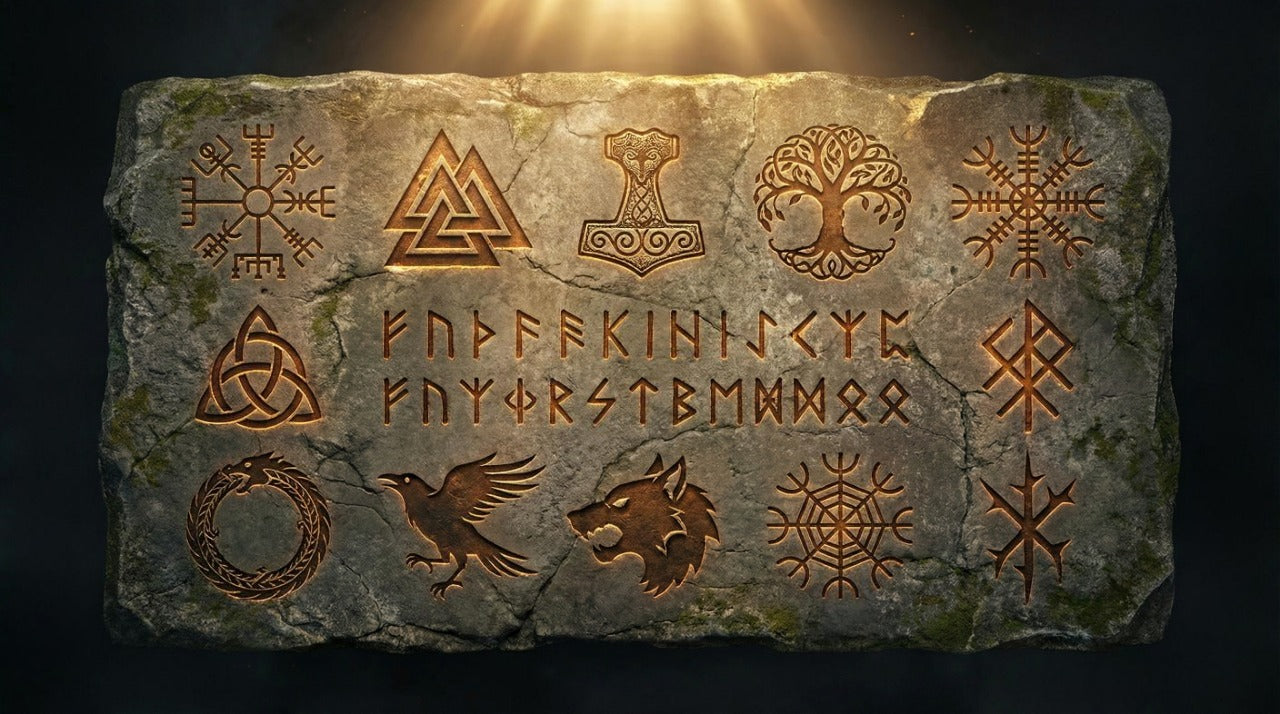
Thurisaz Rune: Thor's Strength and Active Protection
The night before the battle, the berserker slowly carved the Thurisaz rune into the wood of his shield. The sacred thorn, the sign of the giant and the thunder. Around him, the camp slept, but he stayed awake—because Thurisaz does not protect those who sleep. It protects those who wait, eyes fixed on the darkness, ready to strike first. The third rune of the Elder Futhark, Thurisaz carries within it the necessary violence, the strength that defends, and the destruction that purifies.
Table of Contents
- The shape of the thorn: anatomy of Thurisaz
- Thurs, the giant: etymology and origins
- Thor, Mjölnir, and the rune of thunder
- Deep meaning: reactive force and creative destruction
- Thurisaz, rune of active protection
- Thurisaz in divination and runic casting
- Historical inscriptions and magical uses
- Using Thurisaz today
📌 In Brief
- Thurisaz is the third rune of the Elder Futhark, meaning giant or thorn.
- The name Thurisaz is directly linked to Thor (Þórr in Old Norse).
- Upright, Thurisaz indicates an active protective force, an obstacle to be overcome, or a moment of contemplation before action.
- Thurisaz can be carved on a personal object or drawn above an entrance door for home protection.
- Thurisaz resembles the letter D or a triangle pointing to the right on a vertical stave.
The shape of the thorn: anatomy of Thurisaz
Look at the Thurisaz rune and you will see a thorn. A vertical line, as solid as a yew trunk, and a triangular point springing out on the right side—sharp, directed outward. This is no accident. In the heaths of Scandinavia, thorn bushes formed the first natural barriers, hedges that no cattle would cross and where no enemy would venture without leaving blood behind. The thorn wounds those who approach uninvited. It does not seek anyone out, but it punishes anyone who advances without caution.
In the Anglo-Saxon rune poem, the stanza dedicated to Thurisaz explicitly evokes this image: “Þorn byð ðearle scearp”—the thorn is terribly sharp. The text warns that any man who rubs against it will suffer "without measure." This is not delicate poetry. It is a warning carved in stone. The graphic form of Thurisaz translates this reality: a force that does not move, but which makes any intrusion pay dearly.
On the runestones found in Sweden and Denmark, the Thurisaz rune appears with striking regularity in protective inscriptions. Its shape was often carved on door frames, ship prows, and sword pommels. The thorn is not an ornament. It is a sentinel of wood and stone, planted between the known world and the lurking threat.
Thurs, the giant: etymology and origins
The name Thurisaz comes from Proto-Germanic *þurisaz, which designates the þurs—the giant. Not the benevolent Jötnar who sometimes marry the gods, but the Thurses, the giants of chaos, the primordial forces of destruction that existed before the sons of Borr fashioned the world from Ymir's body. The Old Norse word þurs is related to Old English þyrs and Gothic þaúrn, which means thorn. The linguistic kinship is revealing: the giant and the thorn share the same nature—brutal, dangerous, but fundamentally tied to the natural world.
In Norse cosmology, the Thurses represent the forces that the gods must constantly contain. They are the frost that threatens Midgard, the fire that devours from Muspellheim, the wave that engulfs the shores. The Thurisaz rune channels this energy. It does not annihilate it—it redirects it, like a warrior using his opponent's momentum to throw them to the ground. To understand Thurisaz is to understand that brute force is not necessarily blind. Directed, it becomes a shield.
« Where the frost of the Thurses threatens to cover everything, the hammer of thunder smashes the ice and clears the path. Thurisaz is the rune of those who break to open the way. » — Le Comptoir Viking
The Icelandic rune poem confirms this association by describing Thurisaz as "the sickness of women" and "the dweller of cliffs"—a direct reference to the Thurses, those massive beings who inhabit the wild and inhospitable regions of Norse mythology. But this very savagery is a strength: the Vikings did not fear the brutal nature. They respected it and learned to use it.
Thor, Mjölnir, and the rune of thunder
If Thurisaz is the rune of the giant, it is also—and perhaps above all—the rune of the one who fights the giants. Thor, god of thunder, son of Odin and Jörð, protector of Midgard, is the deity that specialists most frequently associate with this rune. The link is deep: Thor is the only god who faces the Thurses in single combat, over and over, without ever backing down. His hammer Mjölnir is the ultimate weapon against chaos—and the very shape of the Thurisaz rune, with its striking point, recalls the motion of the hammer as it comes down.
In the Hymiskviða, Thor lifts the giant Hymir's cauldron after facing the Midgard serpent. In the Þrýmskviða, he retrieves Mjölnir after it is stolen by the giant Þrymr by disguising himself as Freyja. Each myth illustrates the same pattern: the direct confrontation with a seemingly superior force, and victory achieved by brute power coupled with ingenuity. This is exactly the energy of Thurisaz.
Viking warriors often wore Mjölnir-shaped pendants engraved with runes, and Thurisaz was among the most frequent. This was not naive superstition. It was a statement: "I am under Thor's protection. Approach at your own risk." The berserker we spoke of at the beginning of this article likely wore such a talisman around his neck, in addition to the rune carved into his shield. Protection by Thurisaz is cumulative—each inscription strengthens the barrier. It is also worn today as jewelry: rings, necklaces, and bracelets engraved with runes can be found in our runes and Futhark section.
Deep meaning: reactive force and creative destruction
The Thurisaz rune is not a rune of wanton aggression. Its force is reactive. It waits. It accumulates. And when the threat presents itself, it strikes with violence proportional to the danger. This is the fundamental difference between Thurisaz and other force runes: it does not provoke conflict, it responds to it. Like the thorn that only wounds those who touch it, Thurisaz only unleashes itself when the boundary is crossed.
This reactive force is accompanied by an essential concept in Norse thought: creative destruction. Scandinavian myths are permeated by the idea that destruction is necessary for rebirth. Ragnarök itself, the end of the gods, is not a final annihilation—it is the prelude to a new, purer world. In the same way, Thurisaz destroys what must be destroyed so that what is necessary can occur. An obstacle in your path? Thurisaz breaks it. A stagnant situation? Thurisaz shatters it. This is not violence—it is clearing the way.
« Thunder does not ask permission to strike. It comes because the sky can no longer contain the tension. Thurisaz is this release—sudden, brutal, necessary. » — Le Comptoir Viking
On a more personal level, the meaning of Thurisaz invites confrontation with oneself. The internal giants—fears, doubts, destructive habits—must be faced with the same determination as Thor facing the Thurses. The rune teaches that avoiding conflict is not always wisdom. Sometimes, true wisdom consists of grabbing the hammer and striking what threatens to destroy you before it is too late.
Summary Sheet — Thurisaz Rune
- Name: Thurisaz (þurisaz)
- Position in Futhark: 3rd rune, first ætt
- Phoneme: þ (English "th", as in thorn)
- Literal Meaning: Giant / Thorn
- Associated Deity: Thor (and the Thurses)
- Symbols: Reactive force, protection, creative destruction, confrontation
- Element: Fire / Lightning
- Tree: Blackthorn
- Color: Bright red
Thurisaz, rune of active protection
There are two types of protection in the runic system. Passive protection—like a wall that absorbs blows—and active protection, which repels the aggressor, wounds them, and deters them from returning. The Thurisaz rune belongs firmly to the second category. It does not just block: it strikes back. It is a shield bristling with spikes.
In Norse magical practices, Thurisaz was carved as a perimeter defense rune. Runic masters inscribed it at the four corners of a property, on door thresholds, and above lintels. The idea was not merely symbolic: in a world where the boundary between the visible and invisible was porous, carving Thurisaz was akin to posting a supernatural sentinel. Malicious spirits, draugar (revenants), and harmful influences were supposed to collide with this barrier like an intruder colliding with a hedge of thorns.
The berserker from our story knew this well. Before every fight, he would trace Thurisaz three times—on his shield, on his axe, and on his own forehead, using soot mixed with blood. Three inscriptions for triple protection. The sagas mention this type of ritual several times, and even if the details vary, the principle remains identical: the rune carved with intention becomes a rampart. If you are looking to explore magical protection runes and Viking rituals, Thurisaz is the first one you should study.
Even today, many practitioners of Nordic traditions wear rings engraved with protective runes including Thurisaz, perpetuating a millennial tradition. The intention remains the same: to create a space around oneself that malice cannot penetrate without paying the price.
Thurisaz in divination and runic casting
When the Thurisaz rune appears in a reading, it demands immediate attention. It is not a subtle rune. It does not whisper — it growls. Its presence indicates that a powerful force is at work in the situation being questioned, and that the querent must decide whether to face it or be swept away by it.
Thurisaz upright
In the upright position, Thurisaz announces active protection and the need for defense. Something is threatening — a conflict, an obstacle, a hostile person — and the rune advises not to flee. It is time to stand tall, set your boundaries, and strike if necessary. Thurisaz upright can also signal a period of forced waiting, a time when one cannot yet act but must remain vigilant. The thorn does not move — it waits for the threat to come to it.
Thurisaz upright can also signify that the querent possesses unsuspected inner strength. Just as the Fehu rune reveals a potential for wealth, Thurisaz reveals a potential for power. This strength may be dormant, buried under layers of doubt or complacency, but it is there, waiting to be awakened by confrontation.
Thurisaz reversed (merkstave)
In the reversed position, the Thurisaz rune warns against vulnerability and helplessness. Defenses are down. The thorn is turned against oneself. The querent may be their own enemy — their anger misdirected, their strength used in a destructive rather than protective manner. Thurisaz reversed can also signify a refusal of necessary confrontation, a flight from conflict which, paradoxically, worsens the situation.
It sometimes warns of an undetected external threat: a danger that the querent does not see, a brewing betrayal, a blow that will fall without warning. In this case, the advice is simple: open your eyes, strengthen your defenses, do not trust blindly.
Historical inscriptions and magical uses
Archaeology provides us with numerous testimonies of the magical use of Thurisaz. On the Stentoften stone (Blekinge, Sweden, 6th century), a runic inscription mentions the thurses in the context of a protective curse: whoever destroys or profanes the stone will be delivered to the fury of the giants. The Thurisaz rune appears there as a magical lock, a threat engraved in stone that will span the centuries.
Sequences of three consecutive Thurisaz (þþþ) are also found on several artifacts — notably amulets and gold bracteates from the 5th to the 7th century. The triple repetition is a recurring motif in Germanic magic: it amplifies the power of the rune, creating what specialists call a visual galdr (incantation). Three thorns planted together form a barrier that no evil spirit can cross.
The Sigrdrifumal, an Eddic poem where the valkyrie Sigrdrífa teaches the secrets of the runes to the hero Sigurd, recommends engraving "victory runes" on the sword and naming Tyr twice. But it is Thurisaz that takes on a character of warrior protection in later magical formularies. On Merovingian swords and in Anglo-Saxon traditions, it is associated with the weapon's ability to repel the enemy as much as to strike them.
"Three thorns engraved on the threshold, and the house became a fortress. Three thorns on the shield, and the warrior became a wall. Triple Thurisaz, triple protection, triple challenge issued to the forces of the night." — Scandinavian runic tradition
Using Thurisaz today
The Thurisaz rune has lost none of its power. In a world where threats have changed form but not nature, its energy remains deeply relevant. It no longer protects against the thurses of legends, but against daily aggressions — manipulation, encroachment, the loss of one's personal boundaries. Here is how to incorporate it into a contemporary practice.
Meditation on Thurisaz
Sit in a quiet place. Visualize the shape of Thurisaz — the vertical line, the sharp point. Imagine this thorn growing until it forms a complete circle around you, a hedge of luminous, red and gold briars, impervious to any intrusion. Breathe deeply. With each exhalation, strengthen the barrier. With each inhalation, feel the strength of Thor flowing within you. This meditation is particularly effective before a confrontational situation — a difficult interview, a negotiation, a conflict to be resolved.
Wearing Thurisaz daily
The Vikings wore their runes. We can do the same. A pendant engraved with protective Viking runes including Thurisaz creates a permanent physical reminder of your determination to defend your boundaries. The contact of the metal against the skin establishes a tangible link with the rune's energy. This is not magic in the whimsical sense of the word — it is an anchor, an object of personal power that reminds you that you have the right and the strength to protect yourself.
The Thurisaz rune as a bindrune
Combined with other runes, Thurisaz forms bindrunes (linked runes) of remarkable efficacy. Combined with Algiz, it creates a double protection — passive and active. Combined with Tiwaz, it invokes warrior justice, strength in the service of law. Combined with Sowilo, it combines destructive power and purifying light, ideal for breaking negative cycles. The art of the bindrune is a natural extension of the study of the Elder Futhark, and Thurisaz is one of its most powerful components.
When to invoke Thurisaz
- Before an inevitable conflict — to strengthen your determination and defensive capability
- To set boundaries — when someone encroaches on your personal, emotional, or professional space
- To break an obstacle — when stagnation threatens and brute force is needed to move forward
- To purify a space — by engraving or visualizing Thurisaz in a place one wishes to protect from negative influences
- During periods of vulnerability — when you feel your defenses weakening, Thurisaz restores them
The thorn of the North still watches
The Thurisaz rune is the sentinel of the Futhark. It carries within it the fury of the giants and the protective strength of Thor, the violence of the thorn and the wisdom of one who knows the price of defense. The berserker who engraved it on his shield was not looking for war — he was ensuring he would return from it alive. Thurisaz reminds us of a truth that the ancient Scandinavians never forgot: true protection is not a wall behind which one hides, but a force that one wields in the face of a threat.
In a world that demands ever more resilience, Thurisaz remains the rune of those who refuse to bend. The third thorn of the Elder Futhark, it waits — patient, sharp, ready to strike. As it has always done. As it will always do.
Frequently Asked Questions about the Thurisaz Rune
What does the Thurisaz rune mean?
Thurisaz is the third rune of the Elder Futhark, meaning giant or thorn. It represents the brute force of Thor, active protection, and the ability to destroy obstacles. It is a rune of defensive and offensive power.
Is Thurisaz linked to Thor?
Yes, the name Thurisaz is directly linked to Thor (Þórr in Old Norse). The rune channels the strength of thunder and the protective power of Thor. It was used as a symbol of defense against the forces of chaos, just as Thor protects Midgard against the giants.
What does Thurisaz mean in a rune reading?
Upright, Thurisaz indicates an active protective force, an obstacle that will be overcome, or a moment of contemplation before action. Reversed, it warns of danger, an impulsive reaction, or an uncontrolled destructive force that must be channeled.
How to use Thurisaz for protection?
Thurisaz can be engraved on a personal object or traced above an entryway for home protection. In meditation, it helps to strengthen personal boundaries and repel negative energies. It is the defensive rune par excellence.
What is the shape of the Thurisaz rune?
Thurisaz looks like the letter D or a triangle pointing to the right on a vertical stave. It evokes a thorn — a natural defensive point that pricks those who get too close.
Can Thurisaz be combined with other runes?
Yes, Thurisaz combines effectively with Algiz (passive + active protection), Tiwaz (strength of Thor + victory of Tyr), or Isa (freezing the situation + defensive strength) to create powerful protection bindrunes.
👉 Explore our collections of Viking jewelry and Viking rings to carry the Viking spirit with you every day.

Leave a comment
All comments are moderated before being published.
This site is protected by hCaptcha and the hCaptcha Privacy Policy and Terms of Service apply.