
Fehu Rune: Meaning, Wealth, and Prosperity
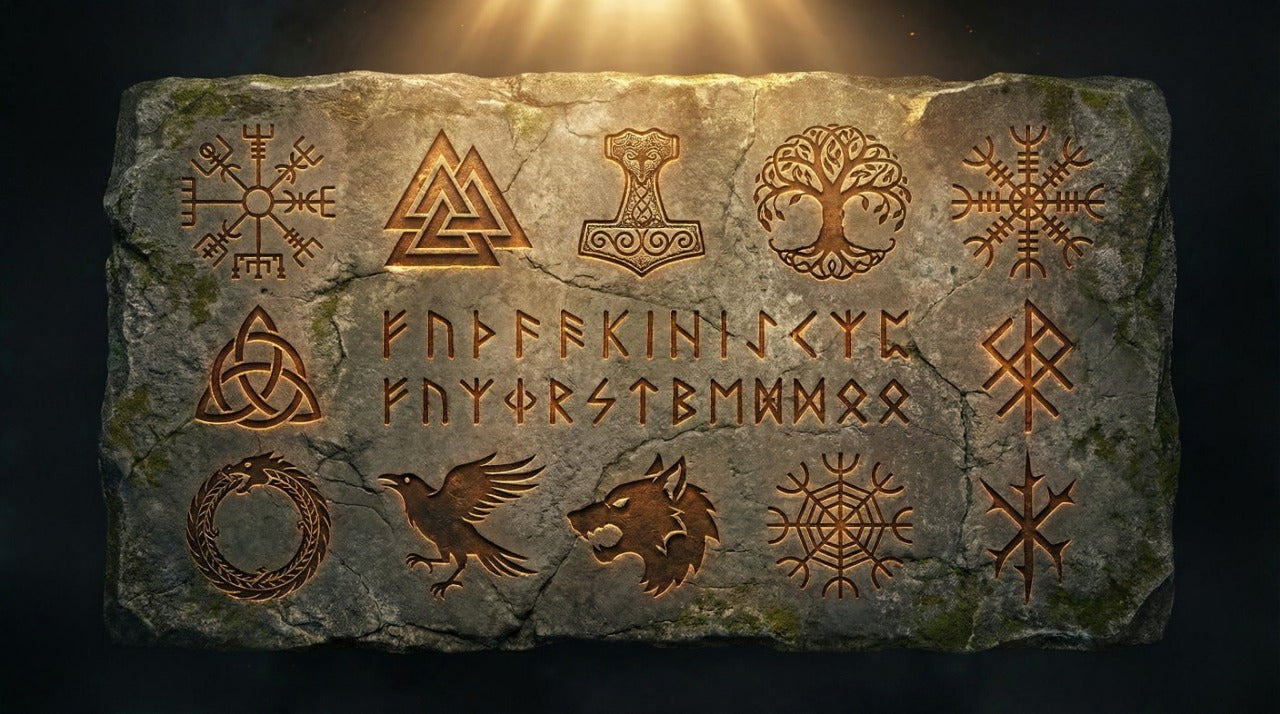
The first rune of the Elder Futhark, Fehu opens the path to abundance and carries with it the promise of a wealth that transcends mere material fortune.
Fehu opens the Elder Futhark, and this is no coincidence. Its name literally means "cattle"—fehu in Proto-Germanic, fé in Old Norse—and it is the word that gave us the English "fee" and the German Vieh. In a society where wealth was measured in heads of livestock, this single word designated both the herd and wealth itself. The Fehu rune, a vertical line topped with two branches angled toward the sky, is therefore the sign of that which is possessed, counted, passed on—and lost.
This scene, which could have taken place in the 9th century on any Viking ship, illustrates the fundamental role that the Fehu rune occupied in Nordic civilization. As the first letter of the runic alphabet, it was not merely a writing character: it embodied a vital concept for the Scandinavian peoples, that of mobile wealth, of the goods one owns, trades, and makes fruitful. Understanding the meaning of the Fehu rune in terms of wealth and prosperity means diving into the very heart of the Vikings' vision of abundance—a vision that, in many respects, remains deeply relevant today.
Pronunciation: "Fay-hoo" — Phonetic value: F
Meaning: cattle, mobile wealth, prosperity
Associated element: Fire — Deity: Freyr / Freyja
📌 In Brief
- Fehu is the first rune of the Elder Futhark.
- Traditionally, Fehu can be carved onto a personal object, traced during meditation, or worn as a pendant.
- Reversed Fehu (Merkstave) indicates financial loss, a waste of energy or resources, or a warning against greed.
- Fehu is associated with the Vanir, particularly the god Freyr, the deity of fertility, prosperity, and abundance.
- Fehu is a popular tattoo choice to symbolize prosperity and success.
Fehu: Form, Pronunciation, and Etymology
A Shape That Evokes Cattle Horns
The Fehu rune is drawn with a main vertical line, extended by two oblique branches rising to the right, evoking the stylized shape of a bovine's horns. This is no coincidence: the Old Norse word fé (related to Proto-Germanic *fehu) literally means "cattle." In the agro-pastoral societies of Northern Europe, livestock was the primary form of wealth. Owning cows, oxen, and sheep meant owning life itself—food, clothing, plowing power, and currency.
The pronunciation of Fehu is similar to "fay-hoo," with an initial sound that recalls the English "f," followed by a soft expiration. This sound finds echoes in modern words: "fee," Vieh (cattle in German), or the French word fief, which shares the same Indo-European root *peku-, designating the herd. Thus, for millennia, the notions of cattle and wealth have been intimately linked in European languages—and the Fehu rune is their primordial symbol.
To better place this rune within the sacred Nordic alphabet as a whole, we recommend our complete guide to the Elder Futhark, which explores all 24 runes and their organization into three families of Aettir.
First of the Futhark: A Significant Position
Fehu is not just any rune: it is the very first of the runic alphabet, the one we call "Futhark" precisely because its first six letters form the word F-U-Th-A-R-K. Occupying the first position is never insignificant in an esoteric tradition. Like the Hebrew Aleph or the Greek Alpha, the Fehu rune represents a beginning, an initial impulse. It is the breath that starts every endeavor, the primordial energy that sets things in motion. In a modern divinatory reading, seeing it appear in the first position is understood in this sense: movement has begun and energy is available; it remains only to make something of it.
"Cattle die, kinsmen die, you yourself must die. But one thing I know, which never dies: the reputation of those who have passed away." — Hávamál, stanza 77 (Sayings of the High One)
This verse from the Poetic Edda, closely linked to the spirit of Fehu, reminds us that material wealth is ephemeral. Cattle (fé) die, but true prosperity—that of reputation and honor—endures beyond death. This is the whole ambivalence of this rune: it celebrates earthly abundance while pointing toward a deeper wealth.
Meaning of Fehu: Material and Spiritual Wealth
Tangible Wealth: Possessing and Circulating
In its primary sense, the Fehu rune embodies concrete wealth: goods, money, possessions, everything that has exchange value. But the Nordic vision of wealth differed profoundly from our modern concept of accumulation. For the Vikings, wealth only made sense if it circulated. A jarl who hoarded his gold without redistributing it lost the esteem of his men. Generosity was a cardinal virtue, and great chieftains were often called "ring-breakers" (baug-broti)—those who break gold rings to distribute the pieces.
Fehu carries this dynamic of flow within it. The wealth it symbolizes is not a treasure buried underground, but a living current that nourishes the community. It is the energy of commercial exchange, the profit from a merchant voyage, the benefit that spills over to everyone. A Scandinavian merchant loading his ship with furs to trade for Arab silver at Hedeby embodied exactly this spirit: transforming a resource through initiative and movement, rather than through accumulation.
Today, enthusiasts of Nordic culture perpetuate this heritage by wearing Viking rings adorned with runes, daily reminding themselves of the power of these ancestral symbols and the energy of prosperity they convey.
Inner Wealth: Spiritual Abundance
Beyond the tangible world, the meaning of Fehu extends to the spiritual realm. The runemasters (rúnameistari) of the Viking Age knew that each rune operated on several planes simultaneously. Psychologically, Fehu represents self-confidence, the sense of inner abundance, the certainty that one possesses the resources necessary to face life's challenges.
This spiritual dimension is linked to Freyr, the god of fertility and prosperity, with whom Fehu is traditionally associated in the Aett (the first group of eight runes bears his name). Freyr reigned over Alfheim, the world of the light elves, and guaranteed good harvests, peace, and abundance. Invoking the Fehu rune was also invoking Freyr's blessing on one's enterprises—a silent prayer for the land to be fertile, for the herd to multiply, for trade to be fruitful.
The Dimensions of Fehu
- Material plane: wealth, goods, money, possessions, financial success
- Social plane: generosity, sharing, reputation, community ties
- Creative plane: energy of initiative, new projects, vital impulse
- Spiritual plane: inner abundance, confidence, fertility of the spirit
- Cosmic plane: the primordial fire of Muspelheim, the creative force of the universe
Some scholars, like runologist Edred Thorsson, even link Fehu to the cosmic fire of Muspelheim—that primordial flame which, in Nordic cosmogony, sprang into the yawning void of Ginnungagap to generate life. Fehu would thus be the spark of creation, the raw energy that precedes all manifestation. An interpretation that gives this first rune a remarkable cosmic depth.
Fehu in Divination: Upright and Reversed Positions
The divinatory practice of runes, attested to by Tacitus as early as the 1st century and described in Icelandic sagas, remains alive today among practitioners of the Nordic tradition. When the Fehu rune appears during a rune reading, its message varies considerably depending on its position—upright or reversed.
The reading changes according to the orientation of the rune on the cloth. Upright, Fehu speaks of a flow that is opening; reversed, it invites caution in exchanges. Here is how to interpret it in each position—keeping in mind, once again, that the system of reversals is a modern convention and not a Nordic legacy.
ᚠ Fehu Upright
- Imminent or ongoing financial gain
- Success of a commercial project
- Period of abundance and prosperity
- Promising new beginning
- Fertility—a project bearing fruit
- Powerful creative energy
- Well-deserved reward for effort
ᚠ Fehu Reversed
- Financial loss or unexpected expense
- Greed or excessive attachment to possessions
- Failure of a transaction or project
- Frustration, feeling of lack
- Creative energy blocked or scattered
- Need to reevaluate priorities
- Warning: greed leads to ruin
Fehu in Different Positions of a Reading
The Fehu rune changes nuance depending on the position it occupies in a reading. In the past position, it indicates that material foundations have been laid—an inheritance, a previous investment, a period of work that built a solid base. In the present position, it signals an active phase of acquisition or growth: it is time to act, to close a deal, to launch a project. In the future position, it promises a harvest to come—prosperity is on the way, but one must stay the course.
Associated with other runes, Fehu reveals particularly eloquent combinations. With the Ansuz rune, the rune of Odin and communication, it suggests gain obtained through speech—a successful negotiation, a signed contract, an idea that is monetized. With Wunjo (joy), it announces wealth that brings sincere happiness. With Hagalaz (hail), on the other hand, it warns of a sudden loss, a storm that carries away one's gains.
"Fehu is the wolf's consolation; the wolf grows in the forest." — Old Norwegian Runic Poem (Norsk Runerim), 13th century
This enigmatic verse from the Norwegian Runic Poem associates Fehu with the wolf — a metaphor for the wild and unpredictable nature of wealth. Cattle feed the prowling wolf; prosperity attracts predators. The warning is clear: wealth demands vigilance. Those who rest on their laurels risk losing everything. The Icelandic sagas abound with illustrations of this maxim: inheritance disputes cause more deaths than raids, and fortune changes hands there far faster than it is built.
Fehu in Runic Magic
Galdr and Prosperity Invocations
Runic magic, or rúnagaldr, held a central place in Nordic spirituality. Runic masters did not merely read runes — they chanted them, carved them, and activated them through precise rituals. The Fehu rune, as a symbol of prosperity, was one of the most frequently used in magic practices related to abundance.
The galdr (magical chant) associated with Fehu consisted of repeating the sound "fé-fé-fé-fehu" in an ascending tone, visualizing the golden energy of wealth pouring into one's life. Odin himself, in the Hávamál, evokes the power of runic chants to attract fortune. Contemporary practitioners of the Nordic tradition perpetuate this practice, meditating on the Fehu rune to align their energy with that of abundance. To delve deeper into these practices, discover our article on magical runes and Viking rituals.
Carving and Talismans
Carving the Fehu rune on an object meant bestowing upon it the power to attract wealth. Viking artisans carved this rune on coins, merchant chests, amulets, and sometimes even on the prows of merchant ships. The repetition of the same sign, two or three times in a row, is well attested in runic inscriptions, where it seems to have served to reinforce its effect.
Bindrunes, those combinations of several superimposed runes, often integrated Fehu as a main component. The Fehu-Jera combination (the harvest) formed a powerful talisman for agricultural prosperity. Fehu-Raidho (the journey) protected merchants on trade routes. These traditions continue to inspire creators today, as evidenced by the magnificent Viking necklaces adorned with runes that perpetuate this ancestral art.
Seasonal Rituals and Fehu
In the Viking ritual calendar, Fehu was particularly invoked during the festivals of Freyr — notably during the Álfablót (sacrifice to the elves) in autumn and the Dísablót in winter. These ceremonies aimed to ensure the prosperity of the community for the coming season. The goði (priest) would trace the Fehu rune with sacrificial blood on the temple pillars, invoking the blessing of Freyr and Freyja upon the herds and grain stores.
This ritual dimension highlights a fundamental aspect of the Nordic view of wealth: it is never permanently acquired. Each season, each cycle requires a renewal of commitment, a symbolic sacrifice, a gesture of gratitude toward the forces that make abundance possible. It is a lesson that our modern world, obsessed with infinite growth, would do well to meditate upon.
Fehu in Archaeological Inscriptions
Testimonies Carved in Stone and Metal
Archaeology confirms the capital importance of Fehu in Nordic civilization. Among the thousands of runic inscriptions discovered in Scandinavia, this rune appears with remarkable frequency, both in secular and sacred contexts.
The Kylver Stone, discovered on the island of Gotland in Sweden and dated to the 5th century, bears one of the oldest complete Futharks ever found. Fehu appears in the first position, confirming that the order of the runic alphabet was already fixed by that time. The fact that the oldest and most stable character of this alphabet is that of wealth speaks volumes about the priorities of these societies.
Even more fascinating, some objects bear the Fehu rune repeated three times (ᚠᚠᚠ), forming what runologists call the fehu-fehu-fehu or "triple Fehu." This sequence, found on amulets in Denmark and Norway, functioned as a magic formula for abundance — a sort of prayer compressed into three strokes. The Vadstena bracteate (Sweden, 6th century) is a remarkable example, blending the complete Futhark with magical formulas where Fehu plays a predominant role.
Fehu on Viking Age Runic Stones
During the Viking Age (793-1066), runic stones erected in Sweden, Denmark, and Norway frequently mention inheritance and the transmission of property — contexts where the Fehu rune resonates strongly. The Hillersjö stone (Sweden, 11th century) tells the story of a woman named Gerlöf who inherited the property of her son and husband, becoming a powerful landowner. Although the text uses the runic alphabet in its writing function, the recurring presence of fé (wealth, property) in these inscriptions testifies to the omnipresence of the concept that Fehu embodies.
Archaeologists have also discovered merchant balance weights marked with runes at Birka (Sweden), Kaupang (Norway), and Hedeby (Denmark) — the three great emporia of the Viking world. Some of these weights bear the mark of Fehu, suggesting that it served as a symbolic guarantee of value in commercial transactions. These weights circulated from one trading post to another: a merchant from Birka would find the same system of measurement in Hedeby, which speaks volumes about the level of integration of Nordic trade networks.
"Wealth is a source of discord between relatives; the wolf lurks in the forest." — Icelandic Runic Poem (Íslenskt Rúnaljóð), 15th century
The Icelandic Runic Poem offers a dark counterpoint to the enthusiasm for Fehu. Wealth, it says, breeds discord within families. The Icelandic sagas are full of stories of brothers killing each other over an inheritance, of clans torn apart by greed. Fehu thus reminds us that prosperity is a fire: it warms and nourishes when mastered, but consumes and destroys when it escapes control.
How to Use the Fehu Rune Daily
Meditation and Visualization
To integrate the energy of the Fehu rune into your daily life, start with meditation. Sit comfortably, close your eyes, and visualize the rune traced in lines of golden fire before you. Imagine this golden energy entering your body with each inhalation, filling every cell with a sense of abundance and possibility. With each exhalation, release the fears related to lack, scarcity, and insufficiency. This simple practice, performed five to ten minutes a day, can gradually transform your relationship with money and prosperity.
Wearing Fehu
The tradition of wearing carved runes has never ceased. Wearing the Fehu rune on a piece of jewelry — a ring, pendant, or bracelet — creates a constant reminder of your intention for prosperity. This is not superstition: it is a psychological anchor that keeps your attention focused on your goals of abundance. Every time your gaze falls on the symbol, your mind recenters itself on what matters. You will find superb pieces carved in our collection of Viking bracelets adorned with runes, forged in the spirit of the ancient Nordic artisans.
Fehu and Managing Your Finances
Some modern practitioners of the runic tradition use Fehu as a framework for reflection in their financial decisions. Before an investment, a major expense, or a negotiation, they meditate on the lessons of this rune: wealth must circulate, greed is destructive, generosity attracts abundance, and vigilance is always necessary. This is not an accounting method, of course — but it is a millennial wisdom that usefully complements modern financial rationality.
Practicing Fehu Daily
- Morning: trace the rune in the air in front of you while setting your intention for prosperity for the day
- Financial decision: meditate on Fehu before any important choice related to money
- Gratitude: each evening, give thanks for three forms of wealth received during the day
- Generosity: honor the spirit of Fehu by sharing — a gift, a meal, knowledge
- Runic journal: note the synchronicities and signs of abundance that you observe
The Eternal Legacy of Fehu
Perhaps that is where the truest meaning of Fehu lies. The wealth it designates is not the chest buried under the floorboards: it is what circulates and what returns. In a world where credit rested on one's word, a merchant's reputation for honesty was worth more than his stock, and alliances made during a journey paid off long after the cargo had been sold. The Fehu rune speaks of this as much as it does of cattle: of what one sets in motion, and of what that motion yields.
This is the entire teaching of Fehu, this primordial rune that opens the sacred alphabet of the peoples of the North. True wealth is a flow, not a stockpile. Authentic prosperity is measured as much by what one gives as by what one receives. And the first rune reminds us, with the wisdom of a thousand years of history, that every great enterprise begins with an act of faith — a hand reaching into a leather pouch, a line carved in wood, a prayer whispered to the gods of wind and fortune.
May the Fehu rune light your own path toward abundance — material, spiritual, and human.
Frequently Asked Questions About the Fehu Rune
What does the Fehu rune mean?
Fehu is the first rune of the Elder Futhark. It literally means cattle or movable wealth. Among the Vikings, cattle represented primary wealth — Fehu therefore symbolizes prosperity, material abundance, and financial success.
How can I use the Fehu rune to attract prosperity?
Traditionally, Fehu can be carved onto a personal object, traced during meditation, or worn as a pendant. Some trace it on their wallet or workplace. Intention is key: Fehu reminds us that wealth must circulate, not stagnate.
What does Fehu reversed mean in a runic reading?
Fehu reversed (Merkstave) indicates financial loss, a waste of energy or resources, or a warning against greed. It can also signal a period of stagnation where your efforts are not yet bearing fruit.
Is Fehu linked to a Viking god?
Fehu is associated with the Vanir, particularly the god Freyr, the deity of fertility, prosperity, and abundance. It belongs to the first ætt of the Futhark, which is appropriately called Freyr's ætt.
Can I get the Fehu rune tattooed?
Yes, Fehu is a popular tattoo choice to symbolize prosperity and success. It is often tattooed alone in a minimalist style, combined with other runes in a bindrune, or integrated into a larger runic circle.
What is the shape of the Fehu rune?
Fehu resembles an F whose two diagonal branches point toward the upper right. It is drawn in three strokes: a vertical line (the stave) and two diagonal strokes starting from the top. It is one of the simplest runes to recognize and trace.
👉 Explore our collections of Viking jewelry and Viking rings to carry the Viking spirit in your everyday life.

Leave a comment
All comments are moderated before being published.
This site is protected by hCaptcha and the hCaptcha Privacy Policy and Terms of Service apply.