
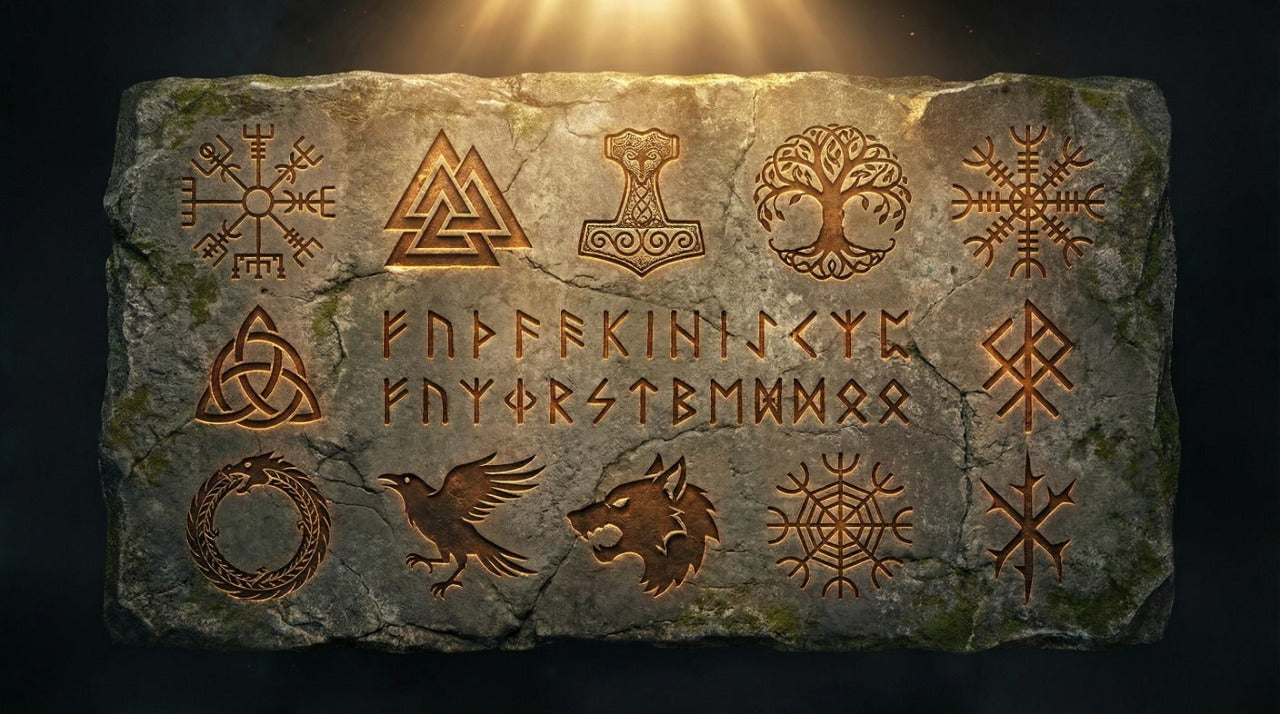
The Elder Futhark: Complete Viking Runic Alphabet
The Elder Futhark is the oldest known runic alphabet: twenty-four signs, in use from the 2nd to the 8th century throughout Germania and Scandinavia. Its name is no mystery — it simply follows the order of its first six letters, f, u, þ, a, r, k, just as our word “alphabet” comes from alpha and beta. It precedes the Viking Age proper, which used a shortened version of sixteen signs, and it is the one found carved on the oldest inscriptions in the North.
The myth of its origin is told in the Hávamál: Odin hangs for nine nights on Yggdrasil, pierced by his own spear, offered to himself, until he seizes the runes with a cry. The text is explicit about the price to pay — runic knowledge is not given; it is torn away. For the Scandinavians, these signs were therefore not mere letters: each carried a name, a phonetic value, and a symbolic charge that the name itself designated.

📌 In brief
- The Elder Futhark has 24 runes and was in use from the 2nd to the 8th century.
- Its name simply takes the order of its first six letters: f, u, þ, a, r, k.
- The 24 signs are divided into three families of eight, called ættir — a categorization attested on the Kylver stone.
- Around the 8th century, it gave way to the Younger Futhark, reduced to 16 signs, for linguistic rather than mystical reasons.
- The divinatory meanings attributed to it today are a 20th-century construct, not a legacy of the Viking Age.
“I know that I hung on a windy tree— Hávamál, stanza 138
nine whole nights,
wounded with a spear and given to Odin,
myself to myself offered,
on that tree of which no one knows
from where its roots run.”

What is the Elder Futhark?
The Elder Futhark is the oldest known runic writing system. Used from the 2nd to the 8th century AD by Germanic and Scandinavian peoples, it forms the matrix for all subsequent runic scripts. Its name comes from the first six runes of the series: F-U-Þ-A-R-K (Fehu, Uruz, Thurisaz, Ansuz, Raidho, Kenaz).
The Elder Futhark comprises 24 runes, divided into three groups of eight called aettir (plural of ætt, meaning “family” or “clan”). Each ætt is placed under the patronage of a Norse deity, and each rune has a name, a sound, and a deep symbolic meaning.
The number is fixed, and this fixity matters: twenty-four signs, not one more. The stability of the system is remarkable — 3rd-century inscriptions in Norway and 7th-century ones in Germany yield the same inventory, in the same order. Several objects, such as the Kylver stone found on Gotland, actually carry the complete series engraved in one continuous run, like an alphabet primer.
The 24 runes of the Elder Futhark: complete table
Here is the complete table of the 24 runes of the Elder Futhark, organized by ætt, with their name in Old Norse, their phonetic sound, and their symbolic meaning.
First Ætt — Freya’s Ætt
Goddess of love, fertility, and magic. This first group covers the primordial forces of material life.
| Rune | Name | Sound | Meaning |
|---|---|---|---|
| Fehu | F | Cattle, wealth, prosperity | |
| Uruz | U | Aurochs, brute force, vitality | |
| Thurisaz | Þ (th) | Giant, thorn, protection | |
| Ansuz | A | God (Odin), speech, wisdom | |
| Raidho | R | Ride, journey, rhythm | |
| Kenaz | K | Torch, knowledge, illumination | |
| Gebo | G | Gift, exchange, partnership | |
| Wunjo | W | Joy, harmony, happiness |
The first rune, Fehu, rune of wealth and prosperity, opens the Elder Futhark just as cattle opened the measure of all fortune. Its drawing is simple: a vertical stem topped by two rising branches. The word fehu literally means cattle, and it has given rise to the English “fee” and the German “Vieh” — among Germanic peoples, wealth was first counted in heads of livestock.

The eight signs of this Ætt are found as beard and hair beads, to be worn one by one on a braid: Fehu, Uruz, Thurisaz, Ansuz, Raidho, Kaunaz, Gebo, and Wunjo.
Second Ætt — Hagal’s Ætt (Heimdall)
Guardian of the Bifröst. This group represents elemental forces and the trials of existence.
| Rune | Name | Sound | Meaning |
|---|---|---|---|
| Hagalaz | H | Hail, destruction, transformation | |
| Nauthiz | N | Need, constraint, resilience | |
| Isa | I | Ice, stillness, concentration | |
| Jera | J (y) | Year, harvest, cycles | |
| Eihwaz | Ï / E | Yew, endurance, world axis | |
| Perthro | P | Cup of fate, chance, mystery | |
| Algiz | Z | Protection, elk, awakening | |
| Sowilo | S | Sun, victory, vital energy |
The second ætt is that of opposing forces. Hagalaz is hail, Nauthiz is constraint, Isa is the ice that immobilizes; then come Jera, the year and its harvest, and Sowilo, the sun. Our three main sources regarding the meaning of the rune names — the Norwegian, Icelandic, and Anglo-Saxon rune poems — describe this same alternation, where trial precedes the return of the cycle.

This Ætt can also be worn in its entirety, one bead per sign: Hagalaz, Nauthiz, Isa, Jera, Eihwaz, Perthro, Algiz and Sowilo.
Third Ætt — Tyr's Ætt
God of justice and courage. This final group embodies human will, social order, and spiritual fulfillment.
| Rune | Name | Sound | Meaning |
|---|---|---|---|
| Tiwaz | T | Tyr, justice, honor, sacrifice | |
| Berkano | B | Birch, birth, renewal | |
| Ehwaz | E | Horse, movement, trust | |
| Mannaz | M | Humanity, self, consciousness | |
| Laguz | L | Water, intuition, flow | |
| Ingwaz | NG | Ing (Freyr), fertility, potential | |
| Dagaz | D | Day, awakening, breakthrough | |
| Othala | O | Heritage, homeland, lineage |

Tiwaz, the rune of Týr, is shaped like an arrow pointing upwards. The myth associated with it is among the most striking in the Nordic corpus: for the gods to chain the wolf Fenrir, Týr agrees to place his right hand in its mouth as a pledge of good faith, and loses it. The Norwegian rune poem links it as much to this one-handed god as to the star that guides the traveler through the night.
"No one brought me bread or a horn to drink;— Hávamál, stanza 139
I peered downwards,
I gathered the runes,
screaming I gathered them,
then fell back from there."
The final Ætt closes the series: Tiwaz, Berkano, Ehwaz, Mannaz, Laguz, Ingwaz, Dagaz and Othala are each available as an individual engraved bead.
Pronunciation and transliteration of the runes
One of the first questions asked by those discovering the Elder Futhark is: "How are these runes pronounced?" Unlike our Latin alphabet, each rune of the Elder Futhark represents a unique sound and bears a name that starts with that same sound — a mnemonic device known as acrophony.
Fehu is pronounced with a crisp "f," like "fortune." Thurisaz uses the English "th" sound (as in thunder), a sound that does not exist in modern French. Ansuz, the rune of Odin linked to communication and wisdom, carries an open, deep "a." Kenaz sounds like a hard "k," never softened. Jera is pronounced "yera" with a consonant "y," as in German. Algiz, the great protection rune, is pronounced with a voiced "z."
A rune's name was not just used to identify it: it was used to pronounce it aloud. This is the principle of galdr, the chanted incantation — the sources use the verb gala, "to sing," to describe the ritual use of runes. The sound and the sign formed a pair, which clearly distinguishes the Futhark from a simple notation system.
To write in Elder Futhark runes, transliteration is relatively straightforward: each Latin letter corresponds to a rune. A few particularities to keep in mind: the "c" is rendered by Kenaz (the "k" sound), but by Sowilo before an e, i, or y, where French pronounces it "s": Cécile therefore starts with a runic S. The "th" has its own rune, Thurisaz, and the "ng" has the unique rune Ingwaz. Double or long vowels have no specific graphic distinction in the original system.
French letters without a runic equivalent — C, Q, X, ç, æ — each require an arbitration. Our Viking rune converter details the rule chosen for each and displays the transcription rune by rune.
The three Ættir: sacred structure of the Elder Futhark
The division of the Elder Futhark into three ættir is not merely a practical classification. Runology scholars, such as Professor Ralph Elliott and historian Stephen Flowers, consider this tripartite structure to reflect a cosmology: matter (Freya's ætt), elemental forces (Hagal's ætt), and human spirit (Tyr's ætt).
The first ætt of Freya begins with Fehu (material wealth) and ends with Wunjo (joy). It chronicles the journey from survival to flourishing. The second ætt of Hagal opens with destruction (Hagalaz) and culminates with the triumphant sun (Sowilo). It is the path of trial and transformation. The third ætt of Tyr begins with noble sacrifice (Tiwaz) and ends with ancestral heritage (Othala). It speaks to the quest for meaning and grounding in one's lineage.
Three families of eight, known as ættir. This division is not a modern reconstruction: the Kylver stone and the Vadstena bracteate both mark the separations between the groups. Each ætt traditionally bears the name of its first rune — Freyr, Hagal, Týr.
If this cosmic structure fascinates you and you wish to wear the runes in your daily life, discover our Viking ring engraved with the Futhark runes, forged for those who honor the ancient knowledge.
"Nine powerful songs I learned— Hávamál, stanza 140
from the renowned son of Bölthorn, father of Bestla,
and I drank of the precious mead
drawn from Ódhrerir."
From Elder Futhark to Younger Futhark: a fascinating evolution
Towards the end of the 8th century, at the dawn of the Viking Age proper, the Elder Futhark of 24 runes underwent a major transformation. The Scandinavian peoples simplified it into a system of only 16 runes: the Younger Futhark.
This change may seem paradoxical: why reduce an alphabet when the language was becoming more complex? Linguists propose several hypotheses. The Old Norse language had evolved, certain sounds had merged or disappeared. Practical needs favored a system faster to carve. And the use of runes was becoming democratized — they were no longer reserved for specialists alone.
The Younger Futhark appeared in two main variants: long-branch runes (Danish), more formal and used on monumental runestones, and short-branch runes (Swedish-Norwegian), better suited for quick everyday writing. Some runes of the Elder Futhark, such as Gebo, Wunjo, Eihwaz, Perthro, and Dagaz, simply disappeared from the new alphabet.
To discover the physical traces of this evolution through archaeology, check out our article dedicated to Viking runestones and their inscriptions, silent witnesses to a thousand years of history carved in stone.
Around the 8th century, the Elder Futhark gave way to the Younger Futhark, reduced to sixteen signs. The reason is linguistic, not mystical, and it is surprising: Old Norse had gained sounds, not lost them, and the system therefore became more ambiguous, with a single rune now noting multiple phonemes. The eight "disappeared" runes are not secret — they simply ceased to be written.
How the Vikings concretely used the runes
The Elder Futhark, and later its successor the Younger Futhark, were not mere writing tools. Runes permeated every aspect of Norse life, from the most trivial to the most sacred.
Commerce and daily life
Hundreds of runic inscriptions discovered in Bryggen (Bergen, Norway) reveal intense commercial use: merchandise labels, debt registers, personal messages carved on wooden sticks. Vikings wrote in runes to designate property ("Thorstein owns this sword"), to sign agreements, and even to exchange banter between craftsmen.
Commemoration and politics
The great runestones, like those of Jelling (Denmark), erected by King Harald Bluetooth, served as commemorative monuments and political statements. They proclaimed heritage, celebrated victories, and marked the conversion to Christianity. These carved stones were the official newspapers of the Viking Age.
Magic and rituals
The magical use of runes is attested by numerous sources, from Icelandic sagas to archaeological discoveries. The galdrastafir (magical runic staves) combined several runes into formulas for protection, healing, or cursing. The very word "rune" comes from Old Norse rún, which means "secret" or "mystery."
For those wishing to explore the art of wearing runes on their skin, our complete guide on Viking rune tattoos and their meaning will guide you through this process with respect and historical precision.
The sequence ALU — Ansuz, Laguz, Uruz — is among the oldest known runic formulas. It is found on bracteates and amulets dating from the 3rd to 7th centuries, from Denmark to Norway. Its meaning remains debated: some runologists read it as a notion of protection or magical power, others link it to ǫl, the ritual beer of ceremonies. No reading is universally accepted — and that in itself is a lesson on the limits of what we know about the runes.
"Then I began to germinate and to become wise,— Hávamál, stanza 141
to grow and to thrive;
from word to word, the word led me to a word,
from deed to deed, the deed led me to a deed."
Learning the Elder Futhark today
The study of the Elder Futhark is undergoing a remarkable revival. Whether you are passionate about history, a practitioner of Nordic spirituality, or simply curious to decipher inscriptions in museums, understanding this runic alphabet opens a unique window into the thinking of ancient Germanic peoples.
Some tips for beginning your learning:
1. Memorize the three ættir separately. Eight runes per group is much more digestible than twenty-four all at once. Start with Freya's ætt, master it, then move on to the next.
2. Associate each rune with its image. Fehu is cattle, Uruz the aurochs, Thurisaz the giant. These visual images help anchor memory far more effectively than a simple abstract letter.
3. Practice carving. Runes were meant to be carved, not written with ink. Get a piece of soft wood and a knife, then practice tracing each rune. You will immediately understand why they are composed only of straight lines — curves are impossible to carve cleanly into wood.
4. Write your name. This is the classic exercise for every beginner. Transliterate your first name into Elder Futhark runes, letter by letter. You have just created your first runic inscription.
To accompany your practice, wear a true symbol of this thousand-year-old tradition with our Viking necklace adorned with runes and the Vegvisir, the magical compass of Nordic navigators.
Why the Elder Futhark remains essential
Even though the Vikings of the historic era (793-1066) mostly used the Younger Futhark of 16 runes, the Elder Futhark remains the keystone of any serious runic study. It is the original system, the most complete, the one that contains the entirety of the sounds and symbols. The eight runes "lost" during the transition to the Younger Futhark — Gebo, Wunjo, Eihwaz, Perthro, Ehwaz, Ingwaz, Dagaz, and the original form of certain others — are accessible only through the study of the Elder Futhark.
Furthermore, the oldest known runic inscriptions, such as those on the Vimose comb (Denmark, circa 160 AD) or the Kylver stone (Gotland, circa 400), are written in the Elder Futhark. Deciphering these artifacts without mastering this system is simply impossible.
To carry the spirit of the Elder Futhark with you daily, also discover our braided leather Viking bracelet engraved with runes, an artisanal tribute to the sacred script of the North.
Conclusion: The runes are alive
The Elder Futhark did not disappear with the Viking Age. Its twenty-four signs continued to be copied in medieval manuscripts, then unearthed by Renaissance antiquarians, before fueling the esotericism of the 19th century — for better or for worse.
One must therefore distinguish between two things that are often confused. The Elder Futhark is an object of history, documented by some four hundred inscriptions and studied for two centuries by academic runology. The divinatory meanings attributed to it today are a 20th-century construction, widely popularized by Ralph Blum and his successors. Both can perfectly coexist — provided one never mistakes the latter for the former.
Twenty-four runes, three families, six centuries of attested use: the Elder Futhark is both faster to learn and longer to understand than it appears. Each sign is a word, and each word is a fragment of the world as the peoples of the North envisioned it.
The runes are alive. They were two millennia ago, and they still are today. It is now up to you to carry on the tradition.
Frequently Asked Questions about the Elder Futhark
What is the Elder Futhark?
The Elder Futhark is the oldest runic alphabet used by Germanic and Scandinavian peoples from the 2nd to the 8th century. It includes 24 runes divided into three groups of eight called ættir. Its name comes from the first six runes: F, U, Þ, A, R, K.
How many runes does the Elder Futhark contain?
The Elder Futhark contains 24 runes, divided into three ættir (families) of 8 runes: Freyr's ætt (Fehu to Wunjo), Heimdall's ætt (Hagalaz to Sowilo), and Tyr's ætt (Tiwaz to Othala). Each rune bears a name and a symbolic meaning.
What is the difference between the Elder Futhark and the Younger Futhark?
The Elder Futhark (24 runes, 2nd-8th century) is the original version used by all Germanic peoples. The Younger Futhark (16 runes, 8th-12th century) is a simplified version used specifically by the Vikings during the Viking Age.
Can you write your name in Futhark runes?
Yes, each rune corresponds to a phonetic sound. You can transcribe any name by finding the rune corresponding to each sound. Note: some modern sounds (like a hard C) do not have a direct equivalent and require an adaptation.
Were the Futhark runes used for magic?
Yes, beyond writing, the Vikings used the runes for magical purposes. Bindrunes combined several runes to create talismans of protection or power. Odin himself is said to have discovered the runes after sacrificing himself for nine days on Yggdrasil.
What is the connection between the runes and Odin?
According to the Poetic Edda, Odin hung himself from Yggdrasil for nine days and nine nights, pierced by his own spear, to obtain the wisdom of the runes. This sacrifice makes Odin the discoverer and master of the runes in Norse mythology.
👉 Explore our collections of Viking rings and Viking bracelets to wear the Viking spirit every day.
👉 Discover Viking jewelry engraved with the 24 runes of the Futhark in our online Viking store.

Leave a comment
All comments are moderated before being published.
This site is protected by hCaptcha and the hCaptcha Privacy Policy and Terms of Service apply.