
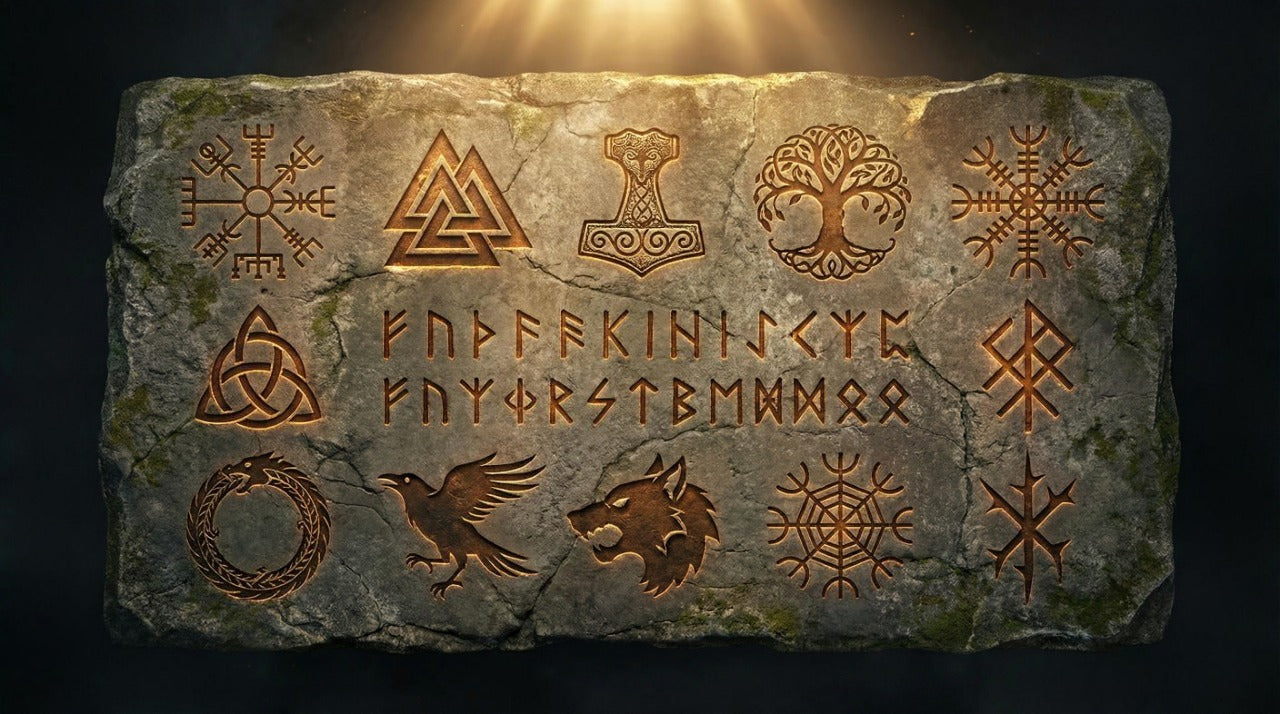
Viking Runestones: Inscriptions and Discoveries
Rain was falling in heavy sheets over the Jutland plain when I first caught sight of the two Jelling monoliths. They stood in the churchyard, massive and impassive, like two sentinels planted there a millennium ago to guard the memory of an entire people. Water streamed over the rock, and as I approached, the grooves carved into the granite seemed to come back to life—lines, curves, and symbols that the hands of a king had ordered engraved over a thousand years ago. These runestones were not mere stones. They were voices. And they were waiting for someone to listen to them.
My name is Sigrid. I am a runologist. My job consists of traveling across Scandinavia, Iceland, and sometimes lands much further away, to find, document, and decipher the inscriptions the Vikings left on stone. Each runestone is a fragment of conversation torn from the silence of the centuries. A warrior commemorating his father. A king proclaiming his conquest. A merchant cursing a thief. Behind every inscription lies a human story, carved into the granite with the same intensity as a cry cast into the North wind.
This article is the story of my discoveries. From Jelling in Denmark to the frozen shores of Greenland, via the mysteries of Rök in Sweden and the medieval alleys of Bergen, I am taking you to encounter the most famous Viking runestones ever discovered. Grab your pack. The journey begins now.
📌 In Brief
- A runestone is a megalith engraved with runic inscriptions, erected by Vikings and Germanic peoples between the 4th and 12th centuries.
- Sweden holds the vast majority, with approximately 2,500 runestones, most of which are in the Uppland region.
- Most inscriptions follow a standard format: who erected the stone, for whom, and sometimes the deeds of the deceased.
- The Jelling stones in Denmark are the most famous.
- Runology is the science that studies runic inscriptions.
The Jelling Stones: Denmark's Birth Certificate
Jelling is a modest village in central Jutland. A few houses, a white church, a graveyard. And yet, it is here that the heart of Danish identity beats. Because the two runestones of Jelling are nothing less than the founding documents of the Kingdom of Denmark—and witnesses to the Christianization of Scandinavia.
The first stone, the smaller one, was erected by King Gorm the Old around 955 AD in memory of his wife, Thyra. The inscription is poignantly sober. In characters of the Elder Futhark, the Viking runic alphabet, it simply proclaims:
“Kurmr kunukr karþi kuml þausi aft þurui kunu sina tanmarkar but”— Inscription on the small Jelling stone, c. 955 AD
“King Gorm made this monument in memory of Thyra, his wife, ornament of Denmark.”
Tanmarkar but — “ornament of Denmark.” In three words, Gorm offers his wife the most beautiful of tributes and, almost by accident, provides the first written mention of the name “Denmark” in all of history. I spent an entire hour in the rain tracing the runes of this stone with my finger, moved by the thought that a grieving king, over a millennium ago, had cast into eternity a declaration of love that still resonates today.
But it is the second stone that captures the imagination. Erected by Harald I, known as "Bluetooth" (Haraldr blátǫnn), around 965, it is monumental: nearly 2.5 meters high, adorned on three sides. One side bears a figure of Christ—the oldest depiction of Christ in Scandinavia. Another shows a great lion intertwined with a serpent, a masterpiece of Viking art. The third side bears the most famous inscription in all of Nordic epigraphy:
“Haraltr kunukr bað kaurua kuml þausi aft kurm faður sin auk aft þaurui muður sina. Sa Haraltr ias sēr uan Tanmaurk ala auk Nuruiak auk tani karþi kristna.”— Inscription on the large Jelling stone, c. 965 AD
“King Harald ordered these monuments made in memory of Gorm, his father, and Thyra, his mother. This Harald who conquered all of Denmark and Norway, and made the Danes Christian.”
In a few lines of runes, Harald proclaims three founding acts: he honors his parents, he claims the conquest of two kingdoms, and he announces the conversion of his people to Christianity. This runestone is a political, religious, and dynastic manifesto of extraordinary power. UNESCO inscribed it as a World Heritage site in 1994, recognizing it as one of the most important monuments of Nordic civilization. For anyone interested in Viking runes and their translation, Jelling is an essential pilgrimage.
The Rök Stone: The Longest Runic Inscription in the World
I left Denmark for Sweden, heading for the province of Östergötland. The Rök Stone was waiting for me in the churchyard of a small country church, protected by a modest shelter. Nothing in the landscape suggested that I was standing before the most extraordinary runic monument ever discovered.
The Rök Stone, dating to the early 9th century, carries about 760 runic characters—the longest runic inscription known to date. It covers all five sides of the granite block, with every square centimeter used, as if the carver lacked space to contain everything he had to say. And what he had to say still challenges runologists after two centuries of study.
The inscription begins with a funerary dedication from a father named Varinn in memory of his son, Vāmōðr. But very quickly, the text transitions into a series of riddles, mythological references, and cryptic questions. Varinn evokes Theodoric the Great, King of the Ostrogoths, sitting on his horse by the sea. He mentions battles where twenty kings lie on the battlefield. He poses riddles about light and darkness, and about the guardians of the world's secrets.
Interpretations diverge. Some scholars see it as a meditation on Ragnarök, the Nordic end of times. Others, such as Bo Ralph of the University of Gothenburg, proposed in 2019 that the inscription reflects climate anxiety—a memory of the catastrophic volcanic winters of the 6th century that had plunged Scandinavia into cold and famine. Varinn, by carving these runestones, may have been seeking to ward off the return of this darkness by invoking cosmic forces.
What struck me at Rök was the sophistication of the text. Varinn uses five different runic writing systems on the same stone—from the Elder Futhark to the Younger Futhark, including ciphered runes and cryptographic codes. It is the work of a man of exceptional erudition, who mastered not only writing but the art of concealing it. Each visit to Rök reveals a new detail to me, a rune I had misread, or a pun that had escaped me. This stone is an ocean.
The Gotland Runestones: When Mythology Takes Shape
The ferry from Nynäshamn dropped me off on the island of Gotland on a frosty morning. Gotland is a world apart. This Baltic island, the largest in Sweden, was for centuries a major commercial crossroads between the Orient and the Occident. The Vikings of Gotland were merchants as much as they were warriors, and they left behind a unique archaeological treasure: the historiated runestones, or bildstenar.
Unlike the runestones of the mainland, those of Gotland are not limited to textual inscriptions. They are adorned with figurative scenes of extraordinary richness: sailing ships, horsemen, battles, rituals, and above all, scenes taken directly from Nordic mythology. The most famous one, the Tjängvide stone (Gotland Museum, Visby), shows a horseman mounted on an eight-legged horse—Sleipnir, Odin's mount—welcomed by a woman offering him a drinking horn. It is a depiction of a warrior's arrival at Valhalla, and it constitutes one of the most important iconographic sources regarding Viking funerary rites and ship burials.
The Hammars stone, for its part, tells a complete saga in pictures. It shows a human sacrifice—a man hanging from a tree, reminiscent of Odin's sacrifice on Yggdrasil—followed by a naval battle scene and a funeral procession with a ship. Archaeologists recognize episodes from the Völsunga saga, notably the story of Sigurd and the dragon Fáfnir. These Gotland stones are granite comic strips, visual narratives that complete and enrich the texts of the Eddas.
I spent three days at the Gotlands Museum in Visby, photographing and sketching the bildstenar one by one. What fascinated me was the consistency of the motifs throughout the centuries. From the 5th to the 11th century, the same scenes repeat: the ship of the dead, the horseman and the valkyrie, the great serpent. It is as if each generation of Gotland carvers transmitted a sacred visual vocabulary, a language of stone as codified as the runes themselves. For anyone wearing a Viking pendant around their neck, these ancestral motifs resonate with an instinctive familiarity.
The Bryggen Inscriptions: Everyday Runes in Bergen
After the royal monuments and mythological stelae, I needed to hear ordinary voices. It was in Bergen, Norway, in the Hanseatic quarter of Bryggen, that I heard them. In 1955, a devastating fire ravaged part of the historic quarter. The subsequent archaeological excavations unearthed an unexpected treasure: more than 670 runic inscriptions carved on wooden sticks, bones, small boards, and fragments of trade goods.
The Bryggen inscriptions are radically different from the large commemorative runestones. These are texts of daily life. Merchandise labels: "This belongs to Sigurd." Commercial messages: "Send dried fish to Þorsteinn in Trondheim." Love letters—yes, love letters in runes: "Kiss me, I know you well." And even obscene graffiti that would make a sailor blush.
« Kyss mik, ek kann þik vel. »— Bryggen inscription, runic stick B145, 13th century
“Kiss me, I know you well.”
What makes the Bryggen inscriptions so precious is that they demonstrate that runes were not reserved for kings and grand occasions. Ordinary people—merchants, artisans, sailors—used runes in their daily lives to communicate, count, label, and have fun. Bryggen shows us a medieval Scandinavia that was vibrant, noisy, and commercial, where runes functioned as a practical tool as much as a sacred alphabet.
In the Bergen Museum, I held in my hands a pine wood stick engraved with runes so fine that a magnifying glass was needed to read them. The message simply said: “Ingibjörg loved me when I was in Stavanger.” A man, far from home, carving the memory of a love into a piece of wood. A thousand years later, his message reached me intact. That is the magic of runes: they are a technology of eternity.
The Kingittorsuaq Stone: Vikings at the end of the world
My last trip took me beyond Scandinavia, even beyond Europe. Headed for Greenland, the land the Vikings called Groenland—the “green land,” named by Eiríkr Rauði (Erik the Red) in 985 to attract settlers. It was on the west coast of Greenland, at a latitude of 72 degrees north—well beyond the Arctic Circle—that an extraordinary discovery was made in 1824.
Three stone cairns were found on the island of Kingittorsuaq, near Upernavik. Under one of them lay a small runestone of oblong shape, engraved with an inscription in Younger Futhark characters. The inscription, now kept at the National Museum of Denmark in Copenhagen, has been translated as follows:
« Erlingr Sigvatsson ok Bjarni Þórðarson ok Eindriði Oddsson laugardaginn fyrir gagndag hlóðu varða þessa ok rýddu. »— Kingittorsuaq inscription, Greenland, c. 1300 AD
“Erling Sigvatsson and Bjarni Thordarson and Eindridi Oddsson, the Saturday before Rogation Day, erected these cairns and cleared this place.”
Three men. Three Old Norse names. At 72 degrees north latitude, in a landscape of ice and tundra, thousands of kilometers from Scandinavia. What were they doing there? Probably a hunting expedition—northern Greenland was rich in walruses, narwhals, and polar bears, whose ivory and furs were luxury goods highly prized in Europe. But the inscription says nothing of their mission. It only says they were there, that they built cairns, and that they left their names on the stone.
The Kingittorsuaq stone is the northernmost runestone ever discovered. It is tangible proof that the Vikings did not just settle in southern Greenland—they explored territories situated on the edge of the habitable world. This discovery, combined with the remains at L'Anse aux Meadows in Newfoundland, confirms the staggering extent of the Nordic expansion. From the fjords of Norway to the ice of the High Arctic, runes traveled with the Vikings wherever they set foot.
Holding this stone in a Copenhagen museum induces a sense of temporal vertigo. Three men, lost in the whiteness of Greenland seven centuries ago, carved their names into the granite to say: we were here. And seven centuries later, we hear them. This is the ultimate function of runestones: to conquer time. Wearing a viking ring adorned with runes today means perpetuating that same ancestral desire to engrave a message into matter to defy oblivion.
The art of deciphering: how do you read a runestone?
Reading a runestone is not merely a matter of letter-by-letter translation. It is detective work that draws upon linguistics, archaeology, history, and sometimes pure intuition. Here are the steps I follow with every new discovery.
Physical examination. Before reading anything, I examine the stone itself. Its size, shape, geology. The type of rock—granite, sandstone, limestone—influences how well the runes have been preserved. The orientation of the grooves, their depth, the tool marks. Sometimes, lichen has overgrown the grooves, and delicate cleaning is required before the runes appear. I often use grazing light—a lamp placed at a very low angle—to bring out details invisible to the naked eye.
Alphabet identification. The Vikings used several runic systems over the centuries. The Elder Futhark (24 runes, used from the 2nd to the 8th century), the Younger Futhark (16 runes, from the 9th to the 12th century), and the Medieval Futhark (with dotted runes, from the 12th century onwards). Identifying the system used is the first key to decipherment. On the Rök stone, for example, Varinn uses five different systems—a deliberate puzzle.
Transliteration. Once the alphabet is identified, I convert each rune into its Latin phonetic value. Runes do not always record all vowels, and word separation is not systematic—some inscriptions form a continuous flow of characters without spaces. That is where knowledge of Old Norse becomes indispensable.
Interpretation. Transliteration provides a skeleton. Interpretation gives it flesh. One must understand the context: who commissioned the stone? For whom? To what end? The formulas are often standardized—“X had this monument made in memory of Y, his father/son/brother”—but the variations, the poetic additions, the invocations to the gods, or the curses against desecrators make each runestone unique.
This deciphering work is a conversation with the dead. Each rune is a sound uttered by a mouth that vanished a thousand years ago. Each inscription is a message sent across time by someone who hoped to be heard. And when, after hours of analysis, the meaning finally emerges from the chaos of signs, it is a moment of rare intensity—as if the carver himself were whispering his story in my ear.
A living heritage: runestones today
Scandinavia today counts about 3,000 recorded runestones, the vast majority of which are in Sweden (nearly 2,500), followed by Denmark and Norway. But this number increases regularly. In 2023, a new runestone was discovered in Svingerud, Norway—dated to about 2,000 years ago, it could be the oldest runic inscription ever found, pushing the origins of runic writing back by several centuries.
These runestones are not locked away in museums. Most remain in their original locations, in fields, cemeteries, and along roadsides in rural Sweden. I have occasionally been driving on a country road in Uppland and had to brake suddenly because a runestone stood on the shoulder, a meter from the road, without protection or signage. In Sweden, runestones are as much a part of the landscape as birch trees and lakes. They are a living heritage, accessible to all, visible every day.
This accessibility is both a blessing and a challenge. Weather, pollution, vandalism, and farming threaten these fragile monuments. Conservation programs, led notably by the Riksantikvarieämbetet (the Swedish National Heritage Board), work to document, protect, and restore these treasures. Modern technologies—3D scanning, photogrammetry, spectral analysis—now allow us to read runes that erosion had rendered invisible to the naked eye.
And then there is the popular fascination. Runestones inspire artists, writers, video game creators, and, of course, fans of Nordic culture. Wearing a viking bracelet engraved with runes is not just a fashion accessory—it is an act of memory, a silent tribute to those anonymous carvers who, a thousand years ago, entrusted their stories to stone.
The voices of the stone
At the end of this journey—from the Danish Jutland to the ice of Greenland, from the riddles of Rök to the lover's graffiti in Bergen—one certainty stands out. Runestones are not dead relics. They are voices. Thousands of voices, carved into granite, sandstone, and limestone, that continue to resonate through the centuries for anyone who takes the trouble to stop and listen.
King Gorm mourns his wife Thyra. Harald Bluetooth proclaims his conquest. Varinn of Rök launches his cosmic riddles into eternity. A merchant in Bergen doodles a declaration of love on a stick of wood. Three hunters lost in the Greenland Arctic stack cairns and carve their names to say they existed. All these voices, separated by centuries and thousands of kilometers, are united by the same gesture: the gesture of carving. Of digging into matter to leave a message. Of defying time, oblivion, and silence.
« Rúnar munt þú finna ok ráðna stafi,— Hávamál, stanza 142, Poetic Edda
mjök stóra stafi, mjök stinna stafi. »
“You shall find runes and signs to interpret, very great signs, very powerful signs.”
It is Odin himself who utters these words in the Hávamál, after tearing the runes from the void during his sacrifice on Yggdrasil. You shall find runes. It is an order as much as a promise. The runes are there, everywhere, carved into the stone of Scandinavia, waiting to be found, read, and understood. And every time a runologist deciphers a forgotten inscription, every time a traveler stops in front of a standing stone on a Swedish roadside, every time someone traces the runes of their own name in a notebook—Odin's promise is fulfilled.
The runestones of the Vikings are the world's oldest social networks. Public messages, carved into the most durable material, intended to be read by all who happened to pass by. A thousand years later, we are still passing by. And we are still reading. This may be the greatest victory of the Vikings—not the raids, not the conquests, but this magnificent obstinacy to carve words into stone so that no one, ever, could silence them.
Frequently Asked Questions about Runestones
What is a runestone?
A runestone is a megalith engraved with runic inscriptions, erected by the Vikings and Germanic peoples between the 4th and 12th centuries. These stones commemorated the deceased, marked territories, or celebrated feats. More than 3,000 have been found in Scandinavia.
Where are the most runestones found?
Sweden holds the vast majority with about 2,500 runestones, most of them in the Uppland region. Denmark has about 250, and Norway about fifty. They are also found in England, Scotland, and even Greece (Viking graffiti in the Hagia Sophia in Istanbul).
What do the inscriptions on runestones say?
Most inscriptions follow a standard format: who erected the stone, for whom, and sometimes the feats of the deceased. A typical example: Thorsten erected this stone for Harald his father, a good warrior. Some include curses against those who would move the stone.
What is the most famous runestone?
The Jelling stones in Denmark are the most famous. Erected by King Harald Bluetooth in the 10th century, they are considered the birth certificate of Christian Denmark. The largest one depicts Christ and bears the inscription Harald who conquered all Denmark and Norway and made the Danes Christian.
How do you decipher runestones?
Runology is the science that studies runic inscriptions. Researchers use their knowledge of the Futhark (Elder and Younger), Old Norse, and the historical context. Some inscriptions are clear, while others remain partially undecipherable due to erosion or obscure magical formulas.
Did runestones have magical power?
Some stones bear protective formulas or explicit curses. The Björketorp stone in Sweden warns: He who destroys this monument will be struck by a curse and death. The Vikings believed that carving runes onto stone gave it lasting power.
👉 Discover our collection of Viking decorations and our relics and artifacts to carry the Viking legacy into your daily life.

Leave a comment
All comments are moderated before being published.
This site is protected by hCaptcha and the hCaptcha Privacy Policy and Terms of Service apply.