
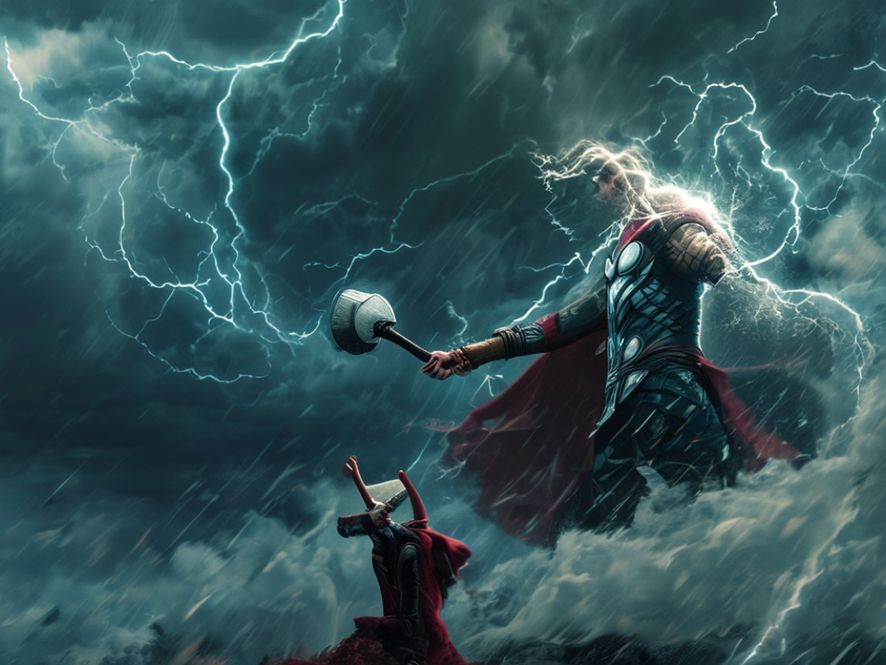
Thor: God of Thunder and Master of Mjölnir
📌 In brief
- Thor is the god of thunder, son of Odin and the goddess Jörd (Earth).
- The mythological Thor is a red-haired and bearded warrior, stocky and short-tempered, who travels in a chariot pulled by two goats.
- Mjölnir means the one that crushes.
- Thor was the protector of farmers, sailors, and ordinary warriors, unlike Odin who favored kings and poets.
- During Ragnarök, Thor faces the world serpent Jörmungandr in a titanic battle.
Who is Thor, the god of thunder?
Before being a character, Thor, the god of thunder, is a meteorological phenomenon. His name, Þórr in Old Norse, descends from the Common Germanic *Þunraz which simply means "the thunder" — the same root gave us þunor in Old English and Donar in Old High German. When the sky rumbled over the fjords, the Scandinavians of the Viking Age did not say the storm looked like the god: they said the god was passing by. This direct link between the name and the sky explains almost everything else about his personality.
The two major sources that introduce us to him are the Poetic Edda, a collection of anonymous poems preserved in the Codex Regius manuscript (13th century, but drawing on much older poems), and the Prose Edda by Snorri Sturluson, an Icelandic manual of poetry written around 1220. To these are added the sagas, skaldic poetry, and, above all, archaeology—because Thor is the Norse god whose cult has left the most material traces: amulets, casting molds, inscribed stones, and place names.
A family of giants and earth
Thor is the son of Odin and Jörd, the personified Earth, whom poetry also calls Fjörgyn or Hlóðyn. It is a telling genealogy: the god of the stormy sky is born of sovereignty and the soil. Since Jörd herself is of giant lineage, Thor, the sworn enemy of the giants, is half-giant through his mother—an irony that medieval texts never try to fix.
He is married to Sif, the golden-haired goddess, whose hair was cut by Loki and then replaced by a dwarven work of art. Snorri gives him a daughter, Þrúðr ("Strength"), whose mother is never named in the texts, and two sons: Móði ("Anger") and Magni ("Power"), the latter born to the giantess Járnsaxa. The names of his children are a statement of purpose. His stepson Ullr, god of the bow and skiing, completes this household. Finally, two human youths, the brother and sister Þjálfi and Röskva, accompany him as servants after an incident we will recount later.
His dwelling is named Bilskírnir, in the realm of Þrúðvangar. The poem Grímnismál (stanza 24) states that it has five hundred and forty halls and is the largest of houses ever built. Once again, excess is the message.
The chariot, the goats, and the roar of the sky
Contrary to what cinema has established in our memories, Thor does not fly. He drives. His chariot is pulled by two goats with evocative names, Tanngnjóstr ("teeth-grinder") and Tanngrisnir ("teeth-barer"), and it is the clatter of his wheels on the celestial vault that produces thunder. The National Museum of Denmark summarizes the belief as follows: Thor travels across the sky in his chariot pulled by the goats Tanngnjóstr and Tanngrisnir, producing thunder and lightning with his hammer Mjölnir.
These goats possess a stunning property: Thor can slaughter and eat them in the evening, then resurrect them in the morning by spreading Mjölnir over their hides, provided the bones have been kept intact. It is precisely this ritual that Þjálfi breaks by cracking a marrow bone: the resurrected goat remains lame, and to make amends for the mistake, the two children enter the service of the god. The myth here says something very concrete for a Scandinavian farmer: food returns, the year begins again, provided the rules are respected.
Thor's objects of power: three attributes and a borrowed staff
We remember the hammer, but Snorri counts three—to which the poems add a fourth object, borrowed for the duration of a single expedition. Here is the thunder god's complete equipment.
| Attribute | Old Norse Name | Function in the texts |
|---|---|---|
| The hammer | Mjǫllnir | Throwing weapon that never misses its target and returns to hand; also used for consecration and resurrection. |
| The belt of strength | Megingjǫrð | Doubles Thor's divine power when he buckles it. |
| The iron gloves | Járngreipr | Indispensable for gripping the hammer's burning handle. |
| Gríðr's staff | Gríðarvǫlr | Borrowed from the giantess Gríðr for the expedition to Geirröðr, when Thor travels without his hammer. |
As for his appearance, the texts insist on the beard, the terrifying gaze, and an unrivaled strength; several later sagas and the testimony of medieval chroniclers further give him the famous red beard. Nothing, however, describes him as blond or slender: the medieval Thor is a stocky colossus, rough, frank, and prone to anger, whose very humor is brutal.
Mjölnir: meaning of the name and the forge of the dwarves Brokkr and Eitri (Sindri)
What "Mjölnir" means
The meaning of Mjölnir has been the subject of much scholarly ink. The most widespread hypothesis links Mjǫllnir to an Indo-European root meaning "to grind, to crush"—the same family as the Russian molnija ("lightning") and the Welsh mellt ("lightning bolt"). Thus, the name is commonly translated as "the one that crushes", with this decisive nuance: the one that crushes while producing lightning. A second, minority view relates it to the Old Norse mjǫll, "fresh snow," or to a term for a light-colored weapon. In any case, the name denotes an instrument of percussion, not a sword: Mjölnir is the blacksmith's tool that became the weapon of the sky.
Loki's bet and the too-short handle
The account of the forging comes to us from the Skáldskaparmál, the second part of Snorri's Edda. It all begins with a prank by Loki, who cuts off Sif's golden hair while she sleeps. Compelled to make amends, Loki goes down to the dwarves and obtains three wonders from the sons of Ivaldi: living golden hair for Sif, the folding ship Skíðblaðnir, and Odin's spear Gungnir. Emboldened, he then wagers his own head that two other dwarves, Brokkr and his brother Eitri—whom many translations and popular accounts name Sindri—will not do better.
Eitri works the forge; Brokkr operates the bellows. Loki, who cannot stand to lose, turns into a fly and pricks the dwarf three times. The first two times, Brokkr holds firm: out come the boar with golden bristles Gullinbursti and then the ring Draupnir, which multiplies every nine nights. On the third time, the fly bites his eyelid, blood runs into his eye, he lets go of the bellows for a second—and the hammer comes out of the forge with a too-short handle. This defect, inscribed in the most powerful object in the Nine Worlds, is one of the finest discoveries of Norse mythology: absolute perfection does not exist, even among the gods.
The Aesir judge Mjölnir to be superior to everything else anyway, as it is the best defense against the giants. Loki loses his bet, saves his head through a legal technicality—the neck was not included in the wager—and gets off with his lips sewn shut.
Thor's hammer: much more than a weapon
Snorri lists three properties: Mjölnir strikes as hard as Thor wishes without ever breaking, it never misses its target, and it always returns to its master's hand. But the texts attribute a fourth virtue to it, the most important for understanding the actual cult: the power of consecration (vígja). The hammer blesses marriages, sanctifies funeral monuments, and resurrects goats. It is an instrument of the sacred as much as a weapon, and it is for this reason that thousands of Scandinavians wore a miniature of it around their necks. If you are interested in the details, our complete guide to the Mjölnir necklace traces its symbolism and archaeological forms.
Þrymskviða: the day Thor dressed as a bride
It is the funniest poem in the Poetic Edda, and no one has ever faithfully brought it to the screen. Thor wakes up one morning: Mjölnir is gone. Loki borrows Freyja's feather cloak and discovers the culprit, Þrymr, lord of the giants, who has buried the hammer eight leagues underground and sets his conditions: he will return the weapon in exchange for the hand of Freyja.
The goddess refuses with such fury that her necklace, Brísingamen, breaks on her chest. It is then that Heimdallr proposes the unthinkable: that Thor himself should dress as a bride. The god of thunder is indignant—it would be said of him that he lacks virility—but Loki reminds him that otherwise, the giants will inhabit Asgard that very evening. Veiled, adorned with Brísingamen, and with a bunch of keys at his belt, Thor sets off for Jötunheimr with Loki as his maidservant.
The banquet is an anthology piece: the "bride" devours an entire ox, eight salmon, all the sweets intended for the women, and empties three barrels of mead. Þrymr is worried; Loki explains that Freyja has not eaten for eight nights because she was burning with impatience. The giant then lifts the veil for a kiss and recoils from a burning gaze; the same excuse is served with the same aplomb: the fiancée hasn't closed her eyes for eight nights. Reassured, Þrymr then orders the ritual gesture that will be his undoing.
"Bring in the hammer to hallow the bride, lay Mjölnir on the young woman's lap, and unite us by the hand of Vár!"— Poetic Edda, Þrymskviða, stanza 30
This stanza is an ethnographic document disguised as a gag. It teaches us that in pagan Scandinavia, a hammer—or its image—was placed on the bride's lap to sanctify the union under the guarantee of Vár, goddess of oaths. The poet does not explain it: he assumes his audience knows the rite. The aftermath is swift. With Mjölnir in hand, "the heart of Hlórriði laughed in his chest": Thor strikes down Þrymr, then exterminates the entire giant household, including the king's old sister who had come to demand her wedding gifts.
Jörmungandr's Fishing Trip: Thor vs. The World Serpent
If the Þrymskviða is the comic myth, the fishing for the serpent is the cosmic myth. It is recounted twice: in the poem Hymiskviða and in Snorri’s Gylfaginning, with variants that prove the story circulated in several forms.
Thor is staying with the giant Hymir, who takes him fishing on the condition that he finds his own bait. The god goes off to decapitate the finest ox in the herd, Himinhrjóðr (“The Sky-Tearer”), and sets sail with this monstrous head. Hymir wants to stop at his usual fishing grounds; Thor rows on, and on, to the waters where nothing sensible lives. He casts his line. Jörmungandr, the serpent that encircles Midgard by biting its own tail, takes the bait.
There follows one of the most powerful images in all of Germanic mythology: Thor pulls so hard that his feet crash through the hull and press against the ocean floor. The serpent’s head emerges, spitting its venom. Thor raises Mjölnir. And there, Hymir, terrified at the idea of the world falling apart, cuts the line. The serpent dives back down. Thor knocks the giant out with a punch and walks back, furious, in a very characteristic mixture of triumph and incompletion.
A Myth Carved in Stone
This narrative is not a late invention by Christian clerics: it was depicted on stone long before it was written down. The Altuna Runestone (Uppland, Sweden, 11th century) shows a figure in a boat, hammer raised, with one foot punching through the bottom of the craft — exactly the scene from Snorri. The Hørdum stone in Denmark and the "Gosforth Fishing Stone" in the English Cumbrian region depict the same scene, which attests to its diffusion from Scandinavia to the Viking colonies of the British Isles. In other words: the iconography confirms the texts, and the texts explain the iconography. It is a textbook case for the history of religions, detailed in the "Thor" entry of the Encyclopædia Britannica.
Finally, note the internal logic: Thor and Jörmungandr are twice separated by outside intervention. The score is not settled. They will meet again.
The Journey to Útgarða-Loki: The Only Time Thor Loses
Snorri dedicates one of the longest developments of the Gylfaginning to Thor’s journey to Jötunheimr, and it is also the most devious. Accompanied by Loki, Þjálfi, and Röskva, Thor crosses a forest and spends the night in a strange building with a main hall and five annexes. In the morning, the house reveals itself to be the glove of a sleeping giant, Skrýmir, whose snoring shakes the forest. Three times during the night, Thor strikes his skull with his hammer; three times the giant wakes up, asking if a leaf or an acorn just fell on him.
Upon reaching the fortress of Útgarðr, the visitors are challenged by King Útgarða-Loki. Each of the trials seems absurd, and each is lost.
- Loki loses a gluttony contest against one Logi, who devours the meat, the bones, and the trough: Logi was wildfire.
- Þjálfi, the fastest of men, is outpaced by the young Hugi: Hugi was thought.
- Thor fails to empty a drinking horn in three gulps: the other end of the horn plunged into the ocean, and yet he lowered its level — this is how the tides were born.
- He fails to lift an old gray cat, only managing to lift one paw: the cat was Jörmungandr in disguise, and the world trembled.
- He is finally brought to his knees by an old woman named Elli: she was old age, which no one has ever defeated.
In the morning, Útgarða-Loki escorts his guests outside the walls and confesses everything: without these illusions, he would never have let Thor enter. The three nighttime hammer blows did not hit his head but a mountain, where they carved out three valleys. Mad with rage, Thor raises Mjölnir — the fortress has disappeared, and nothing remains but an empty plain. This myth says in its own way that brute force, however prodigious, is nothing against time, thought, and fire. It also places Thor back into a precise cosmology, that of the Nine Worlds suspended from the branches of the world-tree, which we detail in our article on Yggdrasil, the world-tree of Norse mythology. And the episode of the bottomless horn has left a lasting mark on the imagination of Nordic drinking culture, the codes of which can be found in our guide to Viking tankards and mugs.
Hrungnir, Geirröðr: The God Who Settles Scores
Two other duels are worth knowing. Against the giant Hrungnir, the only adversary to have wounded him before Ragnarök, Thor receives a fragment of a whetstone in his skull that remains lodged there; it is his son Magni, three nights old, who clears the dead giant’s leg off his father. Against Geirröðr, he sets out without his hammer, belt, or gloves, and owes his salvation only to the staff and belt lent by the giantess Gríðr — the episode inspired the skald Eilífr Goðrúnarson to write his poem Þórsdrápa around the year 1000, one of the great skaldic poems dedicated to Thor’s exploits — alongside Þjóðólfr ór Hvini's Haustlöng (c. 900) and Bragi Boddason's Ragnarsdrápa, which is even older.
Thor and Humans: What Archaeology Proves About Real Worship
This is where Thor radically distinguishes himself from the other Norse gods. Odin fascinates kings, poets, and elite warriors; Thor, however, is the god of working people. The German chronicler Adam of Bremen, writing around 1075, describes the temple at Uppsala and places Thor at the center, between Odin and Freyr: he presides, he says, over the air, thunder, winds, rains, fair weather, and harvests. For a farmer or a sailor, no god is more useful.
Hammer Amulets, and the Købelev Proof
Nearly a thousand hammer-shaped pendants have been found across Scandinavia, Iceland, England, Normandy, and even as far as the Rus' trading posts. They appear massively from the 9th century onwards, precisely at the time when the Christian cross was spreading — many see this as an assertion of identity. A steatite casting mold discovered at Trendgården, in Jutland, allowed for both crosses and hammers to be cast in the same operation: the artisan served both clienteles, which says a lot about the coexistence of the cults.
For a long time, archaeologists had to make do with interpreting the shape of these pendants. Then, in 2014, a detectorist unearthed a 10th-century bronze amulet at Købelev, on the Danish island of Lolland, barely two and a half centimeters long. Under the microscope, runologist Lisbeth Imer, of the National Museum of Denmark, read a short runic inscription: hmar x is — "this is a hammer." To this day, it is the only hammer-pendant bearing a runic inscription, and it ends the debate: these objects do indeed represent Mjölnir, and their wearers knew it. Rarely has a discovery confirmed a century-old hypothesis so literally.
Runes, Standing Stones, and Protection Formulas
Thor is also the only pagan god invoked directly on runestones. At least three Danish monuments — Glavendrup, Virring, and Sønder Kirkeby — carry the formula Þórr vígi, “may Thor hallow” this monument or these runes. The Kvinneby copper plate (Öland, Sweden, 11th century) goes further: it calls on Thor and his hammer to specifically protect a certain Bófi from evil. This is no longer literature; it is daily piety, carved by ordinary hands. For more on how these beliefs translated into images and sculpted figures, see our dossier on Viking statues and representations of Norse gods.
The God Inscribed in the Map and the Calendar
Toponymy tells the same story. Torsåker and Torshälla in Sweden, Torshov and Torsnes in Norway, Thorsager in Denmark, Þórsnes and Þórsmörk in Iceland: places consecrated to Thor are countless, often far more numerous than those dedicated to Odin. Given names follow: Þórsteinn, Þórolfr, Þórgeirr, Þórfinnr, Þórdís, Þóra... A considerable portion of the Icelandic settlers listed in the Landnámabók bear a name composed with that of the god. You do not name your child after a divinity you fear: you name them after the one who protects.
Finally, the calendar. Old Norse Þórsdagr gave us the English Thursday, the German Donnerstag, and the Dutch donderdag: Thursday is indeed, in the Germanic world, Thor’s day. A clarification is necessary, however, for francophone readers: our "jeudi" comes from the Latin Jovis dies, the day of Jupiter. The two names are not independent — Germanic peoples adapted the Roman week by replacing each Latin god with their local equivalent, and it was Thor whom they deemed equivalent to Jupiter, the master of lightning. Thursday and "jeudi" therefore designate, across two pantheons, the same celestial function.
Thor: Norse Mythology vs. Marvel: What Pop Culture Changed
The Thor that most people have in mind was born in 1962 in issue #83 of Journey into Mystery, under the pencils of Jack Kirby and the scripts of Stan Lee and Larry Lieber. That Thor is an American creation from the Golden Age of comics, loosely inspired by the Eddas, and one should no more reproach him for his liberties than reproach a model for moving. But if one seeks to understand the historical thunder god, the gap deserves to be clearly laid out.
| Element | Norse Mythology Thor | Marvel Thor |
|---|---|---|
| Appearance | Stocky, bearded colossus; red beard in late sources | Blond, clean-shaven then bearded, superhero silhouette |
| Movement | Chariot drawn by two goats, or on foot; never flies | Flies by throwing Mjölnir and holding onto it |
| Mother | Jörd, the Earth, of giant lineage | Frigga in the films; in the comics, biological mother Gaea, equated with Jörd, with Frigga as adoptive mother |
| Loki | Blood brother of Odin; traveling companion and rival of Thor, never his brother | Thor’s adoptive brother, son of Laufey the frost giant |
| Sif | Thor’s wife, goddess with golden hair | Asgardian warrior, comrade-in-arms |
| Mjölnir | Forged by dwarves Brokkr and Eitri; short handle by accident; hallows and resurrects | Forged of uru metal; enchanted to obey only the one "who is worthy" |
| Gloves and belt | Járngreipr and Megingjörð, essential for wielding | Virtually absent or purely decorative |
| Character | Frank, gluttonous, short-tempered, not given to guile; protector of the humble | Crown prince, narrative arc of redemption and maturity |
| Fate | Dies at Ragnarök, poisoned by Jörmungandr | Survives his own "Ragnaröks" throughout editorial sagas |
One difference is deeper than all others: dignity. In Marvel, Mjölnir is a moral test; it only allows itself to be lifted by pure hearts. This idea, splendid on screen, is totally absent from the Eddas. The Nordic hammer has no opinion on the virtue of its wielder; it is a tool, and iron gloves are enough to hold it. The medieval Thor, moreover, would probably not be judged “worthy”: he lies under a bridal veil, eats like four, gets angry over a cracked bone, and solves almost all his problems by hitting things. That is precisely why Scandinavian peasants loved him: he was like them, only stronger.
Thor at Ragnarök: Nine Steps and Silence
Everything in Thor's biography converges on one adversary. He missed him while fishing, he lifted him unknowingly in the form of a gray cat, and he will meet him again on the last day. The Völuspá, the opening poem of the Poetic Edda, describes the scene in a few verses of striking sobriety: the son of Hlóðyn — that is to say, of the Earth — advances against the serpent, strikes him dead, then moves nine steps away before falling, struck down by the venom.
Nine steps: the number is not mere ornamentation. Nine is the structuring number of Norse cosmology, that of the worlds, of the nights Odin spent hanging from the tree, and the nights separating the multiplications of Draupnir. Thor does not die defeated; he dies after having won, and he has just enough life left to measure the distance separating him from his own end. No pantheon has written a more dignified death for its most brutal god.
On that day, according to the Völuspá and the Gylfaginning, Odin is devoured by the wolf Fenrir, Freyr falls under Surtr's sword, Heimdallr and Loki kill each other, and the stars disappear from the sky while the earth sinks into the sea. Then the earth re-emerges, green, and a few survivors find themselves in the grass. The Vafþrúðnismál (stanza 51) specifies who inherits: Móði and Magni, Thor's sons, will possess Mjölnir when the battle is over. The hammer changes hands; the protective function is passed on. The end of the Norse world is not an annihilation, it is a succession — a theme found surrounding the Valhalla and the Valkyries, Odin's warriors, tasked specifically with preparing for this battle.
Thor's Legacy Today
A thousand years after the Christianization of Scandinavia, Thor has not disappeared; he has changed medium. We encounter him every week in the name of Thursday in Anglo-Saxon and Germanic languages. We encounter him in Scandinavian surnames, in village names, and on staff maps. We encounter him in scientific vocabulary, since the chemical element thorium, isolated by Berzelius in 1828, bears his name.
He has also returned as a living religious figure: Ásatrú, officially recognized in Iceland since 1973, celebrates the Aesir once again, and the hammer holds its ritual place there. And he is everywhere in contemporary visual culture, from comic books to video games, to the Nordic musical scenes that draw endlessly from the Eddas.
There remains the oldest and simplest gesture: wearing the hammer. Scandinavians of the Viking Age did so in bronze, silver, and sometimes gold, and the Købelev pendant taught us that they knew exactly what they were wearing. It is that same gesture that is extended today by a Mjölnir pendant from our selection of Viking jewelry, a Thor statue placed on a shelf, or even a bottle opener in the shape of Mjölnir that brings a smile with every beer opened — a wink that the god who drank three barrels of mead would surely not have disapproved of.
For that is what makes Thor unique in the Norse pantheon: he was never a distant god. He was the powerful neighbor one called upon when the storm threatened the harvest, when the ship took to the sea, when a marriage needed to hold. A god one wore on oneself.
Still have questions about Thor, his hammer, or his cult? The answers to the most frequently asked ones await you right below.
Frequently Asked Questions About Thor
Who is Thor in Norse mythology?
Thor is the god of thunder, son of Odin and the goddess Jörd (Earth). Armed with his hammer Mjölnir, he protects Asgard and Midgard against the giants. He was the most popular god among the Vikings, considered the protector of ordinary men.
What is the difference between the mythological Thor and the Marvel Thor?
The mythological Thor is a red-haired and bearded warrior, stocky and short-tempered, who travels in a chariot pulled by two goats. The Marvel Thor is blond, elegant, and flies thanks to Mjölnir. Mythology describes him as more brutal and grounded than the Hollywood version.
What does the Mjölnir hammer represent?
Mjölnir means the crusher. Forged by the dwarves Brokkr and Sindri, it never misses its target and always returns to Thor's hand. It symbolizes protection, strength, and consecration — Vikings wore it as a pendant as a protective amulet. To delve deeper into the subject, discover our complete guide to the Mjölnir necklace, including its history, symbolism, and our advice on how to choose your pendant.
Why is Thor the Vikings' favorite god?
Thor was the protector of farmers, sailors, and ordinary warriors, unlike Odin, who favored kings and poets. The Vikings wore Mjölnir pendants for his protection, and Thursday bears his name (Thor's day).
Does Thor fight Jörmungandr during Ragnarök?
Yes, during Ragnarök, Thor faces the world-serpent Jörmungandr in a titanic battle. Thor kills the serpent but succumbs to its venom after taking nine steps. It is one of the most dramatic moments in Norse mythology.
Did Vikings consecrate marriages with Mjölnir?
Yes, Thor's hammer was used during Viking wedding ceremonies. A hammer was placed on the bride's lap to bless the union and ensure fertility and protection. This ritual is described in the Eddic poem Þrymskviða.
What are the delivery times and return conditions for the "Master of Runes" tankard?
For the Master of Runes tankard, as with any order, allow for 10 to 20 business days in total: 3 to 5 days for preparation, followed by 7 to 15 days for delivery in mainland France, and 10 to 20 days within the European Union. Delivery costs €4.90 in France and the EU, and is free on orders over €49. After receipt, you have 14 days to change your mind and return the item: return shipping costs are at your expense. If the item received is defective or does not match your order, we will refund the return shipping costs upon presentation of proof of postage.
"Cattle die, kinsmen die, the self must also die; but I know one thing which never dies: the judgment on each one dead."
— Hávamál, stanza 77
May the Aesir guide you on the path of honor.
👉 Explore our collections of Viking statues and Viking jewelry to carry the Viking spirit in your daily life.
📚 Read also
- The Norse Gods: Complete List of the Asgardian Pantheon
- Freya: Norse Goddess of Love, War, and Magic
- The 17 Viking Symbols and Their Deep Meaning
- Valkyries: Odin's Warriors and Valhalla
- Viking Tree of Life: Meaning, Jewelry, and Tattoos
- Yggdrasil: The World-Tree of Norse Mythology
- Viking Tankards and Mugs: The Art of Drinking Like a Nordic Warrior

Leave a comment
All comments are moderated before being published.
This site is protected by hCaptcha and the hCaptcha Privacy Policy and Terms of Service apply.