
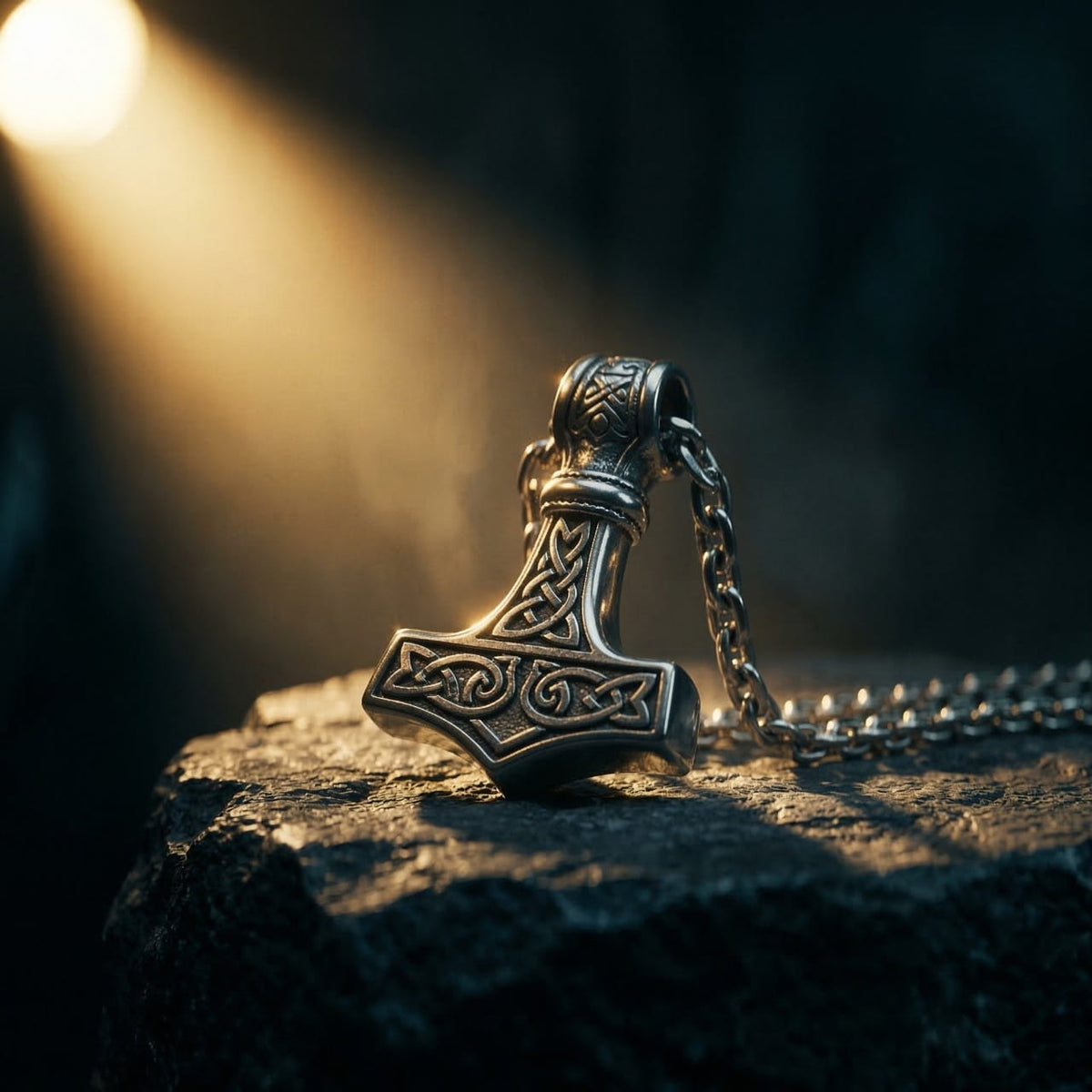
Mjölnir Necklace: The Viking Thor’s Hammer Guide

The Mjölnir, Thor's hammer amulet forged in Nordic steel
The Mjölnir necklace is one of the most powerful amulets in Nordic culture. Representing the hammer of Thor, god of thunder, it embodies divine protection against chaos. More than 50 authentic Mjölnir pendants have been found in Viking graves from the 9th to the 11th century, proof of its sacred importance. Today, this pendant carries on a thousand-year-old tradition of strength, protection, and pride inherited from the warriors of the North.
📌 In short
- The Mjölnir necklace symbolizes the divine protection of Thor, the Nordic god of thunder.
- Vikings wore Mjölnir pendants as amulets for personal protection, but also as a sign of religious affiliation against Christianization.
- 316L stainless steel is the best choice for everyday use: it is water-resistant, corrosion-resistant, does not tarnish, and is hypoallergenic.
- The Mjölnir has become a universal symbol of strength, protection, and pride.
- The Mjölnir can be worn alone as a centerpiece, or layered with other Viking jewelry: Futhark bangle bracelets, rune signet rings, or steel chain bracelets.
Looking for a necklace rather than an explanation? Our necklaces and other Thor's hammer pieces are gathered in the Mjölnir collection.
What is the Mjölnir?
The Mjölnir (pronounced "Mioll-nir") is the sacred war hammer of Thor, god of thunder in Norse mythology. Its name literally means "that which crushes" or "crusher" in Old Norse. This divine weapon is the most recognizable attribute of the Aesir pantheon, much like Odin's spear Gungnir.

The Mjölnir unleashing lightning, embodiment of Thor's power
According to the Prose Edda, the Mjölnir was forged by the dwarf brothers Brokk and Eitri following a bet with Loki. Despite a flaw in its manufacture—its handle was too short, caused by Loki’s interference while in the form of a fly—the hammer became the most fearsome weapon in Asgard. It possessed three legendary powers:
- Never missing its target, regardless of the force with which it was thrown
- Always returning to Thor's hand after striking
- The ability to shrink so it could be hidden under clothing
"It will strike so hard that it will split mountains, and whatever it is thrown at, it will always return to his hand."— Prose Edda, Snorri Sturluson, 13th century
Among Viking symbols, the Mjölnir occupies a central place alongside the Valknut, the Vegvisir, and the Triquetra. Its graphic representation—a stocky hammer with a square head and short handle—has remained almost unchanged since the first rune stones of the 9th century.
The Symbolism of the Mjölnir: Protection, Power, Fertility
Contrary to what its martial form might suggest, the Mjölnir necklace is not just a symbol of war. Among the Vikings, it carried three deep and complementary symbolic dimensions.
1. Protection against chaos
Thor is above all the protector of Midgard (the world of men) against the giants of chaos (Jötnar). His hammer repels the destructive forces that threaten the cosmic order. Wearing a Mjölnir pendant is to invoke this divine protection in everyday life, as an extension of Thor's own shield. Vikings wore this amulet before battles, sea voyages, and moments of trial.
2. Power and self-affirmation
The Mjölnir embodies brute yet controlled strength. It is the tool with which Thor blesses weddings, consecrates funerals, and asserts his sovereignty over the other gods. Wearing this amulet is to claim a form of personal power—not one used to crush others, but to remain standing in the face of adversity. This is a message that resonates particularly with modern men seeking self-affirmation.
3. Fertility and blessing
A lesser-known aspect: Thor was also the god of fertility and blessings. The Mjölnir was used to consecrate Viking marriages—in the Poetic Edda, Thor symbolically places his hammer on the laps of young brides to invoke fertility. This dimension of prosperity and life cycles makes the Mjölnir necklace an amulet of luck as much as a symbolic weapon.
The History of the Mjölnir Necklace Among the Vikings

Viking warrior and his Mjölnir, amulet of protection in combat
Archaeological Mjölnir pendants are among the most iconic Viking objects found by researchers. More than 50 authentic examples have been unearthed from Scandinavian graves, mainly in Denmark, Sweden, and Norway, dating from between the 9th and 11th centuries.
Major archaeological discoveries
The most famous pendants come from iconic sites:
- Bredsätra Hoard (Öland, Sweden): several solid silver Mjölnir, with finely chiseled interlace
- Mammen Grave (Denmark): a gilded bronze pendant covered in gold, discovered in the tomb of a Viking chieftain
- Kiev site (Ukraine, 9th c.): proof that the Mjölnir traveled with the Vikings as far as Slavic lands
- Købelev Pendant (Denmark, 2014): the first Mjölnir with a runic inscription "Hmar x is" — "This is a hammer"
A symbol of resistance against Christianization
The explosion in the number of Mjölnir pendants in the 10th century is no coincidence. It was precisely at this time that Christianity was gaining ground in Scandinavia. Facing the crosses worn by missionaries, pagan Vikings intensified the wearing of the Mjölnir as a marker of identity and faith.
Sociologist Neil Price even speaks of a phenomenon of "resistant religious fashion": Viking blacksmith workshops began producing combined molds capable of casting both a Mjölnir AND a Christian cross on the same matrix, proof that the two symbols coexisted in a competitive context.
How to Choose Your Mjölnir Necklace
Not all Mjölnir necklaces are created equal. To choose a pendant that will last over time and suit your style, four criteria really matter.
The material: stainless steel, silver, or bronze?
The best material for daily use is undoubtedly 316L stainless steel, also called surgical steel. Its advantages are considerable:
- Never rusts, even in saltwater or with intense sweat
- Hypoallergenic (nickel-free), suitable for the most sensitive skin
- Resistant to daily shocks and scratches
- Retains its shine for years without special care
Our Viking Stainless Steel Mjölnir Valknut Rune Necklace uses this material, for a piece you can wear without any special precautions.
Antique bronze and aged silver evoke more of the archaeological aspect of authentic Mjölnirs. They require a bit more maintenance but offer a unique patina that improves with time.
The size of the pendant
The ideal size depends on your build and the look you want to achieve:
- Small (2-3 cm): discreet, perfect for layering with other jewelry, also suitable for women
- Medium (3-5 cm): ideal balance, visible without being ostentatious—the most popular size
- Large (5-7 cm): statement piece, very masculine, ideal for asserting a bold warrior style
The engraving style
Mjölnirs are distinguished by their ornamental engravings. The three main styles:
- Celtic interlace: the most classic, inspired by Scandinavian archaeological finds
- Futhark runes: for a magical and incantatory appearance
- Integrated Valknut: combined with the symbol of warriors fallen in battle, for a sacred dimension
The chain: leather or steel?
The chain accounts for 50% of the final look. Two schools of thought:
- Steel chain (snake chain, Cuban chain): modern and urban look, durable
- Braided leather cord: authentic and raw look, evokes the original Vikings
How to Wear Your Mjölnir Necklace

The Mjölnir worn in a contemporary style: a timeless symbol
The Mjölnir necklace can be worn just as well with ripped jeans as with a white shirt. Here are three ways to integrate it into your style without a misstep.
As a single, visible piece
Wear the Mjölnir over a dark t-shirt (black, charcoal grey, khaki) or an open-collar shirt. This is the most direct way to display its symbolism. Avoid turtlenecks that would hide the pendant and kill the effect.
Layered with other Viking jewelry

Mjölnir layering: a cohesive set with other Nordic jewelry
The Mjölnir pairs perfectly with other Nordic pieces for a complete look. Our recommendations for cohesive combinations:
- With a Mjölnir Triquetra Signet Ring for a thematically coherent duo
- With a Viking Mjölnir Steel Chain Bracelet for a masculine set
- With Futhark rune bangles for a raw Nordic look
- With a Viking Black Wood Mjölnir Watch to carry the theme all the way to the wrist
The golden rule: keep a single central pendant (the Mjölnir) and complete it with pieces without pendants (bands, rings, smooth chains) to avoid visual overload.
Discreet mode, under clothing
Some prefer to wear the Mjölnir under clothing, in direct contact with the skin. This practice follows the tradition of personal amulets, invisible to others but a source of inner strength for the wearer. Perfect for a professional or formal context where ostentatious jewelry would be inappropriate.
The Mjölnir Necklace as a Gift
The Mjölnir necklace is one of the most universally appreciated Viking gifts. Its symbolism of protection and strength makes it a present that transcends mere jewelry.
Who should you give a Mjölnir necklace to?
- A man passionate about Norse mythology or series like Vikings, Valhalla, The Last Kingdom
- A loved one going through a difficult time — the Mjölnir is a symbolic gift of protection and support
- A Marvel fan — Thor has popularized the Mjölnir with a new generation
- A father, a brother, a friend to whom you want to offer a masculine gift that is both stylish and meaningful
For other ideas, explore our complete collection of Viking jewelry — necklaces, rings, bracelets, and exceptional pieces.
Our advice for gift-giving
A Mjölnir necklace offers more than just an accessory: it is a symbol. Take the time to explain the meaning of the pendant in a small card — Thor's protection, the connection to Norse mythology, the ancient tradition. The gift will be all the more impactful.
If you want to go further, pair the necklace with a life-size Thor's hammer replica or a resin Thor statue for a complete Viking gift pack.
Frequently Asked Questions about the Mjölnir Necklace
What does the Mjölnir necklace symbolize?
The Mjölnir necklace symbolizes the divine protection of Thor, the Norse god of thunder. It represents three dimensions: protection against chaos (Thor wards off destructive forces), personal power and self-assertion in the face of adversity, and fertility / blessing (Thor consecrated marriages with his hammer). The Vikings wore it as an amulet of luck and inner strength.
Why did the Vikings wear a Mjölnir pendant?
The Vikings wore a Mjölnir pendant for three main reasons: first, as an amulet for personal protection, invoking Thor during critical moments. Second, as a sign of religious affiliation in the face of the Christianization that was taking hold in the 10th century. Finally, as a marker of social status — solid silver or gold-plated bronze Mjölnirs were reserved for high-ranking jarls and warriors. More than 50 authentic pendants have been found in Scandinavian graves.
What material should I choose for a Mjölnir necklace?
For daily wear, 316L stainless steel is the best choice. It is water-resistant, corrosion-resistant, does not tarnish, is hypoallergenic, and requires no maintenance. For a more authentic and archaeological look, antique bronze or aged silver evoke more of the Viking pieces found in Scandinavian tombs, at the cost of occasional maintenance.
Can I wear a Mjölnir necklace if I am not Viking or Nordic?
Absolutely. The Mjölnir has become a universal symbol of strength, protection, and pride, well beyond its Scandinavian origins. There is no cultural or religious prohibition against wearing this amulet: on the contrary, you are perpetuating an ancient mythological tradition that spread throughout Europe with the Viking expansions. Today, the Mjölnir is worn all over the world as a symbol of personal conviction.
How can I wear the Mjölnir necklace with other jewelry?
The Mjölnir can be worn using three main approaches: alone as a centerpiece (dark t-shirt, open shirt, over clothing); layered with other Viking jewelry (Mjölnir signet ring, Futhark bangle, steel chains) while keeping only one central pendant; or under clothing in contact with the skin for a personal and discreet wear. Avoid mixing it with non-Nordic religious symbols to preserve visual and symbolic coherence.
How much does a quality Mjölnir necklace cost?
Prices vary according to the material and finish. A quality stainless steel (316L) Mjölnir necklace generally costs between 20 and 40 euros. Models in antique bronze or solid silver can range from 60 to 150 euros. Beware of prices that are too low (less than 10 €), which often hide low-end steel that will quickly turn black, or plating that will flake off.
Does the Mjölnir necklace have a religious meaning?
Historically, yes: the Mjölnir was the religious symbol of followers of Ásatrú, the Norse pagan religion. It still is for modern neopagans who follow Ásatrú today. But for the majority of contemporary wearers, it is primarily a cultural and personal symbol without an active religious dimension. You are free to wear it according to your own interpretation: protection, Nordic pride, mythological passion, or simply aesthetic style.
Find your Mjölnir
Discover our selection of necklaces and Viking jewelry: 316L stainless steel, authentic engravings, free delivery from 49€.
To compare models side by side, our Mjölnir collection brings together pieces featuring Thor's hammer, from discreet pendants to signet rings.

Leave a comment
All comments are moderated before being published.
This site is protected by hCaptcha and the hCaptcha Privacy Policy and Terms of Service apply.