
Viking Jewelry: Symbols, Meaning, and Care
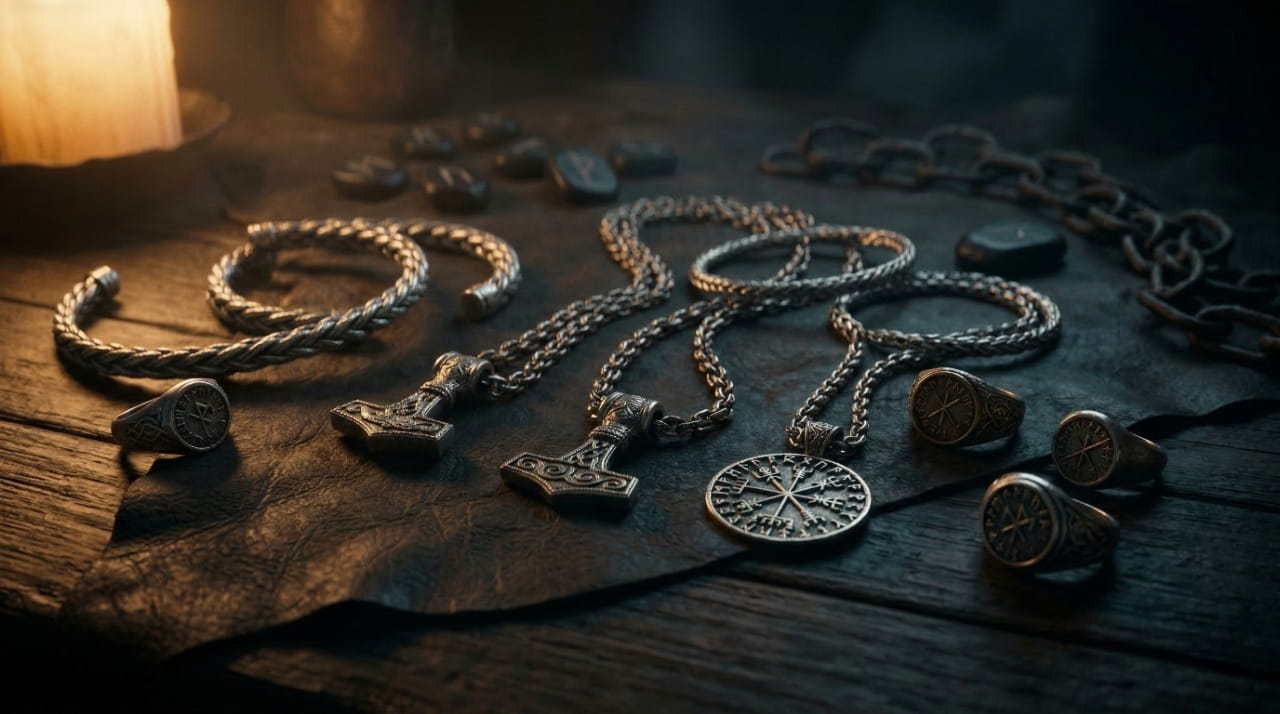
Viking jewelry fascinates with its symbolic power and raw aesthetic. Worn by the warriors, kings, and craftsmen of medieval Scandinavia between the 8th and 11th centuries, these ornaments were not mere decorations: they told stories, invoked the protection of the gods, and affirmed their owner's social rank. From the fjords of Norway to the trading posts of Constantinople, Nordic jewelry has crossed the seas and the centuries to become, today, one of the most powerful symbols of Viking culture.
Whether you are passionate about Norse mythology and its symbols, a fan of men's jewelry with a strong identity, or simply curious to discover this thousand-year-old heritage, this complete guide accompanies you into the world of pendant necklaces, runic bangle bracelets, and Viking signet rings. We will explore the history, symbols, manufacturing techniques, and the best advice for choosing and maintaining your Nordic jewelry.
Table of Contents
- The History of Viking Jewelry
- Viking Necklaces and Pendants
- Viking Bracelets and Bangles
- Viking Rings and Signet Rings
- Symbols Engraved in Jewelry
- How to Choose Your Viking Jewelry
- Caring for Viking Jewelry
- Frequently Asked Questions
In short: The most popular Viking jewelry pieces are Mjölnir pendant necklaces, Futhark rune bangle bracelets, and Vegvisir signet rings. Made of stainless steel, they combine thousand-year-old Norse symbolism with modern durability. The Vegvisir protects and guides, the Valknut honors warriors, and Mjölnir brings the strength of Thor.
Are you looking for a specific piece rather than an explanation? The Viking Jewelry department brings together the entire catalog, with a size guide for each family: rings, necklaces, bracelets, earrings, and Viking watches.
The History of Viking Jewelry: Much More Than Ornaments
To understand the place of jewelry in Viking civilization, one must discard our modern conception of jewelry. In the Nordic society of the Early Middle Ages, a piece of jewelry was never simply decorative. It simultaneously embodied its owner's wealth, religious devotion, social status, and sometimes even their currency. The Icelandic sagas and Frankish chronicles are full of descriptions where rings, torcs, and brooches play a central role in negotiations, alliances, and funeral rituals.
The Viking Age, which lasted approximately from 793 (raid on Lindisfarne) to 1066 (Battle of Stamford Bridge), produced some of the finest examples of medieval European goldsmithing. Scandinavian artisans mastered techniques that their contemporaries envied, creating pieces whose complexity and finesse still surprise archaeologists today.
Hacksilver: When Jewelry Served as Currency
One of the most fascinating aspects of Viking jewelry lies in the concept of hacksilver. Before the widespread adoption of minted coins, the Vikings used a monetary system based on the weight of precious metal. A silver bracelet could thus be literally cut into pieces to pay for a transaction. Archaeologists have found hundreds of these fragments in hoards buried throughout Scandinavia.
The Hoen Hoard, discovered in Norway in 1834, constitutes one of the most spectacular collections of Viking jewelry ever unearthed. It contained gold rings, necklaces, and brooches of inestimable value, testifying to the trade networks that connected Scandinavia to Byzantium and the Arab world. The treasures of Gotland, that Swedish island located in the heart of the Baltic Sea, have revealed over 700 silver deposits, including many whole and fragmented jewelry pieces.
This hacksilver system explains why so many Viking jewels have been found broken or incomplete. Far from being acts of vandalism, these cuts were everyday economic gestures. A Viking merchant could carry their fortune on them in the form of spiral bracelets, which they would section off as needed to settle their purchases at the markets of Birka or Hedeby. Portable scales found in merchants' graves confirm this practice: every transaction involved a precise weighing of the metal.
Viking Goldsmithing: Exceptional Craftsmanship
Viking goldsmiths mastered remarkably sophisticated techniques that rivaled those of the best Byzantine artisans. Filigree, which involves welding fine gold or silver wires onto a metal surface to create complex patterns, reached an extraordinary degree of finesse among the Scandinavians. Granulation, a technique consisting of fixing tiny beads of precious metal to form designs, was also mastered with remarkable precision.
The materials used varied according to the region and the owner's social status. Silver dominated largely, fueled by trade flows with the Islamic world that provided dirhams by the thousands. Bronze was used for more accessible jewelry, while gold remained the prerogative of chieftains and kings. Baltic amber, jet, and rock crystal sometimes embellished the most precious pieces.
Regional styles differed significantly. The Borre style (mid-9th to late 10th century) was characterized by tight interlacing and grimacing animal heads. The Jellinge style featured animals in the shape of sinuous ribbons. The later Mammen style and Urnes style evolved toward more elegant and fluid forms, heralding the transition to Romanesque art. This stylistic evolution can be found in the jewelry of each period, allowing archaeologists to date the finds precisely. Viking artisans were also artists, and their creations reflect a worldview where the beautiful and the sacred were intimately linked, as we explore in our article on Odin, the god of wisdom.
With weapons and fine clothes friends make each other happy; those who give and return gifts remain friends for the longest time.— Hávamál, verse 41, Poetic Edda
Viking Necklaces and Pendants: The Symbol Closest to the Heart
Of all Viking jewelry, the pendant necklace holds a unique place. Worn against the chest, close to the heart, it embodied the most intimate connection between the warrior and their beliefs. Archaeological excavations have revealed that pendants were worn by both men and women, and that they often accompanied the deceased to their final resting place. In cremation graves as well as inhumation burials, necklaces are among the objects most frequently deposited alongside the dead.
The tradition of the Viking pendant rests on a fundamental principle: the symbol worn around the neck protects its owner and affirms their spiritual identity. Whether it is a Mjölnir invoking the power of Thor, a Vegvisir guiding the traveler, or a rune charged with magic, each pendant told a story and carried an intention.
The Mjölnir Pendant: The Quintessential Viking Jewel
The hammer of Thor, called Mjölnir in Norse mythology, is undeniably the most iconic symbol of Viking jewelry. More than a thousand hammer-shaped pendants have been found across Scandinavia, Iceland, the British Isles, and even Russia. This massive distribution testifies to the extraordinary popularity of this symbol, which served both as a protective amulet and a marker of religious identity in the face of the spread of Christianity.
Thor, the god of thunder, was the protector of common men, the defender of Asgard against giants, and the guarantor of cosmic order. To wear his hammer was to place one's life under the protection of the most powerful of the Aesir. The 2014 discovery in Denmark of a Mjölnir pendant bearing the runic inscription "This is a hammer" finally confirmed the identification of these jewels, dispelling the last doubts of archaeologists.
Our Mjölnir pendants carry on this tradition with modern materials. The classic Mjölnir in stainless steel faithfully reproduces the trapezoidal shape characteristic of Scandinavian archaeological finds, with a short handle and a massive head adorned with interlacing patterns.
Viking Mjölnir Valknut Runic Stainless Steel Necklace Viking Mjölnir Valknut and Nordic Rune Necklace This men's stainless steel 316L Viking necklace brings together three sacred symbols of...from 25.90 €View product →The range of Mjölnir pendants comes in several finishes: polished steel for a bright shine that catches the light, blackened steel for a raw look evoking the iron of Viking blacksmiths, and antique bronze for a warm patina that recalls the original archaeological pieces. Each version carries the same symbolic power, the same charge of history, and the same affirmation of identity.
Vegvisir, Yggdrasil, and Runic Pendants
Beyond Mjölnir, the pantheon of Norse symbols offers an extraordinary richness of motifs for pendants. The Vegvisir, often called the "Viking compass," is a symbol of protection and guidance. According to Icelandic tradition, whoever wears this sign will never lose their way, even in the most violent storm. Our Vegvisir pendants reproduce this magic stave with meticulous precision, each branch and auxiliary symbol engraved into the steel with remarkable fidelity.
Viking Vegvisir Compass Runic Steel Necklace Viking compass pendant surrounded by Futhark runes — Protection and guidance25.90 €View product →The Yggdrasil, the world-tree of Norse cosmology, is another major motif of Viking pendants. This gigantic ash tree whose roots plunge into the three primordial wells and whose branches support the nine worlds represents the connection between all levels of existence. To wear an Yggdrasil pendant is to affirm one's awareness of the interconnection of all things and one's quest for wisdom, much like Odin who sacrificed himself on this tree to obtain knowledge of the runes.
Viking Yggdrasil Tree of Life Runic Steel Necklace The sacred world-tree surrounded by runes — Wisdom and cosmic connection25.90 €View product →The runes of the Elder Futhark offer unique personalization. Each rune carries a specific meaning: Fehu (ᚠ) for wealth and prosperity, Algiz (ᛉ) for divine protection, Tiwaz (ᛏ) for victory and justice, Othala (ᛟ) for heritage and roots. Choosing a runic pendant means selecting the energy you wish to carry with you.
Viking Necklace Fehu Rune Wealth Silver Steel The Vegvísir compass encircled by Futhark runes — Never lose your way€19.90See product → Viking Necklace Aegishjalmur Antique Steel The Helm of Awe in antique steel — Protection and courage in battlefrom €19.90See product →Odin's Ravens and Warrior Pendants
The figure of Odin, the All-Father, inspires a particularly striking range of pendants. His two ravens, Huginn (thought) and Muninn (memory), would travel the world each day to report back to their master everything they had seen and heard. Wearing a pendant with Odin's ravens is a way to cultivate thought and memory, the two pillars of Norse wisdom. It is also a reminder that the one-eyed god sees everything, that he knows the secrets of both the living and the dead.
Viking Necklace Patinated Raven Skull Patinated raven skull on a leather cord — Odin's gaze upon the world€19.90See product →For those seeking a bolder style, warrior-themed pendants capture the spirit of berserkers and Norse fighters. The stainless steel skull pendant, delivered in a wooden box, evokes the toughness of warriors who did not fear death, knowing that the Valkyries were waiting to lead them to Valhalla.
Viking Necklace Skull Chain Stainless Steel — Wooden Box Steel skull pendant with premium wooden box — The warrior spiritfrom €34.90See product →The wolf tooth pendant pays tribute to Fenrir, the monstrous wolf son of Loki, whose power was so great that the gods themselves could only contain him with a magical chain forged by the dwarves. This steel and leather pendant blends the brutality of metal with the suppleness of leather, creating a striking contrast that appeals to fans of masculine jewelry with a strong character.
Viking Necklace Wolf Tooth Interlace Wolf tooth adorned with Norse interlace — Power and primal instinctfrom €25.90See product →
Viking Bracelets and Bangles: Strength on the Wrist
The bracelet holds a fundamental place in Norse jewelry tradition. Even more so than the necklace, the Viking bracelet—whether in the form of a rigid bangle, a twisted torque, or a chainmail cuff—was the quintessential piece of everyday jewelry. Warriors wore it into battle, merchants would cut it to pay for purchases, and chieftains distributed it to their followers as a sign of generosity. In the sagas, the expression "ring-breaker" (hringbroti) referred to a generous lord who shared his wealth with his brothers-in-arms.
Archaeological discoveries confirm the omnipresence of bracelets in Viking culture. At Birka, the great Swedish trading center, graves have yielded dozens of bracelets made of silver, bronze, and iron. The Gotland hoards contained silver spirals that served as both ornamentation and monetary reserves. In England, the Cuerdale Hoard (Lancashire) revealed over 8,600 silver objects, including a significant proportion of bracelets and bracelet fragments (hacksilver).
The meaning of the oath ring, model families, pricing, and size selection: everything is detailed in our guide Viking Bracelet Meaning: symbols, models, and size.
Runic Bangles: The Legacy of Torques
The Viking bangle is the direct heir to the Celtic and Germanic torque, that rigid metal collar or bracelet that symbolized social rank and divine protection. Modern runic bangles perpetuate this tradition by adding the magical dimension of runes. Engraved with the 24 characters of the Elder Futhark, these bracelets literally carry the sacred alphabet of the ancient Scandinavians on the skin of their owner.
Each rune engraved on a bangle is much more than a letter: it is a power-laden symbol. According to Norse tradition, the runes were discovered by Odin himself when he hanged himself from Yggdrasil for nine days and nine nights, pierced by his own spear, to access primordial wisdom. Wearing runes on one's wrist is, therefore, wearing a fragment of that divine wisdom, a tangible link to the sacrifice of the All-Father.
Viking Torque Futhark Runic Alphabet Antique Steel Open bangle engraved with the 24 runes of the Elder Futhark — Magic on the wrist€25.90See product →Our range of runic bangles comes in four distinct finishes, each evoking a different aspect of the Viking aesthetic. Antique steel recalls archaeological pieces patinated by the centuries. Matte black steel evokes the Nordic night and the mystery of the runes. Shiny polished steel captures the light like the silver of Scandinavian hoards. Antique bronze steel restores the warmth of the copper alloys used by Viking Age craftsmen.
Viking Bangle Futhark Runes Matte Black Steel Matte black finish for a dark and mysterious style€25.90See product → Viking Bangle Futhark Runes Shiny Polished Steel Mirror-polished finish for a luminous shine€25.90See product → Viking Bangle Futhark Runes Antique Bronze Steel Warm bronze finish for an authentic patina€25.90See product →The advantage of the open bangle lies in its adjustability. Unlike a closed bracelet that requires a precise size, the bangle can be slightly opened or tightened to adapt perfectly to the shape of the wrist. It is exactly the same principle as the original Viking torques, designed to be worn permanently without hindering the movements of the warrior or craftsman.
Chainmail Bracelets: The Warrior's Strength
Alongside rigid bangles, chainmail bracelets constitute another major family of Viking jewelry for the wrist. Inspired by the mail shirts that protected warriors in battle, these braided steel or chainmail bracelets combine robustness and flexibility. Their weight on the wrist evokes the solidity of Norse steel, while their flexibility allows for comfortable wear throughout the day.
The Mjölnir chainmail bracelet is a particularly popular choice. Its solid steel chain ends in a clasp shaped like Thor's hammer, thus combining the symbolism of the god of thunder with the warrior aesthetic of Viking mail. It is a piece of jewelry that does not go unnoticed: it clearly affirms an affiliation with Norse culture and the search for a self-assured masculine style.
Viking Bracelet Mjölnir Steel Chainmail Massive steel chain with Thor's hammer clasp — Power on the wristfrom €19.90See product → Viking Bracelet Black Rope Steel Black rope braiding with steel ends — Norse marine stylefrom €29.90See product →The Odin's ravens bracelet with runes is an exceptional piece in our collection. Adorned with the two ravens Huginn and Muninn flanking Futhark runes, it combines Odinic wisdom with the magical power of the runic alphabet. It is a piece of jewelry that speaks to those who see in Norse mythology not just an aesthetic, but a true philosophy of life.
Viking Bracelet Odin's Ravens Runes Stainless Steel Huginn and Muninn with engraved runes — Wisdom and ancestral memory€25.90See product →
Viking Rings and Signet Rings: Authority on the Finger
The Viking ring is perhaps the Norse piece of jewelry most charged with social symbolism. In the Scandinavian tradition, the ring symbolized oaths, commitment, and honor. Chieftains swore oaths on a sacred ring kept in the temple, and arm rings (baugr) gifted by a lord to his warriors sealed a bond of loyalty stronger than any written contract. The Old Norse term baugbroti (ring-breaker) described someone who betrayed an oath—the worst of crimes in Viking society.
Modern Viking signet rings inherit this symbolic weight while adapting it to contemporary aesthetics. Wide, massive, engraved with powerful symbols, they affirm a strong personality and an embraced connection to the Norse heritage. A Viking ring is not subtle jewelry: it is a statement.
Which finger to wear it on, how to find your size, which family to choose: everything is detailed in our guide Viking Ring Meaning: finger, size, and symbols.
Symbol Signet Rings: Vegvisir, Valknut, Yggdrasil
Signet rings adorned with Viking symbols form the heart of our ring collection. The Vegvisir engraved on the face of a signet ring offers permanent protection to its wearer. The eight branches of this Icelandic magical stave, each ending with a different symbol, form a mystical shield that prevents the bearer from going astray, whether on raging seas or in the storms of life.
Viking Ring Wide Band Vegvisir Triquetra Steel Wide signet ring adorned with the Vegvisir and the Triquetra — Double protectionfrom €14.90See product →The Valknut, formed of three interlaced triangles, is one of the most mysterious symbols in Norse mythology. Associated with Odin and warriors fallen in battle, it appears on several runestones and funerary stelae from the Viking Age. Wearing a Valknut signet ring is a way to honor the memory of warriors from the past and affirm one's courage in the face of adversity. It is also a way to acknowledge Odin's presence in one's life and accept the challenges he sends.
Viking Signet Ring Valknut Interlace Gold Steel Odin's three triangles in gold-toned steel — Honor and braveryfrom €19.90See product →The Yggdrasil signet ring features the world tree in a particularly elegant oval format. The roots and branches of the cosmic tree intertwine in a circular composition that evokes the eternal cycle of life, death, and rebirth—a central theme of Norse spirituality that is also found in traditions surrounding the tree of life.
Viking Signet Ring Yggdrasil Tree of Life Oval Steel The world tree in an oval format — Cosmic wisdom on the fingerfrom €14.90See product →Animal and Mythical Pattern Rings
Norse mythical fauna offers an inexhaustible source of inspiration for Viking rings. The serpent Jörmungandr, the world-serpent that encircles Midgard (the world of men) by biting its own tail, is a motif particularly suited to the circular format of a ring. Our Jörmungandr ring reproduces the cosmic serpent in a steel spiral that seems alive on the finger, the finely engraved scales catching the light with every movement of the hand. Other serpent and dragon pieces can be found in our Norse dragons and serpents section.
Viking Jörmungandr Midgard Serpent Stainless Steel Ring The world serpent that encircles Midgard — Eternal cycle and cosmic powerfrom €19.90See product →The Fenrir wolf, a titanic creature chained by the gods until Ragnarök, inspires rings of remarkable visual power. The wolf head signet ring captures the wild and untamable essence of this legendary beast, with an open jaw and protruding fangs that leaves no one indifferent. It is a piece of jewelry for those who embrace their warrior nature, their refusal of domestication, and their thirst for freedom.
Viking Berserker Bear Signet Steel Ring The jaw of the berserker bear in solid steel — Untamable powerfrom €19.90See product →The raven, Odin's sacred animal, also lends itself to rings of great elegance. Our Celtic raven ring blends Nordic imagery with Celtic-inspired interlacing, reminding us that Nordic and Celtic cultures shared many artistic motifs and spiritual beliefs.
Viking Celtic Raven Steel Ring Odin's raven intertwined with Celtic motifs — Wisdom and mysteryfrom €19.90See product →Finally, the witch's knot (valknútr or knot of protection) appears on our stainless steel ring as a symbol of protective magic. This intertwined motif, found in both Viking art and Celtic and Anglo-Saxon traditions, was reputed to repel evil spirits and curses. It is the ideal piece of jewelry for those interested in the esoteric and shamanic dimension of Nordic culture.
Viking Witch's Knot Stainless Steel Ring The magical knot of protection — Magic and Nordic spiritualityfrom €14.90See product →
Comparison Table of Viking Symbols
Viking Symbols Engraved in Jewelry
Viking symbols are not mere decorative patterns; they constitute a true visual language loaded with meaning, magic, and spirituality. Each motif engraved into the steel of a piece of jewelry carries with it centuries of beliefs, rituals, and traditions passed down from generation to generation by the skalds and völvas of ancient Scandinavia. To understand these symbols is to enter the heart of Nordic thought.
Symbols of Protection: Vegvisir and Ægishjálmur
The Vegvisir and the Ægishjálmur (Helm of Awe) are the two great symbols of protection in the Nordic tradition. Although they are often confused due to their similar appearance — both are staves with eight branches originating from a center — they serve distinct and complementary functions.
The Vegvisir is a symbol of guidance. Mentioned in the Icelandic Huld manuscript (19th century, but based on older traditions), it is described as a sign that prevents the wearer from losing their way. Viking sailors reportedly engraved this symbol on their drakkar longships to navigate safely through the fogs of the North Atlantic. Today, wearing a Vegvisir piece means seeking clarity in life choices and the certainty of always finding one's path.
The Ægishjálmur, on the other hand, is a symbol of invincibility and intimidation. According to the sagas, warriors would paint it on their foreheads before battle to strike terror into their enemies. The Saga of Fáfnir recounts that the dragon Fáfnir wore an Ægishjálmur that rendered him invulnerable. This powerful symbol bestows upon its wearer an aura of unwavering strength, a psychic shield against attacks and negative influences.
Symbols of Strength: Mjölnir and Valknut
The Mjölnir is the most famous weapon in Norse mythology. Forged by the dwarves Brokkr and Sindri, this hammer possessed the power to always hit its target and return to Thor's hand. Beyond its martial function, Mjölnir was also used to consecrate weddings, births, and funerals: it was an instrument of blessing as much as of destruction. In jewelry, Mjölnir represents brute strength tempered by justice, power put to the service of protecting the weak.
The Valknut (knot of the slain) is directly linked to Odin as the god of those who die in battle. The three intertwined triangles symbolize the three realms of existence (Asgard, Midgard, Helheim) and Odin's power to bind and unbind the fates of warriors. This symbol appears on the famous Oseberg stone (Norway) and several Gotlandic grave steles. Wearing the Valknut means accepting that death is part of life and facing each day with the courage of those who are not afraid to fall.
Symbols of Wisdom: Yggdrasil, Runes, and Triquetra
The Yggdrasil is the supreme symbol of Nordic wisdom. This cosmic tree connects the nine worlds of Viking cosmology: Asgard (world of the Aesir), Vanaheim (world of the Vanir), Alfheim (world of the light elves), Midgard (world of men), Jotunheim (world of the giants), Svartalfheim (world of the dark elves), Niflheim (world of ice), Muspelheim (world of fire), and Helheim (world of the dead). Its roots reach into three wells: the well of Urd (fate), the well of Mimir (wisdom), and the well of Hvergelmir (source of the rivers). Wearing Yggdrasil on a piece of jewelry is to embrace the totality of existence and recognize one's place in the great cosmic web.
The Elder Futhark runes (24 characters divided into three families of eight, called ættir) combine the function of writing with a magical and divinatory dimension. Each rune is associated with a concept, a natural element, and a deity. Fehu (wealth, cattle) opens the first ætt and attracts prosperity. Uruz (aurochs) embodies primitive strength. Thurisaz (giant, thorn) protects and destroys. Ansuz (Odin, divine breath) connects to the divine. Rune carvers (erilar) were respected and feared specialists, capable of inscribing magic into stone and metal.
The Triquetra (three intertwined knots), although often associated with Celtic culture, also appears in Viking art, notably on the Snæfellsnes cross in Iceland and the Funbo stone in Sweden. This symbol represents the trinity of cosmic forces — creation, preservation, destruction — or the three aspects of time — past, present, future. In jewelry, the Triquetra evokes harmony and balance between opposing forces.
How to Choose Your Viking Jewelry: The Definitive Guide
Given the richness of the selection of Viking jewelry, it can seem difficult to make a choice. However, the right jewelry is one that resonates with your personality, your values, and your style. Here is a structured guide to help you find the piece that perfectly suits you.
Choose by Symbol and Meaning
The first criterion for choosing should always be the symbol. Each Viking symbol carries a specific energy and intention:
- Are you looking for protection? Opt for the Vegvisir or the Ægishjálmur.
- Do you want to affirm your strength? The Mjölnir or the Fenrir wolf stand out.
- Are you looking for wisdom? Yggdrasil or the runes are meant for you.
- Are you honoring warriors? The Valknut carries that weight.
- Are you drawn to mystery? The ravens of Odin or the Jörmungandr serpent will suit you.
To delve deeper into the meaning of each symbol, check out our complete guide on Viking symbols and their meanings.
Choose by Type: Necklace, Bracelet, or Ring
The type of jewelry depends on your clothing style and the visibility you wish to give your piece:
- The pendant necklace is the most versatile piece of jewelry. Worn under a t-shirt, it remains discreet and intimate. On an open collar or a henley, it becomes a visible accessory that draws attention. It is the ideal choice for a first piece of Viking jewelry because it adapts to all situations.
- The bangle bracelet is the most visible piece of jewelry for everyday wear. Impossible to hide, it clearly asserts your style. Open bangles slip on in seconds and adjust themselves. It is the favorite jewelry for those who want a practical and impactful piece.
- The signet ring is the most expressive piece of jewelry. Every handshake, every gesture of the hand highlights your signet ring. It is a piece of character, which perfectly suits confident personalities.
Choose by Finish and Metal
All our jewelry is made from 316L stainless steel, an alloy that combines resistance to corrosion, durability, and hypoallergenic properties. This modern material offers the benefits of Viking iron's strength without its drawbacks (rust, oxidation). The available finishes allow you to vary styles:
- Polished shiny steel: Bright luster, contemporary and elegant look, reminiscent of the silver of Scandinavian treasures.
- Blackened steel (PVD): Dark and matte appearance, evokes forged iron and the Nordic night, ideal for a raw style.
- Antique bronze steel: Warm golden patina, restores the aesthetic of archaeological jewelry, perfect for an authentic look.
- Gold-toned steel: Gold finish reminiscent of the gold of Viking kings, for a royal and assertive style.
Giving Viking Jewelry as a Gift
Viking jewelry makes an exceptional gift, loaded with meaning and history. To give a piece that will leave a lasting impression, here are the two most popular items from our store:
Viking Odin's Ravens and Runes Stainless Steel Bracelet Huginn and Muninn, the two ravens of Odin — our best-selling jewelry€25.90See product Viking Vegvísir Arrowhead Necklace The runic compass engraved on an arrowhead — ideal for gifting€19.90See productThese sets are carefully curated so that each piece complements the others harmoniously. They represent an ideal entry point into the world of Viking jewelry, offering their recipient a coherent set that can be worn entirely or piece by piece depending on the occasion.

Maintaining Your Viking Steel Jewelry
One of the great advantages of Viking stainless steel jewelry is its ease of maintenance. Unlike silver, which tarnishes, gold, which scratches, or bronze, which oxidizes, 316L stainless steel is remarkably resistant to the rigors of daily life. Nevertheless, a few simple actions can help keep your jewelry looking bright and beautiful for many years to come.
Daily Cleaning and Maintenance
To clean your Viking jewelry regularly, follow these simple steps:
- Lukewarm water and mild soap: Submerge your piece in a bowl of lukewarm water with a few drops of mild soap (Castile soap, neutral dish detergent). Let it soak for 5 to 10 minutes to soften any deposits.
- Gentle brushing: Use a soft toothbrush to clean the reliefs and engravings. Runic patterns and interlace designs sometimes accumulate dust or sebum that a simple rinse cannot remove.
- Rinsing and drying: Rinse thoroughly with clear water and dry carefully with a soft, lint-free cloth. Residual moisture, while not dangerous for stainless steel, can leave limescale marks.
- Occasional polishing: For polished, shiny finishes, a microfiber polishing cloth will restore the steel’s luster. Use gentle circular motions, following the direction of the original polish.
Tips for Preserving the Patina
For jewelry with an antique bronze or blackened steel finish, the patina is an integral part of the aesthetic. Here is how to preserve it:
- Avoid abrasive products: Metal cleaners, toothpaste, or baking soda can alter PVD finishes and decorative patinas. Stick to soapy water for cleaning.
- Remove your jewelry for intense physical activities: Although steel is impact-resistant, repeated friction against weights, barbell bars, or hard surfaces can prematurely wear down the surface finish.
- Store your jewelry separately: Use a fabric pouch or the individual compartments of a jewelry box to prevent pieces from scratching each other. Our packaging boxes make for ideal storage.
- Avoid prolonged contact with chemical products: Pool chlorine, bleach, alcoholic perfumes, and sunscreen can alter certain finishes. Apply your cosmetic products before putting on your jewelry.
With these simple habits, your Viking jewelry will retain its beauty and character for years, or even decades. Stainless steel is a material designed to last, just like the Nordic heritage it carries on.
"The jewelry you wear tells who you are. The jewelry you give says how you feel. The jewelry you pass down promises what you hope for."— Le Comptoir Viking
Frequently Asked Questions about Viking Jewelry (FAQ)
What are the most popular Viking jewelry pieces?
The most popular Viking jewelry includes Mjölnir pendant necklaces (Thor's hammer), bangle bracelets engraved with Futhark runes, and Vegvisir signet rings. These three categories represent the essence of the Nordic jewelry tradition, blending powerful symbolism with recognizable aesthetics. Pendants featuring Odin's ravens and Jörmungandr serpent rings are also gaining popularity among Nordic mythology enthusiasts.
Did Vikings really wear jewelry?
Yes, Vikings wore jewelry in their daily lives. Archaeological discoveries throughout Scandinavia, Iceland, and as far as Russia attest to a rich and diverse jewelry-making tradition. Both men and women wore brooches, rings, torcs, and pendants made of silver, bronze, or gold. Jewelry also served as currency through the hacksilver system: a bracelet could be cut into pieces to pay for a transaction, with each fragment weighed on a portable scale.
How do I choose the size of a Viking bracelet?
To choose the size of a Viking bangle bracelet, measure your wrist circumference with a flexible tape measure. Open bangles adjust easily by widening or tightening them slightly—they suit most body types without needing a precise size. For link bracelets with a clasp, add about 1 to 1.5 cm to your wrist circumference for a comfortable fit that allows the bracelet to move naturally without feeling tight.
Which metal is best for men's Viking jewelry?
316L stainless steel is the ideal metal for men's Viking jewelry. It offers excellent resistance to impact, corrosion, water, and sweat. Unlike silver, it does not tarnish; unlike gold-plated metal, it does not flake. The available finishes—polished bright steel, PVD blackened steel, antique bronze, and gold—allow you to find a style that matches any personality, from a refined look to a raw aesthetic.
Which Viking symbol should I choose for jewelry?
The choice of symbol depends on what you are looking for: the Vegvisir for protection and guidance, Mjölnir for strength and courage, the Valknut to honor fallen warriors and the connection to Odin, Yggdrasil for wisdom and cosmic connection, Futhark runes for magic and ancestral knowledge, or the Ægishjálmur for invincibility against opponents. Consult our guide to Viking symbols to learn more about each meaning.
How do I maintain my steel Viking jewelry?
To maintain your stainless steel Viking jewelry, clean it regularly with a soft cloth and lukewarm soapy water. Use a soft toothbrush for engravings and reliefs. Dry thoroughly after cleaning. Avoid prolonged contact with harsh chemicals (chlorine, bleach). Store each piece separately in a pouch or box to prevent scratches between items.
Can I wear Viking jewelry daily?
Yes, our stainless steel jewelry is designed to be worn daily. The steel resists water, sweat, and everyday impact without alteration. Bangle bracelets and rings are particularly well-suited for daily use due to their compact format and mechanical strength. You can wear them in the shower, during sports (moderate activity), and in all circumstances without fearing damage.
What is the difference between polished and blackened steel?
Polished steel offers a shiny luster similar to silver, ideal for an elegant and contemporary look. It reflects light and highlights the details of the engravings. Blackened steel (PVD) provides a rawer, aged appearance, reminiscent of Viking wrought iron. It absorbs light and gives the jewelry a darker, more mysterious character. Both finishes are equally resistant thanks to the PVD (Physical Vapor Deposition) treatment, which creates a hard and durable layer.
👉 Browse our Viking jewelry, Viking necklaces, Viking bracelets, and Viking rings.
Interlace designs deserve a special mention: our Triquetra collection gathers pieces where the three-pointed knot serves as the main motif.
📚 Read also
- Viking Ring Meaning: Finger, Size, and Symbols
- Viking Bracelet Meaning: Symbols, Models, and Size
- Online Viking Shop: Guide to Recognizing a Reliable Store
- Viking Gifts: The Ultimate Guide to Giving an Unforgettable Nordic Gift
- Mjölnir Necklace: The Guide to Thor's Viking Hammer
- Viking Longship: Construction, Navigation, and Legendary Expeditions
🛒 Discover in the shop
- Viking Signet Ring Bear Paw Runes Steel
- Viking Signet Ring Valknut Triangle Steel
- Viking Signet Ring Polished Triangular Valknut Steel
- Viking Signet Ring Yggdrasil Tree of Life Polished Steel
- Viking Signet Ring Yggdrasil Hexagonal Runes Steel
- Viking Runes Spinner Rotating Steel Anti-Stress Ring
- Viking Runes Spinner Rotating Black Steel Anti-Stress Ring
- Viking Necklace Elder Futhark Runes Steel Cord
- Viking Necklace Vegvisir Compass Runes Gold Steel
- Viking Beads Futhark Runes Beard Hair Silver Steel
- Viking Beads Futhark Runes Beard Hair Gold Steel

Leave a comment
All comments are moderated before being published.
This site is protected by hCaptcha and the hCaptcha Privacy Policy and Terms of Service apply.