
Viking Bracelet Meaning: Symbols, Models, and Sizing
Are you looking for a bracelet rather than an explanation? All our models are gathered in the Viking Bracelet section, with available sizes listed on each product page.
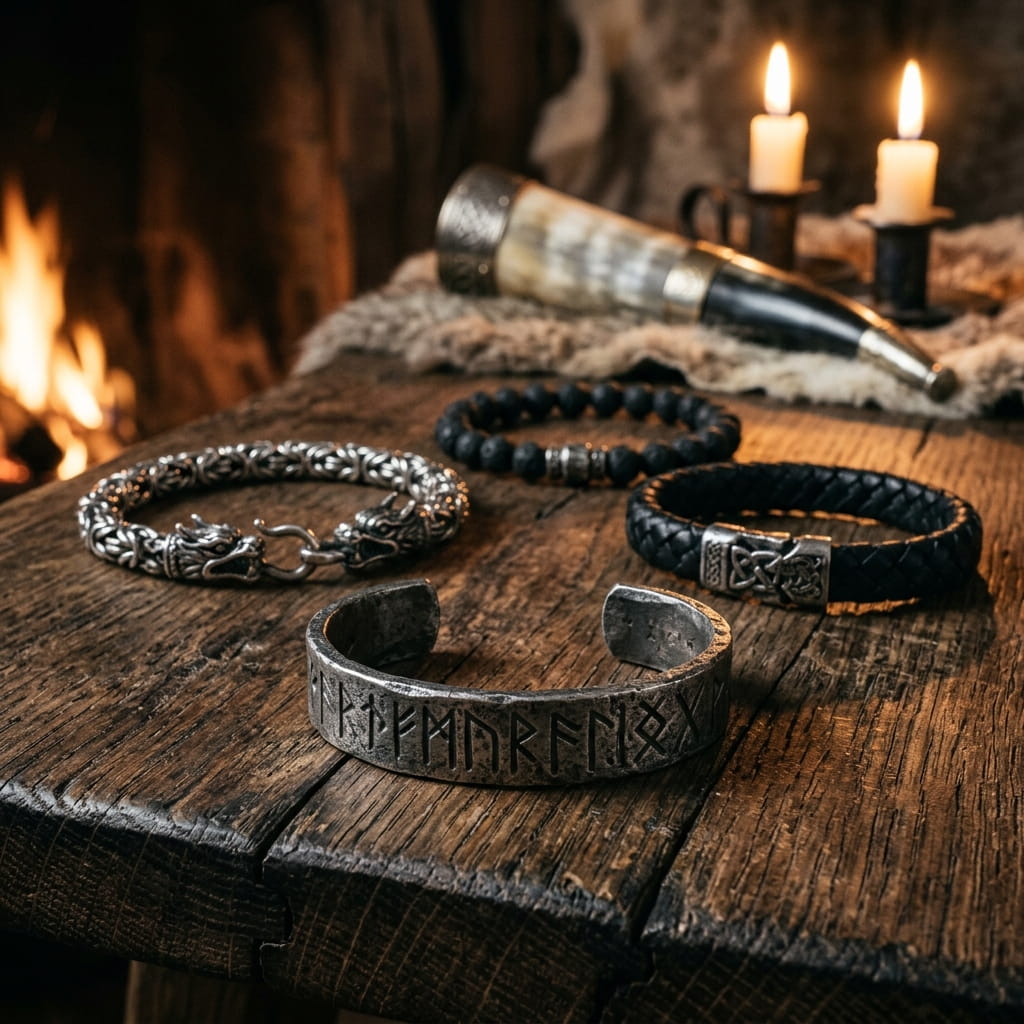
A Viking bracelet replicates the arm ring that Scandinavian chieftains gave to their men: it served as a reserve of silver, a mark of rank, and a pledge of an oath. Current models are divided into four families—engraved open bangles, steel chains, stone beads, and leather—for a price ranging from €19.90 to €29.90.
📌 In short
- In the Viking Age, silver or gold arm rings were simultaneously a reserve of wealth, a mark of rank, and a pledge of an oath: chieftains gave them to their men to seal their loyalty.
- Yes, in great numbers.
- Measure your wrist circumference with a tape measure and add 1 to 2 cm.
- In our section, Viking bracelets cost from €19.90 to €29.90.
- Stainless steel does not rust or tarnish upon contact with water or sweat: a raw steel bracelet can be worn in the shower.
What does a Viking bracelet mean?
Before being jewelry, a Viking bracelet was silver worn on the body. 9th and 10th-century Scandinavia hardly minted any coins: payments were made by weight. A solid silver arm ring was thus a bank account worn on the wrist. To settle a purchase, one would cut off a piece that the merchant would place on their scale. Archaeologists call these fragments hacksilver, and they are found in almost every treasure from that era.

Arm rings and hacksilver: in the Viking Age, bracelets were cut to pay by weight.
The scale of this phenomenon can be measured on the island of Gotland. The Spillings Hoard, discovered in 1999, weighed about 67 kg of silver: among thousands of items, there were nearly 500 bracelets, often tied in bundles of regular weight, like bankrolls.
The ring given by the chieftain
The bracelet was also a political instrument. A Viking chieftain maintained his men through his generosity: he distributed silver from expeditions in the form of rings. Skaldic poetry coined a nickname, baugbroti, the "ring-breaker"—the one who breaks his own bracelets to share them. The Anglo-Saxon poem Beowulf uses the same image to denote a good king: the "ring-giver." To accept the ring is to accept the bond: you fight for the one who placed it on your arm.
Friends should gladden each other with arms and clothing. Those who give and those who return remain friends for the longest time.
— Hávamál, verse 41, Poetic Edda
The ring upon which oaths were sworn
The third role, the most solemn: the oath. The Anglo-Saxon Chronicle reports that in 876, the Danish army swore peace to King Alfred "on the holy ring," an honor they had not previously granted to any people. In Iceland, the Saga of the People of Eyr describes a temple where a ring weighing about twenty ounces rested on the altar: all oaths were sworn upon it, and the priest wore it on his arm during the assemblies.
It is this heritage—wealth, loyalty, the spoken word—that we carry today. This explains why Viking bracelets are so often given as gifts between loved ones, and why it appears in our Viking gift guide.
Engraved symbols and what we know about them
Bracelets of the period were usually twisted, braided, or punched with geometric patterns. Modern models bear symbols, and not all are from the same age. It's worth knowing this before you choose.
Runes remain the most historically sound choice. Our bangles feature the 24 signs of the Elder Futhark; to learn what each means, see our runic alphabet guide, or write a name using our rune converter. For other patterns, each symbol has its own section: runes, Mjölnir, Valknut, Vegvísir, Fenrir wolf, Odin's ravens, and dragons and serpents. The detailed meaning of each is in our Viking symbols guide.
The four families of models

The four families: open bangle, steel chain, stone beads, leather.
1. The engraved open bangle
This is the direct descendant of the arm ring: a rigid, open steel circle that one slides on from the side of the wrist and then tightens with a squeeze of the hand. It has no clasp, so nothing to break, and no size to choose. Engraved with runes all around, it is available from us in polished steel, blackened steel, or bronze finish. It is sometimes called a "torque": the word comes from the Latin torques, originally referring to the rigid neck collar of the Celts; common usage has extended it to the open bracelet.
For whom: those who want understated jewelry that is never taken off and fits under a shirt sleeve.
2. Steel chains, links, and plates
The most extensive family in the department. It ranges from engraved ID bracelets—featuring a wolf's head, raven, or interlace—to massive Byzantine chains finished with dragon heads, as well as braided links and Mjölnir pendant chains. Everything is made of stainless steel. This is the family where the weight is most felt on the wrist, and the one that requires you to choose your length.
For whom: Those who want a visible piece with presence.
3. Beads and stones
Black lava stone, tiger's eye, howlite, turquoise, matte agate: strung stone beads, sometimes punctuated by a metal bead engraved with runes or a Vegvísir. Our models are mounted on a sliding cord or elastic thread: they adapt to all wrists. These are the lightest and easiest to stack. Vikings did wear glass, amber, and carnelian beads, but usually in necklaces; on the wrist, it is a modern usage.
For whom: A first bracelet, a gift with no risk regarding sizing, or a complement to be worn with a bangle.
4. Leather
Braided leather with a metal clasp, a double row with an ornate plate, or a wide cuff with a Valknut plate fastened by a pin buckle: leather brings a raw side that steel lacks. It patinates over time and takes the shape of the wrist. Its only drawback: it does not like water.
For whom: Lovers of natural materials, historical reenactment, and costumes.
Price of a Viking bracelet
Here are the real prices in our department, family by family, as of September 21, 2026.
Three things affect the price of a Viking bracelet, with us as elsewhere:
- The material. Stainless steel holds the bulk of the market because it does not rust or tarnish. A solid silver bracelet commonly costs several times the price of the same model in steel and requires regular maintenance.
- The weight of the metal. A solid Byzantine chain weighs much more than a fine link bracelet: that is what puts it at the top of our price range.
- The craftsmanship. An engraving around the entire circumference of a bangle, a sculpted animal head clasp, or an ornate plate require more operations than a smooth link.
Regarding shipping, the rate is the same for all our destinations: €4.90, free on orders over €49. Two bracelets are generally enough to reach this, making it a logical purchase for two people, or along with an item from the Viking gifts department.
Choosing your size without mistakes

Measure just above the wrist bone, without tightening, then add 1 to 2 cm.
The method consists of three steps:
- Wrap a tailor's tape measure around your wrist, just above the bone, without tightening. If you don't have one, use a strip of paper, mark it, and then measure it with a ruler.
- Add 1 cm for a snug fit, 2 cm for a loose fit.
- Take the next available length up.
Our link and plate bracelets are most often available in 19 and 21 cm; braided leather models and several beaded bracelets go up to 23 or 25 cm. The available lengths are indicated on each product page. Two families are not subject to these measurements: the open bangle, which tightens or spreads by hand, and beads on a sliding cord or elastic thread. These are the safest choices when gifting without knowing the other person's wrist size.
How to wear it

Stacking that works: vary the materials, not the symbols.
Which wrist? No source sets a rule. Common sense is enough: on the wrist opposite to the dominant hand, the bracelet wears out less and does not interfere with writing or working.
With a watch. Either you separate them—watch on one side, bracelet on the other—or you slip a thin bangle next to the case. Avoid a massive chain against a watch: both will get scratched. If you are looking for the perfect match, our Viking watches feature the same symbols.
Stacking. Two or three bracelets on the same wrist work on one condition: vary the materials, not the symbols. A steel bangle, a string of lava stones, and a braided leather one complement each other; three steel chains clash. Keep only one strong piece and let the others accompany it.
Men's or women's? Most models are unisex; only the size changes. On a thin wrist, a narrow open bangle or a bead bracelet keeps its proportions; a 21 cm Byzantine chain requires a larger wrist. And to complete the look, our beard and hair beads feature the same runes.
Maintenance by material

A soft cloth for steel, dry for leather.
- Stainless steel: It does not rust or tarnish upon contact with water or perspiration. A soft, slightly damp cloth is sufficient; for clogged engravings, use soapy water and a soft brush.
- Gold, blackened, or bronze finishes: These retain their luster longer when kept dry; avoid abrasive products and repeated friction against other jewelry.
- Leather: Keep it away from prolonged moisture. Remove it for showering and swimming; if it gets wet, let it air dry, away from heat sources.
- Stone beads: Remove the bracelet before swimming to protect the cord, and store it flat.
Frequently Asked Questions about Viking bracelets
What does a Viking bracelet signify?
In the Viking Age, a silver or gold armband served as a store of wealth, a sign of rank, and a pledge of an oath: the chieftain would give it to his men to seal their loyalty. Today, a Viking bracelet carries that same idea of connection and commitment, added to the meaning of the engraved symbol: protection for Mjölnir, direction for the Vegvísir, or memory through runes.
Did the Vikings really wear bracelets?
Yes, and many of them. The Spillings Hoard, discovered in 1999 on the island of Gotland, contained about 67 kg of silver, including nearly 500 bracelets. These armbands also served as currency: a piece would be cut off to pay by weight. The wolf or dragon heads on modern designs, however, are a modern creation, inspired by Nordic animal art style.
What size Viking bracelet should I choose?
Measure your wrist circumference with a measuring tape and add 1 to 2 cm. For a 17–18 cm wrist, choose 19 cm; for 19–20 cm, choose 21 cm. Our chain bracelets are mostly available in 19 and 21 cm, with some models up to 25 cm. Open bangles, beads on sliding cords or elastic thread, and buckled cuffs are adjustable without measuring.
What is the price of a Viking bracelet?
In our collection, Viking bracelets range from €19.90 to €29.90. Bead bracelets and simpler leather models are entry-level, engraved bangles and steel chains are mid-range, and massive Byzantine chains are the most expensive. Shipping is €4.90 and free on orders over €49.
Can a steel Viking bracelet go underwater?
Stainless steel does not rust or tarnish in contact with water or perspiration: a raw steel bracelet can be worn in the shower. Gold, blackened, or bronze finishes stay shiny longer if kept dry. Leather is sensitive to prolonged moisture, and bead bracelets strung on cords or elastic should be removed before swimming.
On which wrist should you wear a Viking bracelet?
There is no historical rule dictating a specific side. It is most practical to wear it on the wrist opposite your dominant hand: it will wear out less and not interfere with writing. If you wear a watch, put the bracelet on the other wrist, or choose a slim bangle that slides alongside the watch case without scratching it.
Cattle die, kinsmen die, and you yourself must die; but the fame never dies for one who has gained a good one.
— Hávamál, stanza 76, Poetic Edda
May the Aesir guide you on the path of honor.
👉 Discover all our Viking bracelets and our entire range of Viking jewelry.

Leave a comment
All comments are moderated before being published.
This site is protected by hCaptcha and the hCaptcha Privacy Policy and Terms of Service apply.