
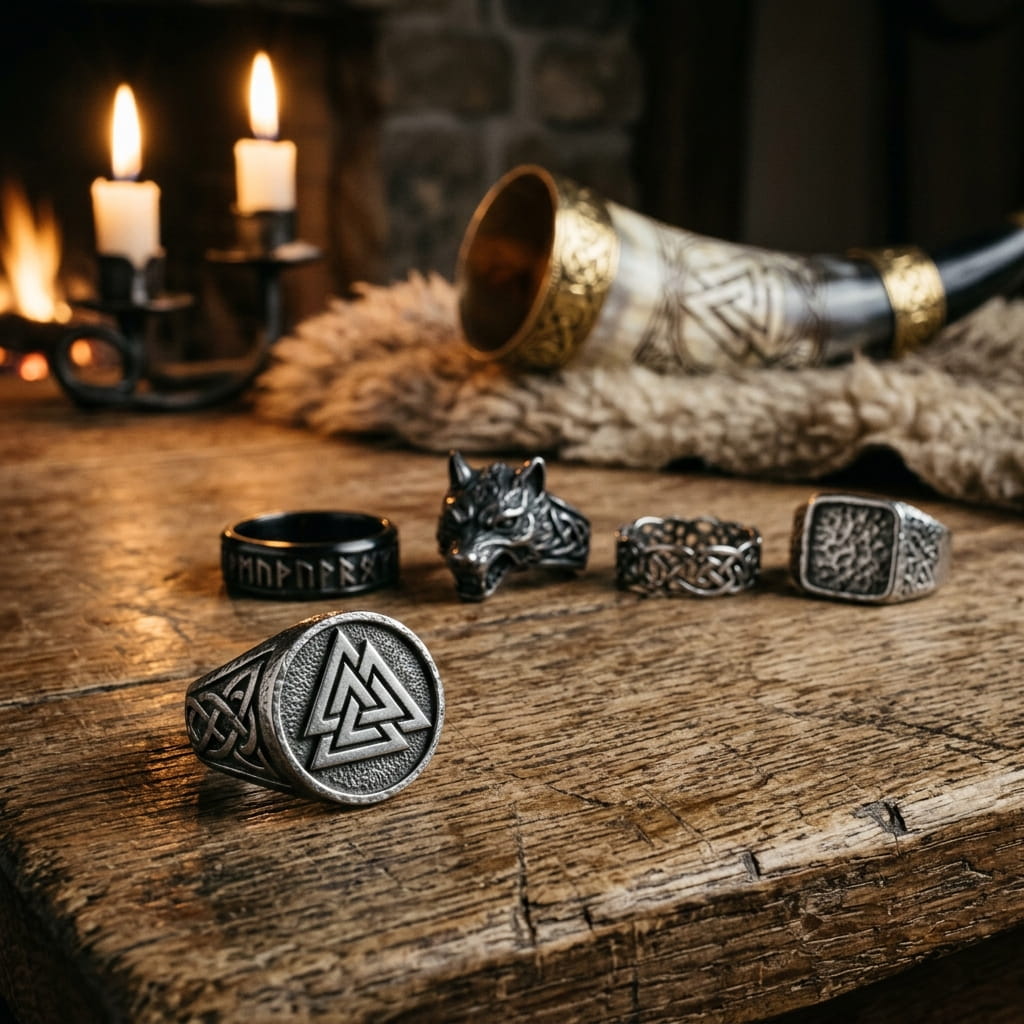
Viking Ring Meaning: Finger, Size, and Symbols
Are you looking for a ring rather than an explanation? All our models are gathered in the Viking Ring section, with available sizes listed on each product page.
A Viking ring carries the Nordic meaning of the ring — wealth, loyalty, and oaths kept — while adding the significance of the symbol it bears: runes, Valknut, wolf, or raven. No period source dictates a specific finger: it is a matter of personal choice based on the ring's volume. Modern models fall into five families, from signet rings to runic bands, ranging in price from €14.90 to €34.90.
📌 In brief
- A Viking ring carries the meaning of rings in the Norse world — wealth, loyalty, and oaths kept — to which is added the significance of the symbol it displays: memory of the runes, connection to Odin via the Valknut, strength of the wolf, or vigilance of the raven.
- Yes, though less common than bracelets.
- No period source dictates a specific finger.
- Wrap a thin strip of paper around your finger, mark the overlap, and measure the length with a ruler: this circumference in millimeters is your ring size.
- In our collection, a Viking ring costs between €14.90 and €34.90.
What does a Viking ring mean?
In the Norse world, a ring is never just an ornament. It represents wealth worn on the body, a gift from a chieftain that binds the recipient, and an object upon which oaths are sworn. This triple meaning is most strongly attested for large arm rings — we detail this in our guide on the meaning of Viking bracelets. The finger ring is the more intimate and rarer version of this.

Twisted wires, braids, and punched bands: Viking-age finger rings look like miniature bracelets.
What archaeology has uncovered
Viking-age finger rings are found in graves and buried treasures. They are made of gold or silver and resemble miniature bracelets: two or three twisted wires, a metal braid, or a flat band punched with triangles and dots, closed with a wire knot. No settings, no animal heads, no cut stones: the beauty lies in the metalwork itself.
The most astonishing piece comes from Birka, the great trading post of Sweden. In a 9th-century woman's grave, archaeologists found a silver ring set with colored glass engraved with an inscription in Kufic Arabic script. A piece of jewelry from the Caliphate, or made as a copy, on the finger of a Scandinavian: material proof that Eastern routes, via Russian rivers, linked the Baltic to Baghdad.
Two legendary rings: Draupnir and Andvaranaut
Norse mythology revolves around two gold rings. The first is a treasure: Draupnir, forged by the dwarves Brokk and Eitri for Odin, who would later place it on his son Baldr's funeral pyre.
Odin placed on the pyre the gold ring named Draupnir. It had the property that every ninth night, eight rings of equal weight dripped from it.
— Snorri Sturluson, Prose Edda, Gylfaginning
The second is a curse. Andvaranaut belonged to the dwarf Andvari; when Loki snatched it from him, the dwarf cursed the ring, which would cause the death of all its possessors. The Völsunga saga follows this trail of blood: Hreidmar killed by his sons, Fáfnir turned into a dragon, Sigurd murdered. Wagner drew his Ring of the Nibelung from this, and Tolkien, who himself rewrote the legend of Sigurd, knew this story by heart. The ring that gives and the ring that destroys: all the Norse significance of jewelry lies between these two poles. To place these stories, see our portrait of Odin.
Symbols and what we know about them
Viking-age rings almost never bore figurative symbols. Today's rings all feature them, and these symbols do not all have the same age. Here is what we can confirm about each.
Each symbol has its own category and article: runes (with the converter to write a name), Valknut and its history, triquetra and interlace, Yggdrasil and its meaning, Fenrir wolf, Odin's ravens, Vegvísir. See the overview in the complete guide to Viking symbols.
The five ring model families

The five families: signet ring, runic band, sculpted ring, interlace, spinner ring.
1. The Viking signet ring
This is the most extensive family in our collection. A face—round, square, hexagonal, or triangular—bears a relief symbol: Valknut, Yggdrasil, Vegvísir, wolf head, bear paw, crossed axes, or raven. To be precise: the signet ring is not a shape from the Viking Age. The signet ring dates back to antiquity and the European Middle Ages, where it was used to stamp wax; the Scandinavians of the 9th century did not seal their agreements this way. The Viking signet ring is therefore a modern fusion of a classic men's jewelry shape and Nordic imagery—and that is what makes it so easy to wear.
For whom: those who want a single, bold piece that is legible from a distance.
2. The runic band
A straight band, engraved with the 24 runes of the Elder Futhark all around, in polished, blackened, sandblasted, or gold-plated steel. This is the ring closest to the original spirit: no face, no volume, the design runs along the ring itself. Understated, it fits any occasion, including on the ring finger. The meaning of each sign can be found in our guide to the runic alphabet.
For whom: a first ring, daily wear, or a matching pair for couples.
3. The sculpted ring
Wolf head with bared fangs, raven with a stone eye, Jörmungandr serpent coiled around the finger, dragon claw clutching a black stone: here, the motif is no longer engraved, it is modeled in volume. These are the most spectacular and heaviest pieces; they require a strong finger, like the index or middle finger.
For whom: lovers of the warrior bestiary, and those who wear few pieces of jewelry but want them to be striking.
4. Symbols and interlace band
Triquetra, tree of life, endless knots and braids: thinner rings, often openwork, which echo the Nordic taste for continuous lines. Some models are open: they can be squeezed to tighten or pulled apart to widen, with no size to choose.
For whom: slender fingers, layering multiple rings, or gifts where the size is unknown.
5. The spinner ring
A central band, engraved with runes or triquetras, spins freely around the base of the ring. You can roll it with your thumb, mindlessly: it is the Nordic version of a fidget ring.
For whom: those who always need to keep their fingers busy.
Which finger should you wear a Viking ring on?

A bold piece on the index finger, a thin band on the ring finger: one free finger between the two.
No saga, law, or tomb dictates a specific finger. Everything you read about "the warrior's finger" or "Odin's hand" is a recent invention. The choice is entirely yours and is primarily practical: it depends on the size of the ring.
Right hand or left hand? Worn on the non-dominant hand, a ring wears down less and is less obtrusive. On the dominant hand, it is more visible: this is the hand you extend for greetings.
How many rings? One bold piece per hand is enough. If you wear two, leave one finger free between them and vary the volumes: a signet ring and a thin runic band complement each other; two signet rings compete. With a Viking bracelet on the same wrist, keep only one of the two pieces massive.
Men's or women's? The models are unisex; it is the width that changes the look. On a slender hand, a narrow runic band or an openwork interlace retains its proportions; a large signet ring is best worn on the index finger as a standalone piece. For a complete masculine set, see the Viking jewelry for men section in our Jewelry department.
Finding your ring size

The finger circumference in millimeters gives the French size directly.
The French ring size is simply the finger circumference in millimeters. Two methods:
- The paper strip method. Cut a thin strip of paper, wrap it around the base of your finger, mark the overlap with a pen, then measure with a ruler. 59 mm = size 59.
- A ring that fits you. Measure its inner diameter to the nearest millimeter and refer to the corresponding column in the table.
Three precautions to avoid the need for an exchange:
- Measure at the end of the day, with warm hands. A cold finger is thinner, a warm finger is larger.
- Check the knuckle. The ring must pass over it: if it is significantly wider than the base of the finger, choose a size between the two measurements.
- Wide ring, size up. A signet ring or a wide band covers more skin and fits tighter: between two sizes, choose the larger one.
Our rings are offered from size 49 to 72, and the vast majority of models from 54 to 70. The available sizes are listed on each product page. For a gift where you do not know the size, an adjustable ring eliminates any risk — and our Viking gift guide offers other ideas.
Price of a Viking ring
Here are the real prices in our department, by category, as of September 21, 2026.
What affects the price:
- Material. Stainless steel is dominant because it does not oxidize and does not deform. The same ring in sterling silver typically costs several times more and scratches more easily.
- Volume. A sculpted wolf head requires more metal and more operations than an engraved band.
- Mechanism and setting. A spinner ring or a set stone adds manufacturing steps: along with the couple's ring, offered in two widths, these are our most expensive pieces.
Shipping is the same rate for all our destinations: €4.90, free on orders over €49.
Wearing and caring for your ring

A sculpted ring is worn on a strong finger and pairs well with a simple bangle.
- Daily use: stainless steel withstands water and perspiration. Still, remove the ring for weightlifting, DIY, and household products: it is shocks and abrasives that mark a ring, not water.
- Gold or blackened finishes: they maintain their luster longer when kept dry and away from repeated friction against another ring.
- Cleaning: warm soapy water, a soft brush for the crevices of an engraving or sculpture, and dry with a soft cloth.
- Storage: separately, in a pouch, to prevent the jewelry from scratching each other.
Frequently asked questions about Viking rings
What does a Viking ring mean?
A Viking ring carries the meaning of the ring in the Nordic world — wealth, loyalty, and a given word — to which is added the meaning of the symbol it displays: memory of the runes, connection with Odin for the Valknut, strength of the wolf, or vigilance of the raven. Myths also give it a dark side: the Andvaranaut ring, cursed by the dwarf Andvari, destroys all who possess it.
Did Vikings wear rings?
Yes, but less often than arm rings. The finger rings found in graves and treasures are made of gold or silver, made of twisted wire, braided or a punched band, like miniature arm rings. The most famous comes from a woman's grave in Birka, Sweden: a 9th-century silver ring set with colored glass engraved with an inscription in Kufic Arabic, a witness to trade routes to the East.
On which finger should you wear a Viking ring?
No period source mandates a specific finger. The choice is practical: the index or middle finger for a signet ring or a massive sculpted ring, the ring finger for a runic band or a couple's ring, the little finger for a compact signet ring, the thumb for a wide band. Always measure the specific finger that will wear the ring: two adjacent fingers rarely have the same size.
How do I find my ring size?
Wrap a thin strip of paper around your finger, mark the point where they overlap, and measure the length with a ruler: this finger circumference in millimeters is your French size. 59 mm gives a size 59. Measure at the end of the day, check that the strip passes the knuckle, and size up for a signet ring or a wide band. Our rings go from 49 to 72, most from 54 to 70.
What is the price of a Viking ring?
In our collection, a Viking ring costs from €14.90 to €34.90. Runic rings and simple signet rings form the entry-level range, sculpted rings are in the middle, and spinner rings, stone-set rings or couple's rings are the most expensive. Delivery is €4.90 and free on orders over €49.
Was there such a thing as a Viking wedding ring?
No Viking-age source describes a wedding ring in the current sense. Nordic marriage was based on a contract between families, a dowry, and a banquet; the exchange of rings on fingers became widespread in Scandinavia with Christianization. Offering two matching rings engraved with runes today is therefore a modern creation, but one that is faithful to the Nordic idea of the ring that seals a word.
Does a steel ring leave a mark on the finger?
No. Stainless steel does not oxidize upon contact with the skin, water, or perspiration: it does not leave the green or black mark that copper or brass can cause. Gold or blackened finishes retain their luster longer if the ring is removed for manual labor and household products.
I know one thing that never dies: the judgment passed on each dead person.
— Hávamál, stanza 77, Poetic Edda
May the Aesir guide you on the path of honor.
👉 Find all our Viking rings and all our Viking jewelry.

Leave a comment
All comments are moderated before being published.
This site is protected by hCaptcha and the hCaptcha Privacy Policy and Terms of Service apply.