
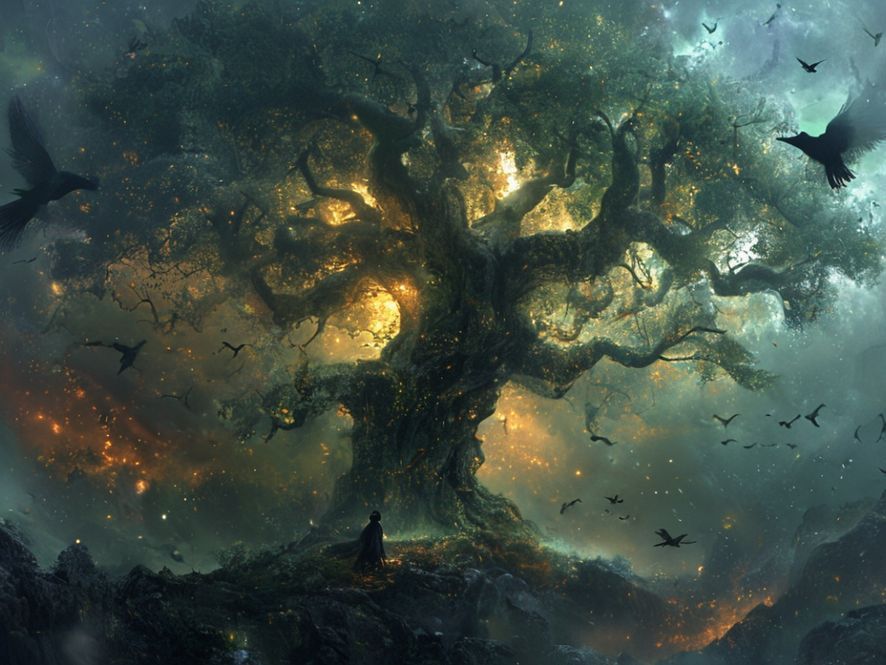
Viking Tree of Life: Meaning, Jewelry, and Tattoos
📌 In brief
- Yggdrasil is the cosmic World Tree of Norse mythology, a gigantic ash tree that connects the nine worlds.
- Yggdrasil is home to several creatures: Nidhogg gnaws at its roots, an eagle watches from the top with the hawk Vedrfolnir, and the squirrel Ratatoskr scurries along the trunk.
- The sources are ambiguous: the Poetic Edda calls it askr, the ash tree, but its evergreen foliage suggests the yew.
- Yggdrasil literally means the horse of Ygg, where Ygg is a nickname for Odin meaning the Terrible.
- Yggdrasil is a central symbol of Asatru and remains omnipresent in popular culture, from video games like God of War to series and tattoos.
What the name Yggdrasil really means
Type "Viking tree of life meaning" into a search engine and you will see the same three words come up: interconnection, balance, renewal. They aren't wrong, but they are interchangeable—they can just as easily be applied to a Celtic pattern, a mandala, or a box of herbal tea. Medieval Scandinavian thought is significantly rougher than that. It gave its tree a precise name, Yggdrasill, and this name speaks neither of serenity nor well-being: it speaks of a gallows.
Let’s break it down. Yggr is one of the many nicknames for Odin in Old Norse; it is usually translated as "the Terrible" or "the Dreadful." Drasill belongs to the poetic vocabulary and denotes a mount, a horse. In the genitive case, Yggs drasill thus results in "Ygg's horse," meaning the mount of the Terrible. Yet Odin does not ride a tree; he hung himself from it. The name of the World Tree is built upon the image of the torture that took place there.
The hanged man's horse: a poet's image, not a modern fantasy
This reading is not a contemporary reconstruction. Skaldic poetry operates through kennings, those coded periphrases that replace a simple word with a small riddle: the sea becomes "the whale’s road," gold "the river’s fire," the ship "the horse of the waves." And the gallows, specifically, is called "the hanged man’s horse" or "the mount of the tortured," because the condemned person appears to be riding it once their feet leave the ground. To name the tree "Ygg’s horse" is, therefore, to name it "Odin’s gallows." The name contains the story.
The Poetic Edda recounts this story in direct speech in the Hávamál, where Odin describes his ordeal himself: nine nights suspended, wounded by a spear, without bread or drinking horn, until he grasped the runes with a cry and fell back. The price paid is explicit, and the formula that summarizes it is one of the densest in Norse literature.
I know that I hung on a wind-swept tree nine full nights, wounded with a spear and given to Odin, myself to myself given, upon that tree of which no man knows from what roots it rises.— Hávamál, stanza 138, Poetic Edda
A debated etymology, and that is precisely what is instructive
Specialists do not fully agree, and it would be dishonest to hide that. A minority reading proposes viewing yggr not as Odin's nickname but as the adjective with the same root, "terrible, formidable," which would result in "the formidable mount." Another difficulty stems from the fact that Eddic poems often use the phrase askr Yggdrasils, "the ash tree of Yggdrasil": if Yggdrasil were already the name of the tree, the expression would be redundant, and some researchers deduce from this that the word first referred to the gallows, with the tree coming to bear the name later through contamination. The philological record is presented in detail on the encyclopedic entry dedicated to Yggdrasil and in the summary of the Encyclopædia Britannica.
Remember this above all: none of these hypotheses lead to "tree of life." That label is a modern, convenient addition, but it is absent from the sources. In the texts, the tree is also called mjötviðr, the "wood of measurement" or "tree of fate," and probably Mímameiðr, Mimir's tree. No term, in this vocabulary, means "life."
Why this etymology changes the entire symbol
If the name of the tree is that of a gallows, then the motif you wear around your neck or on your skin does not tell the same story as a generic tree of life. It does not say "everything is connected and everything will be fine." It says something much more demanding: what is worth obtaining must be paid for, and the tree is the place where one pays.
Odin is already the most powerful god in the pantheon when he ascends the tree. He does not go there to survive; he goes there to know. Elsewhere, he leaves an eye at Mimir's well for the same reason. The pattern is constant: knowledge is purchased through a voluntary amputation. The tree is the counter for this transaction. This is why an Yggdrasil pendant, in its original logic, is closer to a reminder of discipline than to a good-luck charm.
A threshold, more than a decoration
The second consequence is spatial. A tree from which one hangs oneself is a threshold: it stands in the world of the living, but its summit already belongs to something else. Moreover, the sources place wells beneath its roots that are not mere points of water—the spring of Urd, where the Norns reside, and that of Mimir, where wisdom is paid for. The tree articulates the visible and the hidden. It does not decorate the cosmos: it staples it together.
And yet—this is where the "life" interpretation regains its legitimacy—the same wood shelters what will begin again after the end. Death and continuation share the same trunk. This tension is not a contradiction to be resolved; it is the heart of the symbol: one does not go through an ordeal by avoiding it, one goes through it by enduring. For the full breakdown of the cosmology, the nine worlds, and Odin’s sacrifice, we refer you to our in-depth article Yggdrasil: The World Tree of Norse Mythology; this present guide focuses intentionally on the meaning of the symbol.
What the tree symbolizes in Nordic thought
Four ideas recur in medieval sources, and they are enough to cover almost everything one can legitimately say about the Yggdrasil symbol.
The axis: a fixed point in an unstable universe
The Grimnismál and the Gylfaginning of Snorri Sturluson describe a tree whose roots spread in three directions and whose foliage covers the worlds. Above all, they specify that the gods hold their daily assembly at its foot. Now, the judicial assembly is the institution that structures every Scandinavian society of the era: it is where judgments are made, where arbitrations occur, and where decisions are reached. Placing the tribunal of the gods at the foot of the tree is to say that the tree is the reference point from which everything else is measured. A Norse universe without Yggdrasil is not a sad universe; it is a universe without coordinates.
The connection: a permanent circulation
Nothing in this tree is motionless. The squirrel Ratatoskr shuttles between the eagle at the top and the dragon at the roots, carrying poisonous words; the stags move from one branch to another; the water from the wells rises, the dew falls back into the valleys. The motif thus says less "all is one" than "all circulates, including that which is offensive." It is a very concrete vision of interdependence: the worlds do not communicate only through wisdom, they communicate through rumors and conflicts as well. The detail of the nine realms and their inhabitants is developed in our guide The 9 Worlds of Norse Mythology and Yggdrasil, and the bestiary that populates the tree in our overview of Norse Mythological Creatures.
The cycle: a tree that is maintained, not eternal by itself
This point is often neglected, yet it is decisive. Snorri recounts that the Norns draw water from the spring of Urd every day and spread it, mixed with white clay, over the tree so that its branches do not rot. In other words, Yggdrasil does not maintain itself on its own. Its permanence is the result of daily work. For a symbol of "life," this is a considerable nuance—life is not given, it is maintained.
Resilience: holding under wear and tear
The Grimnismál is explicit: the tree endures more hardships than men can imagine; the stag grazes it from above, its side rots, and Nidhogg tears at it from below. This tree is attacked on three fronts simultaneously and holds firm. One does not find, in Norse documentation, a promise of invulnerability; one finds a valuation of endurance under stress. This is probably the most faithful reading one can make of the symbol today: not "nothing will reach me," but "I continue while being reached."
| Tree element | What the sources say | Reasonable symbolic reading |
|---|---|---|
| The three roots | They go toward distinct regions, each associated with a spring or a realm | No single origin: what sustains us comes from several directions at once |
| The spring of Urd and the Norns | They water the tree daily to prevent its branches from rotting | Daily maintenance, not miracles, is what keeps a world together |
| Ratatoskr | He runs from top to bottom carrying hostile words | Information flows in both directions, even when it is venomous |
| The stags and Nidhogg | They graze the foliage and gnaw the roots without interruption | Wear and tear is structural; it is part of normal functioning |
| The trembling at the end | The tree groans and sways during the final upheaval | Shaken is not defeated: the structure withstands what destroys everything else |
Viking Tree of Life or Celtic Tree of Life: clearing up the confusion
This is the most common, and most poorly handled, question. A large portion of pendants sold as "Viking tree of life" actually use a design of Celtic origin: a tree enclosed in a circle, with roots and branches perfectly symmetrical, often extended into interlace patterns that loop back on themselves. This design is beautiful, but it comes from another world.
Two parallel traditions, two separate bodies of work
The Irish tree of life, the crann bethadh, is rooted in medieval insular documentation distinct from the Eddas. The Irish tradition recognizes bile, remarkable trees planted in the center of a clan's territory, under which kings were inaugurated; cutting down an opponent's bile was a major political humiliation. The motif is therefore linked to sovereignty and community. It has nothing to do with a divine gallows.
The two traditions resemble each other because the image of a central tree is nearly universal—it is found in Mesopotamia, India, and Siberia. But resemblance is not kinship: these are two independent responses to the same intuition.
Nordic tree of life and Celtic tree of life: what truly separates them
| Criterion | Nordic Tree of Life (Yggdrasil) | Celtic Tree of Life (crann bethadh) |
|---|---|---|
| Written sources | Poetic Edda, Prose Edda, skaldic poetry (13th century for written accounts) | Medieval Irish texts and laws, toponymy, insular folklore |
| Meaning of the name | "Ygg's horse," meaning Odin's gallows | Literally "tree of life"; the bile is the clan's tree |
| Dominant graphic form | No fixed ancient canon; Scandinavian art favors scrollwork and intertwined beasts | Tree in a circle, root/branch symmetry, endless knots |
| Carried value | Hardship, knowledge acquired at a high price, endurance | Sovereignty, belonging to a territory, harmony |
| Attested period jewelry | No pendant certainly identified as an Yggdrasil | Composition popularized by the modern Celtic revival |
The Yggdrasil symbol facing archaeology: a necessary honesty
The Viking Age amulets that museums have formally identified are mostly Thor's hammers, female figurines known as valkyries, miniature chairs, crosses, and rings. To this day, no pendant found during excavations is unanimously recognized as a depiction of Yggdrasil. This does not disqualify the motif: it means that the tree of life pendant as we wear it today is a modern creation inspired by texts, and not a copy of an unearthed object.
However, there is ancient iconography where a large tree plays a central role, notably the Överhogdal tapestries, preserved in Sweden and dated to around the 11th–12th centuries, where a monumental tree-like figure has often been interpreted as the World Tree. The interpretation remains debated, but it is based on a real object, which in itself is not that common.
The tree of life worn on one's person: jewelry and tattoos
Since the motif is modern, we might as well wear it knowing what we intend it to say. A chosen symbol is better than a suffered one.
What a piece of jewelry tells depending on what it is associated with
The tree design is rarely alone. The most widespread associations each have a different semantic shade. The tree surrounded by runes emphasizes conquered knowledge, in the logic of the Hávamál—this is the meaning of a piece like the Yggdrasil steel tree of life and runes necklace. The tree accompanied by Odin's two ravens, Huginn and Muninn, shifts the focus toward vigilance and memory, as their names roughly translate to "thought" and "memory"; this is the composition of the Yggdrasil necklace with Huginn and Muninn ravens. The tree framed by wolves refers more to loyalty and the pack, a reading found on everyday objects like the runic medallion keychain. Finally, the circular shape of an Yggdrasil tree of life ring emphasizes the cycle rather than the axis, since the motif loses its top and bottom.
A word of caution regarding a very frequent association: the Vegvísir, often paired with the tree. It is a beautiful symbol, but it comes from Icelandic grimoires of the 17th–19th centuries, not the Viking Age. It is perfectly fine to wear it, provided one does not present it as an archaeological find.
Yggdrasil as a tattoo: placement and legibility
The question "Yggdrasil tattoo meaning" almost always comes paired with a question about placement, and the two are linked: the placement changes the meaning just as much as the design.
The entire back or the shoulder blade remains the most generous surface: it is the only place where the roots can take up as much space as the branches, which makes the idea of a subterranean system as vast as the visible part visible. The inner forearm provides a tattoo that the wearer sees several times a day—a personal reminder rather than a public statement; it does, however, impose a vertical and narrow composition, where the creatures are often sacrificed. The sternum and solar plexus suit symmetrical compositions centered on the body's axis, with a very graphic rendering. The calf tolerates high motifs well and deforms little. The bicep wrap, finally, transforms the tree into a circular frieze and favors the cycle.
Styles and their historical fidelity
Fine lines create an elegant but time-fragile tree: on aging skin, very thin branches tend to close up. Dotwork restores bark and foliage gradients well. Massive solid black produces a silhouette that remains readable from several meters away and generally ages better, at the cost of detail. The Scandinavian animal style—scrollwork, intertwining beasts, as on the Urnes monuments or in the so-called Mammen ornamentation—is the one that comes closest to the aesthetics actually practiced at the time, and it produces much more interesting compositions than the Celtic circle applied by default. Watercolor, conversely, does not pair well with a motif that lives entirely on its line.
Three precautions before going under the needle
First, the runes added around the tree: the younger Futhark, used in Scandinavia during the Viking Age, has sixteen signs and does not map to French letter by letter. A word-for-word transcription produces an inscription that makes no sense in Old Norse. Ask for a source from anyone suggesting a runic sentence. Next, some signs were misappropriated by political groups in the 20th century; a serious tattoo artist will be able to tell you which ones have become ambiguous. Finally, decide before the session whether or not you want Nídhögg to appear in the design: incorporating the dragon that gnaws means accepting the complete reading of the symbol, one where wear and tear are part of the picture.
Real trees of Nordic worship: Uppsala, groves, and farm trees
The symbol did not remain in books. Several clues, of varying value, suggest that concrete trees played a religious role in the Scandinavian world.
The great tree of Uppsala according to Adam of Bremen
Around 1070, the German chronicler Adam of Bremen described, in his Gesta Hammaburgensis Ecclesiae Pontificum, a sanctuary in Uppsala, Sweden. He mentions an immense tree with evergreen foliage whose species no one knew, a nearby spring, and a grove where the bodies of sacrificed victims—men and animals alike—hung during a feast held every nine years. The image is striking: it offers a material echo to the tree from which Odin hanged himself.
However, this testimony requires caution. Adam did not make the journey, he reports second-hand information, he writes as a Christian cleric describing a cult he disapproves of, and the archaeology of Gamla Uppsala has yielded vast buildings, alignments of posts, and monumental mounds without confirming the temple he depicts. The file, with its gray areas, is summarized on the entry dedicated to the Temple of Uppsala. Let's simply say: the text is a serious clue, not proof.
Sacred groves and world-pillars
Other traces converge. Scandinavian toponymy preserves names formed on lundr, the grove, sometimes associated with the names of deities, which suggests consecrated wooded places. Among the continental Saxons, Charlemagne had the Irminsul felled in 772, a pillar or trunk that symbolically supported the universe according to Frankish chroniclers—a Germanic cousin of the idea of a world axis. Here again, the documentation is thin and comes from hostile authors, but the accumulation of clues makes the hypothesis of a tree cult difficult to dismiss.
The guardian tree of the farm, or the domestic version of the symbol
This is perhaps the most moving element in the record, because it survived until recent times. Scandinavian farms long maintained a single tree planted near the buildings, called tuntre in Norway and vårdträd in Sweden. The word refers to the concept of vörðr, the guardian, the protective spirit attached to a place or a person. Folklore collected in the 18th and 19th centuries reports that beer or milk was sometimes poured on its roots, that pruning it was avoided, and that felling it was considered a very bad omen: the fate of the household was believed to follow that of the tree.
It is impossible to claim that this custom descends directly from pre-Christian religion—the testimonies are centuries late. But we have a striking idea here: the great cosmic tree may have had, on the scale of a farmstead, a little brother tasked with the same office. Protecting, connecting generations, measuring the health of the home. This is exactly what a Nordic tree of life placed on a living room wall does, as shown by our suggestions for Viking decoration for a Nordic interior.
What the symbol has become today
A living symbol transforms, and this one transformed quickly. In contemporary Nordic paganism—Ásatrú, structured in Iceland since the 1970s—the tree serves as a central representation of the world order and a ritual aid. In popular culture, it has become a familiar setting: video games, series, and cinema have turned it into an immediately identifiable visual landmark, sometimes at the cost of taking great liberties with the texts.
A third life has been added over the last twenty years: the ecological interpretation. The tree nourished by wells, gnawed from below, grazed from above, and maintained by daily care lends itself remarkably well to a metaphor for the interdependence of living things. This interpretation is not medieval, and it must be said; it is no less legitimate for all that. Symbols that survive are those that accept being reinterpreted.
Finally, we encounter the motif in a purely aesthetic, refined register, close to contemporary Scandinavian lines, where it no longer signifies anything very precise. This is the fate of all great symbols, and it is not dramatic—provided you know that you have moved from mythology to graphic design.
Misconceptions to avoid
A few assertions circulate insistently without being based on much. Knowing them avoids repeating mistakes, and above all gives a better reason for wearing the symbol.
- "Vikings all wore a tree of life." The pendant most frequently found in a Scandinavian context is Thor's hammer. The Yggdrasil pendant, in its current form, is a modern creation.
- "Yggdrasil is a rune." No. No futhark contains a sign representing the tree. The motif is an image, not a character of writing.
- "It is a Celtic symbol adopted by the Scandinavians." Two distinct traditions, two corpora, two histories. The visual resemblance of contemporary jewelry comes from the market, not from Antiquity.
- "Yggdrasil means tree of life." The expression is a modern convenience. The Old Norse name designates Odin's steed, in other words, his gallows.
- "The symbol belongs to this or that group." Certain Nordic images were politically co-opted in the 20th century. This co-optation has no historical legitimacy, and the vast majority of current wearers have nothing to do with it.
- "Viking is the name of a people." The term refers to an activity—maritime expedition—practiced by only a portion of the Scandinavians of the period conventionally situated between the end of the 8th century and the middle of the 11th. Speaking of "Scandinavians of the Viking Age" is more accurate.
Wearing the symbol without betraying it
At the end of this journey, the question of the meaning of the Viking tree of life calls for an answer less consensual than the one read everywhere. The Yggdrasil symbol does not promise harmony: it describes a structure under constant attack, maintained every day, and which holds together nonetheless. It bears the name of a gallows because it is the place where Odin paid for his knowledge. It connects without denying the conflicts that circulate along its trunk. And its domestic version, the tree planted in front of the farm, measured the health of a household like a thermometer.
Worn around the neck, engraved on a ring, or tattooed on the back, the Nordic tree of life therefore says something significantly more solid than a wish for serenity: it says that one accepts wear and tear, that one maintains what matters, and that one pays the price for what one wants to know. It is a demanding symbol. That is precisely what makes it enduring.
The most common questions about Yggdrasil find their answer just below.
Frequently Asked Questions about Yggdrasil
What is Yggdrasil in Norse mythology?
Yggdrasil is the cosmic World Tree of Norse mythology, a gigantic ash tree that connects the nine worlds together. Its branches extend to Asgard, its trunk runs through Midgard, and its three roots plunge toward the wells of wisdom and the lower realms.
What creatures live in Yggdrasil?
Yggdrasil is home to several creatures: the dragon Nídhögg gnaws at its roots, the eagle perched at the top and the falcon Vedrfölnir between its eyes, the squirrel Ratatösk who runs between the eagle and the dragon carrying insults, and four stags who graze on its leaves.
Is Yggdrasil an ash or a yew tree?
Ancient sources are ambiguous. The Poetic Edda uses the word askr (ash), but some elements—such as the fact that it is always green—correspond more to a yew, an evergreen tree associated with longevity and death in Nordic traditions.
What does the name Yggdrasil mean?
Yggdrasil literally means Ygg's horse, where Ygg is a nickname for Odin meaning the Terrible. The word drasil means horse or steed. It is a reference to the sacrifice of Odin, who hanged himself from the tree—the gallows being poetically called the hanged man's horse.
Does Yggdrasil still exist in modern beliefs?
Yes, Yggdrasil is a central symbol of Ásatrú (Norse neo-pagan religion) and remains omnipresent in popular culture: video games (God of War, Assassin's Creed Valhalla), jewelry, tattoos, and decoration. It symbolizes the interconnection of all life.
What happens to Yggdrasil during Ragnarök?
During Ragnarök, Yggdrasil shakes violently but does not die. The cosmic tree survives the destruction of the world and protects the two surviving humans, Líf and Lífthrasir, who hide in its trunk and will repopulate the new world.
What are the delivery times and return conditions for the Yggdrasil Tree of Life and Ravens necklace?
For the Yggdrasil Tree of Life and Ravens necklace, as with any order, allow 10 to 20 business days in total: 3 to 5 days for preparation, then 7 to 15 days for delivery in mainland France, 10 to 20 days in the European Union. Delivery costs €4.90 in France and the European Union, and is free on orders over €49. After receipt, you have 14 days to change your mind and return the item to us: return shipping costs are then your responsibility. If the item received is defective or does not correspond to your order, we will refund the return costs upon proof of shipment.
"The fir tree withers, the one that stands at the village: neither bark nor needles shelter it. Such is the man whom no one loves: why should he live long?"
— Hávamál, stanza 50, Poetic Edda
May the Aesir guide you on the path of honor.
👉 Explore our collections of Viking jewelry and Viking necklaces to carry the Viking spirit daily.

Leave a comment
All comments are moderated before being published.
This site is protected by hCaptcha and the hCaptcha Privacy Policy and Terms of Service apply.