
📌 In Brief
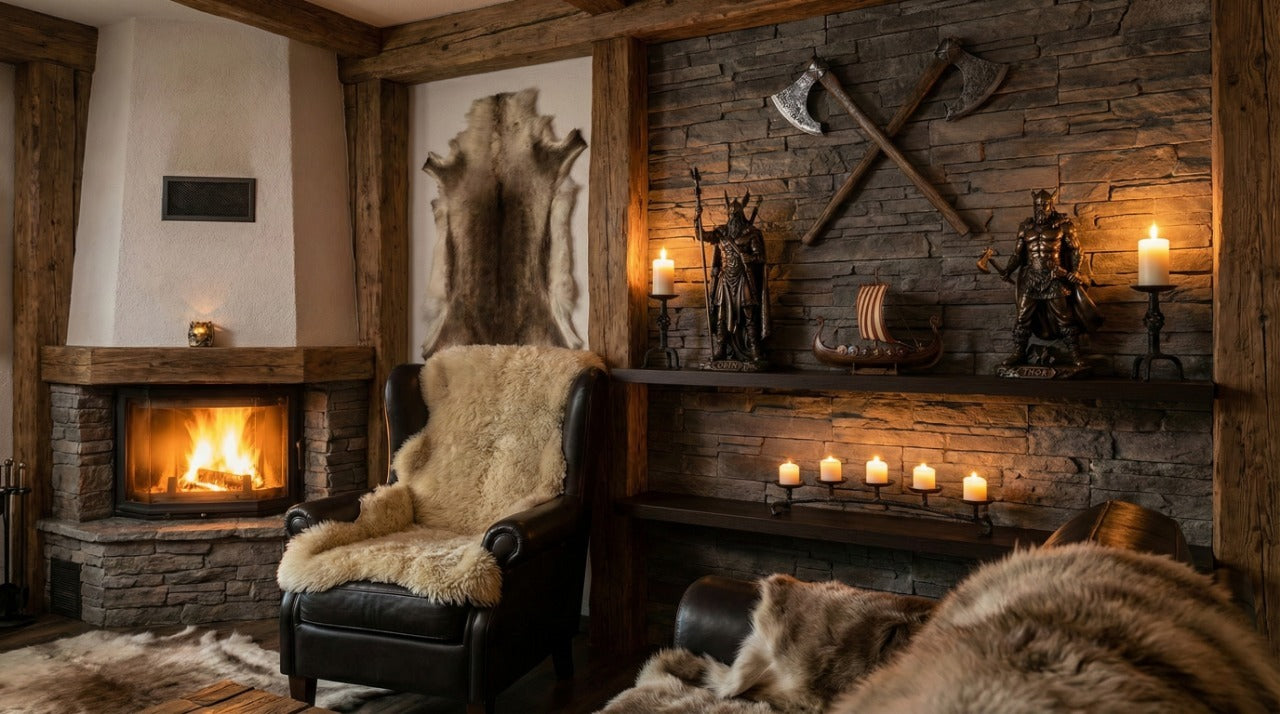
- Combine natural materials (wood, leather, fur) with symbolic Nordic items: statues of gods, runic wall plaques, miniature longships.
- The Odin the Wanderer Statue is a great starting point: it represents the greatest of the Nordic gods and fits just as well on a desk as it does on a shelf.
- The Viking style pairs perfectly with modern Scandinavian minimalism.
- Some items are delivered assembled, while others are construction kits.
- Resin statues can be cleaned with a dry or slightly damp cloth.
Viking Decor: Create an Authentic Nordic Interior
Looking for items rather than advice? Tapestries, wall plaques, statues, and longship models are gathered in our Viking decor collection.
The Longhouse: Key Takeaways
Before discussing objects, one must visualize the space. The langhús, or longhouse, was the setting for almost all Scandinavian life—it was where they slept, ate, wove, entertained, and often housed livestock in the lower section.
The dimensions are surprising. The Borg site, in the Norwegian Lofoten Islands, yielded the largest known Viking Age longhouse: 83 meters long and 9 meters wide. The circular Danish fortresses of Trelleborg and Fyrkat, built around 980, aligned buildings of 30 meters with military precision. These were not mere huts: they were great halls.
The framework rested on two rows of load-bearing posts that divided the space into three naves, much like in a church. Walls were made of wattle and daub, stave wood, or turf, depending on the region and wood availability—in Iceland, where trees are scarce, turf dominated, and walls reached up to two meters in thickness.
In the center ran the long hearth, bordered by stones. There was no chimney: smoke rose toward an opening in the ridge. This meant low, orange light and a permanently smoky atmosphere—a detail modern reconstructions often soften, and which explains why hanging objects quickly became covered in soot.
On either side were the raised earth benches, which served as seating by day and beds by night. The high seat, flanked by the öndvegissúlur—the master of the house's carved pillars—occupied the middle of the north side. These pillars held such value that Icelandic settlers would throw them into the sea as they approached the coast to settle where they washed ashore.
What can be taken from this for today's interiors? Three principles, and they are more useful than any list of objects. Raw wood as the dominant material, never painted or glossy varnished. Warm, low light rather than overhead lighting. And layered textiles—thick wool, fur, linen—which soften and warm the space. A room that respects these three points will work, even without a single rune-adorned object.
— Hávamál, stanza 37
Statues and Figurines: Seven Centimeters, Not Sixty
Scandinavians did depict their gods—but not at all like our contemporary statuettes, and the comparison is instructive.
Two pieces serve as references. The Rällinge statuette, found in Sweden, seven centimeters tall, shows a seated, bearded man with an erect phallus: this is generally recognized as Freyr, the god of fertility. The Eyrarland figurine, from Iceland, measures six centimeters and shows a figure seated while holding an object shaped like a hammer or cross—identified as Thor, or interpreted by some as a chess player holding a piece.
The common point is striking: these objects are tiny and schematic. They were amulets to be carried or held in the hand, not shelf ornaments. No large statues of Nordic gods have been found in Scandinavia.
We do know, however, that large effigies existed because texts mention them. Adam of Bremen, around 1070, described an Uppsala temple housing three statues—Thor in the center, Odin and Freyr at his sides. But Adam wrote from afar, based on reported accounts, and no excavation has confirmed his testimony. It is our only source on this point, and it is fragile.
Therefore, we must be clear: the resin Odin or Thor statue you place on a piece of furniture is a modern object. It reproduces no archaeological model, and its appearance owes more to 19th-century illustrators and contemporary fantasy than to Scandinavian art. This does not disqualify it—it merely contextualizes what it is.
When choosing, two criteria matter more than the subject. Material: a dense, heavy resin holds up better over time than a hollow, lightweight piece, and handles patinas better. Finish: the best pieces are hand-patinated, which deepens the reliefs and avoids a uniform plastic look.
Finally, a display tip. A single statue on an empty surface works better than an alignment of figurines. Nordic interiors did not display collections: they had few objects, yet they were charged with meaning. One strong piece, well-lit, says more than six average pieces side by side.
- Odin — The All-Father: The Odin the Wanderer Statue embodies wisdom and power. Perfect for a study where important decisions are made. For a more imposing presence, the Odin on his Throne Statue reigns majestically on a shelf.
- Thor — The Protector: The Thor Protector of Midgard Statue brings strength and protection. Ideal for a living room or entryway, just as the Vikings did by placing Thor at the door of their homes.
- Freyja — Queen of the Valkyries: The resin Freyja Statue with a wood-look finish adds grace and Nordic femininity to your space.
- Loki — The God of Mischief: The Loki Statue is for fans of complex characters. His enigmatic smile sparks conversation with every glance.
- Týr — The Sacrifice: The Týr Statue represents the god who sacrificed his hand into the jaws of Fenrir. A symbol of absolute honor.
The Wall: Tapestries, Shields, and Wood Carvings
It was on the walls that the longhouse told its stories, and this is the area where documentation is the richest.
Tapestries are attested by exceptional fragments. The Oseberg ship yielded narrow textile strips, woven and embroidered, depicting a procession of chariots, horses, and figures—likely a ritual scene. The Överhogdal tapestries, in Sweden, dated to around the year 1000, show animals, ships, and a great tree that many identify as Yggdrasil.
These textiles were not merely decorative. In a wooden hall heated by a single hearth, a wool tapestry on a wall was primarily an insulator and acoustic absorber. Beauty came on top of function—a principle that still applies today in a living room with bare walls.
Shields hung on the wall, however, belong more to usage documented aboard than on land: the Gokstad ship carried its sixty-four shields along the gunwales, painted in alternating yellow and black. The shield-covered hall of Valhalla, with its roof covered in them, belongs to poetry—but it shows that the image was familiar to the Scandinavians themselves.
Finally, wood carving is the Scandinavian art form par excellence. The Oseberg chariot with its interlaced animal heads and the portals of the Urnes stave church in Norway—a World Heritage site—show the level of craftsmanship. The styles followed one another: Borre, Jelling, Mammen, Ringerike, Urnes, each with its way of treating the animal in ribbon form.
To transpose this into your own home, a simple rule applies: one single large piece is better than ten small ones. A two-meter tapestry transforms a wall; six twenty-centimeter plaques clutter it. If you choose the plaques, group them tightly into a unique composition rather than scattering them.
A note of honesty regarding our wall plaques, since we sell them: they are prints on aluminum, flat, rather than carved reliefs. The rendering is sharp and the format is consistent, but one should not expect the modeling of a carved wood piece. Our product descriptions state this, and it's the kind of detail that avoids disappointment upon delivery.
Longships and Models: And Why the Word is Incorrect
If one object had to represent the Viking Age, it would be the ship. It was the prerequisite for everything else—the raids, the trade, the colonization of Iceland and Greenland, the arrival in America.
Two Norwegian wrecks serve as global references. The Oseberg ship, buried around 834 and exhumed in 1904, measures 21.6 meters and bears a spiraling prow carved with interlace—it is the most richly decorated. The Gokstad ship, dated to around 890, is 23.8 meters long, more robust and seaworthy; a replica crossed the Atlantic in 1893 for the Chicago World's Fair, settling the question of its navigability.
In Roskilde, Denmark, the five Skuldelev wrecks, scuttled around 1070 to block a channel, revealed something else: proof of specialization. They include a slender thirty-meter warship, a squat coaster, an ocean-going vessel, and two smaller boats. There was no single "longship" (or "drakkar"), but rather a range adapted to each use.
The common technique is clinker-built: planks overlapping partially, riveted together, on a flexible hull that works with the swell rather than resisting it. The shallow draft—sometimes less than a meter—allowed them to travel up rivers and land on a beach. That, not ferocity, was where the Scandinavian strategic advantage lay.
The word "drakkar" itself deserves a clarification. It is not Old Norse: it is a 19th-century French distortion of the plural drekar, meaning "dragons." Scandinavians said langskip, "longship," or knörr for cargo vessels. The term has entered common usage, and we use it like everyone else—knowing what it really means.
For a scale model, three criteria make all the difference. The sail: made of real fabric rather than molded plastic, it completely changes the look. The gunwale shields, if painted alternately, replicate the Gokstad arrangement and provide immediate authenticity. And the prow: animal-head models are spectacular, but sources indicate that it was removed when approaching home, so as not to frighten the local spirits.
Regarding size, a twenty-centimeter model blends into a bookshelf; beyond forty, it becomes a centerpiece that requires its own space and an uncluttered background. Choose the location first, the size second.
- 1/72 Drakkar Model — The essence of Norse navigation in a compact format. Faithful details: figurehead, side shields, striped sail.
- 1/50 Drakkar Model — Wooden construction kit for modeling enthusiasts. The experience of building your own Viking ship.
- Robotime 3D Drakkar Puzzle — A fun and accessible version. Ideal as a family activity or an original gift.
- 2073-Piece Viking Ship — The ultimate project: 2073 building blocks for a monumental longship.
The table: chests, turned wood, and low light
The table was the place where the longhouse became social, and it is probably the best place to introduce Norse objects into your home—because they are used there.
The furniture was simple. Dismountable tables set on trestles, which were removed after the meal to free up space; side benches served as seating. Few fixed pieces of furniture, lots of textiles, and chests that served as storage, seating, and luggage all at once. The chest is undoubtedly the most characteristic piece of furniture from this culture.
Tableware mixed materials: turned wood for bowls, steatite imported from Norway for cooking pots, local or Rhenish-imported ceramics for jugs, and horn and wood for drinking. Metal remained rare and precious.
In a modern interior, a Norse table setting consists of three elements and no more. A table runner or tablecloth in linen or wool, in natural shades. Containers made of wood or horn, mismatched rather than matching—uniformity is a modern reflex. And a source of low light: candles, a lantern—never a ceiling light.
Wooden coasters, massive cutting boards, and horn-handled cutlery are among the items that justify themselves through use as much as through decor. That is their advantage over a statuette: they live.
A word about mead, which we are often asked about. It should be drunk cool but not iced, around ten to twelve degrees, from a flared-rim container that lets the honey notes express themselves. A horn is perfectly suitable; so is a barrel mug. This is perhaps the only point in this guide where the recreation is entirely practical.
Finally, resist the temptation of a complete theme. A dining room that is entirely "Viking" quickly turns into a tavern set. Two or three strong objects in an otherwise sober interior produce a much better effect—and it is also, incidentally, closer to the reality of a longhouse, where people owned very little.
- Barrel Mugs in wood and steel — perfect for a display case or bar shelf
- Authentic Yak Drinking Horns — the most genuine Viking collectible
- Mjölnir Mugs with Bottle Opener — functional and spectacular
Five principles, in order of importance
Finally, here are the five principles we would apply—in this order, because the first counts for more than the other four combined.
1. Material over motif. This is the rule that makes all the difference between a Nordic interior and a teenager's bedroom. Raw or oiled wood, thick wool, leather, linen, stone, black iron. Ban shiny plastic, chrome, and saturated colors. A room furnished with these materials is already Scandinavian before adding a single object with runes.
2. Low and warm light. The central hearth produced an orange, low-angle light that emphasized textures. Reproduce this with lamps at seating level, candles, and a bulb with a warm temperature—2,200 to 2,700 Kelvins. A cold white ceiling light cancels out everything else, regardless of your objects.
3. Few objects, but strong ones. We mentioned this regarding statues and plaques: the longhouse was not a museum. A large tapestry, a well-placed model, or an isolated statue are better than an accumulation. If you are hesitating between two pieces, take the larger one and give up the other.
A variation of this principle works particularly well: the dedicated corner. A small area—a dresser top, an isolated shelf—bringing together only three elements: a central object, a light source, and a natural material base. A wooden rune set placed next to a candle and a statuette is enough to create this focal point without invading the room.
4. A zone, not the whole house. The theme works when it is contained: a desk corner, a section of wall, a bookshelf, a lounge area. Extended to every room, it becomes a themed restaurant decor. Constraint is your ally here.
5. Know what your symbols mean. This is the advice we hold most dear. The Vegvísir and Ægishjálmur, omnipresent on "Viking" objects, come from 17th-century Icelandic grimoires—six to seven centuries after the Viking Age. The Valknut does appear on engraved stones from the period, but its name is modern and its meaning remains debated. The Mjölnir and the World Tree, however, are solidly attested.
None of this forbids you from liking a Vegvísir—it is graphically superb. But knowing where a symbol comes from avoids a tattoo you might regret and misplaced pride in front of a guest who happens to know the date. Our product pages and symbol guides systematically specify the origin of each motif, even when it is late.
Apply these five points and you will get something that stands up—sober, warm, coherent—rather than a pile of accessories. It is less spectacular in a photo, and significantly more pleasant to live with.
Frequently Asked Questions about Viking Decor
How to create a Viking atmosphere at home?
Combine natural materials (wood, leather, fur) with symbolic Norse objects: god statues, runic wall plaques, miniature drakkars. Focus on warm tones (brown, gold, black) and dimmed lighting with candles.
What is the best Viking statue to start a collection?
The Odin the Wanderer Statue is the ideal choice to start: it represents the greatest of the Norse gods, fits into any interior, and is the perfect size for a desk or shelf.
Can you mix Viking decor with a modern style?
Absolutely. The Viking style pairs perfectly with modern Scandinavian minimalism. A bronze statue on a white cabinet, a wooden drakkar on a clean-lined shelf, or a wall plaque in a contemporary living room create a striking contrast.
Are miniature drakkars models that need assembly?
Some are delivered assembled, and others are construction kits. The wooden models to assemble offer an immersive building experience, while resin models are ready to display upon receipt.
How to protect Viking decor objects?
Resin statues can be cleaned with a dry or slightly damp cloth. Avoid prolonged direct sunlight. Wooden pieces benefit from an occasional application of natural oil to preserve their luster.
What are the delivery times and return policies for the Odin the Wanderer statue?
For the Odin the Wanderer statue, as with any order, allow for 10 to 20 business days in total: 3 to 5 days for preparation, then 7 to 15 days for delivery in mainland France, 10 to 20 days in the European Union. Delivery costs €4.90 in France and the European Union, and is free for orders over €49. After receipt, you have 14 days to change your mind and return the item: return shipping costs are your responsibility. If the item received is defective or does not correspond to your order, we will refund the return shipping costs upon presentation of proof of postage.
"A man is happy in his home. Unhappy is he who has none."
— Hávamál, stanza 37
May the Aesir guide you on the path of honor.
👉 Explore our collections of Viking decor and Viking statues to bring the Viking spirit into your daily life.
Sources
- The Borg Longhouse (Lofoten, Norway) — 83m long, the largest known from the Viking Age; Lofotr Viking Museum.
- The Oseberg (834) and Gokstad (c. 890) ships, Viking Ship Museum, Oslo; the five Skuldelev wrecks, Viking Ship Museum, Roskilde.
- The Överhogdal tapestries (Sweden, c. 1000) and Oseberg textile fragments—the only preserved witnesses of wall hangings.
- The Rällinge (Sweden) and Eyrarland (Iceland) statuettes — 6 to 7 cm, the only divine Scandinavian representations that have reached us.
- The portal of the Urnes Stave Church (Norway), UNESCO World Heritage site — the pinnacle of the Norse animal style.
👉 To dress your walls: our wall hangings and plaques, and the rest of our Viking decor.

Leave a comment
All comments are moderated before being published.
This site is protected by hCaptcha and the hCaptcha Privacy Policy and Terms of Service apply.