
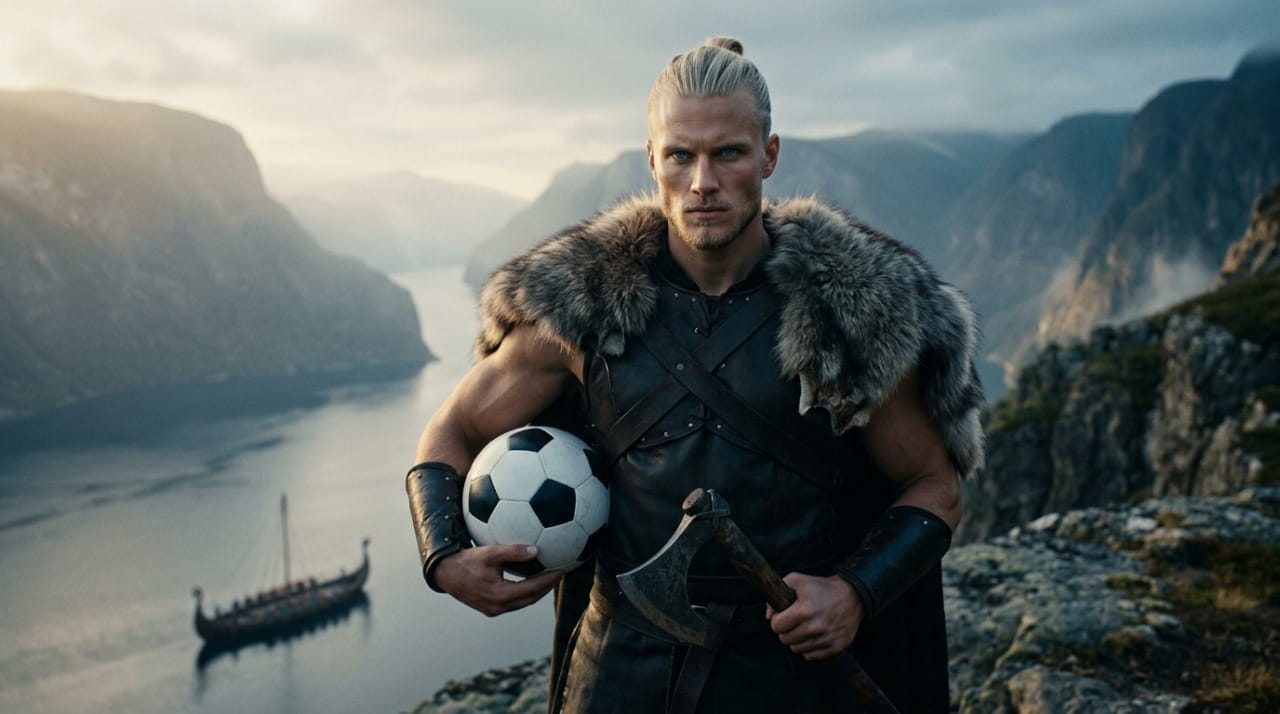
Erling Haaland, the Viking of Modern Times
He runs like a raid, he strikes like lightning, and he celebrates his goals sitting cross-legged with his eyes closed. Erling Haaland is not just the best striker of his generation: he is a Viking Haaland in the literal sense, a son of Norway whose every move seems pulled from a Norse saga. Let’s dive into the Viking heritage of the giant from Bryne.
- Roots planted in the fjords of Norway
- A modern berserker physique
- A warrior's mindset: Norse focus and rituals
- Haaland, the Thor of the pitch
- Transfers conducted like raids
- The Viking spirit to wear every day
- Frequently Asked Questions
Since his explosion at Dortmund and then at Manchester City, one image has stuck to the Norwegian striker: that of a Viking Haaland, half-athlete and half-legendary warrior. This isn't just a commentator's metaphor. Erling Braut Haaland was born to a Norwegian father, grew up between England and the small town of Bryne on the west coast of Norway — the very same coast from which longships set sail a thousand years ago. Watching Haaland play is like witnessing a resurgence of the Norse spirit in modern football. Let’s break down why.
📌 In short
- Erling Haaland is Norwegian: his father Alf-Inge Håland is from Bryne, on the southwest coast of Norway, a region that was one of the cradles of Viking expansion.
- The nickname stems from his 1.95-meter (6'5") frame, his Norwegian roots, and a playing style that commentators compare to that of the berserkers.
- Thor, the god of thunder, is the most common comparison.
- Haaland celebrates some of his goals sitting in a meditation pose, legs crossed and eyes closed.
- Le Comptoir Viking offers jewelry, decorations, and Norse accessories in stainless steel: runic signet rings, warrior necklaces, bracelets, and tankards.
Roots planted in the fjords of Norway

Erling Haaland is Norwegian down to his studs. Although he was born in Leeds in 2000 — his father Alf-Inge Håland was playing there at the time — it was in Bryne, in the county of Rogaland, where he grew up and took his first steps as a footballer. This region of southwestern Norway, carved by fjords and battered by the North Sea, was one of the cradles of Viking expansion. The men who boarded the longship models that we reproduce today set off from these very coasts to explore, trade, and conquer.
Rogaland is no ordinary Viking land. It was off the coast of Stavanger, a few kilometers from Bryne, that the Battle of Hafrsfjord took place in 872, the naval engagement that allowed King Harald Fairhair to unify Norway for the first time. This region gave birth to warlords, navigators, and settlers who spread as far as Iceland, England, and Normandy. Growing up there means growing up amidst burial mounds, runestones, and sagas passed down from generation to generation.
The surname itself sounds like a saga. "Håland" is a classic Norwegian farm name, rooted in the land and the country's rural traditions. It is not surprising that the player has always claimed his national pride, choosing Norway over England for his national team, despite his place of birth. Like his ancestors, Haaland set off to conquer distant lands — Austria, Germany, England — without ever denying where he comes from.
This duality between Norse grounding and continental conquest sums up the entire mythology of the character. The Viking was not just a raider: he was an explorer, a navigator, a strategist. Haaland embodies this same methodical ambition, this hunger for new territories that drove the Scandinavians to the gates of Constantinople.
A modern berserker physique

With his 1.95-meter (6'5") height and carved build, Haaland immediately evokes the berserkers, those legendary Viking warriors who would enter a state of fury in battle. The word "berserk" — from the Icelandic ber-serkr, "bear-shirt" — described those fighters known for being impervious to pain and possessing superhuman strength. It is hard not to think of them when watching the Norwegian absorb charges from defenders without flinching, before pushing them away with a shoulder shove.
The sagas tell that berserkers sometimes fought without armor, howling and biting their shields, carried away by a warrior's trance. Walking alongside them were the ulfhednar, the "wolf-skinned men," another elite brotherhood of warriors dedicated to Odin. This imagery of controlled fury, of raw power channeled in the service of a goal, fits perfectly with how Haaland pounces on any ball in the opposing penalty area.
His power is no coincidence. A precision diet, optimized sleep, physical preparation worthy of an Olympic athlete: Haaland has turned his body into a weapon, just as a Norse warrior forged his condition to survive raids. This obsession with raw strength and endurance is deeply Viking in spirit.
At Le Comptoir Viking, this archetype of the indomitable warrior inspires a whole range of items. The Steel Bear Berserker Signet Ring features the symbol of the fighter's animal totem, while the Berserk Sword Pendant Necklace directly evokes the blade of these war-crazed fighters. Pieces for those who, like Haaland, cultivate an iron mentality.
This bodily discipline extends even to training gear: our Viking tank tops designed for the gym feature Norse warrior motifs — Valknut, Odin's ravens, Thor's hammer — on cuts tailored for effort.
A warrior's mindset: Norse focus and rituals

What is striking about Haaland, beyond his physique, is his composure. His now-cult celebration — sitting in a meditation position, legs crossed, blank gaze turned toward the horizon — has traveled the world. Many have seen it as a nod to yoga or Zen serenity. But the image of a Norse warrior in deep introspection, surrounded by the wisdom of the runes, fits just as well.
For the Vikings were not just brutes. Their culture placed central importance on knowledge, strategy, and self-mastery. The runes — the sacred alphabet of the Futhark — were used as much for writing as for divination and spiritual protection. The great Odin himself, father of the gods, sacrificed an eye and hung for nine days from the tree Yggdrasil to acquire the knowledge of the runes. Among the men of the North, true strength was born from this balance between the arm that strikes and the mind that reflects.
This quest for inner mastery is reflected in Haaland's almost monastic discipline: blue light filtering glasses, meditation, meticulous recovery management. A monk-warrior mindset. For those who want to carry this symbol of wisdom and focus, the Vegvisir Ring engraved with runes — the compass that guides the traveler through storms — or the Odin's Runes Ring perfectly embody this heritage.
Haaland, the Thor of the pitch

If Haaland had to be associated with a god from the Norse pantheon, it would undoubtedly be Thor. The god of thunder, son of Odin, was the protector of mankind, the strongest of the Aesir, the one who crushed giants with hammer blows. His colossal strength, warrior-like simplicity, and loyalty made him the favorite of the people — exactly the kind of popular aura that surrounds the Norwegian striker.
When Haaland winds up his shot, the ball takes off like a bolt of lightning. His goals arrive with the regularity and violence of thunder, season after season, record after record. From his very debut in the Champions League, he shattered early-career statistics; in his first Premier League season, he broke the record for goals in a single campaign in the league's history. Didn't Mjölnir, Thor's hammer, always return to its master's hand after striking its target? The parallel is striking: wherever Thor threw his hammer, Haaland unleashes his shots, and few ever miss their mark.
This symbol of the divine hammer is one of the most powerful in all of Viking mythology. It represents protection, strength, and blessing. Our 44cm Thor's Hammer Mjölnir replica allows you to own this legendary emblem in large format, while the Odin & Thor wall plaque pays tribute to the two deities who watch over warriors.
Transfers conducted like raids
Haaland's career reads like a Viking expedition: departure from the home port of Bryne, a stopover in Molde under the orders of another famous Norwegian, then the conquest of Austria with Salzburg, Germany with Dortmund, and finally England with Manchester City. At every stage, the same pattern: arrive, make his mark, dominate, then move on to a wider territory. Exactly the logic of Norse raids, where you spot the target, strike fast and hard, and return loaded with booty — here, trophies and records.
This methodical trajectory betrays an inherent conqueror's mentality. Haaland does not hide his ambition to win everything, like a jarl built to rule the seas. Where many are content with success, he aims for legend — a goal that the great names of the sagas would not have disowned.
The Viking spirit to wear every day
Whether you are a football fan, a Norse mythology enthusiast, or simply an admirer of this conqueror's mentality, Haaland's example reminds us of a timeless truth: the Viking spirit never disappeared. It lives on in discipline, self-transcendence, courage in the face of adversity, and pride in one's origins.
The warriors of the North believed that a life given without reserve to battle opened the gates to Valhalla, Odin's great hall where the bravest feasted for eternity. This idea of giving everything, of never sparing one's efforts, still permeates Scandinavian sports culture. Haaland is its modern incarnation: every run, every duel, every strike is carried out as if honor depended on it. Perhaps that is, at heart, the true Viking legacy — less a matter of axes than a state of mind.
Wearing a Viking symbol isn't about playing dress-up: it's about claiming these values. Our Viking jewelry (rings, bracelets, necklaces) offers a complete array to display this identity, while the Wolf Tooth pendant necklace evokes Fenrir, the mythical wolf, and the wild strength that Haaland unleashes on the pitch.
The giant from Bryne may never have brandished an axe, but every time he pulls on the Norway jersey, a thousand years of Norse history walk onto the pitch with him. An authentic Viking Haaland, heir to the men of the North.
Frequently asked questions
Is Erling Haaland truly of Viking descent?
Erling Haaland is Norwegian: his father, Alf-Inge Håland, is from Bryne, on the southwest coast of Norway, a region that was one of the cradles of Viking expansion. Although born in Leeds, England, he grew up in Norway and represents that nation in international competition. His roots are therefore well anchored in the Nordic lands from which the longships departed.
Why is Haaland nicknamed "The Viking"?
This nickname comes from a combination of several elements: his imposing 1.95-meter physique reminiscent of berserker warriors, his Norwegian origins, his conqueror's mentality, and his meditation celebration position evoking Norse rituals. Commentators and fans have naturally associated this profile with Viking imagery.
Which Norse god best corresponds to Haaland?
Thor, the god of thunder, is the most frequent comparison. His colossal strength, his role as protector of men, and the power of his hammer Mjölnir echo Haaland's thunderous shots and his regularity in front of goal. Like Thor among the Aesir, Haaland is the feared and popular goalscorer of his generation.
What does Haaland's cross-legged celebration mean?
Haaland celebrates some of his goals sitting in a meditation position, legs crossed and eyes closed. The player sees it as a symbol of calm and serenity. This image of contemplation also recalls the spiritual dimension of Nordic culture, where self-mastery and the knowledge of runes held an important place alongside warrior strength.
Where can I find Viking jewelry and objects inspired by this warrior spirit?
Le Comptoir Viking offers a large collection of Viking jewelry, decorations, and accessories in stainless steel and authentic materials: runic signet rings, warrior necklaces, Thor's hammer replicas, longship models, and much more. Each piece is designed for those who want to carry the values of strength, courage, and Nordic pride in their daily lives.
“The coward believes he will live forever if he avoids the battle; but old age will grant him no respite, even if the spears were to spare him.”
— Hávamál, stanza 16
May Thor's strength guide your steps.

Leave a comment
All comments are moderated before being published.
This site is protected by hCaptcha and the hCaptcha Privacy Policy and Terms of Service apply.