
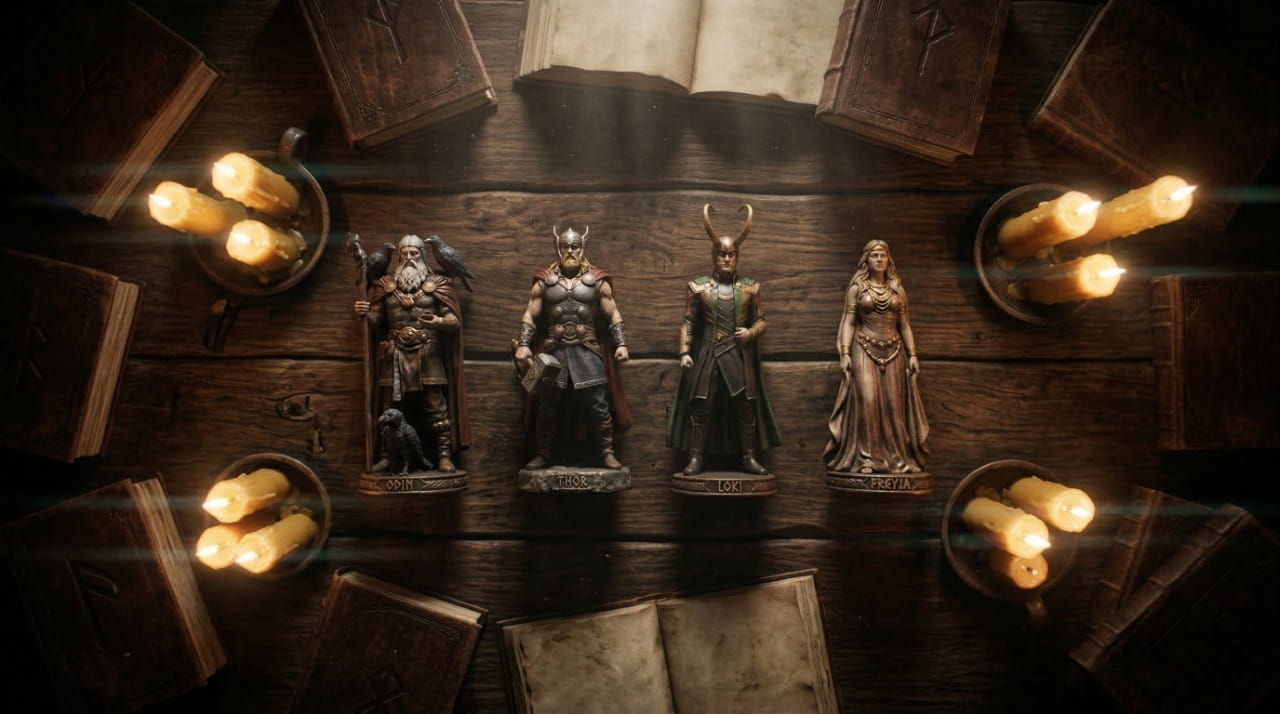
Viking Statues: When Norse Gods Take Shape
Viking statues are sculpted representations of Norse gods and warriors — Odin, Thor, Freyja, Loki, Tyr — heirs to a thousand-year-old tradition. The Vikings erected sacred wooden effigies in their temples, most notably in Uppsala, Sweden. Today, sculpted in high-definition resin, these statues perpetuate Norse symbolism and transform every interior into a Viking sanctuary.
📌 In Brief
- Odin is the most popular choice for a Viking statue, symbolizing wisdom and power.
- Resin statues offer extremely fine detail and great durability, perfect for interior decor.
- The Vikings carved wooden effigies of their gods, which they placed in temples like the one in Uppsala, Sweden.
- A desk or a bookshelf is perfect for a 10-20 cm figurine.
- Dust regularly with a soft, dry cloth.
Are you looking for a statue rather than an explanation? Our statues and figurines of Norse gods are gathered in our Viking statues department.
From Wooden Idols to Resin Masterpieces
A Thousand-Year-Old Sacred Tradition
Long before cathedrals, long before museums, the peoples of the North were sculpting their gods. In the forests of Scandinavia, in the shade of ancient ash trees, the Vikings erected sacred effigies — tangible representations of the invisible forces that governed their world. These statues were not mere ornaments. They were bridges between Midgard and Asgard, anchors of faith carved from wood, stone, or bronze.
The Revival of Norse Statuary
Today, this tradition is experiencing a spectacular revival. Viking statues no longer protect temples — they adorn our homes, our offices, and our bookshelves. But they still carry the same symbolic weight: the power of Odin, the strength of Thor, the grace of Freyja, and the sacrifice of Tyr. Modern high-definition resin casting techniques allow for details of such finesse that the Viking sculptors themselves could never have imagined — every wrinkle on Odin, every muscle on Thor, every Celtic interlace is reproduced with striking precision.
“The gods are not in the sky. They are where men place them.”
— Saga of Egill Skallagrímsson
Odin: The Wanderer Who Sees All

Odin the All-Father — the one-eyed god who sacrificed his eye for wisdom
Archaeological Representations of Odin
No god has been represented as much as the All-Father. In Scandinavian archaeological digs, statuettes of Odin appear in multiple forms: the one-eyed warrior wearing his winged helmet, the old man leaning on his Gungnir spear, the hooded traveler flanked by his two ravens Huginn and Muninn. Vikings placed effigies of Odin in the most important temples, particularly in Uppsala, Sweden, where Adam of Bremen described an immense gilded idol enthroned in the center of the sanctuary in 1070.
Our Odin Statues
Every representation of Odin tells a different aspect of his complex nature. The god seated on his throne Hlidskjálf evokes his sovereignty over the Nine Worlds — it is from this seat that he observes everything happening in the universe. Our Odin the Wanderer Statue captures this duality: the wisdom of the eternal traveler and the power of the king of the gods, his Gungnir spear firmly in hand. For those seeking the majesty of the All-Father in all his glory, the Odin on his throne statue offers a striking representation of his omnipotence. And for enthusiasts of figurines to paint, our 88mm resin Odin figurine allows you to recreate the All-Father according to your own vision.
Owning an Odin statue means invoking wisdom, victory in battle, and the protection of the heroic dead destined for Valhalla.
Thor: The Protector of Men

Thor brandishing Mjölnir — the god of the people, protector of Midgard
The God of the Norse People
If Odin was the god of kings and poets, Thor was the god of the people. The rumbling thunder, the rain that fertilizes the fields, the brute force that repels the frost giants — Thor embodied everything that Norse farmers, artisans, and sailors needed in their daily lives. That is why his representations are the most numerous in Viking archaeology.
The Eyrarland Statuette and Tradition
Statuettes of Thor almost always show him with his Mjölnir hammer, brandished above his head or resting on his shoulder. The famous Eyrarland statuette in Iceland, dating from the 10th century, is one of the oldest representations of Thor ever discovered — a small bronze man clutching Mjölnir on his lap with an enigmatic smile. It is now exhibited at the National Museum of Iceland in Reykjavík.
Our Thor Statues
Our Thor, Protector of Midgard Statue follows this tradition by representing the god of thunder in all his power, with Mjölnir raised toward the sky. For a more detailed version featuring his full armor, the Thor, God of Thunder resin statue captures every detail of his divine equipment. Placing Thor in your home means continuing a gesture that Vikings performed over a thousand years ago: inviting divine protection into your home.
Freyja, Loki, and Tyr: The Forgotten Faces of the Pantheon

Freyja and Loki — grace and mischief, two facets of the Norse pantheon
Freyja: Goddess of Love and War
Beyond the two major figures, the Norse pantheon offers a gallery of characters just as fascinating. Freyja, goddess of love, fertility, and war, was worshipped in every Norse home. Queen of the Valkyries, she received half of the warriors who fell in battle in her realm of Folkvangr. Our Freyja, Queen of the Valkyries Statue represents her in all her warrior grace.
Loki: The Eternal Trickster
Loki, the god of mischief, is a more complex character in statuary. Rarely represented alone in archaeological sources — because the Vikings did not strictly worship him — he nevertheless appears on runestones and sculpted reliefs, often in narrative scenes linked to Ragnarök. Our Loki Statue captures this ambiguous character — neither entirely evil nor truly good — in a pose that betrays his nature as an eternal trickster.
Tyr: The God of Sacrifice
As for Tyr, the god of oaths and justice, his most poignant depiction is that of sacrifice: his right hand in the maw of the wolf Fenrir, offered as a pledge of good faith to allow the other gods to chain the beast. The Tyr Statue immortalizes this mythological moment — a reminder that true courage sometimes requires an irreversible sacrifice.
Warriors and Berserkers: The Human Transcended

Viking warrior resin figure — the art of the Norse hobby
The Ulfhednar: the wolf-warrior
Viking statues are not limited to deities. Norse warriors — particularly berserkers and ulfhednars — occupy an important place in the sculptural tradition. The figure of the wolf-warrior, the ulfhednar, is particularly fascinating. Dressed in a wolf skin and fighting with the ferocity of the totemic animal, he represents the fusion between the human and the bestial. Our Ulfhednar Viking Statue captures this terrifying transformation — the precise moment when the man fades away before the predator.
Figures to paint: the immersive experience
For hobbyists and model makers, our resin figures to assemble and paint offer an even more immersive experience. Each piece is delivered as a kit with an exceptional level of detail. The 75mm Ragnar Lothbrok Figure allows you to recreate the legendary Viking king, while the Valkyrie Figure and the Bjorn Ironside Figure complete a collection of legendary warriors. Even the God of War Kratos Figure fits into this revisited Norse mythological universe.
Viking wall decor
Beyond tabletop figures, Viking statuary also finds its place on your walls. Our Odin & Thor Wall Plaque and the Viking Bull Head Wall Mount bring a spectacular touch to any wall. To go further in your Viking home decor, combine statues and wall pieces to create a true Norse sanctuary.
How to Choose Your Viking Statue
Choosing a Norse statue means choosing an energy. Each god and each warrior carries a distinct symbolism.
Resin or wood: which material?
Resin statues offer remarkably fine details — every fold of clothing, every strand of beard is reproduced with precision. They are durable, lightweight, and easy to maintain. Wood statues have a more authentic charm, directly reminiscent of the idols that the Vikings carved in the Scandinavian forests. The choice depends on your preference: modern precision or ancestral tradition.
Size according to your space
Our 75-88mm figures are perfect for a shelf or desk. Statues of 15-25 cm make an excellent focal point on a fireplace or in a display case. Wall pieces like the Odin & Thor plaque or the bull head add an impressive vertical dimension to your decor.
View the entire Viking Statue collection →
Frequently Asked Questions about Viking Statues
Which Viking god should I choose for a statue?
Odin is the most popular choice, symbolizing wisdom and power. Thor represents strength and protection, while Freyja embodies love and fertility. The choice depends on the symbolism that resonates most with you.
What is the difference between a resin and a wood statue?
Resin statues offer very fine details and great durability. Carved wood statues are more authentic and artisanal, reminiscent of the idols that the Vikings carved themselves in the Scandinavian forests.
Did the Vikings really worship statues?
Yes, the Vikings carved wooden effigies of their gods which they placed in temples such as the one in Uppsala, Sweden. These statues received offerings and were at the heart of Norse religious rituals.
Where to place a Viking statue at home?
An office or library is perfect for a 10-20 cm figure. Large statues make an excellent focal point on a fireplace or in a living room. Avoid direct sunlight to preserve the details.
How to care for a resin Viking statue?
Dust regularly with a soft, dry cloth. For a deeper clean, use a slightly damp cloth without chemicals. Avoid direct sunlight to preserve the colors and details.
What is the symbolism of a Tyr statue?
Tyr is the god of courage and sacrifice. His statue often depicts him with a missing hand, devoured by the wolf Fenrir. He symbolizes honor, justice, and sacrifice for the common good.
“Cattle die, kinsmen die, and you yourself must die. But one thing never dies: the reputation of the dead.”
— Hávámál, verse 77
May the Aesir guide you on the path of honor.
👉 Explore our collections of Viking statues and Norse decorations to transform your home into a Viking sanctuary.

Leave a comment
All comments are moderated before being published.
This site is protected by hCaptcha and the hCaptcha Privacy Policy and Terms of Service apply.