
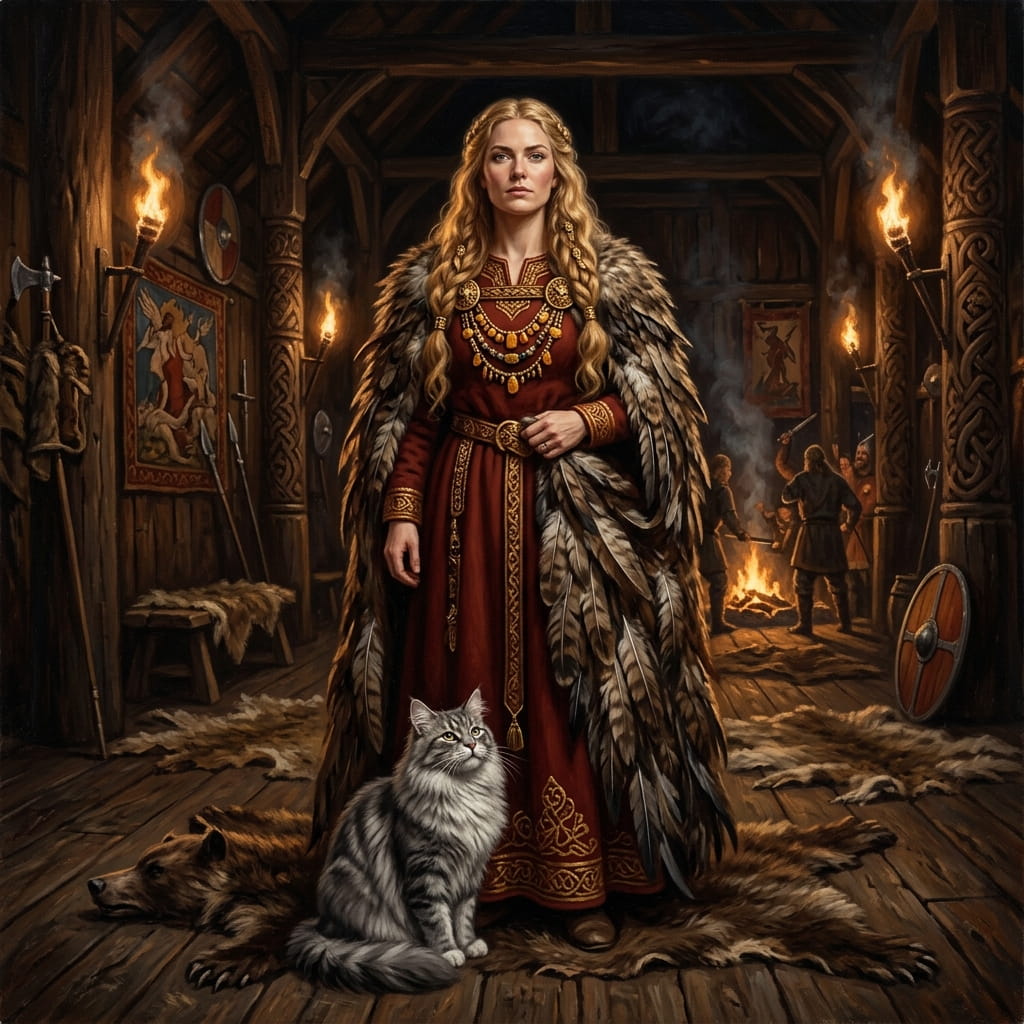
Freya: Norse Goddess of Love, War, and Magic
Freya (Freyja, "the Lady") is the Norse goddess of love, fertility, and magic, and the only deity to share the battle-dead with Odin. A Vanir who came to live among the Aesir, owner of the Brísingamen necklace and a chariot pulled by two cats, she is, according to Snorri Sturluson, "the most glorious of the goddesses." Here is what the Eddas and sagas really say, myth by myth.
📌 In brief
- Freya is the Norse goddess of love, fertility, magic, and a share of the battle-dead.
- Freya is a Vanir, wife of Óðr, goddess of love and magic; Frigg is an Aesir, wife of Odin and mother of Baldr, guardian of marriage.
- Freya's necklace is called Brísingamen, the necklace of the Brísings.
- Freya travels in a chariot pulled by two cats, according to Snorri's Edda, and thus arrives at Baldr's funeral.
- Freya is not a Valkyrie, and sources never name her queen of the Valkyries.
Sources: Freyja, Wikipedia · Snorri's Edda · Poetic Edda · Ynglinga Saga. The cited stanzas are translated by us.
Freya, who is she? A Vanir among the Aesir
Freya (Freyja in Old Norse) was not born in Asgard. She belongs to the second divine family of the Norse world, the Vanir, gods of earth, sea, and fertility, distinct from the warrior Aesir of Asgard. She is the daughter of Njörd, the god of winds and shores, and the twin sister of Freyr, god of harvests and prosperity. Her mother is never clearly named in the texts; one tradition makes her the sister of Njörd himself, a marriage between brother and sister that the Aesir disapproved of and which Loki taunts her about in the Lokasenna.
Her arrival among the Aesir was the result of a war. The two divine families fought and then concluded a peace through an exchange of hostages: the Vanir sent Njörd, Freyr, and Freya to Asgard. Snorri Sturluson recounts in the Ynglinga Saga that Freya became a priestess of sacrifices (blótgyðja) there and taught the Aesir seiðr, the magic of the Vanir. She is therefore a foreigner who became indispensable: Snorri calls her "the most glorious of the goddesses" and notes that she is "the easiest to invoke," the one called upon in matters of love.
Her name itself is a title. Freyja means "the Lady," just as Freyr means "the Lord." The word has survived in the German Frau, the Swedish fru, and the Dutch vrouw. Poets give her other names, which Snorri enumerates: Vanadís, "the Dís of the Vanir"; Mardöll, "who shines upon the sea"; Hörn; Gefn, "the Giver"; Sýr, "the sow," an animal of fertility rather than an insult. The Saga of Burnt Njál even calls her Valfreyja, "Lady of the Slain," a title that corresponds to Odin's Valfaðir, "Father of the Slain."
To locate Freya among the other deities, our complete pantheon of the gods of Asgard presents Aesir and Vanir family by family.
Goddess of love, fertility, and magic
Love, and what people really asked of her
Freya is first and foremost the goddess one prays to for happiness in love. Snorri writes it bluntly: "it is good to invoke her for matters of love." But Norse love was not limited to sentiment. In the Oddrúnargrátr, a woman in labor is blessed in the name of "Frigg and Freya and even more gods": the goddess also watches over childbirth. Her fertility is that of the fields as much as of couples, a direct inheritance from her Vanir family.
This freedom earned her the attacks of Loki. In the Lokasenna, the god of discord accuses her of having shared the bed of every god and elf present in the hall, and of having been caught with her own brother. Njörd replies that it is no crime for a woman to have a lover. The scene says two things: Freya is free, and the Aesir themselves admit it.
Óðr, the absent husband, and the tears of gold
Freya is married to Óðr, about whom almost nothing is known except that he "travels far away." She searches for him across the world under assumed names and weeps for his absence. Her tears are red gold, and poets have made this into a kenning, a coded image: to say "Freya's tears" is to say gold. Her two daughters bear names that extend this image, Hnoss and Gersemi, two words that mean "treasure" and "jewel."
The resemblance between Óðr and Óðinn has escaped no one: many historians see them as the same split figure, just as Freya and Frigg could be. The question remains open, and we return to it below.
Seiðr: the magic that came from the Vanir
Freya is the mistress of seiðr, the magic of divination and influence practiced by the völur, those seeresses whom Scandinavian farms hosted during the winter. According to the Ynglinga Saga, she brought it to the Aesir, and Odin learned it from her. Seiðr was considered a feminine practice; a man who practiced it risked the accusation of ergi, a mark of infamy. Loki reminds Odin of this in the Lokasenna. That the greatest of the gods had to learn it from a Vanir speaks volumes about the prestige of Freya. Our article on magical runes and Viking rituals describes these practices.

Freya's chariot, pulled by two cats: the only feline carriage in Norse mythology (Gylfaginning 24).
Warrior Freya: Fólkvangr and half the dead
The goddess of love is also a goddess of the slain. The Grímnismál, one of the oldest poems in the Edda, says it in one stanza: Fólkvangr, the "field of the host," is Freya's domain, and every day she chooses half the dead in battle, with the other half going to Odin. Her hall is called Sessrúmnir, "rich in seats." In other words, Valhalla is not the only destination for the fallen warrior: there is a fifty-fifty chance he ends up with Freya.
This division is not a late invention. In Egil's Saga, when the old skald Egill wishes to die of grief, his daughter Þorgerðr pretends to join him and declares that she has eaten nothing and will eat nothing "until she sups with Freya." For a 10th-century woman, dying meant joining the goddess. Freya is thus the only Norse deity to reign over both desire and death, and it is this duality that makes her so unique.
Freya and the Valkyries: what the texts say, and what they do not
It is often read that Freya is "the queen of the Valkyries." The ancient sources never say this. The Valkyries are Odin's messengers; Freya chooses her dead for herself. The association comes from her title Valfreyja, "Lady of the Slain," and from her feather cloak, which makes her fly just as the Valkyries ride through the air. The link is poetic and modern, not mythological. We point this out because our own Freya statue uses this popular title: it is a contemporary representation, and we prefer to let you know.
"Fólkvangr is the ninth: there Freya decides the seats in the hall. Each day she chooses half the slain, and Odin possesses the other half."
— Grímnismál, stanza 14 (Poetic Edda)
Freya's attributes: Brísingamen, cats, falcon, and boar
Brísingamen, the necklace of the Brísings
The most famous piece of jewelry in Norse mythology is a necklace. Brísingamen, "the necklace of the Brísings," is cited as early as the Anglo-Saxon Beowulf as Brosinga mene, and it runs throughout the Edda. The account of its origin only reached us late, in the Sörla þáttr, a 14th-century text: four dwarves forge it, Freya wants it, and she pays the price by spending a night with each of them. Odin, jealous, sends Loki to steal it while she sleeps.
A much older poem, the Húsdrápa by Úlfr Uggason, composed around 985, shows Heimdall and Loki fighting over the necklace in the form of seals, and Heimdall returning it to the goddess. In the Þrymskviða, finally, the necklace breaks when Freya flies into a rage: her fury makes the hall of the Aesir tremble. A piece of jewelry that shatters under its owner's fury is enough to say what it represents: her beauty, yes, but also her power.
"Freya flew into a rage, trembling with anger; the entire hall of the Aesir shook, and the great necklace of the Brísings broke."
— Þrymskviða, stanza 13 (Poetic Edda)

Brísingamen, the necklace of the Brísingar, forged by four dwarfs: the most famous jewel of the North.
The chariot pulled by two cats
Snorri is categorical: Freya "travels in a chariot pulled by two cats." He does not name them, and the names found on the internet (Bygul, Trjegul) come from a 20th-century novel, not the Eddas. At Baldr’s funeral, the goddess arrives this way, her cats before her, in the middle of a procession of giants and gods. The word used, fress, refers to a tomcat; people have imagined lynxes or large forest cats. What is certain is that the cat, an animal of the home and fertility, is Freya’s animal just as the wolf and raven are those of Odin.
The falcon feather cloak
Freya possesses a valshamr, a "falcon skin" that allows whoever wears it to fly from one world to another. She lends it to Loki at the beginning of the Þrymskviða so he can go retrieve Thor’s hammer from the giants, and Loki borrows it again in the Skáldskaparmál to rescue Iðunn. Some texts attribute the same cloak to Frigg: this is one of the clues suggesting that the two goddesses share a common origin.
Hildisvíni, the battle boar
In the Hyndluljóð, Freya rides a boar with golden bristles, Hildisvíni, to the home of the giantess Hyndla. The boar is none other than Óttar, a young man who honors her with sacrifices, whom she transformed so he could recite his genealogy and win an inheritance. The boar is the animal of the Vanir: her brother Freyr owns Gullinbursti, "the golden-bristled." Freya protects her followers, and she does so with cunning.
The great myths where Freya plays a leading role
Freya is not a secondary character in the Eddas. She is the stake in several major stories, which speaks to her value in the eyes of giants and gods alike.
The Þrymskviða: Thor disguised as Freya
The giant Þrymr has stolen Mjöllnir, the hammer of Thor, and will only return it in exchange for Freya's hand. Loki comes to bring her the news: get ready, you are being taken to the giants. This is when Freya flies into a rage that causes Brísingamen to shatter. She flatly refuses, and the gods must find another way. Heimdall suggests disguising Thor himself as Freya, with a bridal veil and the Brísingar necklace around his neck. The god of thunder, furious at being mistaken for a woman, gives in to Loki: "Without my hammer, the giants will settle in Asgard." At the banquet, the "bride" devours an ox and eight salmon; Þrymr is astonished, and Loki explains that Freya hasn't eaten in eight nights because she was so eager. When the hammer is placed on the bride’s lap to bless the union, Thor grabs it and massacres the giants.
The poem is a comedy, but its motivation is serious: Freya is the one thing the giants always demand, because she is fertility itself. To lose her is to lose the future of the gods.

The Þrymskviða: Thor in a wedding dress, Freya’s necklace around his neck, ready to reclaim his hammer.
The builder of Asgard and the price of the wall
A master builder proposes to build the wall of Asgard in one winter. His price: Freya, the Sun, and the Moon. The gods accept, convinced he will fail, but his horse Svaðilfari performs prodigious work. As the deadline nears, they threaten Loki, who advised the deal. Loki turns into a mare, lures the stallion away, and the wall remains unfinished: the builder, unmasked as a giant, is killed by Thor. From that night, Sleipnir, the eight-legged horse, will be born. Here again, Freya is the wager, and the gods only agree because they are certain they will not lose her.
Hrungnir, Hyndla, and the others
The giant Hrungnir, drunk at the table of the Aesir, boasts that he will carry off Freya and Sif to Jötunheim; it is Freya who, alone, still dares to serve him drink before Thor challenges him. In the Hyndluljóð, she leads Óttar to Hyndla and threatens the fire-giantess to obtain the memory of a lineage. At Baldr’s funeral, she is there, with her cats. And in the Lokasenna, she is the first to stand up to defend Frigg against Loki’s insults. Every time, there is a constant: Freya does not submit, she acts.
Freya or Frigg? Two goddesses, one common origin?
Beginners confuse them, and they are not the only ones: the texts themselves waver. Frigg is Odin's wife, mother of Baldr, guardian of marriage and the home, who knows everyone’s destiny but reveals nothing. Freya is the free Vanir, Óðr’s lover, the sorceress. Yet both possess a falcon cloak, both are linked to gold, and the name Óðr is too similar to Óðinn for it to be a coincidence.
Many specialists believe that the continental Germanic peoples had only one great goddess, Frijjō, whose name means "the beloved," and that Scandinavia split her into two: the wife Frigg and the lover Freya. The debate is not settled, and it likely never will be, due to a lack of texts prior to Christianization. Remember this: in the Eddas as we read them, they are two distinct individuals who speak to and defend one another.
A word about Friday. The English word Friday comes from the Old English Frīgedæg, the day of Frigg, modeled on the Latin dies Veneris: the Germanic peoples had recognized their goddess in Venus. The French vendredi, for its part, comes directly from Venus. Attributing Friday to Freya is therefore a simplification: the day bears the name of Frigg, even if, as we have seen, the two figures perhaps overlap.
The cult of Freya: what archaeology and place names reveal
Everything we know about Freya comes from texts written in Iceland two centuries after the conversion by Christian scholars. Her actual cult is therefore poorly known, but it has left traces. Scandinavian place names preserve her name, often associated with a word designating a sanctuary or a field, a sign that she had her places of devotion, especially in Sweden and Norway, just as her brother Freyr had his.
Archaeology provides a famous image: the Aska pendant, a small 10th-century silver figure found in Östergötland, Sweden. It depicts a seated woman, hands on her belly, wearing a large multi-strand necklace. Many see this as Freya and her Brísingamen; others, a pregnant woman placed under her protection. Both readings converge, and they tell the same story: a goddess one wore on oneself, as a pendant, like an amulet.
After the conversion, Freya was the most attacked goddess. The Saga of Olaf Tryggvason shows new converts being ordered to ridicule her, and an Icelandic poet, Hjalti Skeggjason, was condemned for a verse that called her a bitch. Several historians believe that some of her attributes shifted to the Virgin Mary in Scandinavian popular piety, as occurred elsewhere in Europe with other goddesses. Today, she is one of the most honored deities of Ásatrú, modern Nordic paganism, and Freja has been among the most popular girls' names in Denmark for years.

Sessrúmnir, "of many seats": half of those who die in battle go to Freya, the other half to Odin.
Freya in popular culture: from Lagertha to God of War
In the series Vikings, Freya does not appear, but she is everywhere: Lagertha places herself under her protection, and the warrior's devotion to the goddess of love and the slain speaks precisely to the dual nature we have described. Our article on Lagertha returns to this character. In Marvel, however, it is Frigga, Thor's mother, who occupies the screen; Freya is almost absent there.
It is the video game that gave her her biggest role. In God of War (2018) and then God of War Ragnarök, Freya is an exiled Vanir, former wife of Odin, mother of Baldr, fearsome sorceress and warrior; the game deliberately merges Freya and Frigg, which is, as we have seen, as much a scholarly hypothesis as it is a screenwriter's license. Players who discover mythology through this medium are often surprised to learn that, in the Eddas, Baldr's mother is named Frigg.
What Freya represents in a tattoo or jewelry
Unlike Thor or Odin, Freya has no single graphic symbol. She is represented by her attributes: the cat, the falcon, the boar, and above all the necklace. A pendant worn close to the heart is, literally, Freya's jewelry. In a tattoo, she is chosen to express both love and strength, and our guide to viking tattoos for women details the designs that suit her. For jewelry, our viking necklace collection and our viking jewelry range bring together pieces of Nordic inspiration, and you can find the goddess herself among our statues of Nordic gods.
Frequently asked questions about Freya
Who is Freya in Norse mythology?
Freya is the Norse goddess of love, fertility, magic, and a portion of those who die in battle. Daughter of Njörd and twin sister of Freyr, she belongs to the Vanir and has lived in Asgard since the peace concluded with the Aesir. Snorri Sturluson describes her as the most glorious of goddesses.
What is the difference between Freya and Frigg?
Freya is a Vanir, wife of Óðr, goddess of love and magic; Frigg is an Aesir, wife of Odin and mother of Baldr, guardian of marriage. Both may have been born from a single ancient Germanic goddess, but the Eddas treat them as two distinct individuals.
What is Freya's necklace?
Freya's necklace is called Brísingamen, the necklace of the Brisings. Forged by four dwarves according to the Sörla þáttr, stolen by Loki, and recovered by Heimdall, it breaks when the goddess becomes angry in the Þrymskviða. It is the most famous piece of jewelry in Norse mythology.
Why does Freya have cats?
Freya travels in a chariot pulled by two cats, according to Snorri's Edda, and arrives at Baldr's funeral in this way. The texts do not name them; the names circulating online come from a modern novel. The cat, an animal of the home and fertility, has remained her animal.
Is Freya a Valkyrie?
Freya is not a Valkyrie, and the sources never name her queen of the Valkyries. She chooses for herself half of the warriors who die in battle, whom she welcomes into her hall Sessrúmnir in Fólkvangr, while Odin receives the other half in Valhalla.
Who is Freya's husband?
Freya's husband is Óðr, a god about whom we only know that he travels far away. Freya searches for him and cries for his absence, and her tears are red gold. Their two daughters are named Hnoss and Gersemi, two names that mean treasure and jewel.
What does the name Freya mean?
Freya means "the Lady" in Old Norse, just as Freyr means "the Lord." The word gave rise to the German word Frau. Poets also give her the names Vanadís, Mardöll, Gefn, Hörn, Sýr, and Valfreyja, the Lady of the Slain.
Does Friday come from Freya?
Not directly. The English word Friday comes from Frīgedæg, the day of Frigg, modeled on the Romans' day of Venus. The French word vendredi comes from Venus. Freya is only associated with it if one admits that Frigg and Freya were originally the same goddess.
Is the Freya in God of War faithful to the mythology?
In part. The game makes her an exiled Vanir, former wife of Odin and mother of Baldr, which merges Freya and Frigg. In the Eddas, Baldr's mother is Frigg, and Freya is married to Óðr. Her powers as a sorceress and her nature as a warrior are, however, consistent with the texts.
"She is the most glorious of the goddesses. It is good to invoke her for matters of love."
— Gylfaginning, Chapter 24 (Snorri's Edda)
May the Aesir guide you on the path of honor.
👉 The goddess, her cats, and her necklace: find Freya among our statues of Nordic gods, and the most famous piece of jewelry in the North in our Viking Necklace range.

Leave a comment
All comments are moderated before being published.
This site is protected by hCaptcha and the hCaptcha Privacy Policy and Terms of Service apply.