
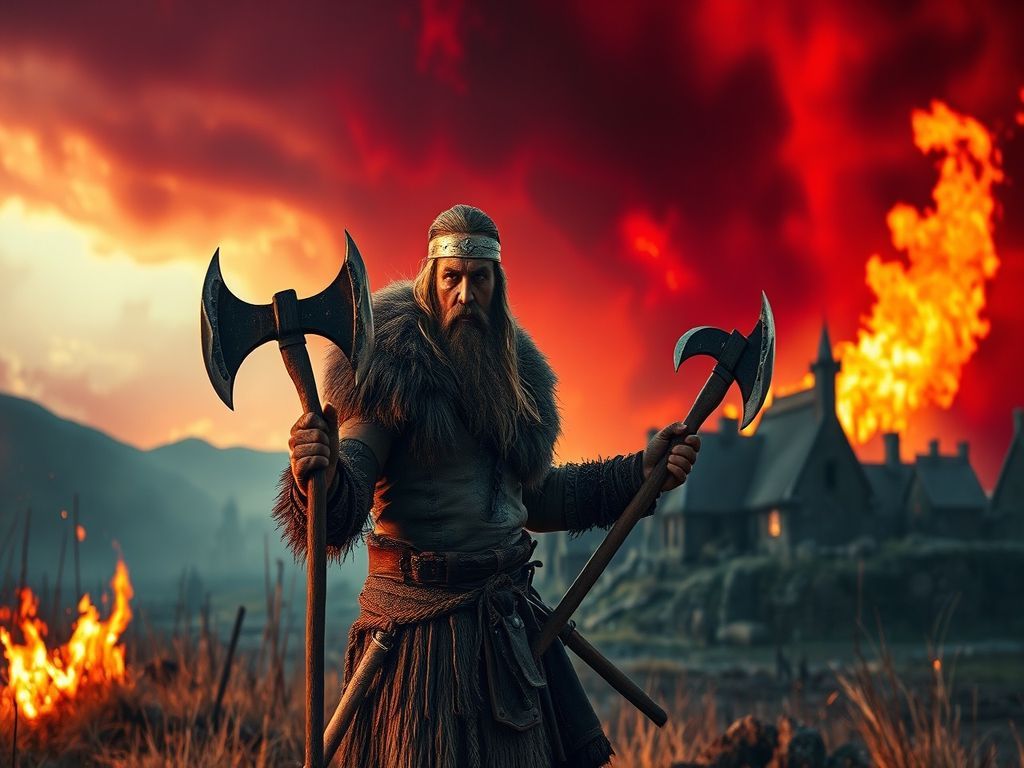
The Viking Axe: The Iconic Weapon of Northern Warriors
The Viking axe was the most widely used weapon by northern warriors from the 8th to the 11th century. More accessible than the sword, it served both as an everyday tool and a formidable weapon of war. From simple bearded axes (skeggöx) to imposing two-handed Dane axes (breiðöx), each type fulfilled a precise role on the battlefield and in daily life.
Historical sources: Viking Age arms and armour — Wikipedia | Mammen style — Wikipedia | Dane axe — Wikipedia
📌 In a nutshell
- The axe was versatile and accessible. Unlike the sword (a costly prestige weapon), the axe also served as a daily tool for cutting wood and construction.
- The main types are the bearded axe (skeggöx) with a downward-extended edge, the two-handed Dane axe, and the lighter throwing axe.
- Vikings used the axe to hook enemy shields and pull them down, strike over shield walls, and disarm opponents.
- Specifications varied by type. A one-handed axe had a 60–90 cm handle with a 15–20 cm head.
- The Vikings series takes aesthetic liberties, but the types of axes shown are generally realistic.
Looking for a replica rather than an explanation? Our Viking axes department features our foam replicas, from hatchets to large two-handed Dane axes, for costumes and decoration. Viking shields and the rest of our Viking weapons can be found in nearby departments.
Why the Axe and Not the Sword?
The popular image of the Viking brandishing a sword is misleading. In reality, the vast majority of northern warriors fought with an axe. The reason is primarily economic and practical.
A Viking sword required a considerable amount of high-quality iron and dozens of hours of work from a skilled blacksmith. The most renowned blades, such as the famous Ulfberht swords, were forged from crucible steel imported from the Orient and cost the equivalent of several heads of cattle. Only jarls (chieftains) and the wealthiest warriors could afford one.
The axe, by contrast, required only a small iron head attached to a wooden handle. A village blacksmith could produce one in a few hours. Above all, every Scandinavian farm already owned an axe for felling trees, splitting firewood, and constructing buildings. When the jarl called his men to battle, the free farmer (bóndi) only had to grab the tool he handled every day.
This dual function—tool and weapon—explains why the Icelandic sagas mention the axe so often. In the Saga of Burnt Njáll, Skarpheðinn fights with his axe as a natural extension of his arm. The axe was not a default choice: it was the weapon of the Nordic people, the one that accompanied the Viking from birth to the grave.
"A man should not take a step away from his weapons in the field, for one never knows when one will need his spear."— Hávamál, stanza 38 (Words of the High One)
Different Types of Viking Axes
Archaeologists have identified several types of axes used by Scandinavians between the 8th and 11th centuries. Each model corresponded to a specific use, from daily work to combat in formation.
The Skeggöx (Bearded Axe)
The skeggöx (literally "bearded axe") takes its name from the characteristic shape of its edge which extends downward, resembling a beard. This extension of the iron allowed the warrior to hook the edge of an enemy shield to pull it down and expose the opponent to a fatal blow.
With a 60 to 90 cm handle, the skeggöx was wielded with one hand, leaving the other free to hold a shield. It was the most widespread model throughout Scandinavia. Its ingenious design also allowed for gripping the handle just behind the head for precision work—carving wood, cutting joinery, or shaping the hull of a longship.
The Breiðöx (Dane Axe / Broad Axe)
The breiðöx (broad axe), also called the Dane axe, is the weapon that most captures the imagination. With a handle that could reach 1.2 to 1.5 meters and a crescent-shaped blade 30 to 45 cm wide, it was an exclusively military weapon, too large and heavy to serve as a tool.
The Dane axe required both hands to be wielded, which meant the warrior fought without a shield. This defensive sacrifice was offset by terrifying offensive power: a strike from a breiðöx could split a shield, shatter chainmail, or sever a limb. Scandinavians who wielded this weapon generally stood in the second rank of the shield wall, striking over the heads of the first line.
The Bayeux Tapestry (1070) depicts Anglo-Saxon warriors—the housecarls, elite guards of Danish origin—wielding these large axes at the Battle of Hastings in 1066. It is one of the oldest depictions of this weapon in action.
The Throwing Axe (Francisca)
The francisca is a light throwing axe inherited from the Franks, but also used by certain Viking warriors at the beginning of the Norse era. With a short 40 to 50 cm handle and a compact head with a rounded profile, it was designed to be thrown at the enemy just before melee combat.
The goal was not necessarily to kill from a distance, but to break the opposing formation. A volley of franciscas could crack shields, wound fighters in the front rank, and sow confusion in enemy lines—just enough for the Viking charge to be irresistible. However, this technique was more common among Merovingian Franks than Scandinavian Vikings, who generally preferred to keep their weapon in hand.
The Work Axe
One must not forget the utility axe, the one that every Scandinavian household possessed. Smaller, with a straight edge and a short handle, it served to cut wood, build houses, craft ships, and clear land. In times of war, it became a weapon of last resort for the mobilized farmer.
Archaeologists find these axes in great numbers in Scandinavian settlement sites. Their simple shape—without the characteristic "beard" or wide crescent—distinguishes them from battle axes. But in the hands of a desperate man, they were just as deadly.
| Type | Size | Usage | Hands | Period |
|---|---|---|---|---|
| Skeggöx (bearded axe) | 60–90 cm | Combat + tool | One hand | 8th–11th C. |
| Breiðöx (Dane axe) | 120–150 cm | Combat only | Two hands | 10th–11th C. |
| Francisca (throwing axe) | 40–50 cm | Throwing before melee | One hand | 6th–9th C. |
| Work axe | 50–70 cm | Tool / reserve weapon | One hand | All Viking Age |
Anatomy of a Viking Axe
Understanding the construction of a Viking axe allows one to appreciate the ingenuity of Nordic artisans. Each element was designed to maximize combat effectiveness while using a minimum of precious metal.
The head (iron) — The axe head was forged in a single piece. Viking blacksmiths used an ingenious technique: the body of the head was made of soft iron (less expensive and more shock-resistant), while the edge was forge-welded steel. This technique of welding a hard steel edge onto a soft iron body allowed for a sharp blade that would not shatter upon impact. The weight of the head varied from 300 grams for a one-handed axe to over 1.5 kg for a Dane axe.
The eye — The opening in the axe head where the handle is inserted is called the eye. Viking axes typically had an oval or "D-shaped" eye, which held the handle firmly in place. Unlike modern axes, the Viking handle was inserted through the top of the eye and held naturally thanks to its slightly tapered shape—a simple but effective system that tightened with every blow struck.
The handle — Almost always made of ash wood (askr in Old Norse), the same wood used for spears and shields. Ash offered an ideal balance between flexibility and strength. It absorbed vibrations upon impact without breaking. The length of the handle determined the type of combat: short for close quarters, long for reach and power. To learn more about the materials and manufacturing techniques of Nordic weapons, consult our article on the anatomy of the Viking sword.
The edge — The shape of the edge varied according to use. Work axes had a straight, thick edge for splitting wood. Battle axes featured a thinner and wider edge, sometimes convex, optimized for slicing into flesh and armor. The edge of a skeggöx was beveled finely on one side, which allowed it to slide along the edge of a shield to hook it.
The Axe in Combat: Techniques and Tactics
The Viking axe was not a brute's weapon. Nordic warriors developed sophisticated combat techniques that fully exploited the unique characteristics of this weapon. Sagas and medieval weapon manuals describe a rich repertoire of strikes, parries, and feints.
In the Shield Wall (Skjaldborg)
The skjaldborg (shield wall) was the primary combat formation of Viking armies. Warriors stood shoulder to shoulder, shields overlapping, forming a nearly impenetrable defensive barrier. In this tight formation, the axe played a crucial role.
The warrior in the front rank used his skeggöx with one hand to hook the top edge of the enemy shield and pull it downward, creating an opening for the comrade positioned behind him. The "beard" of the axe was perfect for this maneuver. Meanwhile, in the second rank, a warrior armed with a breiðöx struck over the first line with devastating arcing blows.
Sagas also describe defensive techniques: an experienced warrior could use the flat of his axe to deflect a spear or block a sword strike with the reinforced handle of his axe. The versatility of the weapon made it an ideal choice for formation combat, where space was limited and every movement had to count. To learn more about defensive tactics, see our article on the Viking shield.
Individual Combat (Holmgang)
The holmgang was a judicial duel codified in Scandinavian law. Two adversaries faced off on a marked-out space (often an animal hide or a small island) to settle a dispute. The axe was a formidable weapon there, as its reach and ability to hook the opponent's shield offered a significant advantage.
In a holmgang, the fighter armed with an axe sought to destroy his opponent's shield blow after blow. Rules typically provided for three spare shields per combatant — proof that shield destruction was a common and expected strategy. Once the opponent was deprived of protection, the axe could deliver the final blow.
Axe-fighting techniques included low feints followed by high strikes, wrist rotations to change the angle of attack, and using the back of the axe (the hammer) to stun an opponent one wished to capture alive rather than kill.
Famous Viking Axes in History
Archaeology has unearthed exceptional Viking axes that testify to the craftsmanship and social status of their owners. These discoveries allow us to go beyond the tales of the sagas to touch the material reality of the Viking Age.
The Mammen axe is arguably the most famous Viking artifact in the world. Discovered in 1868 in a grave in Mammen, Denmark, dating to around 970-971 AD, this axe is a masterpiece of Nordic art. Its iron head is entirely covered in silver inlay forming complex interlacing patterns. On one side is a large stylized bird (probably a phoenix or a rooster), and on the other, a tree that could represent Yggdrasil. This axe gave its name to the Mammen style, a Viking artistic movement characterized by its fluid animal motifs and metal inlays.
The Langeid axes — In 2011, Norwegian archaeologists discovered a Viking cemetery in Langeid, in the Setesdal valley, containing 20 graves dated to approximately 1030 AD. Among the finds was a remarkably preserved large Danish axe with brass and silver inlay on the head. This axe probably belonged to a warrior who had fought in England under King Cnut the Great, as the period corresponds to the Danish campaigns in Great Britain.
The Birka axes — The trading site of Birka, in Sweden, has yielded numerous Viking axes in burial contexts. Warrior graves often contained an axe alongside other weapons — sword, spear, shield — and jewelry. These discoveries confirm that the axe was considered a weapon worthy of accompanying the warrior into the afterlife, just like the sword. Metallurgical analyses of the Birka axes revealed the steel-iron welding technique mentioned earlier, proving the sophistication of Viking blacksmiths.
The Viking Axe in Popular Culture
The Viking axe holds a place of honor in contemporary popular culture. From television series to video games, it has become an iconic symbol of the Nordic warrior — sometimes historically accurate, sometimes heavily romanticized.
The series Vikings (2013-2020) popularized the image of the Nordic axe-warrior to millions of viewers. Ragnar Lothbrok, the main character, primarily wields an axe in combat, which is historically more realistic than a hero armed with a sword. The series correctly shows the use of the axe with the shield, hooking techniques, and strikes over the shield wall. The battles in the series offer a visually spectacular recreation, even if some axes are more ornate than actual weapons of war would have been.
God of War (2018) and God of War Ragnarök (2022) propelled the Viking axe into the world of video games with the Leviathan, Kratos's magical axe. While this enchanted weapon capable of freezing its enemies is obviously fantasy, its throwing and recalling mechanic (the axe returns to the thrower's hand) is loosely inspired by the mythology of Mjölnir, Thor's hammer. The game has helped make the Nordic axe an object of fascination for a new generation.
Assassin's Creed Valhalla (2020) offers an immersion into 9th-century England through the eyes of Eivor, a Viking warrior. The game allows for the use of a wide variety of axes — one-handed, two-handed, double axes — and reproduces combat techniques attested to by archaeology. The combat system highlights the axe-and-shield duo as the primary fighting style, which is historically accurate.
Beyond entertainment, the Viking axe has become a symbol of cultural identity in Scandinavian countries. It appears on municipal coats of arms in Norway and Denmark, and historical reenactments surrounding the Viking Age attract thousands of enthusiasts who train in the handling of axe replicas according to period techniques. Discover our selection of accessories inspired by Nordic warriors, such as our Viking axe replicas.
Frequently Asked Questions About the Viking Axe
Why was the axe the favorite weapon of the Vikings?
The axe was versatile and accessible. Unlike the sword (an expensive prestige weapon), the axe also served as an everyday tool for chopping wood and building. Every Viking owned one, making it the most widespread weapon, from the farmer to the elite warrior.
What types of Viking axes existed?
The main types are: the bearded axe (skeggöx, with an edge extended downward), the Danish axe (large two-handed axe with a wide blade), the throwing axe (francisca, light for throwing), and the long-handled battle axe.
How did the Vikings use the axe in combat?
Vikings used the axe to hook enemy shields and pull them down, strike over the shield wall, and disarm the adversary. The two-handed Danish axe could split a helmet or a shield in a single blow.
What was the size of a Viking axe?
This varied by type. A one-handed axe had a 60-90 cm handle with a 15-20 cm head. The large two-handed Danish axe could reach 1.5 meters in length with a blade of 30-45 cm — a fearsome weapon on the battlefield.
Is Ragnar's axe in the series realistic?
The Vikings series takes aesthetic liberties, but the types of axes shown are generally realistic. The axes in the series are sometimes more decorated and larger than the originals, but the combat technique — particularly the use with the shield — is well represented.
Were Viking axes decorated?
Prestige axes were richly decorated. The Mammen axe (10th century, Denmark) is the most famous example: silver-inlaid with interlacing patterns and a stylized bird. Ordinary axes were functional and undecorated.
Learn More
- The Ulfberht Sword: Legendary Viking Steel
- Anatomy of the Viking Sword: Parts and Manufacture
- The Viking Shield: Combat, Techniques, and Defense
- Ragnar Lothbrok: The Legendary Viking
- The Legendary Battles of Ragnar Lothbrok
- Viking Symbols and Their Meanings
Discover our products inspired by Viking warriors:

Leave a comment
All comments are moderated before being published.
This site is protected by hCaptcha and the hCaptcha Privacy Policy and Terms of Service apply.