
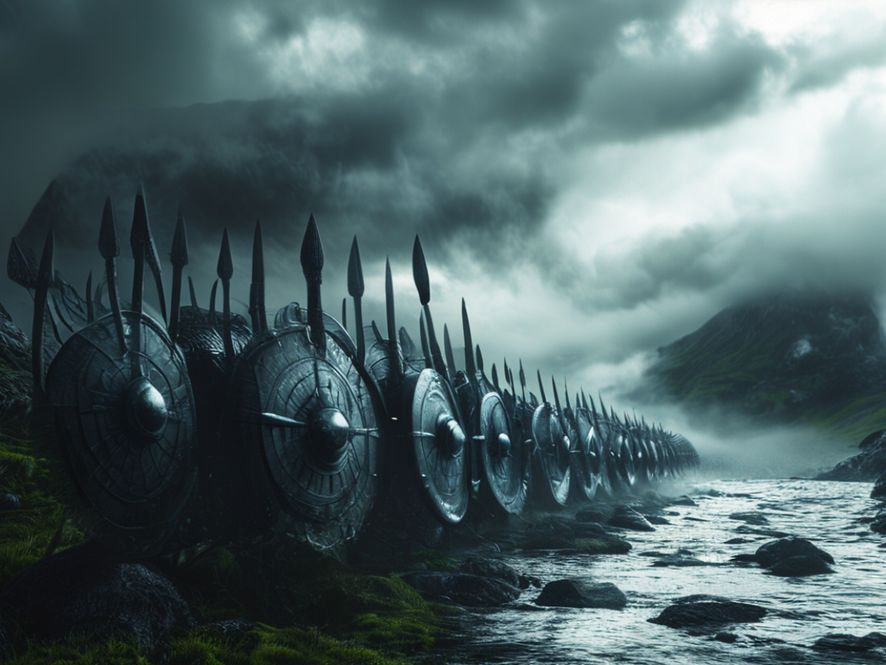
The Viking Shield: Combat and Defense Techniques
Published on · Reading time: 8 min
Mist crawled across the moor, thick as the breath of the gods. In the distance, the enemy line took shape in the gray light of dawn. Sigurd tightened his grip on his Viking shield, feeling the linden wood vibrate beneath his clenched fingers. Around him, thirty warriors drew close, shoulder to shoulder, edge to edge — the skjaldborg was taking shape. The shield wall. The formation that had repelled entire armies, broken cavalry charges, and withstood showers of arrows. In that moment, every man knew his survival depended on the warrior to his left and the one to his right. The shield was not a simple object of wood and iron. It was the boundary between life and death.
How could a disk of assembled planks become the most decisive weapon on the Scandinavian battlefield? To understand this, one must delve into the construction, materials, combat techniques, and deep symbolism of the round Viking shield — that piece of equipment every Norse warrior carried before even girding a sword.
📌 In brief
- The Viking shield was a round disk 80-90 cm in diameter, made of assembled linden or pine planks.
- The round shape offered maximum versatility in combat.
- The shield wall (skjaldborg) is a combat formation where warriors stand side-by-side, shields overlapping, creating a continuous defensive barrier.
- Sagas and archaeology confirm that shields were painted in bright colors: mainly red, yellow, black, and white.
- A Viking shield could absorb several blows but was not indestructible.
Are you looking for a replica rather than an explanation? Our Viking shields collection brings together our round shields and foam shields for costume and wall decoration. Viking axes are in the neighboring aisle.
I. Anatomy and Construction of the Round Shield
The round Viking shield is the dominant form found in Scandinavian archaeological discoveries between the 8th and 11th centuries. Unlike the kite shields that would appear later in continental Europe, the round shield offered remarkable versatility: it protected the body from chin to thigh, could be maneuvered quickly in all directions, and served equally well in attack as in defense.
Its structure relied on an assembly of planks — generally between seven and ten — arranged side by side and held together by a rawhide covering or iron rivets. At the center, a circular hole accommodated the warrior's hand, protected by a domed metal piece called a boss (umbo). Behind this boss, a horizontal wooden handle, sometimes reinforced with wrapped leather, allowed for a firm and mobile grip.
The average diameter ranged between 75 and 90 centimeters. Some examples reached a meter, but most warriors preferred a more maneuverable size. The weight varied between 5 and 7 kilograms depending on the thickness and reinforcements — light enough to be carried in one hand during hours of marching, heavy enough to withstand the shock of a Viking axe brought down with full force.
II. Materials: Wood, Iron, and Leather
The choice of wood was paramount. Linden (Tilia) was the material of choice for crafting the Viking shield. Light, fibrous, and resistant to splintering, linden absorbed impacts without fracturing into sharp shards — a considerable advantage against hacking blows. When linden was unavailable, craftsmen turned to fir, poplar, or alder, all softwoods with similar shock-absorption properties.
The thickness of the planks varied between 6 and 12 millimeters. This thinness is surprising, but it was deliberate: a shield that was too thick became too heavy for prolonged combat. Sagas regularly mention shields split in two during fierce encounters, which confirms that these defenses were designed as semi-consumable equipment, replaced between battles.
The forged iron boss protected the hand and was the most durable part of the shield. Hemispherical or slightly conical in shape, it measured between 13 and 16 centimeters in diameter and was fixed by four to six rivets passing through the wood. This metal element also served as a weapon: an iron-boss strike to the face could break a nose or knock out an opponent.
The edge of the shield sometimes received a rim of rawhide, rarely iron. This peripheral reinforcement limited the splitting of the wood during lateral impacts. Leather was also used to partially or completely cover the front, adding a layer of protection against cuts while providing an ideal surface for applying paint. To complete their defensive kit, many warriors combined their shield with a full Viking armor, including chainmail and a helmet.
III. The Skjaldborg: The Shield Wall
“The warriors formed the shield wall, packed tight like the scales of a serpent. No arrow could pass, no blade could find a breach. They advanced together, or died together.”
The skjaldborg — literally “shield fortress” in Old Norse — represents the most iconic tactical formation in Scandinavian warfare. It was in this formation that the Viking shield revealed its full power, not as an individual weapon, but as part of a formidable collective system.
The principle was brutally simple: warriors stood shoulder to shoulder, each shield slightly overlapping the one to the left. The right edge of the shield covered the left flank of the adjacent warrior, creating a continuous wall of wood and iron. The first rank held shields in front; the second rank raised theirs above their heads to protect the formation from projectiles.
This formation required extraordinary discipline. A single man who fell back, who fell, or who panicked opened a fatal gap. Sagas are full of descriptions where the collapse of the shield wall marks the turning point of a battle. The Battle of Stamford Bridge in 1066 offers one of the most famous examples: the Norwegians of Harald Hardrada formed a skjaldborg so solid that the English of Harold Godwinson had to use trickery to break it.
The shield wall was not a purely static formation. Warriors could advance as a block, pushing the enemy with the combined mass of their shields — a technique called svinfylking when it took the shape of a wedge, or "boar snout." Men in the second and third ranks pushed into the backs of those in the first, turning the formation into a human battering ram. The associated weaponry played a key role: the Viking spear allowed them to strike over the wall while remaining protected behind the curtain of shields.
IV. Offensive and Defensive Techniques
Reducing the Viking shield to a purely defensive role would be a fundamental error. Scandinavian warriors had developed a sophisticated technical repertoire that transformed this wooden board into a truly versatile weapon.
Active defense
The central grip — that handle behind the boss — offered mobility that strap shields (held by the forearm) could not match. The warrior could pivot his shield in any direction with remarkable speed, intercepting axe, sword, or spear blows with fluid circular movements. This "defensive rotation" technique allowed them to deflect attacks rather than blocking them frontally, preserving the shield's integrity for longer.
Angled blocking was another master technique. Rather than receiving a blow perpendicularly — which risked splitting the wood — the warrior tilted their shield to make the opponent's blade slide off. This principle of angle of incidence, which would be understood centuries later in armor design, was already perfectly grasped by Viking fighters.
Offensive use
The Viking shield became formidable in attack. The edge strike — hitting the adversary with the shield rim — targeted the face, throat, or hands of the enemy. An impact from the rim to the temple could knock someone out instantly. The boss strike, thrust forward like a steel fist, targeted the solar plexus or chin. Several sagas describe warriors killing opponents with a single boss strike to the face.
The hooking technique used the shield's edge to catch the opponent's shield and yank it downward, exposing the enemy's torso to a blow from a battle axe or sword. This shield-weapon combination formed an integrated combat system where the left hand (the shield) created the openings that the right hand (the weapon) exploited.
“Thorolf struck with his shield so hard that the man fell backward. Before he could rise, the axe had already finished the work.”
The collective push in a melee represented perhaps the most brutal technique. In the chaos of the shield wall, warriors in the front rank used their shields as a tool for wrestling, pushing, striking, and crushing the opponent in a suffocating close-quarters fight where brute strength counted as much as skill. Those who lost their shield in this press were almost always doomed.
V. The Gokstad Shields: Archaeological Evidence
The discovery of the Gokstad ship in 1880, in Vestfold, Norway, provided archaeology with one of the most complete sets ever unearthed concerning the Viking shield. Sixty-four shields — thirty-two on each side — were arranged along the ship's sides, alternating yellow and black in a striking decorative layout.
These shields date to around 900 AD and exhibit remarkably uniform characteristics: a diameter of about 94 centimeters, a thickness of 7 millimeters in the center tapering toward the edges, pine wood (not linden, which suggests regional variants), and a simple iron boss. Their fragmentary state — the wood had largely decomposed — nevertheless allowed for the reconstruction of the assembly technique.
The alternating colors on the Gokstad ship were not merely aesthetic. They bore witness to a visual culture where the shield functioned as a marker of identity. Hanging the shields on the sides of the longship also served as a signal: visible shields meant peaceful intentions during a coastal approach — a maritime code attested to by several textual sources. For enthusiasts of this period, our round Viking shield with red and black quarters captures this culture of bold colors, made of PU foam, for decoration or costumes.
VI. Paints, Colors, and Symbolism
The Viking shield was a canvas for expression as much as it was an instrument of war. Archaeological and textual sources reveal a recurring color palette: red, yellow, black, and white dominated. Red, obtained from ochre or cinnabar, was the color most frequently mentioned in the sagas — to the point that the expression "red shield" became a poetic kenning to designate war itself.
Painted motifs ranged from simple solid colors to elaborate decorations. Radial patterns — colored segments starting from the center toward the edge — have been identified on several fragments. Spirals, Nordic-style interlace, and animal figures adorned the shields of chieftains and high-ranking warriors. In the 9th century, the skald Bragi Boddason described a shield decorated with mythological scenes covering its entire surface in a poem titled Ragnarsdrápa — one of the oldest preserved skaldic poems.
These decorations served an undeniable psychological function. On the battlefield, facing a wall of shields painted with menacing motifs, the intimidation effect was real. Bright colors also allowed for the rapid identification of allies in the chaos of the melee — a primitive but effective visual recognition system that foreshadowed medieval heraldry.
Some warriors had their shields adorned with religious or magical symbols intended to invoke the protection of the gods. Protective runes, Thor's hammer, the valknut, or the aegishjalmur (helm of awe) were among the most common motifs. For collectors fascinated by this symbolism, a decorative wall-mounted Viking shield brings the full aesthetic power of the Viking Age into one's home.
VII. The Shield Beyond Combat
The Viking shield transcended its military function far enough to permeate every aspect of Scandinavian culture. In mythology, shields appear as cosmic elements: the goddess Sól traversed the sky on her chariot, protected by the shield Svalinn, which prevented her flames from setting the earth ablaze. Without this mythical shield, the world would have been reduced to ashes.
In Scandinavian law, the shield served as a legal support. Decisions of the assembly (thing) were ratified by the vápnatak — the "weapon-taking" — where free men struck their shields with their weapons as a sign of approval. This metallic din constituted a unanimous vote. Conversely, brandishing a red shield in front of a property signaled a formal declaration of war.
Funerals for high-ranking warriors systematically included a shield among the grave goods. The tombs of Birka, Hedeby, and Kaupang have yielded hundreds of bosses — often the only metal remains of shields whose wood has decomposed. These discoveries confirm that the shield accompanied the warrior into the afterlife, necessary to fight alongside Odin on the plains of Valhalla.
The shield also played a social role during banquets. The Skáldskaparmál by Snorri Sturluson mentions shields given as gifts between chieftains, an act of diplomacy and alliance sealed by this object imbued with martial significance. To receive a jarl's shield was to receive his trust and protection.
Conclusion: The Legacy of the Round Shield
The round Viking shield embodies the very essence of Scandinavian military thought: simplicity of design, maximum effectiveness, total adaptability. With a few planks of linden, an iron boss, and a leather handle, Norse craftsmen produced equipment that defined the warfare of an entire era. From individual combat, where it served as much to strike as to protect, to the collective shield wall, where it became the brick of a human fortress, the round shield was the most democratic weapon in the Viking arsenal — owned by every free man, from the simple farmer to the king.
Today, the Gokstad shields watch over us from the display cases of the Oslo museum, fragments of wood and iron circles that still carry the echo of the battlefields of the North. They remind us that behind every shield stood a man, and that behind every shield wall stood a community — united, resolute, unshakable.
Frequently Asked Questions About the Viking Shield
How was a Viking shield made?
The Viking shield was a round disc 80-90 cm in diameter, made of assembled linden or pine planks. The center was reinforced by an umbo (metal boss) protecting the hand. The edge could be reinforced with leather or metal.
Why were Viking shields round?
The round shape offered maximum versatility in combat. The round shield allowed for parrying blows from all directions, striking with the edge (shield bash), and forming the shield wall. Its central grip (behind the umbo) allowed for quick and offensive movements.
What is the shield wall?
The shield wall (skjaldborg) is a combat formation where warriors stand side by side, shields overlapping, creating a continuous defensive barrier. Warriors struck over or between the shields with axes and spears. It was the most iconic Viking tactic.
Were Viking shields really painted?
Yes, sagas and archaeology confirm that shields were painted in bright colors: mainly red, yellow, black, and white. Motifs included spirals, crosses, and colored segments. The shields of the Gokstad ship were alternately yellow and black.
Could a Viking shield stop a sword?
A Viking shield could absorb several blows but was not eternal. Wooden planks would split under repeated impacts from axes and swords. Warriors expected to use several per battle, and sagas often describe shields broken in combat.
Did Viking women use shields?
The shieldmaidens (skjaldmær) of the sagas wielded shields in combat. Archaeology has confirmed the existence of Viking warrior women, notably the Birka warrior buried with weapons. The use of the shield by women is therefore historically plausible.
👉 Discover our collection of Viking decorations and carry on the Viking legacy every day.
👉 Discover our collection of Viking weapons: axes, swords, and Norse shields.

Leave a comment
All comments are moderated before being published.
This site is protected by hCaptcha and the hCaptcha Privacy Policy and Terms of Service apply.