
The Viking Spear: The Most Widely Used Weapon of War
📌 In Brief
- The spear was the most widespread weapon of the Viking Age, far ahead of the sword.
- Its existence was driven by economics: an iron head and an ash shaft cost a fraction of the price of a blade.
- Depending on the shape of the point, it was used for close-quarters combat or throwing.
- It is the weapon of Odin, whose spear Gungnir never misses its mark.
- Throwing a spear over the enemy army was a ritual gesture: dedicating the dead to Odin.
The most common weapon, by far
If a 9th-century Scandinavian warrior were asked what weapon he carried, he would not answer "a sword." He would answer "a spear"—and the archaeological evidence overwhelmingly proves him right.
In weapon graves across Norway, Sweden, and Denmark, spearheads are found by the thousands, far outnumbering swords. Jan Petersen, whose typology published in 1919 still serves as a reference, classified these points into a long series of alphabetical types precisely because the corpus was vast enough to allow for fine chronology. You don't build a typology on rare objects.
The primary reason is economic. A spearhead uses a fraction of the iron of a sword—a few hundred grams versus more than a kilogram of wrought metal, and without the weeks of pattern-welding a long blade requires. As for the shaft, it is free: it is wood, and everyone had wood.
The second reason is tactical, and it is even more decisive. A spear provides two to three meters of reach. Against a man armed with a ninety-centimeter sword, this gap is not a marginal advantage: it is the difference between striking and being struck. In a tight formation, it becomes structural.
The third is legal. Norwegian and Icelandic laws written down after the Viking Age list the minimum equipment for a freeman called to the levy: a shield, a spear, and a sidearm. The spear is on the list of things everyone is expected to possess. The sword, never.
We must therefore overturn the image inherited from cinema. The typical Scandinavian army is not a horde of swordsmen: it is a forest of spear points, with a few swords in the front ranks belonging to those whose status justified the expense. The spear was not the default poor man's weapon—it was the weapon of the many because it worked.
Anatomy of a spear: point, socket, and ash shaft
A Viking Age spear consists of two parts, only one of which has survived to our time.
The point is forged in one piece with a conical socket—a tube into which the shaft is inserted, fixed by one or two rivets passing through it. This socket mount, inherited from the Iron Age, is clearly superior to the tang mount: it distributes stress, does not split the wood, and allows a broken shaft to be replaced in minutes in the field.
Dimensions vary considerably. The heads found range from twenty centimeters to over sixty for the longest ones, sometimes referred to as "hafted blades" because they look like short swords mounted on a stick. The cross-section is usually diamond-shaped, sometimes with a central rib that stiffens the assembly.
The shaft, however, has almost always disappeared. Wood only survives in exceptional conditions, so we must estimate lengths based on rare impressions in rust and historical depictions. The consensus places the total length between two and three meters.
The preferred wood was ash, for its long fibers and its ability to bend without breaking. This detail left a remarkable linguistic mark: in Old Norse, askr refers to the ash tree, the spear shaft, and, by poetic extension, man himself—the first human in mythology is named Askr, and the world tree Yggdrasil is an ash. The language itself binds together the tree, the weapon, and the man.
The result weighs very little: about a kilo to a kilo and a half, shaft included. This is three times less than one might imagine, and it changes everything about usage—a spear of this weight is handled quickly, recovered easily, and redirected. It is nothing like the cumbersome pole suggested by clumsy re-enactments.
The manufacturing process itself deserves a mention, as it is less trivial than it seems. Forming a conical socket from a flat bar involves folding it around a mandrel and welding the seam while hot, without leaving defects that would cause it to open under stress. This is a tube weld, one of the most demanding operations in the blacksmith's repertoire—and it had to be performed successfully thousands of times.
The finest pieces go even further: several heads found are pattern-welded, meaning made of twisted and welded bars like sword blades, with steel edges added. The wavy pattern is visible after polishing. Thus, the most expensive metallurgy technique of the time was applied to spears, which directly contradicts the idea of a bargain-bin weapon.
Then there was the finish. Sockets of prestige pieces feature inlays of silver, copper, or brass, hammered into engraved grooves to form geometric or animal patterns. A spear could be a sumptuous object, and one would be wrong to think that only the sword deserved fine craftsmanship.
Spjót, gaflak, krókspjót: types and their uses
Old Norse did not settle for just one word, and this lexical richness is in itself informative: where a language multiplies terms, it is because the object was omnipresent and differentiated.
The spjót is the generic term and most often refers to the thrusting spear, robust and intended for close combat in formation. It is the basic weapon, the one of the levy.
The gaflak—related to Old Irish and Frankish—refers to a lighter javelin, designed to be thrown. The sagas describe volleys of projectiles opening the engagement before lines locked. Some warriors carried several, and texts mention the art of catching an enemy javelin in mid-air—a feat mentioned often enough that it is unlikely to be pure literary invention.
The winged spear—krókspjót, "hooked spear"—features two side appendices at the base of the blade. Their function is twofold: to prevent the weapon from penetrating too deeply into a body, which would make it impossible to withdraw, and to allow hooking the opponent's shield or weapon. This type is of Frankish origin and reached Scandinavia through trade and booty, making it a good marker of contacts with the continent.
Then there is a debated case: the atgeirr. It is the weapon of Gunnarr of Hlíðarendi in Njal's Saga, which sings before battles and pierces opponents while lifting them off the ground. Translators often render the word as "halberd," but no archaeological object matches it with certainty. It is possible that the atgeirr is simply a large spear, magnified by literature—caution is advised.
Regarding range, experimental archaeology provides useful orders of magnitude. A javelin of one meter eighty and eight hundred grams can be thrown effectively around twenty to thirty meters, and well beyond if one only aims to rain projectiles down on a formation. Some neighboring peoples used a leather thong wrapped around the shaft, the amentum of the Romans, which imparts rotation and significantly increases range; its Scandinavian use is not proven, but the technique was known in Northern Europe.
These figures explain the sequence of engagements. Thirty meters is the distance two lines cover in about ten seconds. The throwing phase was therefore brief and unique: a volley, sometimes two, then contact. People did not bombard each other for hours—they disorganized the enemy line just before striking it.
A practical distinction is worth noting. A throwing spear is expendable: you abandon it on the first throw. A thrusting spear is an investment you keep for the whole battle. Both coexisted in the same troop, and probably with the same man, who opened from a distance before closing in.
The spear in the shield wall
It is in formation that the spear reveals its superiority, and the skjaldborg—the shield wall—is the arrangement that organized all Scandinavian combat.
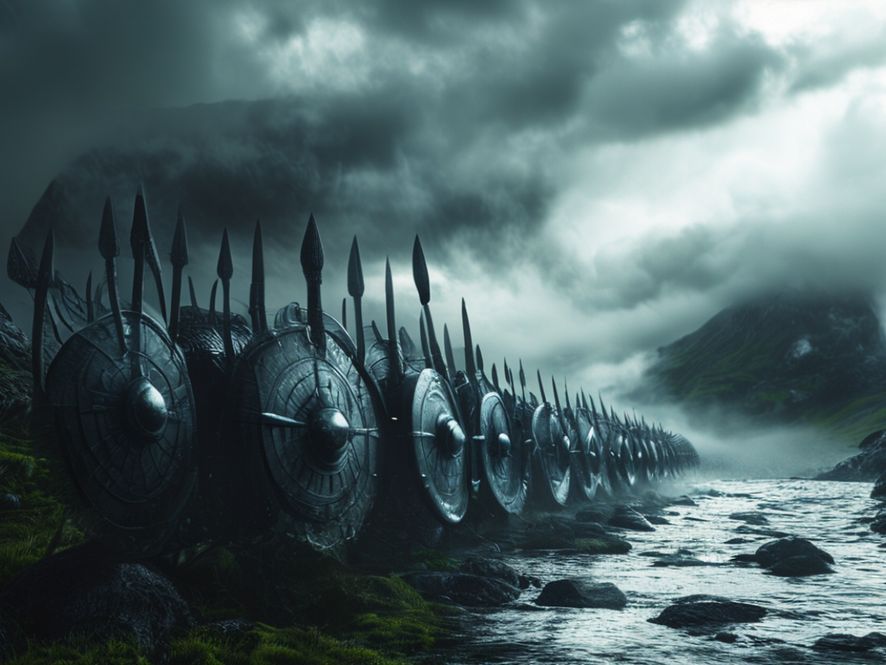
The principle is simple and formidable. Men stood shoulder to shoulder, each shield overlapping the neighbor's, so that no one protected only themselves. Behind this wall, spear points protruded—over the upper edge for the rear ranks, between the shields for the first rank. The opponent faced a wall of wood bristling with steel, with no accessible target.
The spear also allowed striking from the second and third ranks, which no sword could do. A deep shield wall could thus engage with two or three times more weapons than it had men in contact. It was a force multiplier, and it is the reason why this formation dominated Northern Europe for centuries.
Handling varied according to the situation. With one hand, the spear accompanied the shield and struck in short thrusts, at throat or thigh height. With two hands, it gained range and power but left the carrier exposed—a choice that only made sense when protected by neighboring shields.
Sagas and chronicles describe a fairly constant sequence: first a volley of projectiles, javelins and arrows, to disorganize the enemy line; then the advance of the walls against each other; then a push where one struck with the spear until a breach opened. Only at that moment, when the formation broke and combat became individual, did the axe and sword take over.
Against Frankish cavalry, the long spear also offered the only credible response for infantry. The horse did not willingly approach a hedge of points, and the Scandinavians, who almost always fought on foot, made it the pivot of their defense.
The wall was not the only tactical maneuver. Texts also describe the svínfylking, the "boar's snout" formation: a wedge whose point was held by the best-armed men, intended to pierce the enemy line by concentrating the push on a few meters. Snorri attributes the invention to Odin himself, which is a way of saying it was ancient and prestigious; historians recognize in it primarily a legacy of the wedge formations of Late Antiquity.
When the wall broke, everything changed. Once cohesion was lost, everyone was exposed on their flanks, and a long spear became a handicap in the melee. It was precisely at this moment that the axe and seax took over—many warriors actually carried both, the spear for the line, a short weapon at the belt for what would follow. Scandinavian battle narratives almost always shift at this turning point.
There is finally a social reason for this preeminence. A troop of peasants summoned for the season can learn to hold a rank and push a spear in a few weeks. Wielding a sword takes years. The spear is the weapon that makes an army of non-professionals immediately formidable — and that is exactly what the Scandinavian leaders had at their disposal.
Gungnir and the ritual throw: Odin's spear
No Nordic weapon is as religiously charged as the spear, and that is because it is Odin's.
Gungnir, "the swaying one," was forged by the sons of Ivaldi during the craftsmanship contest that also produced Mjölnir and Skíðblaðnir. Its property is not power but infallibility: it never misses its target, and oaths sworn upon it are inviolable. Where Thor possesses a hammer that crushes, the god of sovereignty possesses a weapon that designates.
Odin uses it against himself, moreover. The Hávamál shows him hanging for nine nights from the wind-swept tree, wounded by a spear, "given to Odin, myself to myself," to grasp the runes and bring them back to the world. The founding sacrifice of knowledge passes through a spear point.
From this flows a practice that belongs not to myth but to military history. Before an engagement, a leader could throw a spear over the enemy army while shouting that he was giving it to Odin. The gesture consecrated the adversaries to the god: they were promised to him as dead. The Völuspá alludes to this for the very first war in the world, and several sagas describe the scene — the Styrbjarnar þáttr and the Eyrbyggja saga among them.
This ritual gives the spear a special status: it is the weapon that transforms a massacre into an offering. One better understands, in this framework, why the Scandinavians deposited weapons in bogs and lakes, sometimes bent or broken to render them unusable. The practice is massively attested in the great Danish deposits of Nydam and Illerup Ådal — centuries before the Viking Age, but testifying to a long continuity between weapon and sacred in the North.
Language also keeps traces of this omnipresence. Scandinavian personal names composed with geirr, "spear," number in the dozens — Geirmundr, Geirríðr, Þorgeirr, Ásgeirr, and even that dark-skinned Geirmund whom the Icelandic sagas have sailing to the Hebrides. A society does not baptize its children with the name of a secondary weapon.
Skaldic poetry points in the same direction. Its kenningar, those coded periphrases that replace simple words, constantly refer to battle as "the storm of spears," "the song of spears," or "the meeting of ash-trees." Combat is spoken of through the spear, not the sword. For poets who chose every image, this constant choice is as solid a testimony as an excavation.
One final echo, this one iconographic. On Gotland picture stones as on amulets, figures identified as Odin almost always carry the spear, never the sword. The people who invented Valhalla did not entrust their main god with the weapon of kings: they entrusted him with the weapon of everyone.
Why the sword stole the spotlight from the spear
If the spear was so dominant, why does the collective imagination remember only the sword? The answer lies in three mechanisms, and none have anything to do with combat efficiency.
The first is documentary. The Icelandic sagas were written in the 13th and 14th centuries by and for an elite that celebrated its ancestors. Yet the sword is the aristocratic object par excellence: it costs a fortune, it is passed down, it bears a name — Fótbítr, Gramr, Skǫfnungr. A spear does not. Literature therefore overrepresented what distinguished the great, just as a court chronicle speaks of crowns and not plows.
The second is archaeological, and it works in the opposite way to what is believed. Swords, rare and precious, have been spectacularly showcased in museums; the thousands of spearheads sleep in storage, in indistinct series. What the public sees does not reflect what the ground contains.
The third is narrative. A sword allows for the duel, the individual gesture, the clash of two heroes. A spear belongs to the rank, the mass, the collective maneuver — everything that a narrative struggles to portray. Cinema and video games have inherited this bias and amplified it.
The result is a distorted portrait. The Scandinavian warrior we imagine is a man alone, sword in hand, whereas the real warrior stood in a line, shoulder against his neighbor's, a spear-point of ash extended before him. The former makes for good posters; the latter conquered England.
One final use completes the imbalance of the comparison, and it is systematically forgotten: the spear was also used for hunting. The boar, the elk, and the bear are taken with the boar spear, a short and sturdy spear often equipped with a crossbar to prevent the wounded animal from charging up the shaft — the same principle as the wings of the krókspjót. A sword, meanwhile, is absolutely useless in a forest.
This means that a spear lived in almost every farm, outside of any war, as a tool for subsistence among others. It belonged to the ordinary world of work and food, not just that of combat. This is perhaps the deepest reason for its omnipresence in graves: one buried what the deceased used every day.
Giving the spear back its place is therefore not a detail of erudition. It is changing the subject: moving from the hero to the troop, from the duel to the formation, from the exception to the rule. And it is, incidentally, recovering what the sources say when one reads them instead of illustrating them.
Frequently Asked Questions about the Viking Spear
Was the spear really the weapon most used by the Vikings?
Yes, the spear (spjót) was the most widespread weapon among the Vikings. Cheaper to manufacture than a sword, effective in combat and for hunting, it equipped the vast majority of warriors. Even Odin's spear, Gungnir, testifies to the prestige of this weapon.
What types of Viking spears existed?
The main types are: the throwing spear (gaflak, light for throwing), the melee spear (spjót, long for close combat), and the heavy spear (höggspjót, with a wide blade for cutting). The points varied from 20 to 60 cm in length.
How did the Vikings use the spear in combat?
The spear was used in the front line of the shield wall, stabbing between enemy shields. It was also thrown at the start of battle (like the ritual throw dedicated to Odin). Its superior reach gave an advantage over fighters armed with swords or axes.
What is Gungnir, Odin's spear?
Gungnir is Odin's magic spear, forged by the dwarves. It never misses its target and symbolizes sovereign power. Odin threw it over the army of the Vanir to trigger the first war of the world — a ritual repeated by the Vikings before every battle.
Was the Viking spear more effective than the sword?
In shield wall formation, yes. The spear offers superior reach, costs less, and requires less training than the sword. The sword was superior in close individual combat, but the spear dominated the group formations that constituted the bulk of Viking battles.
Were Viking spears decorated?
Prestige spears were decorated with silver or copper inlaid motifs on the socket and the base of the blade. Some recovered points bear runic inscriptions. The shafts could be engraved with protective symbols or wrapped in worked leather.
What are the delivery times and return conditions for the Vegvisir Compass necklace?
For the Vegvisir Compass necklace, as with any order, allow for 10 to 20 business days in total: 3 to 5 days for preparation, then 7 to 15 days for delivery in mainland France, 10 to 20 days in the European Union. Delivery costs €4.90 in France and the European Union, and is free on orders over €49. After receipt, you have 14 days to change your mind and return the item to us: return shipping costs are then your responsibility. If the item received is defective or does not match your order, we will refund the return costs upon receipt of proof of shipment.
"Cattle die, kinsmen die, the self must also die; but I know one thing which never dies: the judgment on each one dead."
— Hávamál, stanza 77
May the Aesir guide you on the path of honor.
👉 Discover our collection of Viking decorations and carry the legacy of the Vikings in your daily life.
👉 Explore our collection of Viking weapons inspired by Nordic warriors.
Sources
- Jan Petersen, De norske vikingesverd, Kristiania, 1919 — reference typology of Viking Age weapons, including spearheads, established on a Norwegian corpus of several thousand pieces.
- Nationalmuseet, Copenhagen — Viking weapons: the sword as a costly elite weapon, the axe and the spear within the reach of the many.
- Hávamál (stanzas 138-139) and Völuspá (stanza 24), Poetic Edda — Odin's sacrifice wounded by a spear, and the first spear-throw consecrating an army.

Leave a comment
All comments are moderated before being published.
This site is protected by hCaptcha and the hCaptcha Privacy Policy and Terms of Service apply.