
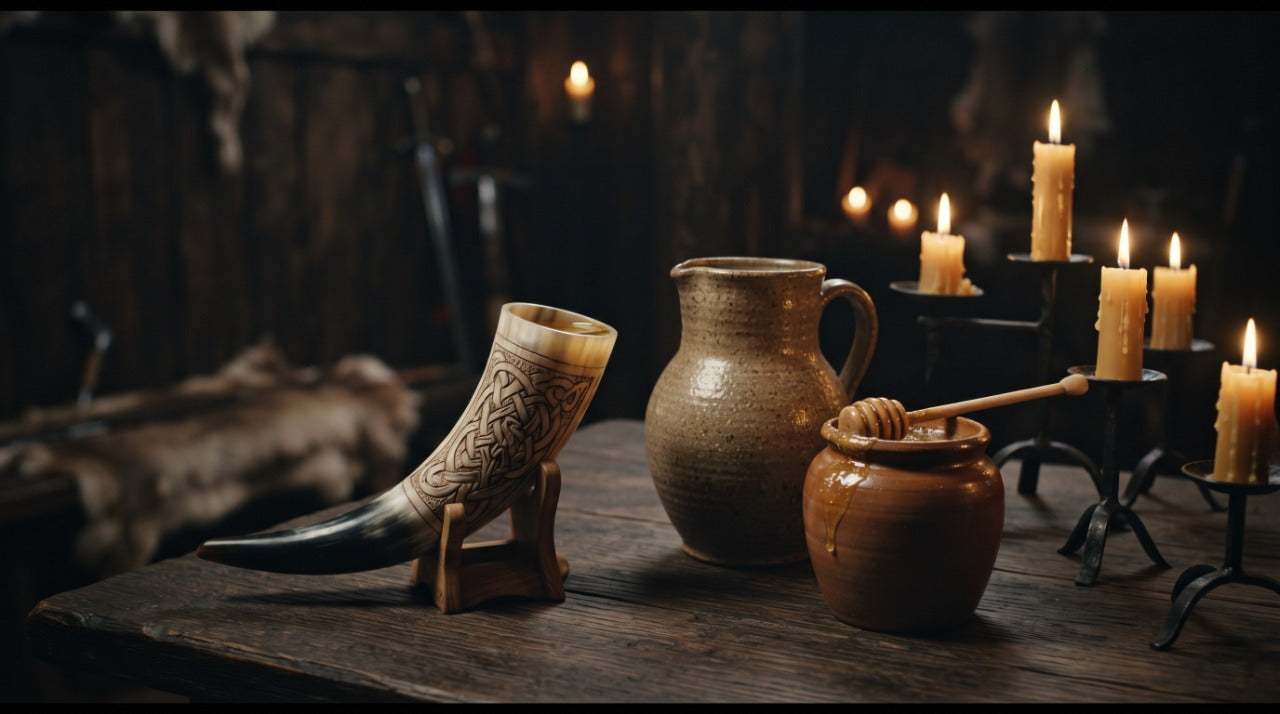
Mead: The Homemade Recipe for the Drink of the Viking Gods
Mead is the world's oldest fermented drink, and the easiest to make at home: honey, water, yeast. No brewer's equipment, no secret tricks — just cleanliness and patience. Here is the full recipe, followed by everything that makes the difference between an average mead and a mead you'll be refilling a glass of. To serve it the Norse way, see our drinking horns.
The recipe at a glance
Homemade Mead — 5 liters
🍯 Ingredients
|
🛠️ Equipment
|
The 7 steps
- Sanitize everything that will touch the must. This step dictates everything else.
- Dilute the honey in 2 L of lukewarm water (35-40°C, never boiled), then fill to 5 L with cold water.
- Oxygenate: stir vigorously for a good minute.
- Pitch: rehydrated yeast + nutrients, must below 30°C.
- Ferment for 3-4 weeks at 18-22°C, with airlock in place, away from light.
- Rack, leaving the sediment at the bottom. Repeat a month later if cloudy.
- Age for at least 2 months before bottling. At 6 months, it's a completely different mead.
📌 In short
- Mead is just three ingredients: honey, water, yeast. 90% of the final taste comes from the honey.
- Plan on 1.5 kg of honey for 5 liters: about 12% ABV once dry.
- Success relies on two things: sanitizing the equipment and patience during aging.
- For the Scandinavians, mead was a prestige drink — daily life was barley beer.
- Never bottle before fermentation is completely finished: it's the only real danger in the recipe.
The recipe step-by-step, in detail
1. Sanitization — the step that decides everything
A honey must is a paradise for everything that ferments — including what you haven't invited. Acetic bacteria and wild yeasts can turn a mead into vinegar faster than you'd think. Wash everything with hot soapy water, rinse, then sanitize: use a no-rinse product like Chemipro Oxi, or as a last resort, boiling water for everything that can handle it. Your hands too.
2. Diluting the honey — without cooking it

Warm about 2 liters of water to 35-40°C. Off the heat, pour in the honey and stir until completely dissolved. Do not boil the honey: boiling drives off the volatile aromas that make good honey worthwhile. Then top up with cold water to 5 liters — this immediately brings the must to a temperature acceptable for the yeast.
Bottled spring water avoids the chlorine in tap water, which can hinder yeast. If you only have tap water, let it breathe for a night in an open container.
3. Oxygenating the must
This is the only time oxygen is an ally: the yeast needs it to multiply before it gets to work. Stir vigorously for a good minute, or shake the closed fermenter. After fermentation starts, the opposite becomes true — air becomes the enemy.
4. Pitching
Rehydrate the yeast according to the packet instructions — usually ten minutes in a glass of lukewarm water. Check that the must is below 30°C (above that, you'll kill it), pour it in, and stir one last time. Yeast nutrients are not mandatory, but honey is naturally nitrogen-poor: without them, fermentation can drag on or stop midway.
Which yeast? Lalvin 71B is the classic choice for beginner mead makers: it respects honey aromas and stops around 14%. Baker's yeast works — the Vikings had nothing else — but the result is more rustic and less predictable.
5. Fermenting — three to four weeks

Fermenter closed, airlock filled with water, in a dark corner between 18 and 22°C. From the very next day, the airlock will start to bubble: the yeast is turning the honey sugars into alcohol and CO2. The pace will gradually slow down. When the airlock remains silent for several days in a row, primary fermentation is finished.
6. Racking

A layer of dead yeast has settled at the bottom of the fermenter: the lees. Carefully transfer the mead into a clean — and always sanitized — container, leaving the sediment behind, ideally with a small siphon to avoid stirring the bottom. If the liquid remains cloudy, do it again a month later: mead clarifies with every racking.
7. Aging, then bottling

Young mead is harsh, alcoholic, and unbalanced — this is normal. Let it sit for at least two months in a full, sealed container. The transformation between the first month and the sixth is spectacular. Bottle only when fermentation is completely over: residual sugar refermenting in a closed bottle results in an exploding bottle.
The recipe on video
To see the technique in real conditions — from must to bottling — here is the most followed mead brewing guide in the French-speaking brewing scene.
“Brasser de l'Hydromel !” by Tomi Sauvage — a complete brew through to bottling, over 108,000 views.
Which honey to choose (and which to avoid)

Honey accounts for most of the final taste. The rule is simple: never ferment a honey you wouldn't enjoy eating by the spoonful.
| Honey | Mead profile | For whom |
|---|---|---|
| Wildflower | Balanced, floral, golden | First attempt — impossible to go wrong |
| Chestnut | Full-bodied, woody, almost tannic | Those who like character |
| Acacia | Pale, delicate, very sweet | A great aperitif mead |
| Buckwheat | Dark, powerful, rustic | The most “Viking” profile |
| Cheap blended honey | Flat, alcoholic, disappointing | Nobody — glucose syrup doesn't forgive |
Proportions dictate the style: 1.2 kg for 5 L yields a dry and light mead (~9%), 1.5 kg is the classic balance (~12%), 2 kg a rich sweet mead that the yeast won't be able to finish fermenting.
The 5 mistakes that ruin a mead
- Neglecting sanitization. The number one cause of meads turning to vinegar. Ten minutes of rigor versus months of regret.
- Boiling the honey. You sterilize, but you cook off the aromas. Dilution at 40°C is more than enough.
- Bottling too soon. Residual sugar referments, CO2 builds up, the glass fails. Wait for complete silence from the airlock, then wait some more.
- Fermenting too hot. Above 24°C, the yeast produces fusel alcohols — that “burn your throat” taste found in bad rotgut.
- Tasting too soon and dumping it all. At one month, every mead is disappointing. At six months, it’s unrecognizable. Patience is part of the recipe.
What the Vikings actually drank
In Norse myths, mead is everywhere. The Skáldskaparmál recounts that the wise Kvasir, born from the saliva of the gods, was killed by two dwarves who mixed his blood with honey: whoever drinks this "Mead of Poetry" becomes a poet or a scholar. Odin stole it by seducing its guardian Gunnlöð and fled in the form of an eagle. And in Valhalla, the Grímnismál describes the goat Heiðrún, whose udders provide not milk, but mead for the warriors who died in battle.
“From its udders flows clear mead; the cup is never empty.”
— Grímnismál, regarding the goat Heiðrún
The archaeological reality is more sober—and more interesting. Traces of fermented honey drinks appear in northern Europe long before the Viking Age. But in the era of the Scandinavians, honey was an expensive commodity, partly imported: it was impossible to make it an everyday drink. Mead was served at banquets, offered to distinguished guests, and poured during the sumbl—the ritual where people drank in turns while making oaths and toasts. Daily life was sustained by barley beer, which was less costly to produce.
Drinking mead from a horn added its own rule to the banquet: a horn cannot be set down. You finish it, or you pass it to your neighbor. If you want to serve your homemade mead according to the rules of the art, it is the entire art of the Nordic tavern.
Chouchen, spices: the variants
Chouchen is the Breton cousin: traditionally, honey ferments there with apple juice, which provides its yeasts and a touch of acidity. Metheglin refers to a spiced mead—cinnamon, ginger, cloves, added at the end of fermentation so as not to cook them. Melomel incorporates fruits: cherries, raspberries, blackberries. The base remains the same; add the fruits or spices at the time of the first racking, let infuse for two to four weeks, then rack again.
A word of advice: master a plain mead first. That is what will teach you what your honey does—the variants come later.
FAQ — your questions about mead
Can you make mead without adding yeast?
Yes—unpasteurized honey carries wild yeasts capable of starting a spontaneous fermentation. This is the historical method, and a lottery: the result varies from delicious to undrinkable. Oenological yeast provides a reliable, clean result with controlled alcohol content.
What alcohol content does homemade mead reach?
With 1.5 kg of honey for 5 liters, about 11 to 12% ABV if fermentation goes to completion. 1.2 kg gives a dry and light mead around 9%, 2 kg a sweeter, stronger one whose sugar the yeast will not consume entirely.
How long does mead keep?
For years. Alcohol and honey are two natural preservatives: well-sealed and away from light, a mead evolves like a white wine and improves for 2 to 5 years.
My fermentation isn't starting—what should I do?
Three likely causes: must too hot during pitching (yeast killed), chlorinated water, or expired yeast. Wait 48 hours; if nothing happens, repitch with fresh yeast rehydrated in non-chlorinated water at 25°C.
What is the difference between mead and chouchen?
Chouchen is Breton mead, traditionally fermented with apple juice which provides yeasts and acidity. Classic mead uses only honey, water, and yeast.
Did Vikings really drink mead?
Yes, but as a prestige drink: honey was expensive. Banquets and the ritual of the sumbl were conducted with mead; daily life, with barley beer. Myths, however, made it the drink of gods and poets.
Your mead deserves better than a mustard glass
Genuine drinking horns, horn and steel tankards: the banquet begins with the vessel.
Discover horns & tankards ›
Leave a comment
All comments are moderated before being published.
This site is protected by hCaptcha and the hCaptcha Privacy Policy and Terms of Service apply.