
Viking Interlace Brooch Badge
Specifications
| Color | Bronze |
| Material | Alloy, bronze or antique silver finish |

- For: men & women (adults)
- Alloy, shield shape, pin on the back
- Free shipping from 49€ · secure payment
A Shield Instead of a Disc
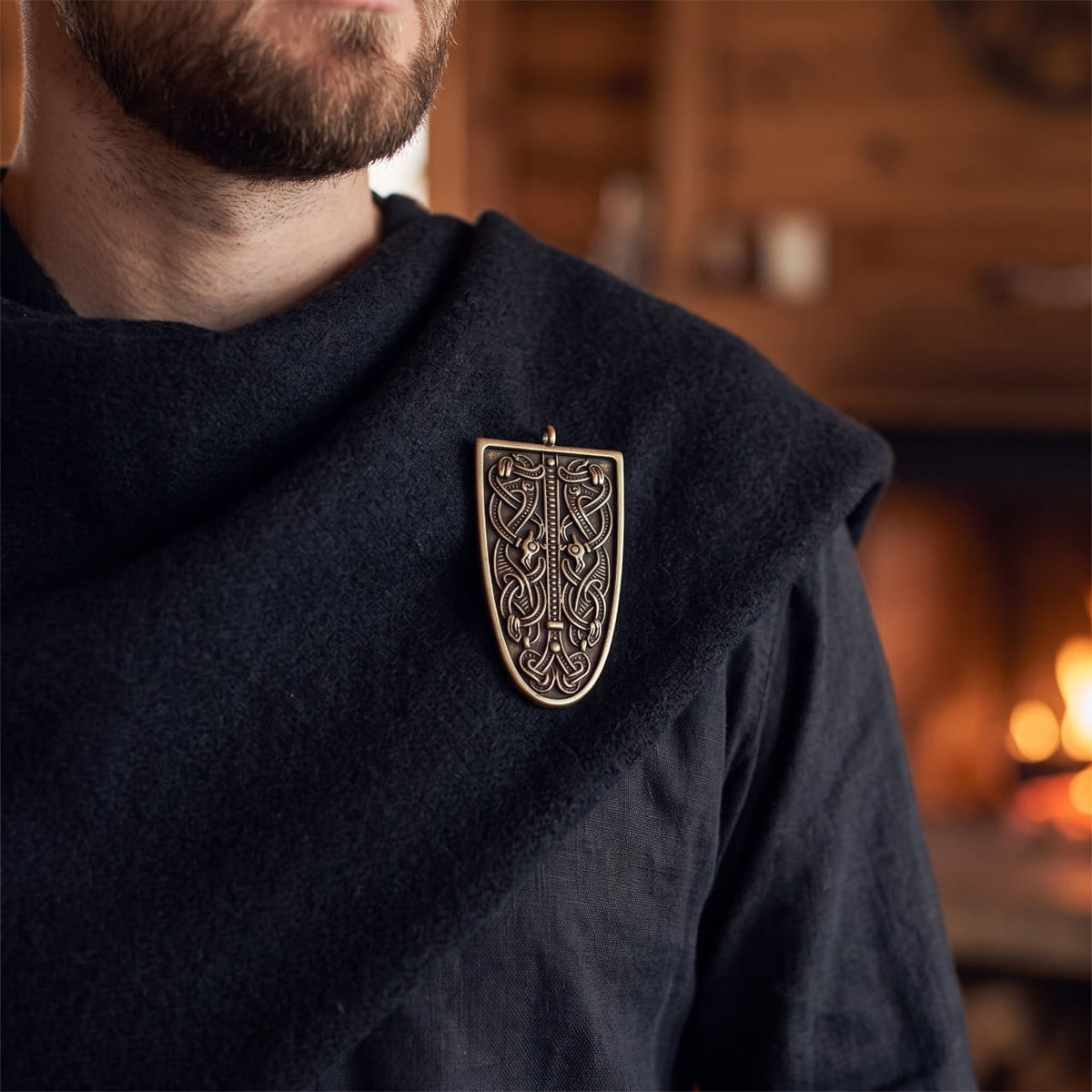
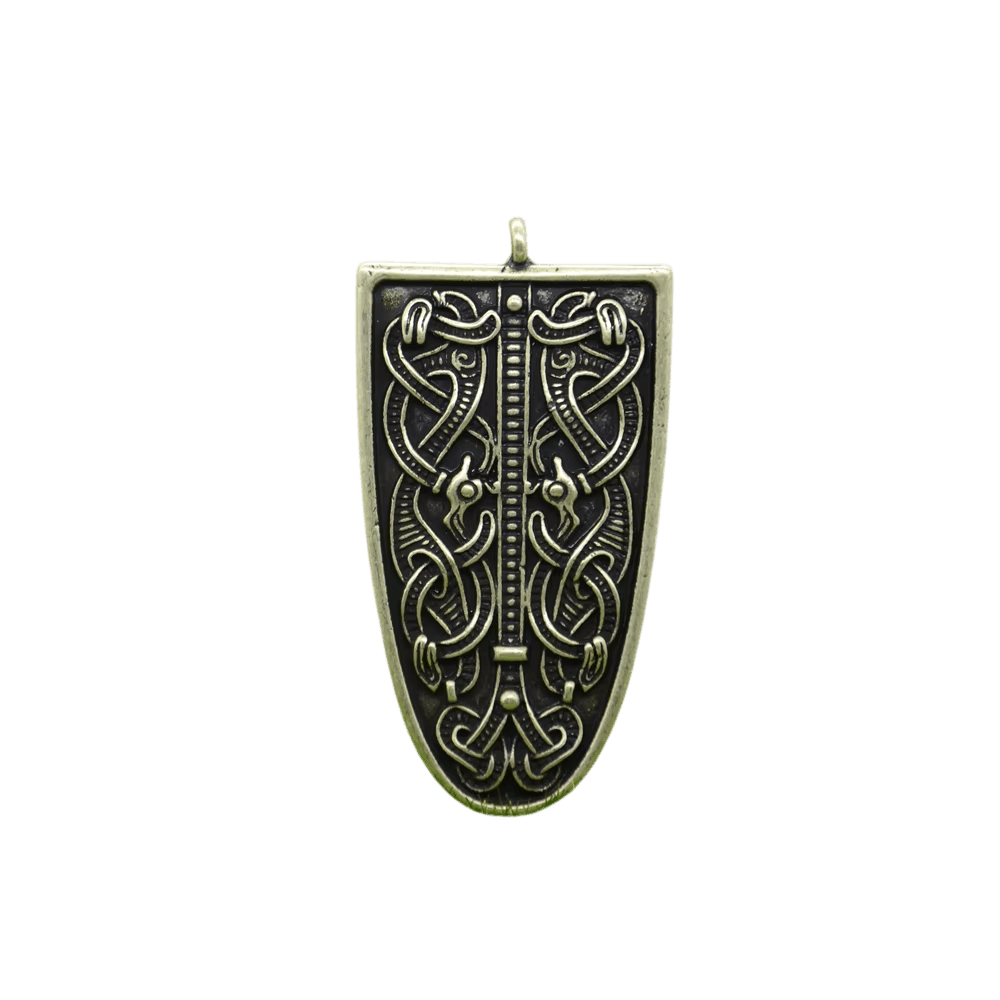
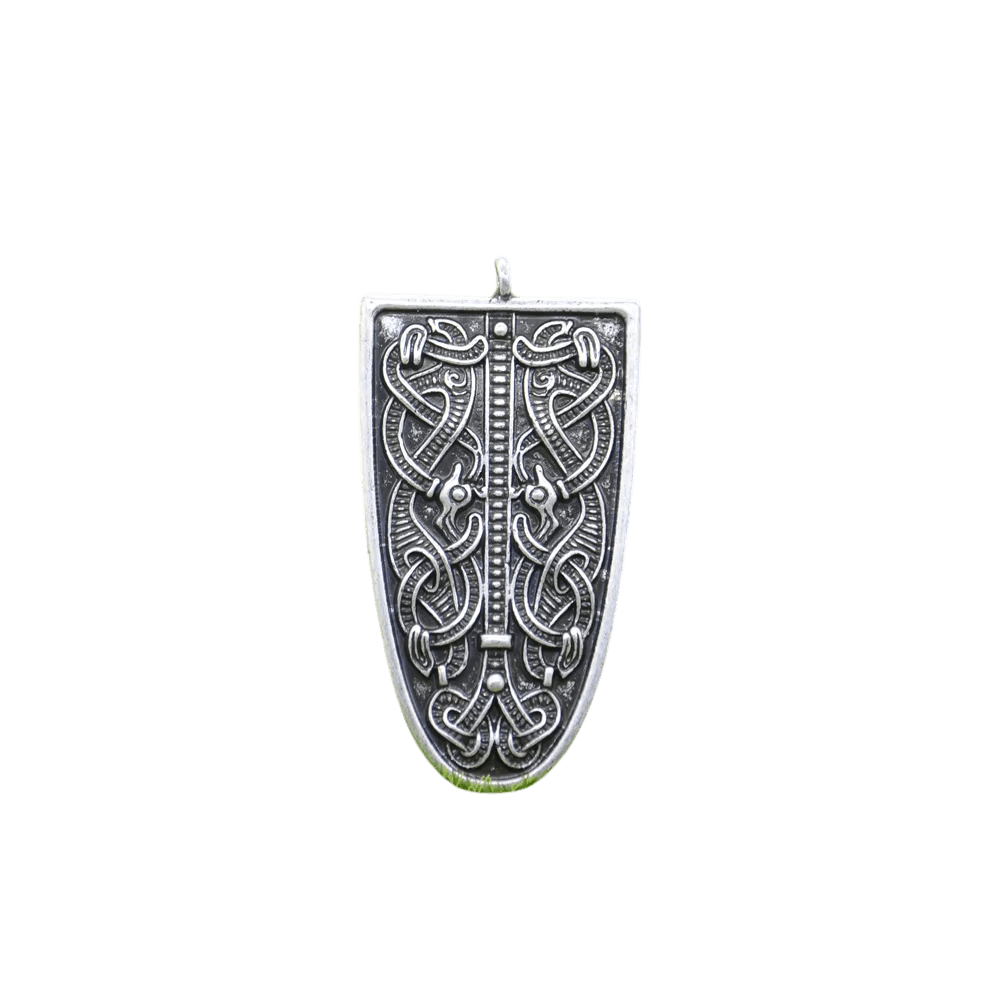
This Viking fibula breaks away from standard round shapes: it is a shield-shaped plaque with a rounded top and pointed bottom, covered in symmetrical relief interlace with blackened recesses. A straight pin with a clasp is soldered to the back. Find it in our collection of Viking fibulae and brooches.
For the same style of decoration on a round shape, see the round brooch with interlaced animals.
What Sets This Fibula Apart
The shape is not just decorative: it changes the way the piece is worn.
- A vertical, not a point: the shield follows the line of a lapel or collar instead of sitting flat like a disc.
- Strict symmetry: the design is mirrored on the central axis, which requires a clean mold — asymmetrical interlace is much more forgiving of imperfections.
- Two finishes to choose from: warm bronze or antique silver, on the same relief.
- Pin clasp: secure on thin clothing, whereas a ring-style mount requires fabric to bite into.
If you are looking for a fastener without a mechanism instead, the penannular brooch with interlace is secured solely by the tension of the fabric.
Specifications
- Material: Alloy, bronze or antique silver finish
- Shape: Elongated shield
- Fastening: Straight pin with clasp on the back
- Decoration: Symmetrical relief interlace, blackened recesses
- Worn on: Cape, coat, jacket lapel
- Maintenance: Dry cloth, avoid water and perfumes
Did you know?
Symmetrical interlace patterns like these belong to what archaeologists call the Borre style, named after a burial mound site in southern Norway excavated in 1852. Its signature is the "ring-chain": a chain of overlapping circles held together by transverse bars. This style circulated between approximately 850 and 950, and is found as far away as Danelaw England and the Volga region of Russia — making it one of the best markers for dating an object and tracing Scandinavian trade routes.
📖 To learn more: Discover our guide to Viking symbols.
♦ Complete Your Viking Collection
Discover other pieces you might like:
Brooch or hair barrette: which one to choose?
| Type | Where it is worn | What you need to know |
|---|---|---|
| Garment brooch (fibula) this product | On a cloak, a shawl, a coat or a jacket lapel. | These are the largest pieces in the range. Six close with a straight pin and a clasp; two are penannular: an open ring locked by the tension of the fabric, with no spring to wear out. |
| Barrette with a hair stick | In a bun, a braid or a half-up ponytail. | Two pieces: the plate sits on the hair, the stick goes through the lock and holds everything in place. You need enough hair for the stick to go through: with hair shorter than shoulder length, the hold becomes uncertain. |
| Light barrette or clip | On medium-length hair, including fine hair. | The filigree models have a small chain that holds the stick; the flat barrettes close with a clip and need no minimum length. These are the most discreet pieces and the easiest to put in. |
| Medallion barrette | Flat on a half-up ponytail or a low bun. | A solid disc that sits on the gathered lock instead of going through it. It is the shape that needs the least hair length, and the only one that shows a scene rather than an ornament. |
How to wear it
There is no size to choose. A brooch (fibula) is fastened to the fabric, not to the body: the only question is the cloth.
The six straight-pin models are worn like a classic brooch: push the pin through the fabric and close the clasp. They suit a jacket lapel, a shawl or a thick scarf.
The two penannular models (the open ring crossed by a long pin) work differently: pass the pin through the cloth, turn it a quarter turn, and the tension of the garment locks it against the ring. The more the cloak pulls, the tighter it holds. It is the most secure fastening on heavy wool, and the one with no mechanical part to break.
On thin fabric, any pin leaves a mark. These pieces are made for broadcloth, wool and thick linen, not for silk or fine knits.
Care: dry cloth. Avoid water, perfume and silver polish, which remove the patina lodged in the hollows: it is what gives the design all its relief.
Which finish should I choose?
Bronze goes with brown, ecru and green wools; antique silver with grays, blacks and blues. Both are the same alloy under a different plating, so the weight and relief are identical.
Is the fastening a simple pin?
Yes. A straight pin with a clasp is soldered to the back of the plate. It goes through the fabric and locks — the most secure system on a thin garment, unlike the penannular design, which needs thicker material.
Is the relief engraved or cast?
It is cast in the solid metal, then the recesses are blackened to bring out the design. It is not a print: you can feel the pattern with your finger.
Is it suitable for thin fabric?
Yes, better than a ring brooch. The pin is thin and the weight stays moderate. On silk or a very loose knit, pin it through a lining or a hem instead.
Delivery — Allow 7 to 15 business days for mainland France, 10 to 20 days for the European Union. Free delivery on orders over €49.
Delivery guarantee — If your parcel is not delivered within 60 business days, we will provide an immediate reshipment or a full refund.
14-day returns — You have 14 calendar days from receipt to request an exchange or refund. The item must be returned within this period, in its original packaging.
Legal guarantees — All our products are covered by the legal guarantee of conformity and the guarantee against hidden defects, in accordance with the Consumer Code and the Civil Code.


