
Viking Trilobate Interlace Brooch
Specifications
| Color | Silver |
| Material | Alloy, antique silver or bronze finish |



- For: men & women (adults)
- Alloy, three-lobed shape, pin on the back
- Free shipping from 49€ · secure payment
Three Lobes, an Attested Shape
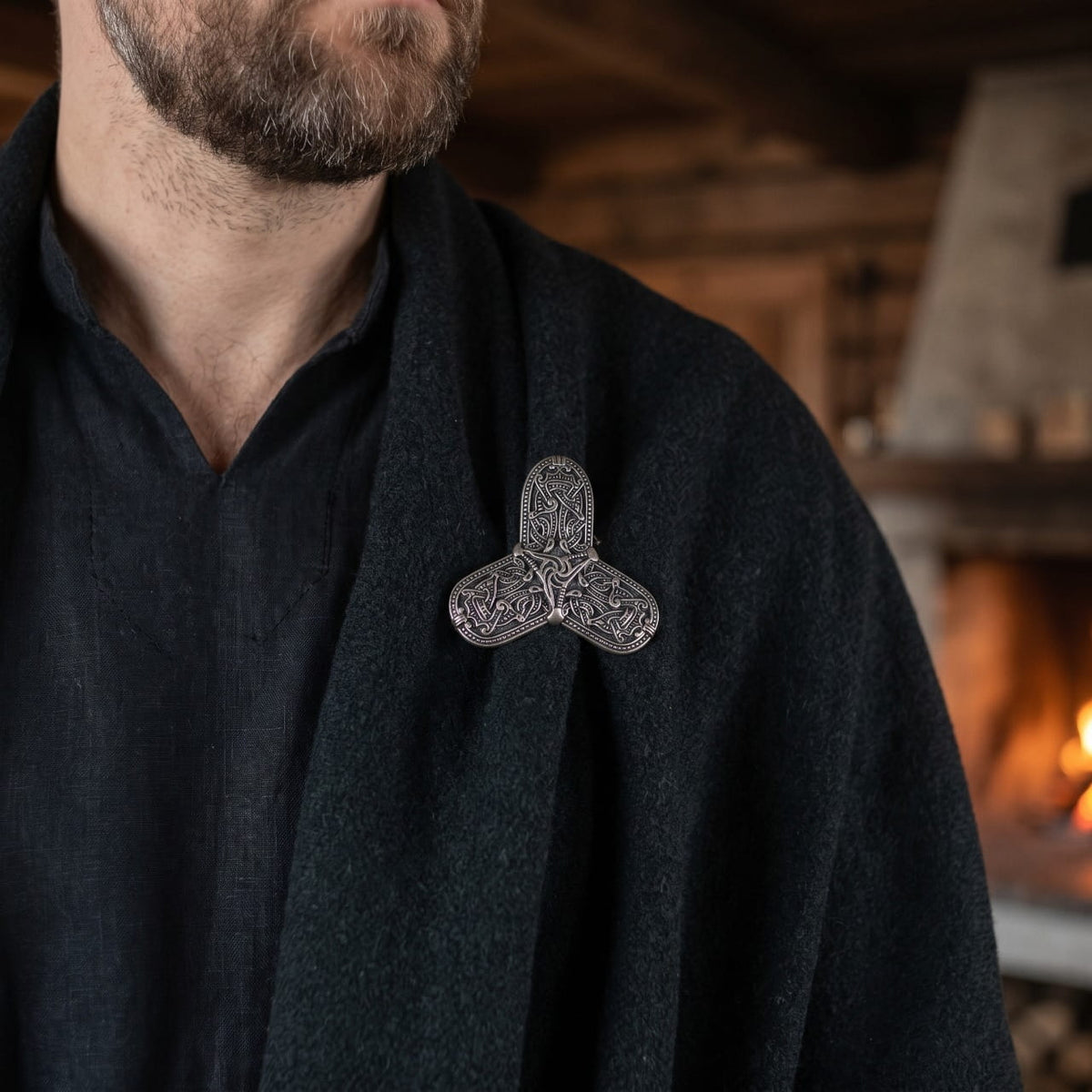
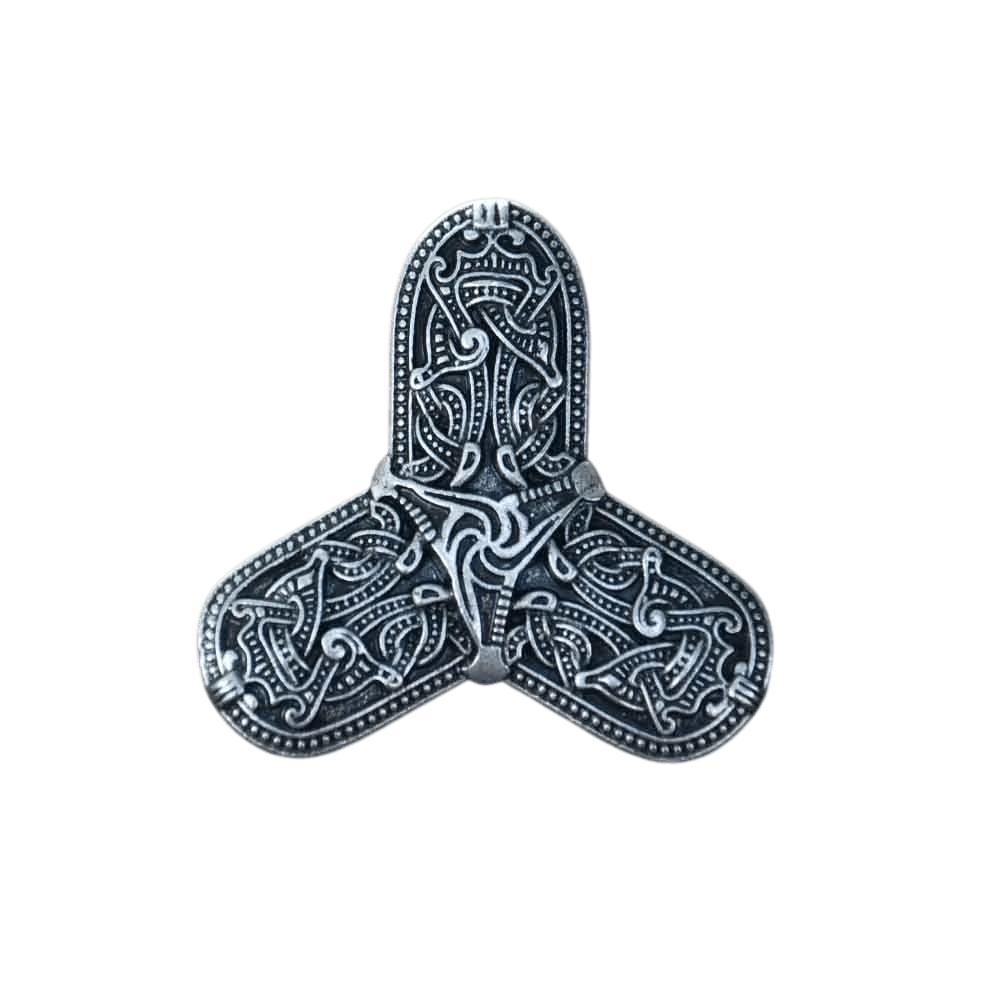
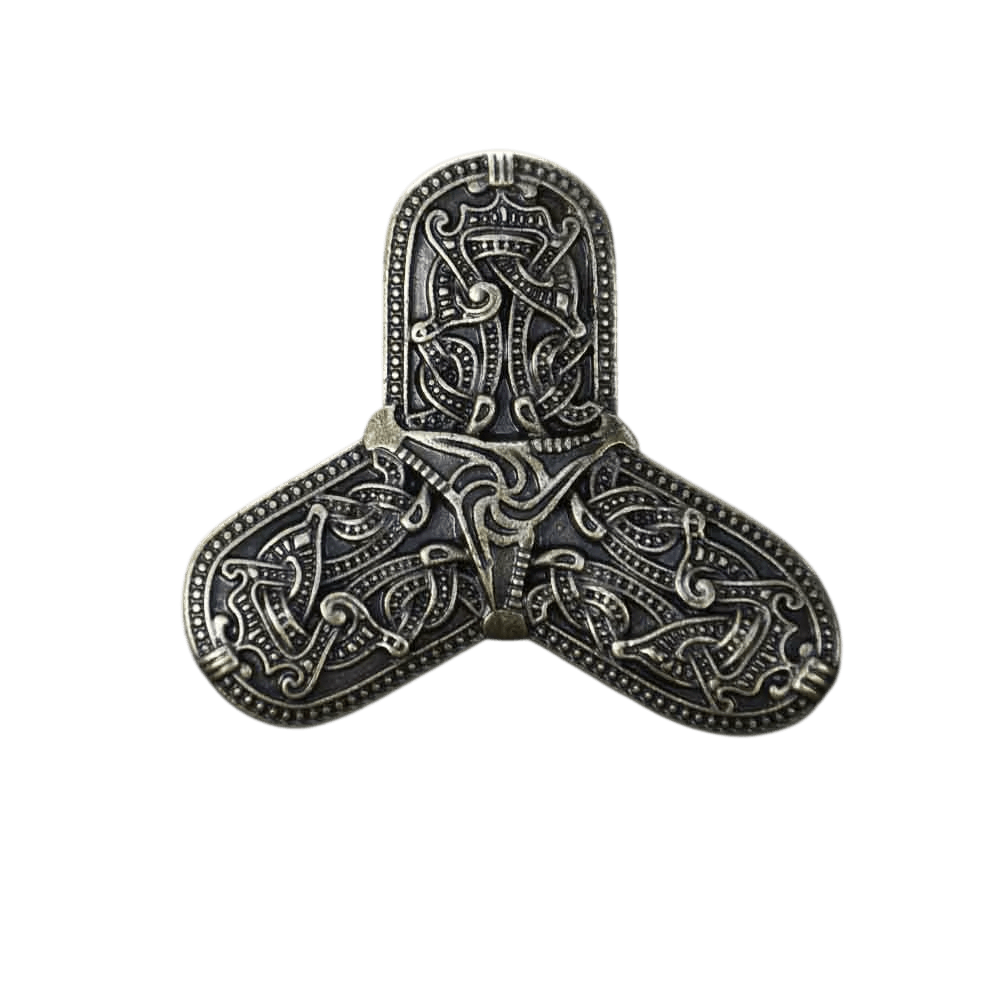
This trefoil Viking fibula opens into three equal branches, each filled with relief interlace on a blackened background. A straight pin with a clasp is welded to the back. Of all our fibulae, this is the one whose shape is most directly copied from archaeological finds. Discover it in our collection of Viking fibulae and brooches.
For a round shape treated in the same spirit, see the round brooch with interlaced animals.
What Sets This Fibula Apart
Its shape tells a story of borrowing, which is rare for a decorative piece.
- An archaeological type: the trefoil exists in reality in Scandinavian graves, which not all shapes on the market can claim.
- Three decorative fields: each lobe bears its own interlace, offering three different perspectives depending on the angle.
- Blackened background: the contrast is achieved by the recessed areas, not by surface paint.
- 120° symmetry: no specific orientation required.
If you prefer a fastening without a piercing pin, the Irish penannular secures itself via the tension of the fabric.
Specifications
- Material: Alloy, aged silver or bronze finish
- Shape: Trefoil, three equal branches
- Fastening: Straight pin with clasp on the back
- Decor: Relief interlace on a blackened background
- Worn on: Cape, shawl, wool coat
- Care: Dry cloth, avoid water and perfume
Did you know?
The trefoil fibula is a documented case of recycling. 9th-century Scandinavians brought back Carolingian baldric fittings from the West—the metal pieces that held a Frankish warrior's sword harness. These fittings had a three-lobed shape. Rather than melting them down, Northern goldsmiths welded a pin to the back and turned them into brooches; they then copied the shape to produce them themselves. A piece of Frankish military equipment thus became a Scandinavian piece of women's jewelry, and archaeologists today distinguish the Frankish originals from local copies by the fineness of the decor.
📖 To learn more: Discover our article on the Viking blacksmith.
♦ Complete Your Viking Collection
Discover other pieces you might like:
Brooch or hair barrette: which one to choose?
| Type | Where it is worn | What you need to know |
|---|---|---|
| Garment brooch (fibula) this product | On a cloak, a shawl, a coat or a jacket lapel. | These are the largest pieces in the range. Six close with a straight pin and a clasp; two are penannular: an open ring locked by the tension of the fabric, with no spring to wear out. |
| Barrette with a hair stick | In a bun, a braid or a half-up ponytail. | Two pieces: the plate sits on the hair, the stick goes through the lock and holds everything in place. You need enough hair for the stick to go through: with hair shorter than shoulder length, the hold becomes uncertain. |
| Light barrette or clip | On medium-length hair, including fine hair. | The filigree models have a small chain that holds the stick; the flat barrettes close with a clip and need no minimum length. These are the most discreet pieces and the easiest to put in. |
| Medallion barrette | Flat on a half-up ponytail or a low bun. | A solid disc that sits on the gathered lock instead of going through it. It is the shape that needs the least hair length, and the only one that shows a scene rather than an ornament. |
How to wear it
There is no size to choose. A brooch (fibula) is fastened to the fabric, not to the body: the only question is the cloth.
The six straight-pin models are worn like a classic brooch: push the pin through the fabric and close the clasp. They suit a jacket lapel, a shawl or a thick scarf.
The two penannular models (the open ring crossed by a long pin) work differently: pass the pin through the cloth, turn it a quarter turn, and the tension of the garment locks it against the ring. The more the cloak pulls, the tighter it holds. It is the most secure fastening on heavy wool, and the one with no mechanical part to break.
On thin fabric, any pin leaves a mark. These pieces are made for broadcloth, wool and thick linen, not for silk or fine knits.
Care: dry cloth. Avoid water, perfume and silver polish, which remove the patina lodged in the hollows: it is what gives the design all its relief.
Is the trefoil shape historical?
Yes. The trefoil brooch is a well-attested type in Scandinavian graves of the 9th and 10th centuries. Its shape derives from Carolingian baldric fittings, which were salvaged and reused, then copied by the goldsmiths of the North.
Which finish should I choose?
Antique silver goes with grays, blacks and blues; bronze with browns, off-whites and greens. The relief and the weight are identical; only the plating changes.
Is it worn in the center or on the side?
Both work. On a cloak, the trefoil brooch is traditionally placed at collarbone height, on the side where the fabric folds over. Its three-armed symmetry doesn't dictate any particular orientation.
Does the blackened background wear off?
No, not with normal use. The blackening sits in the recesses of the relief, where there is no friction. It's the raised edges that lighten over time, which heightens the contrast.
Delivery — Allow 7 to 15 business days for mainland France, 10 to 20 days for the European Union. Free delivery on orders over €49.
Delivery guarantee — If your parcel is not delivered within 60 business days, we will provide an immediate reshipment or a full refund.
14-day returns — You have 14 calendar days from receipt to request an exchange or refund. The item must be returned within this period, in its original packaging.
Legal guarantees — All our products are covered by the legal guarantee of conformity and the guarantee against hidden defects, in accordance with the Consumer Code and the Civil Code.


