
Perched Dragon Viking Brooch with Dangling Tail
Specifications
| Color | Bronze |
| Material | Patinated alloy, dark bronze shade |

- For: men & women (adults)
- Bronze-tone alloy, perched dragon, pin on the back
- Free shipping from 49€ · secure payment
A Perched Dragon, Hanging Tail
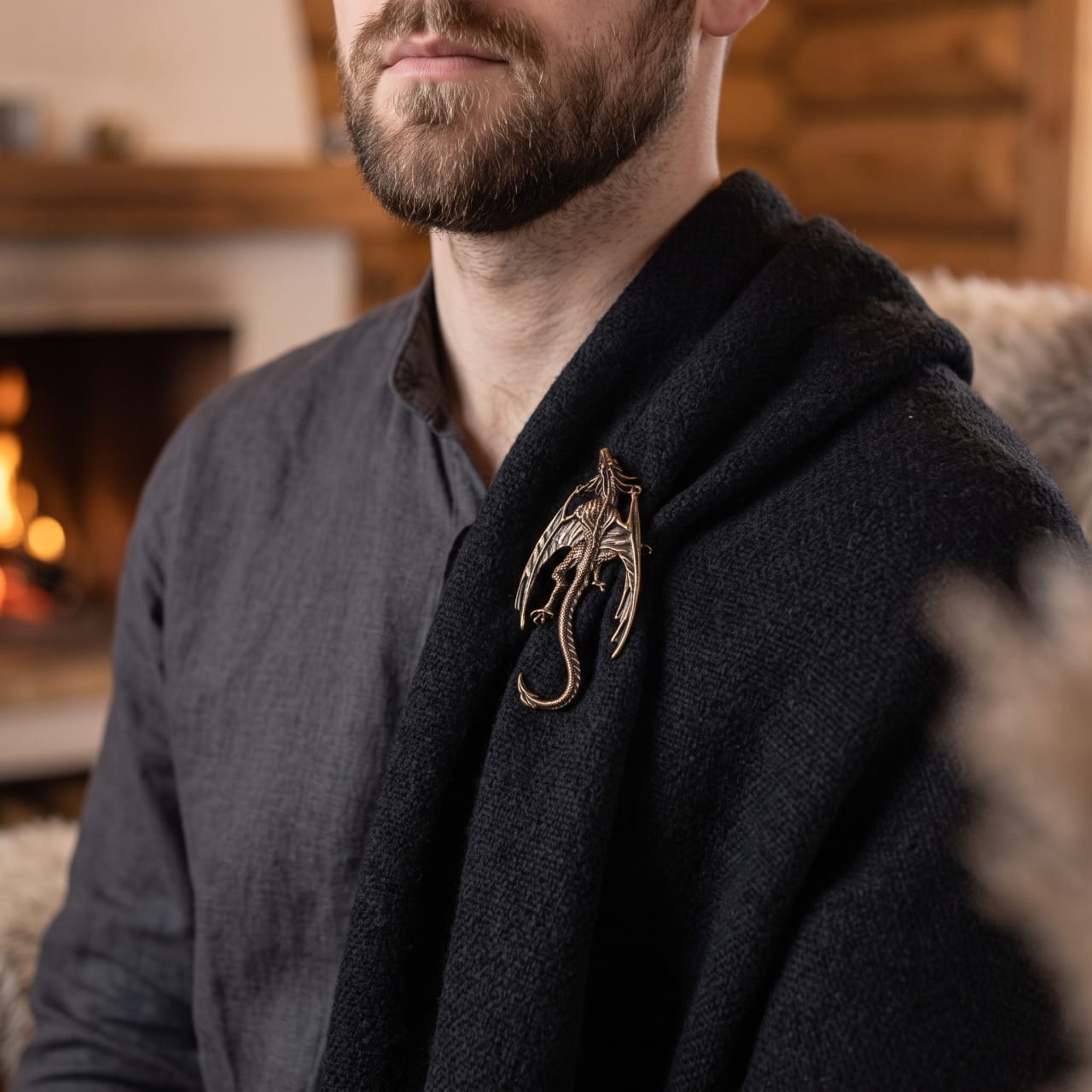
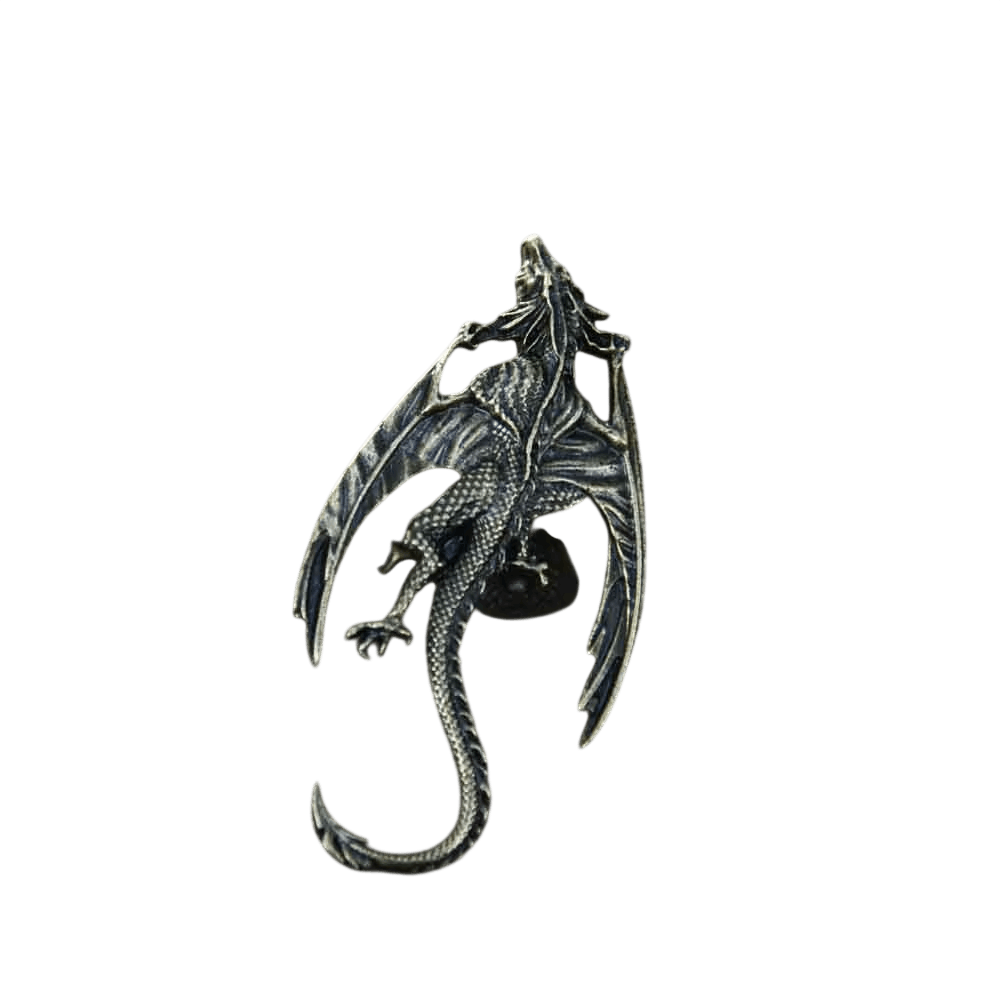
This Viking brooch depicts a perched dragon with wings folded back, mouth open, and crest raised. Its long, scaly tail hangs freely below its body, forming a curve: the piece is read vertically rather than horizontally. Bronze finish, pin on the back. Find it in our collection of Viking fibulae and brooches.
The same manufacturer offers a second, very different sculpture: the dragon in flight, with wings spread and a silver finish.
What Sets This Brooch Apart
It is the only piece in the category that features a freely hanging section.
- A vertical line: the hanging tail gives the brooch a height that no disc-shaped piece has.
- Folded wings: they hug the animal's back instead of opening, keeping the silhouette compact despite its length.
- Bronze only: this model does not exist in a silver finish.
- Clear details: jaw, teeth, and crest are distinctly molded and blackened in the recesses.
For a dragon contained within a disc rather than a free-form piece, see the dragon coiled in a ring.
Specifications
- Material: Alloy, bronze finish
- Pattern: Perched dragon, folded wings, hanging tail
- Attachment: Straight pin with clasp on the back
- Worn on: Lapel, collar, jacket, cloak
- Care: Dry cloth, avoid water and perfumes
Did you know?
Scandinavian dragons did not always fly. In the texts, Fáfnir—the most famous of them—has no wings: he is a giant worm, an ormr, who crawls to the stream to drink and is killed by Sigurd, who hides in a pit dug in his path. Dragon wings are a late continental import, arriving in Norse imagery with Christianity. A piece like this one, winged and perched, therefore belongs more to the medieval dragon than to the serpent of the sagas—and we prefer to be transparent about it.
📖 To learn more: Discover our guide to Norse creatures.
♦ Complete Your Viking Collection
Discover other pieces you might like:
Brooch or hair barrette: which one to choose?
| Type | Where it is worn | What you need to know |
|---|---|---|
| Garment brooch (fibula) this product | On a cloak, a shawl, a coat or a jacket lapel. | These are the largest pieces in the range. Six close with a straight pin and a clasp; two are penannular: an open ring locked by the tension of the fabric, with no spring to wear out. |
| Barrette with a hair stick | In a bun, a braid or a half-up ponytail. | Two pieces: the plate sits on the hair, the stick goes through the lock and holds everything in place. You need enough hair for the stick to go through: with hair shorter than shoulder length, the hold becomes uncertain. |
| Light barrette or clip | On medium-length hair, including fine hair. | The filigree models have a small chain that holds the stick; the flat barrettes close with a clip and need no minimum length. These are the most discreet pieces and the easiest to put in. |
| Medallion barrette | Flat on a half-up ponytail or a low bun. | A solid disc that sits on the gathered lock instead of going through it. It is the shape that needs the least hair length, and the only one that shows a scene rather than an ornament. |
How to wear it
There is no size to choose. A brooch (fibula) is fastened to the fabric, not to the body: the only question is the cloth.
The six straight-pin models are worn like a classic brooch: push the pin through the fabric and close the clasp. They suit a jacket lapel, a shawl or a thick scarf.
The two penannular models (the open ring crossed by a long pin) work differently: pass the pin through the cloth, turn it a quarter turn, and the tension of the garment locks it against the ring. The more the cloak pulls, the tighter it holds. It is the most secure fastening on heavy wool, and the one with no mechanical part to break.
On thin fabric, any pin leaves a mark. These pieces are made for broadcloth, wool and thick linen, not for silk or fine knits.
Care: dry cloth. Avoid water, perfume and silver polish, which remove the patina lodged in the hollows: it is what gives the design all its relief.
Is this the same dragon as your other brooch?
No, they are two separate sculptures. This one shows the dragon perched, wings folded back and a long hanging tail. The other shows it in flight, wings spread wide. The manufacturer sells them under the same name, but they really are two different pieces.
Does the tail hang freely?
Yes, it drops below the body in a curve. That is what gives the piece its height, but it needs a spot where it will not get caught — avoid wearing it under the strap of a cross-body bag.
What color is the metal?
A dark patinated bronze, closer to aged pewter than to a golden bronze. The manufacturer calls it bronze, but the actual shade is clearly darkened by the patina — we would rather tell you than let you expect a warm-toned metal. For a distinctly silver-colored dragon, see our flying dragon.
Is the open mouth detailed?
Yes. The jaw, teeth and rear crest are molded separately and the recesses are blackened, which keeps the head readable despite its small size.
Delivery — Allow 7 to 15 business days for mainland France, 10 to 20 days for the European Union. Free delivery on orders over €49.
Delivery guarantee — If your parcel is not delivered within 60 business days, we will provide an immediate reshipment or a full refund.
14-day returns — You have 14 calendar days from receipt to request an exchange or refund. The item must be returned within this period, in its original packaging.
Legal guarantees — All our products are covered by the legal guarantee of conformity and the guarantee against hidden defects, in accordance with the Consumer Code and the Civil Code.


